The Revolution in Regional Alignments, 1960-68
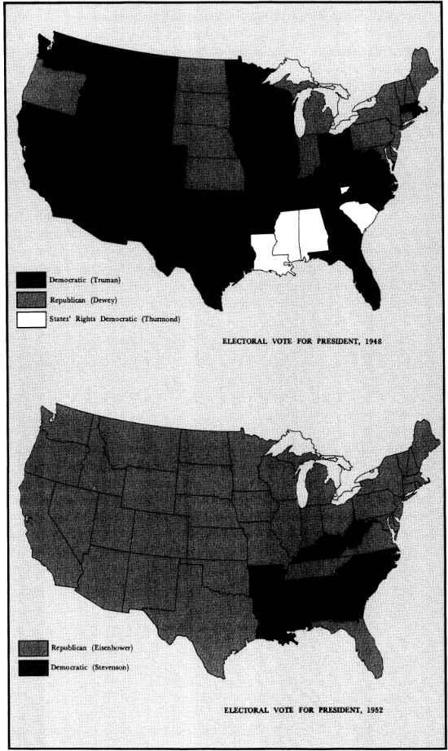
During the decade of the 1960s, a revolution occurred in regional voting patterns. For a century, New England, Pennsylvania, Ohio and Michigan had voted Republican in nearly every presidential election except when Woodrow Wilson and Franklin Roosevelt had drawn them away. In the same period, the coastal and highland south had gone Democratic in every presidential contest except during the Reconstruction era. This general pattern had persisted from 1856 to 1956.4
Then, during the 1960s, new trends of great strength and stability began to appear. The leading tendency was the growth of a new Democratic voting bloc in New England and New York, Pennsylvania, Michigan, Wisconsin and Minnesota. These states had been the core of the Republican coalition in the nineteenth century. Now they became the new base of the Democratic party; in the elections of 1960, 1964 and 1968, most of them voted for liberal Democratic candidates.
At the same time, southern states turned toward the Republican party. A new conservative coalition united the coastal and highland south, the mountain states, the great basin and the far southwest. In 1964, the candidate of this alliance was Republican Barry Goldwater. Many conservative Democrats throughout the south changed parties to vote for him. The pattern of support for Republican Goldwater was strongest in the south and west.
Behind this change in regional alignments lay a striking continuity in their environing cultures. Political scientist Walter Dean Burnham made an interesting discovery in that respect. While studying the election returns of New York in 1964, he found that the counties which voted Democratic and supported civil rights in 1964 were the same as those which had voted Republican and opposed slavery in the mid-nineteenth century. They were also the counties which had been settled from New England during the late eighteenth century. Burnham concluded that voting in this region was determined by “durable community norms which have their historical origins in the values of the original settlers and their descendants.”5