
 The New Regionalism, 1968-86
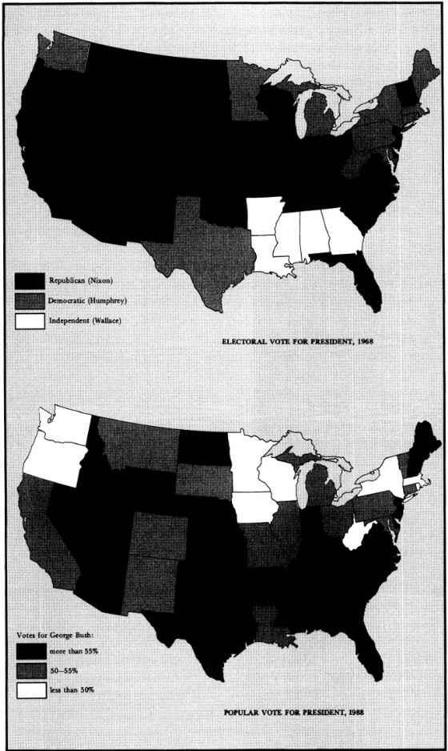
Dean Burnham’s conclusions were not widely shared by his colleagues, who repeatedly predicted the imminent extinction of regional voting in American politics.6 But once again, reports of the death of regionalism proved to be premature. In the presidential elections of 1968 and 1972, voting patterns were strongly regional. Conservative Republican candidate Richard Nixon won his largest pluralities in the coastal south, the highland south and Great Basin. He was less successful in the midlands, and least so in the north. The only state that voted against him was Massachusetts. His smallest pluralities were in the northern tier that extended through southern New England, Wisconsin, Minnesota, South Dakota and Oregon.7
These new regional patterns in American politics tended to break down from time to time, just as earlier alignments had done. They came apart when one party nominated a candidate from the regional base of the other. The Democrats, for example, had their strongest successes in this period when they ran Texan Lyndon Johnson (1964) and Georgian Jimmy Carter (1976). Carter won every electoral vote in the south except Virginia; his southern strength divided the conservative coalition and carried the election.
Regional patterns also tended to disappear when either party chose a candidate who seemed to be outside the cultural mainstream. Republican Barry Goldwater in 1964 and Democrat George McGovern in 1968 were both made to appear radicals of the right and left, respectively. In substantive terms neither was very far from the center, but their rhetoric appeared radical with disastrous results for their parties.
Regional ties were also disrupted when the conservative coalition put up an omnibus candidate. In 1980, this device was tried again in a novel form. No victorious generals had emerged from the Vietnam War, but the Republican party discovered that a professional actor made a highly acceptable substitute. Ronald Reagan proved to be a perfect omnibus candidate. In the election of 1980 he carried every cultural region and all but six states.
In 1984, Reagan won an even more commanding victory when Democrats made the fatal mistake of nominating Walter Mondale, a candidate from their only strong region. Mondale’s political style was reminiscent of many northern candidates in the past; it did not attract voters from other parts of the country. The resulting Reagan landslide buried regional patterns. Once again journalists and political scientists predicted that regions were disappearing from American life. But in the Congressional and gubernatorial elections of 1986, regional voting became visible once again.
On most substantive issues of the mid-1980s, regional patterns were also very strong. The nuclear freeze, for example, was supported by all but a few New England Congressmen, and opposed by most Representatives from the south and west. In attitudes toward military affairs, foreign policy, capital punishment and many domestic questions, regional attitudes are still powerful.
These regional patterns were also evident in the presidential campaign of 1988. Among Democratic contenders, Massachusetts Governor Michael Dukakis combined his Greek and Yankee heritage in a manner reminiscent of the Irish Yankee John Kennedy; Dukakis’s managerial style was in the tradition of New England ideas of ordered liberty. Jesse Jackson also combined an ethnic and a regional identity—a black minister and politician, who had been born in upcountry South Carolina, and christened with an old border name—his style was descended from three centuries of field preaching in the region of his birth. Richard Gephardt was a backcountry politician who ran heavily on a single issue, which was to apply the old border rule of lex talionis to foreign affairs; his message was well received in his own region, but found little support outside it. Among Republicans, Robert Dole of Kansas was also a midland candidate who did well in his region and badly everywhere else; Pat Robertson came from the “backcountry ascendancy” and had a very strong regional identity. The candidates who did worst in both parties (Hart, Babbitt, Schroeder, Kemp, Haig, Dupont) had no firm base in any cultural region. The one who did the best, Republican George Bush, had a base in more regions than one—with his old New England origins, his long residence in Texas, and an accent that combined
both a Yankee twang and a southern drawl—an extraordinary feat of political linguistics.
The presidential election of 1988 was marked by cynical manipulation of cultural symbols—which were perceived very differently in various regions. Democrat Michael Dukakis did best in the northern tier from Massachusetts to Washington and Oregon, but his ideas of ordered liberty alienated voters in every region except his own. Republican George Bush carried every southern state plus the conservative Great Basin by very large margins. The American midlands were divided. Bush carried this region too, but often by paper-thin pluralities—51 percent in Pennsylvania, Maryland, and Illinois. The final result showed that the new regional voting patterns were very strong, and increasingly stable.