
 Distressed Cavaliers and Indentured Servants, 1642-75
Virginia [was] the only city of refuge left in His Majesty’s Dominions, in those times, for distressed cavaliers.
—Ingram’s Proceedings, Virginia, 1676
The gentlemen called Cavaliers are greatly esteemed and respected, and are very courteous and honorable. They hold most of the offices in the country.
—Durand of Dauphine on Virginia, 1687
The people of fortune … are the pattern of all behaviour here.
—Philip Fithian on Virginia, 1773
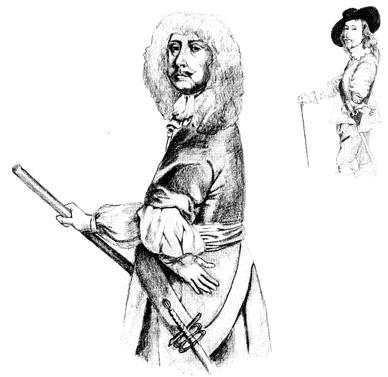
IN THE WINTER OF 1641, just as the Puritan migration was coming to an end, a young Englishman boarded an emigrant ship for Virginia. He would have been received with high ceremony by the captain and crew, for he was no ordinary passenger. His appearance was that of a nobleman—short cloak, deep bands, great boots, belted sword, and long hair cascading in ringlets around his patrician face. His manners were those of a courtier, polished by years in the presence of the King. His speech was that of a scholar, full of Oxford learning; and he had the bearing of a soldier, knighted on the field of honor by Charles I. The name of this traveler was Sir William Berkeley. In his baggage, he carried the King’s commission as Royal Governor of Virginia.
This proud young cavalier was destined to rule the colony of Virginia for more than thirty years. In that period, he had a profound impact upon its development. At a critical moment, he bent the young sapling of its social system and made it grow in the direction that he wished. The cultural history of an American region is in many ways the long shadow of this extraordinary man.1
Sir William Berkeley was born in 1606 to a powerful West Country family which had been seated since the eleventh century at Berkeley Castle in Gloucestershire. The massive battlements of this great building still loom high above the Vale of the Severn, where on a bright fall day one may see the Berkeley Hunt in its distinctive yellow riding coats quartering the countryside, as members of that ancient family have done for more than nine centuries.2
The future governor of Virginia belonged to a cadet branch of his family. It kept two houses: one high on a hill above the ancient wool town of Bruton, Somerset; the other in London where the future governor was born. He lived his youth in a broad belt of territory between London and Berkeley Castle—the region which was to become the cradle of Virginia’s culture.3
As a young man, Berkeley showed something of a scholar’s bent. He matriculated at The Queen’s College in Oxford, earned his degree at St. Edmund Hall and became a fellow of Merton College. After graduating, he took himself to London and became a literary figure of some consequence, publishing a highly polished “tragy comedy” called The Lost Lady in 1639. He was also introduced at court by his brother John Lord Berkeley, and made such an impression that the King appointed him Gentleman of the Privy Chamber Extraordinary. In 1639, he was knighted in the field at Berwick, and two years later became Royal Governor of Virginia.4
In many ways, Berkeley was not an admirable character. He bullied those beneath him, and fawned on people above. He openly enriched himself from his offices, and set a sad example for peculation that long persisted in Virginia. In 1667, for example, he wrote directly to his superior, Lord Arlington, “Though ambition commonly leaves sober old age, covetousness does not. I shall therefore desire of your lordship to procure of His Majesty the customs of two hundred hogsheads of tobacco.”5
These were the vices of his age, and Berkeley had them in high degree. But he also had the virtues of candor, courage, fidelity to family and loyalty to a cause. His social values were as highly developed as those of the Puritans—though in a very differentdirection. And he cared deeply for Virginia. For thirty-five years, Berkeley devoted himself to the welfare of his colony with energy, intelligence, and effect.
When Sir William Berkeley reached Virginia in February 1642, it was a sickly settlement of barely 8,000 souls. The colony had earned an evil reputation “that none but those of the meanest quality and corruptest lives went there.” The quality of life in early Virginia was more like a modern military outpost or lumber camp than a permanent society. Its leaders were rough, violent, hard-drinking men. Berkeley’s predecessor, Governor John Harvey, had knocked out the teeth of a councilor with a cudgel, before being “thrust out” himself by the colonists in 1635. When Harvey returned with royal warrant to arrest his enemies, he was driven out again in 1639.6 The colony was in a state of chronic disorder. Its rulers were unable to govern, its social institutions were ill-defined, its economy was undeveloped, its politics were unstable, and its cultural identity was indistinct.7
In the thirty-five years of Sir William Berkeley’s tenure, Virginia was transformed. Its population increased fivefold from 8,000 to 40,000 inhabitants. It developed a coherent social order, a functioning economic system, and a strong sense of its own special folkways. Most important, it also acquired a governing elite which Berkeley described as “men of as good families as any subjects in England.”8
This social system did not spring spontaneously from the soil of the new world. No less than New England, the colony of Virginia was the conscious creation of human will and purpose. In that process, Sir William Berkeley played the leading role, laboring through his long years in office to build an ideal society which was the expression of his own values. More than any other individual, he framed Virginia’s political system—becoming, in Thomas Ludwell’s words, “the sole author of the most substantial
This portrait of Sir William Berkeley (by Peter Lely, 1661-62) was an image not merely of the man himself but also of the Royalist ideals that guided his actions in Virginia. The governor is dressed for war. He wears an officer’s half armor with a baton in hand and a sword hanging at his side. In the background the artist painted a cavalry charge, probably in the Western campaign of 1644, in which Berkeley fought for his King. This painting also reveals an identity with the King in yet another way. Berkeley stands in an unnatural pose with his right hand extended, left hand bent back above the hip, left leg extended forward and head turned sharply to the side. His posture imitated a favorite pose of Charles I which appears in Van Dyck’s Roi à la chasse, now in the Louvre. Even Berkeley’s facial expression mimicked that of his royal master. This is a portrait of the governor in middle age. His youth has faded, and his swollen face is ravaged by the chronic illness that afflicted many Virginians. In his cruel eyes we see a hint of the tyranny that lay ahead. But this is a likeness of Sir William Berkeley in the prime of his maturity, secure in his power, and firm in his determination to create in Virginia a Royalist utopia dominated by ideals of honor and hierarchy.
parts of it, either for laws, or other inferior institutions.”9 When the laws of Virginia were first published, the volume was dedicated to Sir William Berkeley, who was identified as himself “the author of the best of them.” Berkeley governed the colony through a pliant “long assembly” which he kept in office for fourteen years, refusing to call an election from 1662 to 1676. Its laws expressed the wishes of the governor; many were drafted by his own hand.10
Important as his role as a lawgiver may have been, Berkeley had his greatest impact upon Virginia in another way. More than any other person, he shaped the process of immigration to the colony during a critical period in its history. That process in turn defined its culture, and largely determined the main lines of change for many generations to come.