
 Sir William Berkeley and Virginia’s Elite
Of all Sir William Berkeley’s many projects as governor, the most important was his recruitment of a Royalist elite for Virginia. In the words of historian Philip Bruce, he “encouraged the cavaliers to come over in large numbers.” When they arrived, he promoted them to high office, granted them large estates and created the ruling oligarchy that ran the colony for many generations.1
This cavalier migration continued throughout Berkeley’s tenure as governor (1642-76). Much of it occurred during the decade of the 1650s, when a Puritan oligarchy gained the upper hand in England and tried to impose its beliefs by force upon an unwilling people. Virginia’s Royalist immigrants were refugees from oppression, just as New England’s Puritans themselves had been. Many had fought for Charles I in England’s Civil War. Some continued to serve him until his armies were broken by Parliament and the King himself was killed in 1649. Others rallied to the future King Charles II, and in 1651 fought at his side on the field of Worcester, where they were beaten once again.
They suffered severely in this struggle. One Royalist wrote, “ … in our unnatural wars, most of the ancient gentry were either extinct or undone. The king’s side was almost all gentlemen, and of Parliament’s few … in the quarrel of the Two Roses there were not half as many gentlemen slain.”2 So shattered was the Royalist cause that William Sancroft wrote, “ … when we meet, it is but to consult to what foreign plantation we shall fly.” Indeed, Henry Norwood later remembered that “a very considerable number … did fly from their native country, as from a place infected with the plague.”3
Most of these émigrés took refuge in Europe. But many were recruited by Sir William Berkeley. Some had been his kinsmen and friends before they came to America; others became his relations in the New World. They shared his Royalist politics, his Anglican faith, and his vision for the future of the colony.4
These “distressed cavaliers” founded what would later be called the first families of Virginia. But they were not chronologically the first to settle in the colony. Only a few had appeared during the first forty years of its history. Their great migration came later, and was nearly as concentrated in time as the exodus of the English Puritans had been. If most Yankee genealogies commenced within six years of 1635, the American beginnings of Virginia’s ruling families occurred within a decade of the year 1655.
The founder of the Carter family, for example, came over in 1649. His forebears had been very rich in England; his children became still richer in Virginia. The first Culpeper also arrived in 1649; as did the first Hammond, Honywood and Moryson. The first Digges migrated in 1650, together with the first Broadhurst, Chicheley, Custis, Page, Harrison, Isham, Skipwith and Landon. The first Northampton Randolph appeared circa 1651, and the first Mason in 1652. The first Madison was granted land in 1653, the first Corbin in 1654. The first Washington crossed the ocean in 1657; he was John Washington, the younger son of an Oxford-trained clergyman who had been removed from his living by the Puritans. The family seat was Sulgrave Manor, a few miles north of Oxford. Also in 1657 arrived Colonel William Ball, the ancestor of George Washington’s mother, and in 1659 the first Fairfax. Every year of that troubled decade brought a fresh crop of cavaliers to Virginia. Of seventy-two families in Virginia’s high elite whose dates of migration are known, two-thirds arrived between 1640 and 1669. A majority appeared between 1647 and 1660.5
After the Restoration of Charles II in 1660, Sir William Berkeley continued his recruiting campaign. In 1663 he published a pamphlet addressed to the younger sons of England’s great families:
A small sum of money will enable a younger brother to erect a flourishing family in a new world; and add more strength, wealth and honor to his native country, than thousands did before, that dyed forgotten and unrewarded in an unjust war … men of as good families as any subjects in England have resided there, as the Percys, the Barkleys, the Wests, the Gages, the Throgmortons, Wyatts, Digges, Chichelys, Moldsworths, Morrisons, Kemps, and hundred others which I forbear to name, lest I should misherald them in this catalogue.6
Sir William Berkeley’s recruiting campaign was highly successful. Nearly all of Virginia’s ruling families were founded by younger sons of eminent English families during his governorship. Berkeley himself was a younger son with no hope of inheriting an estate in England. This “younger son syndrome,” as one historian has called it, became a factor of high importance in the culture of Virginia. The founders of Virginia’s first families tried to reconstruct from American materials a cultural system from which they had been excluded at home.7
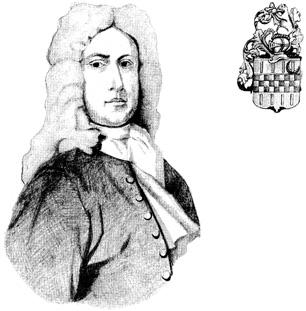
Colonel Richard Lee was the younger son of an old Shropshire family. He emigrated to Virginia ca. 1640 and became Attorney General, Secretary of State, and Sir William Berkeley’s chief lieutenant. For long and loyal service, he received vast holdings of land and by 1663 owned at least seven plantations and many servants and slaves. Colonel Lee was immensely proud of his lineage. His Saxon family was as ancient as the Berkeley’s had been and looked down upon England’s Norman nobility as coarse and vulgar upstarts. He lived in high style. In 1655, agents of the Puritan Commonwealth seized Lee’s baggage and found “200 ounces of silver plate, all marked with his coat of arms.” Above his front door, Lee hung a wood carving of his arms, which still survives with one side broken and faint traces of its original paint. Worked into the design was a crescent, the heraldic mark of a second son which appeared on many escutcheons in Virginia. The Lee family became the archetype of Governor Berkeley’s armigerous elite.
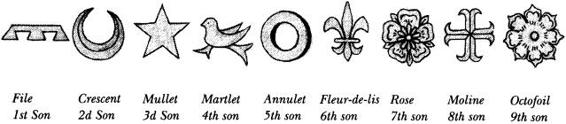
The great majority of Virginia’s upper elite came from families in the upper ranks of English society. Of 152 Virginians who held top offices in the late seventeenth and early eighteenth century, at least sixteen were connected to aristocratic families, and 101 were the sons of baronets, knights and the rural gentry of England. Seven more came from armigerous urban families, with coats of arms at the college of heralds. Only eighteen were the sons of yeomen, traders, mariners, artisans, or “plebs.” None came to Virginia as laborers or indentured servants except possibly the first Adam Thoroughgood who was also the brother of a baronet. Only two were not British, and nine could not be identified.8
Some of these families had grown very rich before the Civil War. As early as the sixteenth century, they had made matrimonial alliances with mercantile families and also with others who prospered in the countryside. An example were the Spencers of Althorpe, a family of humble sheep graziers in the fifteenth century who rose so rapidly in the sixteenth century that by 1603 Sir Robert Spencer was reputed to have “the most money of any person

Anna Constable Lee, the beautiful wife of Colonel Richard Lee, raised five sons in Virginia. Those children produced a vast progeny of Lees who became the archetypical first gentlemen of Virginia. The carriers of this culture from one generation to the next were women such as Anna Lee. She was a “lady of quality” who came to Virginia in the household of Sir Francis Wyatt, perhaps as his ward. In the handsome features of her portrait, the artist has captured the cultural values that were shared by Virginians of both sexes. Her open expression implies an ideal of candor and an utter contempt for falsehood and deceit. Her erect carriage communicates a pride of rank and reputation that was called honor in a gentleman and virtue in a lady. The firm lines of her mouth and chin suggest independence of mind and strength of character. The costume creates a feeling of simple dignity and grace that requires no ornament for its embellishment. In her eyes one sees a hint of sadness and suffering—which may serve to remind us that the ideals of this culture were continuously tested by its environment, and toughened in the testing. Here was the ideal type of a first lady of Virginia.
in the kingdom.”9 Some of these Spencers settled in Virginia, as did the children of other great landed families. A few were able to bring capital to Virginia. Others in Oldmixon’s phrase were “men of good families and small fortunes,” whose pedigrees became their passports to Sir William Berkeley’s favor.
These younger sons, by reason of their birth order, were forced to leave the land. Many, perhaps most of them, entered commerce in London and Bristol. There they adopted mercantile and maritime occupations which brought them in contact with Virginia. John Washington followed this path, as did Nicholas Spencer and Thomas Chamberlain and many other progenitors of Virginia’s first families. But the roots of all these men were in the English countryside, and Virginia offered a chance to return to the rural life which they preferred. Even the minority of Virginia who had been city-born and city-bred shared this cultural attitude. The first William Byrd found “a private gentleman’s life in the country … (at this time) most eligible.”10
With very few exceptions, these immigrants were staunch Royalists. Many had served in the Civil War as military officers of company or field grade. Of those whose opinions are known, 98 percent supported the King in the Civil War. If they had gone to a university, they tended to choose Oxford—especially the colleges of Christ Church, Merton and Queens which had an association with the royal family. They were Anglican in their religion, and their faith was as important to them as it had been to the Puritans.11
These families came from every part of England. But two-thirds (68%) had lived within a triangle of territory in the south and west of England, stretching from the Weald of Kent to Devon and north to Warwickshire. If emigrants from London are added to this regional group, its proportion rises from two-thirds to nearly three-quarters. Comparatively few came from the north of England (8%), and fewer from East Anglia (7%). There were only a scattering from Cornwall, Wales, Scotland, Ireland, and abroad.12
In England, most had lived within a day’s journey of London or Bristol. These cities, especially London, had been an important part of their world. One-third of them had lived in London before coming to America.13
In 1724 Hugh Jones wrote, “The habits, life, customs, computations, etc., of the Virginians are much the same as about London, which they esteem their home … for the most part [they] have contemptible notions of … country places in [other parts of] England and Scotland, whose language and manners are strange to them. … they live in the same manner, dress after the same fashion, and behave themselves exactly as the gentry in London.”14
In houses as ancient as the Berkeleys, younger sons and daughters married London merchants. In families as honorable as the Filmers, country cousins did their city business with traders and lawyers who were their kin.15 At the same time London merchants intermarried with the gentry of Essex and Kent: an example was the Byrd family, prosperous goldsmiths who were descended from landed gentry and who proudly possessed their own arms.16
After 1650 these families continued to intermarry on both sides of the Atlantic, and moved freely back and forth across the ocean. The result was a tightly integrated colonial elite which literally became a single cousinage by the beginning of the eighteenth century. Historian William Cabell Bruce compared the genealogies of these Virginia families to “a tangle of fishhooks, so closely interlocked that it is impossible to pick up one without drawing three or four after it.”17
One genealogical example was the Filmer-Horsmanden-Byrd-Beverley-Culpeper-Carter connection. The ancient Kentish family of Sir Edward Filmer produced several sons in the early seventeenth century. Among them was Sir Robert Filmer, author of the royalist treatise Patriarcha which became a favorite target for Locke and Sydney. This Patriarcha Filmer had a son named Samuel Filmer, who married his cousin Mary Horsmanden and moved to Virginia where he died in the dreaded “seasoning.” The young widow quickly remarried the prosperous planter William Byrd. She became the mother of William Byrd II, the mother-in-law of Robert Beverley and James Duke, and the grandmother of Thomas Chamberlayne, Charles Carter, Landon Carter and John Page. Within three generations most of Virginia’s first families were related to Mary Horsmanden Filmer Byrd, whose genealogy might be titled Matriarcha.18
That same royalist lady was also related to leading families in other southern colonies. Her first cousin Frances Culpeper married no fewer than three colonial governors in a row: Samuel Stephens, governor of North Carolina; Philip Ludwell, governor of South Carolina; and Sir William Berkeley, governor of Virginia. Frances Culpeper was also the cousin of William Penn and Nathaniel Bacon who became her husband’s mortal foe.19
Virginia’s Royalist Elite
The Filmer-Byrd-Beverley-Carter-Culpeper-Berkeley Cousinage
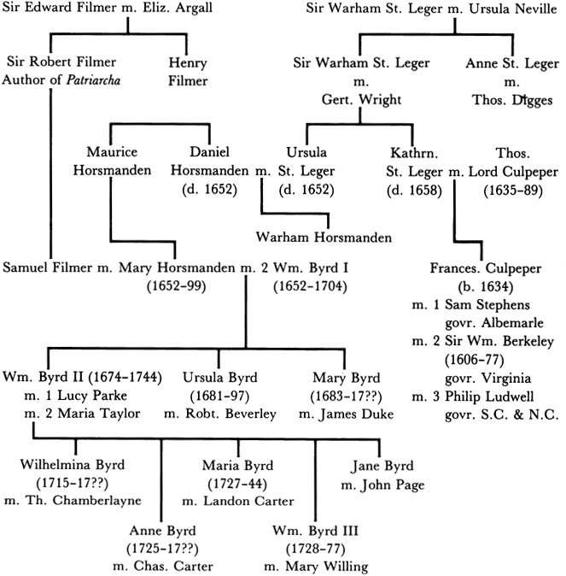
Sources: Mildred Campbell Whitaker, Genealogy of the Campbell, Noble, Gorton, Shelton, Gilmour and Byrd Families (St. Louis, 1927); Marion Tinling, ed., The Correspondence of the Three William Byrds of Westover, Virginia, 1684-1776 (2 vols., Charlottesville, 1977), II, 825-36; genealogical materials listed in Swem, Virginia Historical Index; William Berry, County Genealogies: Pedigrees of the Families in the County of Kent (London, 1830).
The Northampton Connection
The Isham-Washington-Spencer-Randolph-Jefferson-Bland-Beverley-Bolling-Eppes-Hackett Cousinage
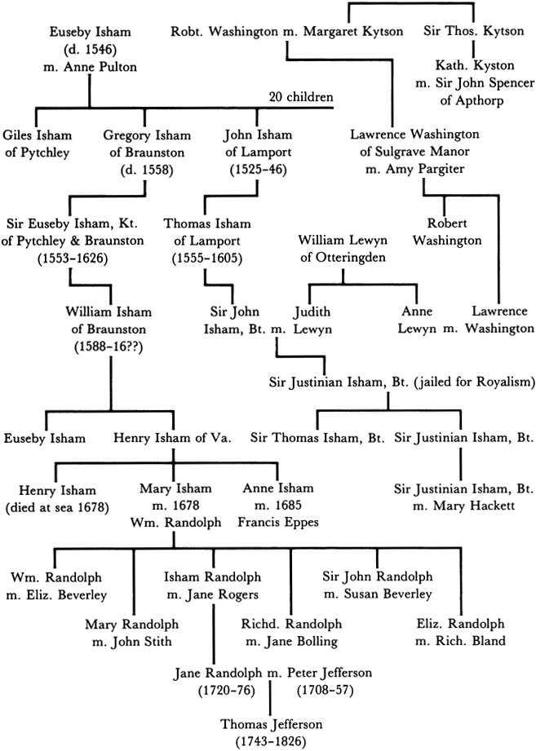
Sources: “The Washington Memorials at Garsden,” WMQ V1 (1910), 482-85; VII (1911), 1-6, 337-43, 452-57, 529-36; Henry Isham Longden, Visitation of Northamptonshire HARLSP 87 (1935), 250-63; Henry Isham Longden, The History of the Washington Family (Northampton, 1927); Oswald Barron, Northamptonshire Families (London, 1906); Finch, The Wealth of Five Northamptonshire Families, 141-68.
This Filmer-Byrd-Culpeper-Berkeley connection, centered on the person of Mary Horsmanden Filmer Byrd, was merely one of many alliances among Virginia’s ruling families. Another was a Northampton cousinage which formed mainly around the Isham family, and included the Randolphs, Washingtons, and Spencers of Althorp. All of these houses intermarried in Northamptonshire during the sixteenth and seventeenth centuries.20 They were closely linked to the Filmer connection. For example, the Washingtons of Sulgrave Manor, Northamptonshire (from whom George Washington was descended), had at least three ties to the Filmers. One branch of the Washingtons settled in Kent near Sir Robert Filmer; in the beautiful little church next to the Filmers’ seat at East Sutton (now a school for wayward girls) one may still see an old window dedicated to Washingtons who intermarried with Filmers. Another cadet branch resided briefly in Essex when the Reverend Lawrence Washington of Sulgrave (sometime fellow of Brasenose College, Oxford) obtained a place there through the patronage of the Horsmanden family. The sons of this Royalist clergyman migrated to America after his living was taken away by the Puritans. Other Washingtons intermarried with the Fairfax and Culpeper families who lived at Leeds Castle in Kent, only a few miles from the Filmers’ estate in East Sutton.21
Still a third Virginia connection centered on the family of Sir William Berkeley in Gloucestershire and Somerset. In the old woolen town of Bruton, Somerset, the Berkeleys were related to the Ludwells and Pages, both old and eminent families who had held many high offices. Sir William Berkeley himself was also kin to the Carys who came from the neighboring town of Castle Cary three miles from Bruton, and intermarried with rich merchants in Bristol.
This Berkeley connection was also tied to the Northamptonshire group, and to the Kentish alliance. Sir William Berkeley’s family was related to the Washingtons of Northampton and to the Filmers of Kent. Berkeley himself was a cousin of Mary Horsmanden
Filmer Byrd, a kinsman of her father-in-law, Patriarcha Filmer, and a second cousin, once removed, of William Byrd. Many of these ties were cemented by cousin marriages, which were carefully planned to create a web of kinship as dense as that of the Roman patriciate. It is difficult to think of any ruling elite that has been more closely interrelated since the Ptolemies.
A case in point was the composition of Virginia’s Royal Council. In 1724, there were twelve members of this body; all without exception were related to one another by blood or marriage. Most were kin of Mary Horsmanden Filmer Byrd. They included Robert “King” Carter and his son John Carter, and their cousins William Byrd, Nathaniel Harrison, and Peter Beverley. The other councilors were John Robinson, who had married Katherine Beverley; Philip Ludwell II, who had married Hannah Harrison; James Blair, whose wife was Sarah Harrison; John Lewis, who had married the daughter of Augustine Warner and was tied to all the major connections; Mann Page, who was kin to Judith Wormeley; Edmund Jennings and Cole Digges, who were related by marriage and birth to many of these families.22
This elite gained control of the Council during the mid-seventeenth century and retained it until the Revolution. As early as 1660, every seat on the Council was filled by members of five related connections. As late as 1775, every member of that august body was descended from a councilor who had served in 1660.23
A seat on the Council was not an empty honor. This small body functioned as the governor’s cabinet, the upper house of the legislature and the colony’s supreme court. It controlled the distribution of land, and the lion’s share went to twenty-five families who held two-thirds of the seats in that body from 1680 to 1775. These same families also controlled other offices of power and profit: secretary, treasurer, auditor general, receiver general, surveyor
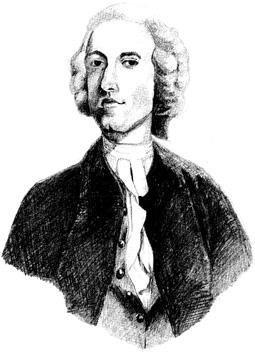
Norborne Berkeley, Lord Botetourt, personified the special relationship that long persisted between the Berkeley family and Virginia. Lord Botetourt (1718-70) was “a gracious, amiable and bankrupt nobleman” who became one of Virginia’s most popular colonial governors. Appointed to that office in 1768, he conducted himself in the same vice-regal manner as his kinsman had done before him. Just as Sir William Berkeley copied the gestures of Charles I, so Lord Botetourt imitated George III, opening the Assembly much as the King opened Parliament, riding through Williamsburg in a state coach drawn by a matched team of cream-colored Hanoverian horses. When he spoke in public Botetourt mimicked the dress, manners, appearance and even the peculiar speech defects of George III. By 1768, the first gentlemen of Virginia like many old Royalist families in England had become outspoken Whigs. They disagreed with Lord Botetourt on constitutional questions, but they held him in high respect, liked him enormously and accepted him as one of themselves. When Lord Botetourt died suddenly of a tidewater fever in 1770, the Virginians erected a monument that survived the Revolution.
general, collectors and naval officers, and governors of William and Mary College.24
In company with a larger group of lesser gentry, they also kept a firm grip on the economic life of the colony. In 1703 an official wrote, “ … in every river of this province there are men in number from ten to thirty, who by trade and industry have gotten very competent estates. Those gentlemen take care to supply the poorer sort with goods and necessaries, and are sure to keep them always in their debt, and consequently dependent on them. Out of this number are chosen His Majesty’s Council, the Assembly, the Justices, and Officers of Government.”25
This small elite was destined to play a large role in the history of Virginia—not merely in its politics and economics, but also in its society and culture. The formation of southern folkways owed much to their example. An English immigrant who came in 1717 observed, “ … at the Capitol, at publick times, may be seen a great number of handsome, well-dressed, complete gentlemen.” He thought that they made “as fine an appearance … as I have seen anywhere.”26 In 1773, a clear-sighted northern visitor to Virginia, Philip Fithian, observed that “the people of fortune … are the pattern of all behavior here.”27
The more hierarchical a society becomes, the stronger is the cultural dominion of its elite. The hegemony of Virginia’s first families was exceptionally strong through the first century of that colony’s history. One English emigrant named George Fisher remembered being warned about their power:
John Randolph, in speaking of the disposition of the Virginians, very freely cautioned us against disobliging or offending any person of note in the Colony …; for says he, either by blood or marriage, we are almost all related, and so connected in our interests, that whoever of a stranger presumes to offend any one of us will infallibly find an enemy of the whole. Nor, right or wrong, do we forsake him, till by one means or other his ruin is accomplished.28
This Virginia elite was firmly established during the governorship of Sir William Berkeley, and remained dominant for more than a century. Throughout this long period, English aristocrats who came to the New World instantly recognized a cultural kinship with the great planters of Virginia. In 1765, for example, Lord Adam Gordon, the first son of the second Duke of Gordon, observed that the “topping families” of Virginia had been founded by “younger brothers of good families of England.” He felt perfectly at home among them. “Upon the whole,” he wrote, “was it the case to live in America, this province in point of company and climate would be my choice.”29
The social origins of Virginia’s “topping families” were better understood by Lord Adam Gordon than by many middle-class historians in the twentieth century, who have replaced the image of “topping families” and “complete gentlemen” with an idea of upwardly-mobile bourgeois entrepreneurs. But the legend of the Virginia cavalier was no mere romantic myth. In all of its major parts, it rested upon a solid foundation of historical fact.30