
 Virginia’s Great Migration: Social Origins
The settlement of Virginia had actually begun more than a generation before the arrival of Sir William Berkeley and his elite. Its starting point was the founding of Jamestown (1607) by English colonists in the ship Susan Constant and her two small consortsGodspeed and Discovery. These immigrants succeeded in planting the first permanent English settlement in America. But there is today no Susan Constant Society comparable to that of the Mayflower descendants. Most of Jamestown’s founders either died in their new homes or speedily returned to England.1
The population of Virginia began to grow rapidly at a later date—after the Puritan migration to New England. Many authorities now agree that English “immigration to the Chesapeake colonies was heavily concentrated in the third quarter of the seventeenth century.”2 From 1645 to 1665, Virginians multiplied more than threefold and Marylanders increased elevenfold, while New Englanders merely doubled. Given the very high mortality rates in the Chesapeake colonies and low birth rates during the first generation, the number of immigrants to the Chesapeake was probably in the range of 40,000 to 50,000 during the period from 1645 to 1670.3
Virginia’s second great migration differed from the Puritan exodus to Massachusetts in many ways—in its English origins, in its American destination, and especially in its social composition. New England had drawn mostly from the middle of English society. Virginians came in greater numbers from both higher and lower ranks. In quantitative terms, Sir William Berkeley’s “distressed cavaliers” were only a small part of the total flow to the Chesapeake colonies. The great mass of Virginia’s immigrants were humble people of low rank. More than 75 percent came as indentured servants.4
One surviving English register of emigration contains the names of approximately 10,000 servants who sailed from Bristol to America between 1654 and 1678. Roughly half of these emigrants went to Virginia. The rest found their way to the West Indies—mainly the island of Barbados which was much favored during the 1650s, and the beautiful little island of Nevis which was preferred in the early 1660s. Scarcely any chose to make New England their home. The main stream flowed from the south and west of England to the Caribbean and the Chesapeake.5
Virginia’s servants were recruited mainly from the lower strata of English society, but not from the very lowest—“the bottom of the middle ranks,” one historian has written, “below their older and wealthier contemporaries, but above the poor laborers, vagrants and the destitute.” Unlike most emigrants to New England, their passage was paid by others.6 They tended to be more rural and agrarian than the founders of Massachusetts. Two-thirds of Virginia’s colonists were unskilled laborers, or “farmers” in the English sense—agrarian tenants who worked the land of others. Only about 30 percent were artisans (compared with nearly 60 percent in New England). Most were unable to read or write; rates of literacy in the Chesapeake Bay were much lower than in Massachusetts Bay.7
Patterns of gender were also very different from New England’s great migration. Altogether, females were outnumbered by males by more than four to one—in some periods, as much as six to one.8 Few women freely chose to settle in Virginia. Some were “trapanned” or “snared” and sent against their will, as an old folk ballad called “The Trappan’d Malden” tells us:
Give ear unto a Maid, that lately was betray’d,
And sent into Virginny, O:
In brief I shall declare, what I have suffer’d there,
When that I was weary, weary, weary, weary, O. …
Five years served I, under Master Guy,
In the land of Virginny, O,
Which made me for to know sorrow, grief and woe,
When that I was weary, weary, weary, weary, O. …
I have played my part both at Plow and Cart,
In the Land of Virginny, O;
Billets from the Wood upon my back they load,
When that I am weary, weary, weary, weary, O. …
Then let Maids beware, all by my ill-fare,
In the Land of Virginny, O;
Be sure to stay at home, for if you here do come,
You all will be weary, weary, weary, weary, O. …9
In 1643 a woman named Elizabeth Hamlin was sent to Newgate for “trapanning” girls in this manner. Another ballad tells the
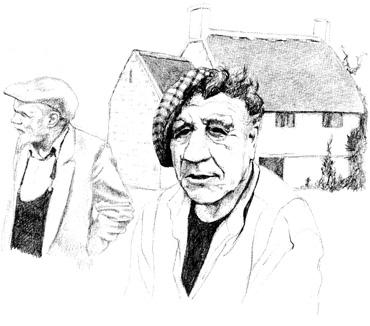
Virginia’s immigrants in the late seventeenth century were mostly indentured servants whose families had been poor tenant farmers and country laborers. The last remnants of this class still survive today in remote rural villages of southern England. As recently as 1985, two tenant-laborers named Jack and Roy French were suddenly thrust into the national limelight by the death of their landlord. They lived in the Cotswold village of Great Tew (Oxfordshire), in old stone cottages without electricity or water, and were tenants of a local squire named Major Eustace Robb. The death of Major Robb caused a furious controversy in the West Oxfordshire District Council about the disposition of the cottages and occupants.
tale of an “honest weaver” who sold his wife to Virginia. This practice, bizarre as it may seem, actually occurred in England during the seventeenth century.10
Most of Virginia’s servant-immigrants were half-grown boys and young men. Three out of four were between the ages of fifteen and twenty-four. Only 3 percent were under fifteen, and less than 1 percent was over thirty-five—a sharp contrast with Massachusetts.11 More than a few of these youngsters were “spirited” or kidnapped to Virginia. Parliament in 1645 heard evidence of gangs who “in a most barbarous and wicked manner steal away many little children” for service in the Chesapeake colonies.12Others were “lagged” or transported after being arrested for petty crime or vagrancy. Another ballad tells the story of a London apprentice was who “lagg’d” by a “hard-hearted judge,” and “sold for a slave in Virginia”:
Come all you young fellows wherever you be,
Come listen awile and I will tell thee,
Concerning the hardships that we undergo,
When we get lagg’d to Virginia …
When I was apprentice in fair London town,
Many hours I served duly and truly,
Till buxom young lasses they led me astray,
My work I neglected more and more every day,
By that I got lagg’d to Virginia.
But now in Virginia I lay like a hog,
Our pillow at night is a brick or a log,
We dress and undress like some other sea hog,
How hard is my fate in Virginia.13
The character of Virginia’s great migration thus differed in almost every important way from the Puritan exodus to Massachusetts. From the start, immigrants to the Chesapeake colony were more highly stratified, more male-dominant, more rural, more agrarian, less highly skilled, and less literate. Many came from the south and west of England; few from East Anglia or the north. These patterns did not develop merely by chance. Virginia’s great migration was the product of policy and social planning. Its royalist elite succeeded in shaping the social history of an American region partly by regulating the process of migration.