
Over the last several chapters I have dug into the details and consequences of Chaplin’s leaving Essanay in 1916—what we haven’t touched on yet, is what he left it for.
Money, yes, in part. Chaplin joined Mutual Film Corporation on terms that stagger the mind: he was contracted to make 12 short comedies, one a month. In return, he would be paid the staggering amount of $10,000 a week, plus a onetime signing bonus of $150,000. To put these numbers into perspective: he’d parted with Keystone when Sennett balked at paying him $1,000 a week.
Such a salary was unprecedented. Mutual’s publicity guys gushed, “Next to the war in Europe, Chaplin is the most expensive item in contemporaneous history.” It was the first salvo in the star-salary arms race that continues to this day.
To give their prize the best possible working condition, Mutual bought him a studio. It had once been Climax Studios, and when Charlie was done with it, the place would be home to Buster Keaton. Mutual then established a subsidiary company whose sole function was to administer Chaplin’s product: the Lone Star Company.
He might have been the Lone Star of the company, but Chaplin did not work alone. He needed a reliable stock company of supporting players whose skills, rhythms, and loyalty was never in doubt. Edna Purviance he brought with him from Essanay; from the ranks of Karno he poached Albert Austin, John Rand, and Eric Campbell. Henry Bergman arrived midway into the Mutual series but would stay on in Chaplin’s retinue until Modern Times in 1936.
Chaplin also required an equally dependable crew. His films were about performance—especially his own pantomiming. The last thing he needed was to fret about technical issues when his mind should be on the comedy—his films were only “scripted” in the roughest sense. Improvisation and inspiration ruled. What Chaplin wanted was someone to set up a camera that could capture the action without fussy camerawork, and then stay out of his way while he did his stuff. This he got in Rollie Totheroh—who, like Henry Bergman, continued to work for Charlie until 1936 and Modern Times. He also got it in William C. Foster, who worked literally alongside Totheroh, on a second camera (and was replaced later by George Zalibra, a minor-league ballplayer Chaplin met at Essanay). With two cameras, photographing from essentially the same vantage point, Chaplin could get two negatives of every shot. The practice has since resulted in some debate as to which of these two similar but not quite identical negatives is the “true” or “best” one, but it also doubled the odds of Chaplin’s movies survival over the years.
In front of these handcranked boxes, Charlie used his skills as a pantomimist to work his magic. Other comedians (Snub Pollard, I’m looking at you) had an anything-for-a-joke mentality, but Chaplin never strayed outside the possible. He would stray outside the likely, sure, but he would never pull an impossible gag.
This became no small part of Chaplin’s universal appeal. He could play a drunk, a hobo, an itinerant, an immigrant, an ex-con, a genius, an acrobat, a saint, a hero—he earned his Everyman status by virtue of collating traits of every man.
Thus it all came together at Mutual. Chaplin could enjoy creative freedom, financial reward, the comforts of fame, a loyal team, and the joys of discovering the outer limits of what silent comedy could do. Future endeavors might find Charlie chafing against those limits, pushing the envelope ever outward, but his stint at Mutual was unmarred—nothing less than the glorious sensation of limitless opportunity and unchecked horizons.
It begins with The Floorwalker, a short memorable chiefly for Chaplin’s losing battle with an escalator. This also features a self-referential gag in which Charlie and another character manage to trade places simply by swapping clothes—a direct dig at the likes of Billie Ritchie and Billy West who were making a living as off-brand Chaplins sold to less-discriminating audiences. Chaplin was aware of their threat, a constant reminder that he could not afford to rest on his laurels. He had to stay one step ahead of such mimics—and to do so had more to do with the man inside the clothes than the clothes themselves.
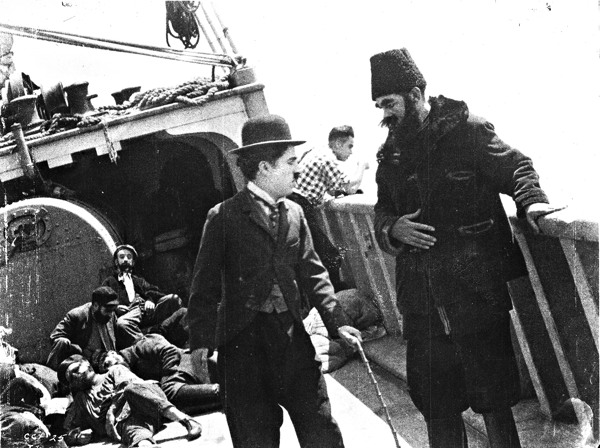
Charlie (left) and Albert Austin face seasickness on the way to Ellis Island in 1917’s The Immigrant.
The third Mutual, The Vagabond, found Chaplin in full “serious artist” mode. The Vagabond eschews jokes for “serious” cinematic values—character, story, setting. Edna Purviance plays an abused gypsy girl rescued by a wandering musician (Chaplin). Aside from a funny bit where Charlie sets a table using a shirt, folding its sleeves into passable imitations of napkins, there is scarcely a joke in it. It would take time for Chaplin to reconcile his competing impulses, and bring pathos and laughs together in the same work.
The Vagabond is also notable for introducing the notion of art as salvation. Class politics are ever-present in Chaplin’s films. The underclass are destitute and only occasionally noble; the rich are foolish and often drunk. What then can help lift the poor out of the wretchedness of poverty? Here, and in The Immigrant, Charlie’s answer is: they will be recognized as artists and suddenly enriched. Don’t laugh—remember the axiom: unlikely but never impossible. Charlie Chaplin went from dirt poor beggar to highest paid entertainer in the world solely because somebody recognized him as an artist.
Which brings us to One A.M., a slapstick classic that amply proves why they paid him the big bucks. Aside from an Albert Austin cameo in the first scene, this really is a “lone star” production, in which Charlie plays a rich drunk at war with his own furniture.
Very soon Chaplin hit his stride, and almost everything he made would be an unqualified masterpiece. From December 1916 through June 1917 they came: The Rink, Easy Street, The Cure, The Immigrant. Each one phenomenal—any one of them has an equal claim to being The Greatest Short Comedy Of All Time. Descriptions of these films would be pointless—words cannot capture the full extent of what Chaplin did with these moving pictures, and serve only to cheapen them into recitations of gags: this is the one where Charlie stows his hat and coat in an oven, here’s the one where Charlie pulls a gun, here’s the bit where Charlie falls down the stairs. These are quite simply as good as silent comedy would ever be.
The final Mutual short was The Adventurer, in which Charlie plays an escaped convict who passes himself off as a heroic and wealthy man, only to realize he’s doing so in the house of the judge who convicted him. It was not the stellar blend of emotion, social conscience, slapstick, and wit that enervated the brilliant run of films immediately preceding it, but was the most popular of the entire Mutual run and a superb encore.
The Adventurer appeared in theaters in October 1917, 18 months out from the start of Chaplin’s supposed 12-month contract. So much for a movie a month. Given total creative autonomy, Chaplin found that if he was not happy with any particular scene he could reshoot it, revise it, rethink it—endlessly—until he was satisfied. Hours turned into days turned into weeks, deadlines collapsed. As long as it was worth waiting for (and, hoo boy, it was), Mutual had no objections.
Chaplin’s policy was to destroy outtakes. Only the finished end product of all these fits and starts was what mattered. However, policies are not always scrupulously carried out, and a treasure trove from these Mutual days survived. The discarded footage revealed the often tortuous process by which ideas were honed to perfection on the anvil of the Chaplin lot. These trims formed the basis for the documentary Unknown Chaplin.
Charlie Chaplin was a comedian of the first order. And in his day, there was plenty of competition. In the silent era there were lots of slapstick clowns—and most don’t even come close. The true extent of his genius is obscured by our modern focus on the so-called Three Geniuses: Chaplin, Keaton, Lloyd. But sift through the countless hours of silent comedy by … Ford Sterling, Mabel Normand, Roscoe Arbuckle, Billy Bevan, Harry Langdon, Ben Turpin, Charley Chase, Larry Semon, and on and on—some of them were gifted, some had flashes of brilliance, but none of them touched the same heights as Chaplin. To use a word too often misused, he was unique.
There is quibbling to be done over solitary gags—did Roscoe Arbuckle do the bun dance first?—but no one pulled it all together the way he did. He was the Elvis of silent comedy—and the Mutual years were his Sun Sessions.