
A Woman of Paris. Not a title that stirs your soul, is it? Maybe you’ve never even heard of it. Or you’ve heard of it but just never cared. Or like me you cared but still avoided it because you thought it was the movie equivalent of broccoli—something good for you, but not fun. Well, I’m here to testify. Brothers and sisters, I was once like you, but then I saw the light. I’m here to tell you, you need to put this movie high on your to-watch list. And I’m gonna tell you why. If you want to watch Charlie Chaplin’s funniest features, you could sit down with the Mutual shorts and call it a day. But, if you wanted to watch his most important features, you need to focus on The Kid and Woman of Paris.
I’m defining “important” as “influential,” and the influential aspect of The Kid is evident: that was the line in the sand between all those comedians who made two-reelers, and those who would join Chaplin as feature comedians. There had been feature comedies before The Kid, but now a feature comedy was taken seriously as a movie, not just a really long short. Feature comedies were to be coherent stories with emotional depth–and not every comedian could follow Chaplin into that realm.
It could be argued that was not necessarily a good transition. Comedies often work best in short bursts. In the grand history of movies there have been relatively few truly great feature comedies, and there has always been a tension between being a good movie and being a funny movie. By contrast, television comedies (operating with a running time comparable to a two-reeler) have consistently found ways to be simultaneously well made and funny.
A Woman of Paris, though, earns its importance by different means. For one thing, it isn’t a comedy. It opens with this disclaimer (just in case you were inclined to complain to the theater management): “TO THE PUBLIC: In order to avoid any misunderstanding, I wish to announce that I do not appear in this picture. It is the first serious drama written and directed by myself. CHARLES CHAPLIN.”
It was a singular foray by a great comedian out of his comfort zone into the realm of drama that in turn inspired a great dramatist to transform into a great comedian. Sorry, that is an unfair oversimplification. The “great dramatist” I’m referring to is Ernst Lubitsch, and by calling him that I’m grossly distorting his history just to fit a clever turn of phrase. Lubitsch’s early work can’t be summed up so curtly as his being a “great dramatist.” He was a slapstick clown in two-reelers, then he became the master of Cecil B. DeMille-style opulent spectacles, then he took to making absurdist sex comedies. In short, his early work is muddle of mismatched styles. Each individual work is terrific in its own right, but there’s no sense of order.
Then, he sees Woman of Paris, and suddenly it all snaps into place. From that point on, he was the Ernst Lubitsch we know today. Without Woman of Paris, there would be no Lubitsch as we know him, and without Lubitsch I doubt we’d have had the rise of the romantic comedy in the 1930s.
So, let’s get to the movie itself. According to David Robinson, the term “gold digger” had been coined specifically to describe one Peggy Hopkins Joyce, a young lady with whom Chaplin had a brief affair in 1922. Apparently she alternated between boasting of her sexual conquests and painting a picture of herself as a naive country girl. Evidently Chaplin wrote the lead character of Marie St. Claire in Woman of Paris in reaction to Joyce. Whatever psychological games Chaplin may have been playing, he structured Woman of Paris as a vehicle for Edna Purviance. I’ll leave it up to someone else to comment on the awkwardness of casting one ex-lover in a role written about a different ex-lover.
Prior to seeing this film, I had developed the impression that Chaplin’s reputation rested entirely on his admittedly peerless physical comedy—as a director he was prone to lapses of judgement. His films can sometimes display seemingly poor editorial choices, continuity errors, and cinematic glitches—which really just reflect Chaplin’s priorities. The point of his comedies are his performances, and every cinematic choice is predicated on how to get the best physical performance on screen. If a sloppy cut is needed to get the joke right, the joke wins every time.
But Woman of Paris is a beautiful piece of work, flawless in every frame. Much of it looks like it could have been made by F. W. Murnau or Fritz Lang (and I’m not sure I can give any higher praise). This time he doesn’t have to worry about directing himself, so he can give undistracted attention to all the other details. He can at last afford to indulge in a level of visual perfectionism unimpeded by the dictates of physical comedy.
Part of the attention to visual detail evident in Woman is the efficient use of expressive elements. Consider for example one famous and influential scene. A young man from Edna’s past has tracked her down in the Big City and is meeting with her in her apartment. As Edna looks over various dresses, her maid opens a dresser drawer and a man’s shirt collar falls to the floor. The maid casually places the collar back in the drawer and continues on her business.
A single prop, shown once, a knowing look, and bingo! Chaplin has made his point: the boy knows she has a lover. That took, what, six seconds? And yet it is a pivotal plot point that drives the whole second half of the film. It is in many ways a Lubitsch touch—that seemingly effortless association of complex ideas with simple props that enables the storyteller to convey massive amounts of information with subtle gestures.
Chaplin and Lubitsch were buddies at this point, and Charlie treated Ernst to a private screening of the film as an unfinished work in progress. Lubitsch emerged from the screening gushing, “I like it because I feel that an intelligent man speaks to me and nobody’s intelligence is insulted.”
Hollywood producer Henry Blanke would later remark that Woman of Paris “influenced Lubitsch’s entire life from then on.” Where he had once been the master of massive epic spectacle, Lubitsch would from then on narrow his focus to the domestic and the subtle.
Lubitsch wore his admiration for Woman plainly on his sleeve. When caught in arguments with pretentious European intellectuals about whether Chaplin deserved to be called an artist, he routinely touted Woman as his go-to evidence (and let’s face it, he is one of the very few who would choose Woman first in such a debate, as opposed to, I dunno, The Gold Rush?) Almost immediately, Lubitsch hired Adolphe Menjou, the charismatic cad of Woman of Paris, and cast him as, well, a charismatic cad in The Marriage Circle.
That’s not to say Lubitsch was all about imitating Woman. In fact, the differences between Chaplin’s movie and Lubitsch’s works are crucial. For one thing, Chaplin’s is not a comedy. It has the pace of a comedy, and has touches that feel so very Chaplinesque, but there are few if any intentional chuckles. By contrast, Lubitsch adopted the same stylish veneer, the same ironic distance and dry wit, but in his hands this, in and of itself, was the comedy.
The fundamental difference in stance between Chaplin and Lubitsch surfaces as well in the content. To explore this, I need to describe something of the plot of Woman. The film revolves around the idea that the only way a woman can make her way in the world is in relation to a man. The socially approved mechanism for this has a virginal girl conveyed from the house of her father to the house of her husband on the night of her family-sanctioned wedding. But, when Edna’s character Marie finds this avenue foreclosed due to a set of cruel circumstances out of her control, she opts for Plan B, in which she trades sexual favors to powerful men in return for a comfortable but empty life.
At no point in the movie does Chaplin present a single female character who does not conform to one or another of these two paths, and at no point does anyone ever challenge the social assumptions at play. When Lubitsch took to copying Chaplin’s technique, he dropped all that Victorian nonsense and happily depicted emancipated and uninhibited women.
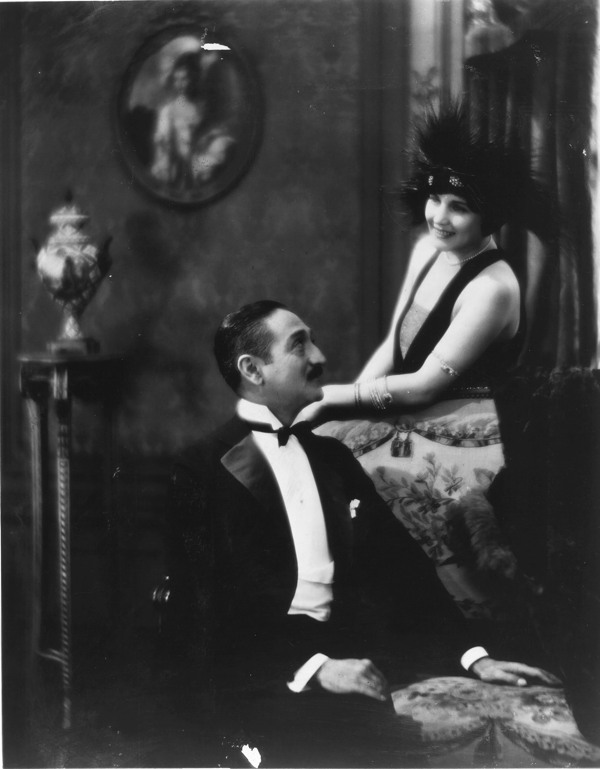
Adolphe Menjou romances the woman of Paris herself, Edna Purviance.
It isn’t just that Lubitsch saw a different kind of world, even Chaplin’s own slapstick peers did. Just a few short years after this film came out, the folks at Hal Roach Studios were churning out two-reelers with Thelma Todd and Anita Garvin as single girls living on their own, maintaining apartments, holding down jobs, paying their own bills.
Chaplin was very stubbornly a 19th-century kind of thinker. Throughout his films, when he depicted work, it was manual labor—while competitors like Harold Lloyd and Charley Chase depicted a world of white-collar office-drone employment that was actually more in line with the experience of the audience. Even his supposedly forward-thinking Modern Times clung to a sense of robber barons vs. alienated laborers that wouldn’t have been at all out of place in a movie made 10 or even 15 years earlier, but which would have seemed utterly passé 10 or so years later.
As a result of this anachronistic stance, even at his most eloquent, Chaplin seems to be arguing a point that’s already been made. In Woman of Paris he sets out to condemn a restrictive Victorian attitude, and does so to an audience of flappers and suffragettes.
Because contemporary audiences have lost touch with the specificity of the historical moment, and merely encounter a film like this as something old, this anachronism gets swept under the carpet. We can just sit and marvel at those very same qualities that thrilled and inspired Lubitsch—a film of visual poetry and efficient expressivity, a work of ironic detachment and intellectual confidence, a masterpiece.