
Let’s say you just saw The Gold Rush, or City Lights, and are overwhelmed with the genius of Charlie Chaplin. You want to see more of this genius, you want to chase it back into the past to see from whence it came. If you sit down to watch his short comedies from 1917, the ones he made at Mutual, you will be delighted. They are at least the comic and cinematographic equal to his later features. Here in the Mutual comedies is a fully formed comic personality, full of humanity and tolerance, whose films are innovative works of cinema, trenchant social critiques, and transcendent physical comedy all in one.
If you skip back just one year, however, to the shorts he made at Essanay in 1916, suddenly that perfection is tarnished. Here we find rough edges and primitivity. These things are funny enough and quite well made for their time, but the Essanay shorts appear to be rough drafts for the Chaplin to come.
Skip back just another year or two more, though, and you will land somewhere altogether else. These are the shorts that Charlie Chaplin made at Keystone Studios following his arrival in Hollywood in 1914. Frankly, it is hard to see these as rough drafts. It isn’t just that Chaplin’s Keystone shorts are cruder than the phrase “rough draft” would imply—it’s more that they seem to have wholly different comic ambitions altogether.
Keystone producer Mack Sennett’s style of comedy was built on riffing on a specific kind of melodrama that was common then but extinct today. It is extraordinarily difficult for modern audiences to connect with these films because we lack the basic cultural assumptions that underlie the humor. Sometimes, though, lightning struck and the result was a film that could connect with audiences both then and now with equal power. Which brings us to Kid Auto Races at Venice.
Kid Auto Races at Venice is an important film in Chaplin’s canon—this is the first film in which he appears in the costume he would soon make famous. Despite that historical significance, Kid Auto Races rarely gets much respect. Historians and Chaplin-o-philes will make their dutiful pilgrimage to check it off their lists, but few will admit to genuinely enjoying it. Which is to my mind a shame, since this movie is one of the few of Chaplin’s Keystone films that actually works today.
To really understand this crucial turning point in Chaplin’s life, we need to jump back in time even further, to a time when Charlie Chaplin and his half-brother Syd were ragamuffins in London. They were so poor they had to trade who got to eat on which day. Nobody knew for sure who Syd’s father was, and while the identity of Charlie’s papa was known, fat lot of good it did since the man himself was gone. Mama Chaplin was succumbing to a family history of mental illness. Charlie and Syd were in and out of orphanages and institutions. If Charlie’s future films ended up ruminating on social injustice and the arbitrary cruelties of life, we should not be surprised.
Syd and Charlie had a way out of this daily nightmare: they went into show business. They each joined Fred Karno’s troupe of music hall entertainers. In America they called this stuff “vaudeville.” Same difference really. You should have something like Saturday Night Live in your mind at this point—an ensemble troupe of performers offering a live show with comedy sketches and music. Charlie was but one of a number of talented performers who took the Karno stage—and if he “popped” out of that background, think of that as akin to someone like Eddie Murphy suddenly outstripping his co-stars on SNL (I’m sorry—was that reference too old? How about Tina Fey? Kate McKinnon?).
The main show Karno did involved a sketch called “Mumming Birds.” It went through a number of name changes and cast changes over the years, but we don’t need to worry over the details—the point is, it was a show-within-a-show in which a vaudeville (sorry, music hall) performance is heckled and interrupted by an unruly audience, in particular one conspicuous drunk. Various comedians played that drunk—Billy Reeves, Billie Ritchie, Charlie Chaplin. Chaplin did not originate the role, but he perfected it, and became a megastar. On the basis of this performance he got himself headhunted by Hollywood, and a job offer at Keystone.
Try to imagine Charlie’s mindset at this point. One day he’s literally a starving artist, facing down a family implosion, and the next he’s a much-sought-after entertainer. His ability to make people laugh is a gift that can transform his life—but while we know how this story ends, Charlie has no way of knowing where this is leading, or when his luck will run out.
Charlie’s earliest days at Keystone were legendarily awful. He had difficulty ingratiating himself with the established comedians on the lot (who may have worried about his prima donna way of stealing the limelight), and he fought with his director Henry Lehrman. Unfamiliar with the mechanics of film production, he missed his cues, was stiff in front of the camera, lost. According to Denis Gifford’s biography of Chaplin, the first film Lehrman shot with Charlie went so badly, the thing was junked (Gifford does not reveal the title of this aborted project).
Chaplin was humiliated. Moreover, he was scared. Mack Sennett, the impresario behind Keystone, was now making noises about canceling the contract with the unreliable Englishman and sending him back to London. So Charlie reached deep into himself to try again—and the next film they shot was Making a Living.
If you want to set down the book now and go watch Making a Living, knock yourself out. I don’t recommend it, but I’m not the boss of you. After having seen it, if you can recall any of it meaningfully, then you’re a better person than me. I’ve seen it dozens of times in different versions, I even own a couple of prints, and I barely recall a single frame. It’s as forgettable and disposable as they come. Sennett laid Chaplin off for a week, and returned to considering firing him.
Then, on January 10, 1914, in the city of Venice, California there was a race. I grew up calling these things “box cars,” but they called them “kid autos.” Either way, we’re talking about gravity-operated miniature cars driven by children. Lehrman and Chaplin trundled off to improvise a film there.
This sort of thing was standard practice at Keystone. Many of the films were properly scripted and worked out in advance, more or less, but the grueling pace of production was so demanding that it simply wasn’t an option to do this for every picture. Some were just made up on the spot, if there happened to be a convenient location or event that could be used to prompt the act of creation.
Chaplin fans and scholars generally dismiss Kid Auto Races at Venice as not evidencing enough in the way of forethought or creative imagination to warrant much attention. It’s got just one joke, repeated and stretched out for 10 minutes. There’s no deep social critique, no elaborate miming, no interplay with other characters—none of the details that critics go looking for when they dig through these early seminal works. Legend has it Charlie improvised this in 45 minutes—it hardly took much longer to make the movie as it takes to watch it. To the extent it gets much notice in the critical press it is for Charlie’s appearance. This was the first time that audiences saw Charlie in his “Little Tramp” costume, and that has historical significance no matter how you cut it. By the way, the phrase “Little Tramp” has been completely taken over by Chaplin’s legacy such that if you’re talking about a Tramp, you’re talking about a funny little guy with a Hitler moustache and a bowler hat. But for audiences at the time, this iconic image was meant to carry its own connotations. A “tramp” was what we might today call a homeless drunk. So, in the interest of making you think about Chaplin’s character in the proper context, that’s what I’ll call him here.
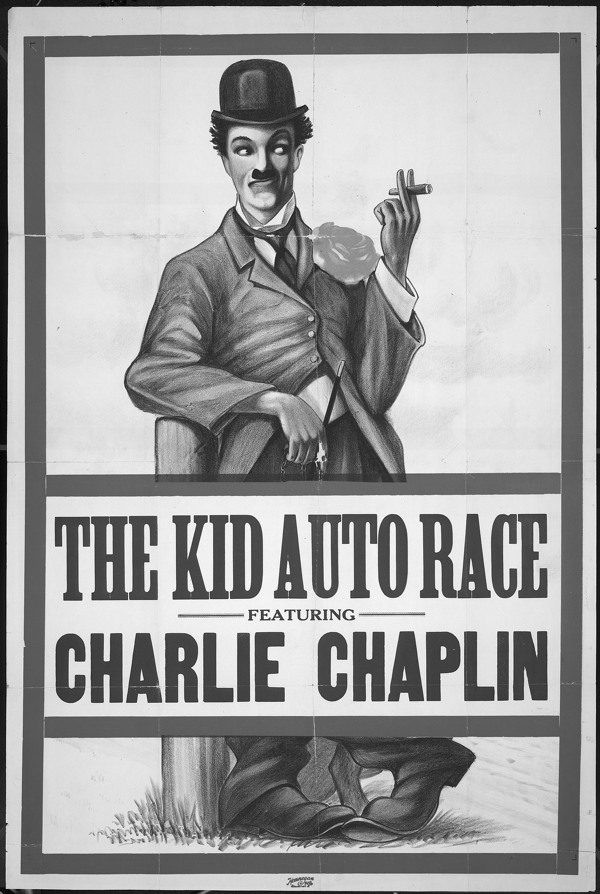
Poster for Kid Auto Races at Venice (Library of Congress Prints and Photographs Division, LC-USZC4–4714).
There are as many different legends about how Chaplin came up with his Homeless Drunk costume as there are historians to tell them. No two are the same, and they tend to contradict each other quite dramatically. I don’t trust legends. But if you ignore them, one thing jumps out—this character was in general appearance, behavior, and comic constitution the same as the one Charlie played on the Karno stage. It makes sense, doesn’t it? Chaplin comes to Keystone, has trouble slotting into the expectations the company has for him, his job is on the line—so what would you do? Rely on the tried and true—go back to the character that made you a star in the first place.
Here’s where it gets interesting—the character of the Drunk that Chaplin played in “Mumming Birds” was a disruptive element who derailed a performance by professional entertainers. The character of the Drunk that Chaplin plays in Kid Auto Races is a disruptive element who derails a documentary film by professional filmmakers.
The genius of Kid Auto Races at Venice is that like any contemporary fake documentary it pretends to be a straight documentary recording of the race. Nothing in the film aside from Chaplin’s intrusion is played for laughs—this is a newsreel record of a real event at which some stray homeless drunk wandered into the frame, obscuring the action. When the camera crew waved him off, he noticed the camera—and became fixated on the idea of getting himself into the movie. “Hey, ma!” Over and over again, in every shot, here comes Charlie. He doesn’t do anything especially funny once he’s there—the joke is how he continually insinuates himself into the frame, unwanted. He becomes the self-appointed star of a hijacked movie.
He’s smitten. He won’t take his eyes off the camera. He flirts with it. It’s been said that certain charming movie stars knew how to “make love” to the camera. This fellow rapes it. Sorry for the rude language, but there it is—he’s forced himself on this movie. The camera pans away, burly men shove him away, the crew switches the camera off and relocates altogether … and he returns, always, center of the frame.
Bear in mind: Charlie had been hired by Keystone to be a part of a comic ensemble that included such established stars as Mabel Normand, Roscoe Arbuckle, and Ford Sterling. There was no intention to turn him into a standalone star (or at least, if that was Charlie’s desire, it wasn’t shared by his employers). But that’s what he would do—the real-life Charlie Chaplin hijacked his movies as thoroughly and selfishly as his character here invades this one little movie.
It is worth noting that “Mumming Birds” worked a clever meta-textual trick: it was a music hall show about a music hall show being disrupted. Take away the disruptions, and you’d still have an intact show. Translating that into cinematic terms was tough. Kid Auto Races at Venice maintains the meta-textual element, but it was the only instance in the entire history of silent comedy that it was done like this. The idea of interrupted performances became a reliable workhorse for slapstick comedians. Charlie Chaplin and Buster Keaton, Laurel and Hardy and Harry Langdon, Charley Chase and Snub Pollard … you’d be hard pressed to find a notable comedian of the period who didn’t make a movie about some kind of show being turned on its head. But once and only once was this disrupted show presented as if it had actually happened.
Oh, but wait. It did happen.
There was an actual race, remember? Those were actually professional filmmakers recording that race. Some weird-looking guy who appeared to be drunk did disrupt the filming of the race. These events happened as we see them—it’s just that the filmmakers were cognizant of the eventual entertainment value of what they were doing.
It is the same joke structure of Borat, of a reality-age culture that seeks the thrills of commingling fiction with fact. Never mind that its fictional nature is obvious, the joy is in the pretense. The makers of satirical news programs like Brass Eye and The Day Today reveled in conning genuine politicians and publicity-hungry celebrities onto what they believed to be a real news show, only to be punk’d. The Office and Modern Family are but two of the increasingly common trope of the faux-documentary sitcom. Kid Auto Races at Venice is a reality-age silent comedy, minted nearly one hundred years ahead of its time.