
Mack Sennett was a miserly skinflint whose extraordinary ability to identify and nurture talent made his studio the jumping-off point for more superstars than anywhere else. The litany of film greats who started here, even if they went on to achieve greatness elsewhere, is astonishing—not to mention all the has-beens and already-ares who cycled through his orbit as well.
But Mack Sennett’s films remain difficult territory for film fans. Call him the King of Comedy if you wish, but a great many of his productions fall flat to today’s audiences, or require a patience or mindset that only the most dedicated fan can muster. Seeing as I am one of those patient, dedicated fans, I offer up here a tribute to—and primer on—the man who invented American slapstick.
One of the reasons Sennett’s earliest comedies feel foreign to modern audiences is that we have grown accustomed to looking for something that wasn’t there yet. The kind of silent comedy that developed in Sennett’s wake was oriented around “hero” comedians—the likes of Charlie Chaplin, Harold Lloyd, or Buster Keaton, whose personality served as the organizing principle of the films around them. Sennett’s comedies played by a different set of rules, and often acted as parodies of a particular style of melodrama as popularized by Biograph Studios.
To understand Sennett’s slapstick, you have to start with D.W. Griffith’s dramas. Mack Sennett, born Michael Sinnott, signed up with Biograph in late 1907 as an actor. They paid him $5 a day, and he was glad of it—the boy wanted more than anything to be a serious actor, and here he was now a regular player at the world’s premiere movie studio. He arrived at around the same time as D.W. Griffith, who quickly ascended to the spot of “Director-General.”
During the years 1908–1913, Griffith directed some 450 films—most of them one-reelers, all of them silent. A fair number were identified as “farces,” but the exact figure is hard to pin down. Not all farces were self-identified as such, which leaves it up to interpretation: what is a farce? I might find something funny you don’t, and vice-versa. So, let’s put down an estimate of 150 or so Biograph comedies. The number I have in front of me is actually 152, but that seems weirdly specific for a figure I’ve just said is a fudge, so I’m rounding down to an even 150.
The biggest hit of these farces—and indeed the biggest Biograph hit of any genre—was The Curtain Pole, in which Mack Sennett was cast as a clumsy idiot whose havoc knows no bounds. It’s built around just one joke—if you hold a long pole horizontally, it will whallop people in the head—but if you do the same joke over and over for 10 minutes, it becomes something superlative. This may not be the first slapstick movie, but it is just about as fully formed and perfect an example as you will find that early in the history of movies.
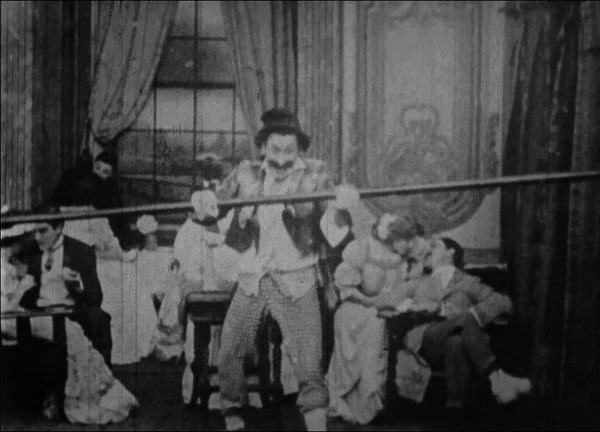
Mack Sennett wields the titular Curtain Pole in the 1909 Biograph film of the same name.
Griffith knew enough to keep making Curtain Pole–ish farces, since audiences paid good money to see them, but he didn’t much enjoy making them himself. Griffith thought such tawdry nonsense was beneath a serious artist, and his talents were better suited to directing domestic melodramas and adaptations of classic literature. He figured since Mack seemed to have a feel for this kind of thing, he could delegate the comedies to him altogether.
Meanwhile, Sennett couldn’t quite figure out what Griffith was even talking about. Serious art? Are you kidding me? Griffith’s films ran a scant 10 minutes and made no allowance for the actors to ever even speak. You can “adapt” all the classic literature you want, but the absurd limitations of the form (at that time) were destined to undermine you. At least, that’s how Sennett saw it. He thought Griffith’s melodramas were already so pretentious as to border on the ridiculous—it wouldn’t take much to push them over the edge.
Sennett’s farces, first at Biograph and then later at his own studio Keystone, differed little from the Griffith template. He used the same situations, the same character types. But he would exaggerate everyone into some ludicrous extreme. (This is one of the reasons why I find it hard to tally how many farces Sennett made at Griffith—the difference between a serious one that veers into unintentional self-parody and one that aims for parody but soft-pedals it is awfully slim.)
It’s not that Sennett was unsuited to making Griffith-style art: The Lonely Villa, hailed as the first full-blown example of Griffith’s “cross-cutting” was scripted by Mack Sennett. But Sennett and Griffith were operating on wholly different levels. On long walks together, Griffith would elaborate on his theories of how cinema should evolve, how he could use cinematic devices like editing to elide the less important bits so as to fit longer stories into the available running time, how he could use other devices like close-ups to emphasize the good bits. In these same walks, Sennett merely kept harping on how funny police could be if they were bumbling morons.
Exactly where the idea for the Keystone Kops came from is unclear. Too many alternate theories and competing anecdotes have been told. Many of these anecdotes are terrific (I especially like the one in which Sennett was stuck outfitting his police characters with ill-fitting costumes because Griffith had taken all the good ones already, and the result prompted the Chicago police department to issue a formal complaint. Sennett was delighted, and decided to stick with the misfit uniforms). But the fact is funny cops predate Sennett, both in film and vaudeville, so worrying too much about origins is a fool’s game.
The Keystone template as it now emerged was this: a mischief-maker causes some havoc, and the Kops descend on him to restore order. The mischief-maker could be any force of selfish wickedness—a Ford Sterling, for example. But the reason these old Ford Sterling shorts seem so odd to us today is we’re accustomed to looking for something that wasn’t there yet—we’ve become inclined by the later development of slapstick comedies to expect our identification and sympathy to align with the star. But there’s no reason to root for Ford Sterling—he’s a bastard. The point isn’t to root for him, but to revel in the catharsis of absolute social disorder. Authority is defied, social norms violated—this is rebellion, packaged as entertainment. This is rock and roll, circa 1914.
The appeal of slapstick comedy was for its era comparable to the safe rebellion of rock and roll. It was a way of rebelling against a system that you actually still had to live and function within. Few rockers ever really dropped out—fewer still their fans—which is why they now seem so odd in their ’60s and ’70s as establishment figures. They sold the illusion of rebellion.
Sennett gave audiences a space to gather in mixed groups, mingling classes and races and genders, and laugh in communion at the foolishness of authority figures, at the absurdity of social graces, at the overwhelming silliness of life.
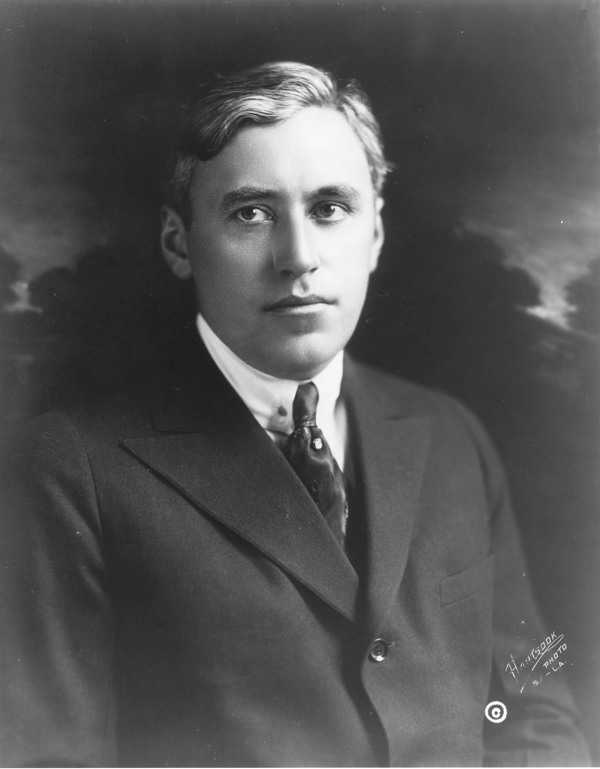
Mack Sennett, King of Comedy.
That, and he hired some amazing comedians.
Chaplin, obviously. And once, just for kicks, Sennett put himself on camera alongside his new star. The Fatal Mallet, which Sennett also directed, finds Charlie stealing away Mack’s girlfriend Mabel Normand. You watch this thing today for the historical curiosity of seeing Mack and Charlie side by side, pummeling each other. But there’s a weird undercurrent here, a troubling subtext: Mabel Normand was Mack Sennett’s great unconsummated love in real life, Charlie Chaplin was indeed a disruptive intruder whose presence was realigning Mack’s relative power and influence over others. Maybe things would have turned out differently if, during their contentious contract negotiations, they’d just taken out some big-ass hammers and had at each other.
But Chaplin was just the biggest name among big names—Sennett also had Harold Lloyd, long before he put on his famous glasses, before he even played “Lonesome Luke.” A highlight of Lloyd’s intersection with Sennett was Courthouse Crooks, because it features Lloyd doing what he would always do—running. This is quite possibly the earliest and most seminal appearance of anything resembling the Harold Lloyd we would come to know later.
By the 1920s, Sennett’s preternatural ability to spot talent had too often come into conflict with his unwillingness to pay people what they were worth. He’d lost Lloyd, who went on to become one of the greatest box office draws of the age. He’d lost Chaplin, who went on to become the greatest box office draw of the age. He’d lost Roscoe Arbuckle and Charley Chase—and the list goes on.
So when he saw the bidding war going on for the truly bizarre vaudeville star Harry Langdon, Sennett made sure he won that war and gave the nutty little man space to do his thing. Chaplin hadn’t just quit over money—he’d chafed against the restrictions on his creative freedom. Langdon would have no such cause to complain. (Langdon will feature later in this book, as an example of the apotheosis of silent slapstick before its transformation into screwball. We’ll cycle back to him in time.)
One major comedian that Sennett didn’t employ was Buster Keaton, but they worked together nonetheless. During Buster’s time at Educational Pictures in the early 1930s, after Sennett’s various studios had imploded and vanished, Mack was hired to direct Buster in the two-reeler The Timid Young Man. It starts off with a virtual remake of Harry Langdon’s The Hansom Cabman, with Buster now cast as the man waking up from an epic bender trying to shake both a hangover and a gold-digging vamp insisting he’d promised to marry her. Buster flees to the woods, where he joins forces with a pretty hitch-hiker to embark on remakes of scenes from several of Keaton’s silent classics (The Balloonatic, The Battling Butler), before winding the whole thing up with standard-issue Keystone-style violence. It’s an odd but amiable blend of the two men’s differing comic aesthetics.
So, that’s Mack in a nutshell. Not a bad legacy for a failed actor.