
Alone among the great silent comics, Harold Lloyd stood at the exact intersection of slapstick and screwball, at the intersection of physical comedy and dialogue. Harold Lloyd, you see, made a film with Preston Sturges. It was neither man’s greatest hour, but the mere fact of its existence is breathtaking. It’s like finding Ernst Lubitsch directing Charlie Chaplin, or Blake Edwards directing Laurel and Hardy.
Let’s take stock of this for a minute: we have one of the greatest physical comedians of the entire silent era, yet who is also preternaturally comfortable with the world of talkies. He is paired with a visionary of the new dialogue school of comedy, yet one who has an enduring appreciation of the values of silent comedy. They are going to collaborate as equals on a film that will be made without studio interference. If there is ever going to be a moment when the old guard of silent comedians are going to function without compromise in this new world of screwball, then there could be no better opportunity than this.
Harold Lloyd was the first feature comedian to release a talkie.1 Lloyd yanked his already completed feature Welcome Danger from theaters to reshoot it with dialogue. From a contemporary viewpoint Welcome Danger is hardly remembered fondly in either form, but it was in its day one of Lloyd’s biggest commercial hits.
Emboldened by his first success in the brave new world of sound, Lloyd followed it with several more talkies—including the frankly marvelous Movie Crazy—all of which he produced under complete artistic freedom.
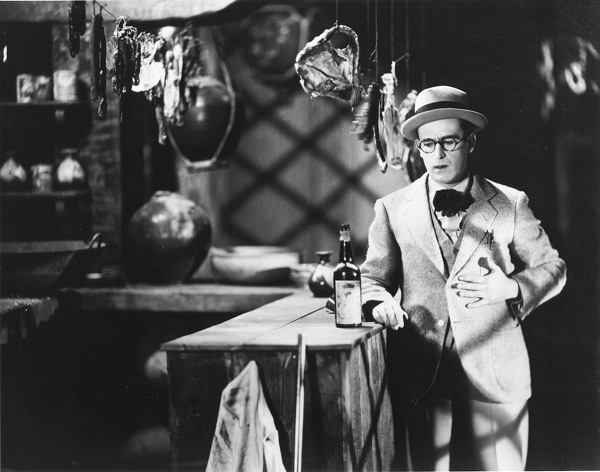
Harold Lloyd yanked his already completed feature Welcome Danger (1929) from theaters to reshoot it with dialogue.
Lloyd viewed these talkies with deserved pride, and when he put together his own retrospective Greatest Hits compilation film Harold Lloyd’s World of Comedy in 1962, he mixed and matched clips from his silent classics and talkies in equal measure.
In his biography of Lloyd, Richard Schickel put forth the assertion that Lloyd had a speech defect that impaired his ability to function in sound films—but I’m unpersuaded by the evidence. What evidence even is there, you ask? This: Lloyd used a dialogue coach for a couple of days on the Welcome Danger set, but that’s about the extent of it. If anything, Lloyd’s speaking voice seemed perfectly suited to his screen persona to a degree not shared by Keaton’s or Chaplin’s voices.
In fact, come the early 1940s, Lloyd was performing on the radio. On the radio! A silent comedian on the radio!
None of this supports the idea that Harold Lloyd was out of place in a world ruled by talking pictures.
But … then there’s Lloyd’s own words, in which he complained about battling with a director regarding what Harold saw as a ruinous over-reliance on dialogue, to the exclusion of physical comedy, or “business.” “He didn’t want gags to come into it, he wanted this dialogue. But this called for business, and he said, ‘Well, the business is too good for my dialogue … it’ll kill the dialogue.’ I said, ‘Let it kill the dialogue, what are we after? We’re after entertainment, laughs.”
Sadly, and oddly, the circumstances behind that quote are the film that brings us here today: Preston Sturges’ The Sin of Harold Diddlebock. I’m a bit leery of citing a year for this movie—the bulk of it was shot in 1946, it was released in 1947, then pulled from theaters for re-editing and reissued in 1951 as Mad Wednesday.
Sturges had always shown a great predilection for slapstick pratfalls in his films, and frequently cited the influence of the great physical comedians of the preceding generation. Sturges had just completed cinema’s equivalent of a homerun streak: between 1940 and 1944 he made: The Great McGinty, Christmas in July, The Lady Eve, Sullivan’s Travels, Palm Beach Story, Miracle of Morgan’s Creek, and Hail the Conquering Hero. The man was a visionary genius, and the output of just those four years alone is enough to cement a legend as one of filmdom’s finest comic minds.
Feeling unappreciated at Paramount and tired of making some of history’s greatest comedies in an atmosphere of perpetual institutional combat, he left to forge an ill-advised partnership with Howard Hughes. This was a dumb move in several respects—not least of which the fact that battling Paramount executives was a minor and prosaic annoyance compared to battling the impossible Mr. Hughes, and the fact that Preston was now obliged to create a movie studio from scratch.
As his first act under this new professional agreement, Sturges sought out Harold Lloyd and convinced him to return to the screen in a pseudo-sequel to Lloyd’s silent The Freshman. Sturges was so firmly convinced of the unassailable rightness of this idea that he didn’t even bother to negotiate a salary with Lloyd—if the aging comedian felt that his fabulous personal wealth wasn’t enough and he deserved to be paid a Clark Gable–style star’s ransom, that was fine by Preston. Whatever. And if he had to pay half again on top of that to secure permission to reuse footage from The Freshman, that too he accepted without blinking.
Furthermore, Sturges decided to afford Lloyd the same working conditions he used to enjoy on the silent films of yore: a lackadaisical production schedule that assumed large swaths of the film would be improvised or improved upon as they went.
So what went wrong?
Well, for one thing, it didn’t really go all that wrong. The reputation of The Sin of Harold Diddlebock is more dire than is deserved—it opened to decent reviews and strong business. True, box office returns started to piffle and it played better in some regions than others. Hughes withdrew it from release to spend a couple of years tinkering with it, but that had much more to do with Hughes’ egomania than any actual demerit of the film itself. And say what you will against Hughes’ recut version Mad Wednesday (now sporting a better title, one fewer reels, and a talking horse)—it scored a Grand Prize nomination at Cannes in that form.
In fact, a fair bit of Sin’s poor reputation these days is the fault of its wretched presentation—not since the 1940s has anyone seen this thing in the form Sturges intended in anything other than a dilapidated and run down print. I hunted down multiple copies in various film and video formats from several different countries and every one of them was the same public domain detritus.
Of course, even if someone like the Criterion Collection were to come along and polish this back up to its original glory, it would still look cheap compared to Sturges’ Paramount classics. As I noted above, his partnership with Hughes was a business agreement, not an actual functioning movie studio. Whatever skills Sturges had in the screenwriting and directing departments didn’t necessarily imply an administrative aptitude—in fact, he may well have had ADHD. He needed some institutional resources to back him up, and Hughes did not supply any.
On top of all that, Sturges allowed the situation to become a right mess. His carrying on with the female lead, Francis Ramsden, provoked Mrs. Sturges to file for divorce, and the ensuing litigation was an ugly distraction (the way I phrased that may have implied that Sturges took a shine to the starlet and started up an affair—in fact he took a shine to Ramsden, a model with no pretension towards being an actress, and cast her in the film as a way of keeping her close). The gradually deteriorating relationship with Hughes was another ugly distraction.
Be that as it may, that’s not enough of an explanation. I’ve come out swinging on behalf of any number of shoddily-made films or decrepit relics of once-lost movies that have spoken deeply to me—the crummy appearance of Sin of Harold Diddlebock is no excuse. So let’s dig into the movie and see where it works and where it doesn’t.
Sturges has a history of toying with audience expectations. Palm Beach Story (a close contender with The General for the greatest comedy of all time) behaves as if it is a sequel to a non-existent film, and Sullivan’s Travels recursively folds details of its own making into the film’s plot. Miracle of Morgan’s Creek concludes by bringing in the characters of Great McGinty—suddenly and unexpectedly recasting the proceedings as having taken place in that same filmic universe. So his decision to open Sin of Harold Diddlebock with the finale of another movie, The Freshman, is in some ways the next logical step.
What follows though is perhaps not the sequel we would have expected. The brash young go-getter of The Freshman has turned into a grey, worn-out office drone, all ambition drained of him. On his cubicle walls are vapid slogans consistent with the earnest all-American character we saw in 1925, but living a decent life doesn’t seem to have paid off for him.
Now here is where it gets interesting—and where the relative approaches of Lloyd and Sturges first start to meaningfully diverge. When Harold’s boss Mr. Waggleberry (Raymond Walburn) fires him, he ostensibly does so because Harold has fallen into a stale rut and allowed his former fire to die out. Later, Harold voices his belief that his boss was right to do this—that the security of a 9-to-5 job allowed him to stagnate, and only the chaos of “mad Wednesday” provided the adrenaline rush necessary to rekindle his ambition and innovative thinking.
In interviews about the film, Harold Lloyd highlighted this theme as part of what excited him about the project. Lloyd called it “a lovely story. The theme of the story—the fight against smugness which comes from security—is a very fine theme.” That quote goes on to find Lloyd complaining about how the finished film came out, but my interest is in the suggestion that this is the theme of the movie. Because I am not at all sure that it is.
Sturges’ films generally function by saying one thing and meaning another. In most cases, the most reasonable person’s position is made to sound foolish, and the most foolish position is treated as the obvious truth. So, while it is true that Harold Diddlebock goes around saying he is a better man for being pushed into extremity, since when has a Preston Sturges hero ever been right about anything?
Reading between the lines of Waggleberry’s firing of Harold, we can pick up on a few important details: He doesn’t actually remember much about Harold at all, and has a habit of plucking sports stars out of their lives to give them menial entry level jobs. He makes big noises about upward mobility in his firm, but there is no evidence apart from his own self-serving statements that any of this is true. In particular, we can see that the Depression hit these people hard, and largely wiped out Harold’s savings, while his wealthy boss genuinely believes they shared that sacrifice equally.
In other words, the job Diddlebock loses was an unfair system that tended to blame its victims. And now all of a sudden we’re in a very different world than anything Lloyd ever created. As good as Lloyd’s films are—and they are sublime—they are not what you would call ironic. He traded on shared assumptions of American values and work ethics that were exceedingly popular in the Jazz Age.
During the mid-century slapstick revival, Walter Kerr’s book The Silent Clowns took a jaundiced eye towards Lloyd’s legacy. In general, Kerr seemed suspicious of Lloyd’s value system—and he critiqued Lloyd’s comedies from that political perspective. In an age where the Establishment was allied with the Vietnam War and the Watergate break-in, turning fire hoses on peaceful protestors or opening fire on college students, Lloyd’s conservative pro–Establishment value system rang the wrong bells.
I have to bring myself into this conversation here: when I was a kid, I was enthralled by Keaton, and to a lesser extent Chaplin. I adored Laurel and Hardy. But the only Harold Lloyd film I had access to was Safety Last! Until I was an adult, that was the only Lloyd film I had ever seen, and had ever had the opportunity to see. But I got a copy of Walter Kerr’s book when I was a pre-teen and I memorized it. I read that thing ’til the glue failed and the pages fell out. So I internalized this critique of Lloyd from Kerr’s book when that was my only exposure to the man.
Eventually the home video boom opened up my access to other Lloyd films—and the day would come that I helped restore a few myself.2 Despite the late exposure to Harold Lloyd, I fell in love with his films. I struggled to reconcile that with this image that had been built up in my head from reading Kerr—the preconceived idea that Lloyd would feel like some reactionary thug, that my most personal values would feel attacked by his films. Nope. Looking back, I realize Kerr was influenced by the zeitgeist of his day, and probably would have felt differently had he been writing in, say, the 1990s.
But what this shows is how Lloyd’s local-boy-makes-good aesthetic can potentially run aground in eras in which those values are not as widely agreed upon as in the 1920s.
The 1930s, the Depression era, was a time in which the country was full of Harold Diddlebocks—hard-working people who couldn’t get ahead. People whose ambition was stunted because of outside factors. People who lost their jobs at the whims of the 1 percenters who dared claimed they all shared the same sacrifices. If Harold Lloyd’s comedies lost some of their allure in the 1930s, it may have been due to this larger cultural shift more than anything else—because as we can see in Lloyd’s quote about the theme of Diddlebock is that he didn’t get the joke. Lloyd believed in the very values his films espoused (and why shouldn’t he?) and missed any ironic commentary on those values. Sturges crafted a satire that subtly played off Lloyd’s established persona, and Lloyd took it at face value.
Note also that the latter half of the film finds Diddlebock rampaging through Wall Street trying to threaten the mavens of high finance into running a circus that is guaranteed to lose money because admission will be free to the poor—his sales pitch, shouted at top volume while he wields a live lion, consists of “Hello! Everybody hates bankers!” It’s not as if any of this is, y’know, subtle—but apparently as far as Lloyd was concerned, the theme was “the fight against the smugness which comes from security.” Lloyd and Sturges were speaking the same words but they weren’t talking the same language.
And so the movie barrels on, thundering riotously through its comedy set-pieces as if these incidents are meant to prove the point that risk taking is a good thing. Risk taking may well be a good thing—sure, why not?—but this film is not really making that point at all, and these comedy set-pieces are working off a different agenda anyway.
What we get in the movie are four different Harold Lloyds (or is that four different Harolds Lloyd?) The first is the “classic” model, represented by the Freshman footage. The fourth is his 1940s analogue—a middle-aged Harold Lloyd clambering across a skyscraper’s ledges dangling from a lion. Between these bookends are two other variations on the character: the defeated office monkey we met above, and his drunken Jekyll and Hyde counterpart. Or maybe Jekyll and Hyde is the wrong reference—this is a comedy, and it’s about the liberating effect of alcohol—perhaps the better reference is The Nutty Professor’s Buddy Love.
In one sequence, Harold is accosted by a rummy gambler, Wormy (Jimmy Conlin). Wormy starts out trying to wrestle some spare change from Harold (who just happens to have $2,000 in cash on him). It quickly turns into a battle of aphorisms, in which familiar phrases are bandied about as if they were actual arguments. Schickel’s bizarre comments about Lloyd’s speech impediment notwithstanding, Lloyd shows himself here to be a first rate dialogue comedian. Throughout the film he lasers in on exactly where Sturges’ dialogue has its greatest punch, and then softens his delivery around it. He never oversells the jokes. Lloyd pitches every line with the right wry sensibility. Compared to the over-broad mugging of Eddie Bracken in Sturges’ last couple of pictures, this is a revelation.
Inspired by the idea of helping a virgin drinker discover his inner rummy, bartender Edgar Kennedy invents a concoction he calls the Diddlebock, whose potency turns mild Harold temporarily into a Buddy Love-ish lunatic. In anticipation of The Hangover over 60 years later, the rest of the film consists of Harold trying to reconstruct his memories of what he did while he was drunk—and like The Hangover, it entailed jungle cats and life-changing decisions.
That the Diddlebocked version of Diddlebock would end up with his own personal lion with which to wreak wild havoc across Wall Street was an aspect of the film that Lloyd was reportedly wary of—but which was consistent with comic trends of the time. Less than 10 years earlier, Cary Grant and Katharine Hepburn’s slapstick antics with a mountain lion made Bringing Up Baby one of the keystone comedy hits of its era. (That’s keystone with a little k, mind you, not a capital K.)
If anything, the problem with this middle stretch of the movie is that Sturges is calling upon Lloyd to carry too much of the movie. That was the paradigm of the old silent classics, in which “hero” comics like Lloyd dominated the screen in vehicles designed to highlight their personalities. But the dialogue comedies of the 1930s and ’40s, of which Sturges was a master, were built on double acts—usually a romantic couple. You could have a staid, repressed, normal like Cary Grant and a wild, uninhibited sprite like Katharine Hepburn, toss in a leopard, and let the lunatic havoc fly.
The “screwball” in screwball comedies referred to the nutty behavior that, more often than not, the female lead unleashed during a combative relationship with the male lead. But the pattern was flexible—in Hail the Conquering Hero, Eddie Bracken tries to be the reasonable wet blanket but he’s pulled along into screwball antics thanks to the soldiers around him.
The problem here is that Harold Lloyd has to be both parts of the double act, the straight man and the comic. In his Diddlebock phase he wears a loud suit and a crazy hat and invades bankers’ offices with a lion to tell them how much people hate bankers, and then he comes down off his alcoholic high to wonder what he’s been up to.
There’s a lot to like about The Sin of Harold Diddlebock. It is not a failure by any means—and it is due for a reappraisal. Neither is it a success. In the end, the disappointment of finding such a train wreck at the intersection of slapstick and screwball has to be tempered by understanding that the fault maybe didn’t lie in the premise, but in something simpler.
Wouldn’t this movie have worked a lot better if Lloyd had enjoyed a proper co-star? What if he got to do his Diddlebock routine and let somebody else play straight man to him—or better yet, since he’s more entertaining as the straight man, what if you put the loud suit and the lion’s leash on a pretty girl and had her lead Harold into predicament after predicament?
You know who I would have nominated as that co-star? Lucille Ball. This was 1946, a few years before her breakout on TV in I Love Lucy, but she was already a solid performer seasoned by working alongside the Three Stooges, The Marx Brothers, Edgar Bergen and Charlie McCarthy, and had made a truly wonderful screwball gem for director Garson Kanin called Next Time I Marry.
You know, it’s too bad she didn’t work with Harold Lloyd during this period. Because just imagine how splendid it would have been if Harold Lloyd had directed Lucille Ball in a screwball comedy in, I dunno, let’s say 1941 … wouldn’t it be awesome if that turned out to be true?