
Most histories of silent comedy tend to focus on two major turning points in the lives of each of the major slapstick comedians: (a) the moment when they transitioned out of two-reel shorts and into features, and (b) the moment they transitioned out of silent films and into talkies. Our understanding of Chaplin and Keaton has largely drawn from how they navigated these crucial turning points. But in the case of Harold Lloyd, there are actually two major artistic turning points that eclipse those more familiar ones, but which have been largely ignored by history. As it happened, Harold Lloyd handled the leap to features and then to talkies fairly effortlessly. He’d already taken his knocks long ago. If we want to grapple with Lloyd’s artistic evolution, the real things to pay attention to are a) when he stopped playing Lonesome Luke and put on his trademark glasses instead, and b) when he transitioned from one-reel shorts to two. The only problem is, these turning points occurred in a cycle of films that have been largely unavailable, and so even if scholars recognized that these turning points mattered hugely, they just weren’t things anyone was in a position to actually comment on.
Chronology is important here, so let’s start at the beginning: If you have my DVD of American Slapstick Volume 1, put on A Submarine Pirate and listen to my commentary. Wait until the bit where I say I don’t think Harold Lloyd is even in the movie, then pause it and look at the cook in the background: that’s Harold Lloyd (it wasn’t my finest moment in the history of audio commentaries).
Before Harold Lloyd became one of the country’s most beloved comedy stars, he was a struggling actor living hand to mouth in the margins of Hollywood. He found work with legendary comedy producer Mack Sennett as a bit player, where he quickly distinguished himself as something other than a mere upright actor. In case you don’t know the special lingo, at Sennett’s lot, actors were cataloged by their abilities with slapstick action and stunts. Some actors were just “stand-up actors,” but the valuable ones could do things like “Brodies” (a particular kind of fall named for a man who leapt off the Brooklyn Bridge), or “108s” (a fall preceded by a leap). Lloyd was a Brodie master and an adept 108-man, which made him especially useful. In 1915 he got the rare chance to show his stuff in a Sennett film. Courthouse Crooks concerns the villainous machinations of leading man Ford Sterling and his attempts to hide his affair with the judge’s wife, Minta Durfee. Along the way, Lloyd gets framed for stealing a necklace. On the run for a crime he didn’t commit, Lloyd takes flight in a chase scene that dominates the middle stretch of the film and shows what Lloyd would be capable of, as soon as he was in the starring role.
If that augured a new place for Lloyd on the Keystone lot, it was too late: he and Hal Roach decamped to start their own company, Rolin. But since the startup venture was undercapitalized and fraught with financial risk, Harold had the good sense to take few creative risks.
This is where the Lonesome Luke era starts—a cycle of 62 one-reel shorts Lloyd made between 1915 and 1917. In Lloyd’s own description, the Luke character was designed to riff on Chaplin: “The cunning thought behind all this was to reverse the Chaplin outfit. All his clothes were too large. Mine were going to be too small. My shoes were funny but different. My mustache was funny but different, as well. Despite the fact that my costume was a direct reversal of Chaplin’s, it was purely imitative.”
With so little of the Luke era available for viewing, this is the part that commentators latched onto to have something to say about it. When Tom Dardis wrote Lloyd’s biography in 1983, at that time only four Luke films were known to survive. But what everyone “knew” about them were that they were Chaplin imitations.
Which is sort of true. Thirty years after Dardis made his count, we now know 14 Luke films to have survived (at least that’s the current count as I write this). I’ve only seen a handful (Luke Joins the Navy, Luke’s Movie Muddle, and Lonesome Luke, Messenger) but what I see in them is mostly consistent with the way they’ve been described.
Take Lonesome Luke, Messenger for example. Luke wants to finagle his way into a girls’ boarding school by posing as an electrician. He is neither a competent electrician nor a competent bike messenger (his earlier attempt to deliver a package to the school—which was actually his job—failed, which is what led him to grab a pile of wires and try again). The Chaplinesque elements include the costume (as noted), his laconic attitude and balletic slapstick as he swans in, towing chaos in his wake, and his status as an outsider crashing the party. But there’s something missing. In film after film, Chaplin was the rambling outsider tramp, caught up in slapstick mayhem, but he tended to be able to function in these alien situations anyway. That was part of the comedy. He never failed to do things correctly—instead he succeeded at doing things he just wasn’t supposed to have been doing in the first place. It’s a subtle thing, and a lot of Chaplin mimics missed it.
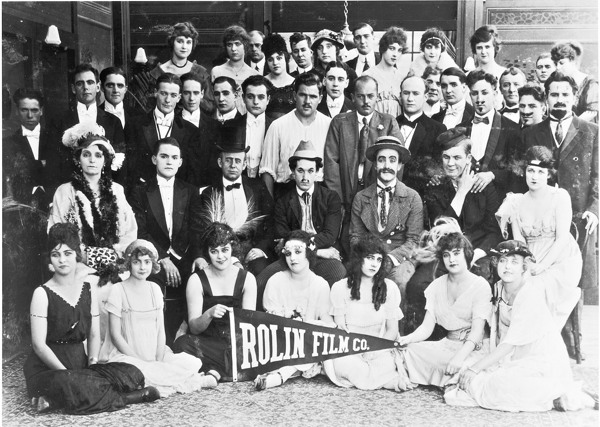
Harold Lloyd (fourth from left, second row) and Hal Roach (immediately behind him in the third row) launched the Rolin Film Company in 1915.
So for all the Chaplinesque trappings around Luke, he couldn’t actually do Chaplinesque comedy because Luke was designed as a failure. Here’s a guy who can’t even deliver a package. If this was a Chaplin film, Charlie would stagger in with fistfuls of random wires, and then somehow miraculously actually wire up the house after all. (See also Buster Keaton’s The Electric House where that’s exactly what he does.)
But within months of that film came the “glasses character.” That’s what all the books call it—the “glasses character.” Lloyd took off the anti–Chaplin costume and put on a pair of wide-rimmed glasses and found fame and success. Except, now that we can see these early glasses films rather than just make assumptions about them, there’s something else going on. In some of the earliest glasses character films like Bashful, A Gasoline Wedding, and Take a Chance, he didn’t just put on glasses. He had a whole costume that went along with them, a fancy dress three-piece suit and top hat! He abandoned that outfit after a while, and no one’s really talked about it since, but it helps mark the transition for us: although he’s dressed like a rich man, that’s not how the character is written. He’s living hand-to-mouth, just trying to get by. In Take a Chance, he starts off wondering how to spend his last quarter: he can either have a meal or get a haircut. One or the other. Then he loses his quarter and can’t have either. He does all this while wearing that suit.
So what we have is a character depicted as a striver, a yearner. Instead of being an outsider because of his inability to conform, he is an outsider by circumstance, struggling to get in and succeed. He’s dressed for the job he wants to have (rich guy). And whenever opportunity knocks, he’s prepared to go to extreme lengths to seize it. His business strategies are dishonest, he’s quick to shove another out of his way to get what he wants, he’s pushy—but he’s endearing because he is defined in affirmative terms. He wants something. In contemporary parlance, that makes him proactive.
The comedy is still made up of chase scenes and Keystone-inflected knockabout. Some of these early “glasses” shorts feel like off-brand Keystone films in every detail—Take a Chance is a prime offender in the Let’s-Rip-Off-Mack-Sennett Sweepstakes. But what changed was the underlying structure of that slapstick: he swapped out a comedy of failure for one of success, and gave the audience a character they could root for. He stepped away from the most recognizable superficial aspects of Chaplin mimicry but surreptitiously stepped closer to Chaplin’s secret formula.
From 1917 to 1919 he churned through endless variations of this material, refining and improving as he went. If you watch the entire block of shorts in a row, you’ll risk tiring of seeing the same gags over and over—but the obsessive focus on refinement paid off. He moved away from the top hat and tails; he abandoned the Keystone approach of simply choosing an interesting location and hoping for the best; he gradually allowed his supporting cast to stop playing grotesques and start playing realistic human beings; and he redirected the slapstick away from violence for violence’s sake.
Then in 1919 he stopped making one-reel shorts, and with Bumping into Broadway started making two-reelers. This was a gargantuan leap for the Hal Roach Studio, which had been so ramshackle and amateur a company that managing to make two-reelers was a technical and logistical challenge they hadn’t cracked for years. But the real money was in two-reelers, and if the studio was going to survive they needed to make that leap.
Eventually, Lloyd broke with Roach and started his own studio. And afterwards, he came back to his old boss and partner and negotiated to buy the rights to a package of his back catalog, to preserve and maintain. The Harold Lloyd estate has since kept care of those films and helped keep them in circulation in various media. But there was a catch: when Lloyd made that deal, he bought the rights from Bumping into Broadway forward. He left the one-reelers on the other side of the divide, orphaned, destined to be forgotten. Fire eventually consumed most of them, hence our lingering uncertainty over what survives.
The Harold Lloyd estate has since gone back and acquired as much of the pre–Bumping into Broadway material as possible. But it is very telling that Harold Lloyd made the choice he did, to orphan those older films. By 1919 he’d worked out what he was doing, and all traces of the earlier experimentation were gone. He could start from there, and present to the world a coherent back catalog of films for which he need make no excuses or explanations.
But for the scholars and fans who want to see how he became the Lloyd we know and love, those early experiments are absolutely mission critical.