
Arguably Lucille Ball’s most characteristic screen appearances was in the underrated screwball gem Next Time I Marry. This fun B-movie is a thinly-disguised knock-off of It Happened One Night, directed by the great Garson Kanin. There’s no good excuse for this treasure to be so little known. Admittedly, the parallels to It Happened One Night are easy enough to catalog: a screwy heiress on the run, trying to engineer her wedding to a smarmy European count against her family’s opposition; she spends the film on a cross-country road trip with an earthy American man, as their shared adventures spark a genuine romance between them. Some moments come so close as to be near clones: a hitch-hiking gag, a camping scene, the bride takes a runner during her own wedding, etc., etc.
Lucille Ball makes a ditzier and more energetic lead than Claudette Colbert did—she seems less interested in being glamorous and loved, and simply throws herself fully into being funny. I haven’t seen every one of Lucy’s films, so I’m hesitant to throw out superlatives like “the best” this or “the first” that, but I’d be surprised if there were many movies that come as close as this does to rivaling her I Love Lucy excesses. Throughout the film she concocts hair-brained, poorly-thought-out schemes that inevitably backfire on her, provoking increasingly frantic yelps and cries. That she also spends most of the film locked in a trailer doing combat with her “husband” also invokes fond memories of The Long Long Trailer. But listing the ways in which this film resembles other works of popular culture grossly undersells its charms, and largely misses the point. Sure, this is a brazen attempt to cash in on the success of It Happened One Night, but what makes it work so well aren’t the similarities but the idiosyncratic differences.
The crux of the plot is the inheritance of socialite Nancy Crocker Fleming (Lucille Ball): her father has encumbered her wealth with the proviso that she must marry an ordinary American, so as to protect her from the clutches of gold-diggers like Count Georgi (Lee Bowman). Lucy’s great scheme to circumvent this problem is to go marry some schmuck (she finds one at a ditch-digging project and pays him to marry her), then she can scurry off to Reno to divorce him and marry the Count with all her money intact.
The problem is that the schmuck she cons into marrying her, Anthony J. Anthony (James Ellison, trying very hard to be Joel McCrea) didn’t do it for the money. He didn’t do it for love either—he sees Lucy for the scatterbrained human tornado she is right away. He did it to buy his freedom—Lucy offers him $1,000, but he bargains her down to $793 because that’s what he needs for a specific purpose (I won’t say what that is—that’d be a spoiler, and some of the film turns on Lucy’s attempts to figure out what that money is needed for). So, in a sense, he did do it for money—but he’s not a gold-digger, and he has his pride. When Lucy tells the press that he was just a Cinderella Man trying to get at her money, James Ellison decides to race to Reno first to divorce her and prove his point.
At this point the film jumps into some new territory unlike that of any comparable It Happened One Night-alike. As Lucy and James race each other to Reno (with the Count in hot pursuit), the clichés of chase movies start to fall apart. The antagonists camp together, take their meals together, and plot their next moves in tandem—and then when the sun rises they get right back to chasing each other! It’s like those Looney Tunes cartoons in which the sheepdog and the wolf socialize during their off-hours, and return to comic antagonism only when on the clock.
Next Time I Marry is almost half as long as It Happened One Night, yet is packed with something like twice as many comic incidents and set pieces. For a low-budget B-quickie, it’s very handsomely appointed: Garson Kanin ponied up for some expensive special effects and some dicey stunts, and keeps the whole thing zippy and refreshing.
The one place where you might see the low budget evident is in the cast. There’s Lucy, natch, and an underused but nevertheless brilliant Mantan Moreland (whose increasingly exasperated reactions to the Count are fantastic—the guy had expert comic timing, and was routinely wasted in racist supporting roles). Granville Bates plays Lucy’s guardian, in a role that was seemingly written with a Charles Coburn or a Walter Connolly in mind. As noted above, James Ellison tries his mightiest to channel Joel McCrea, and Warren William would have brought even more greasiness to the role of the Count. But all I’m really doing there is just listing better known actors who would have done exactly the same thing—there’s no knocking the solid work of Granville Bates, James Ellison, or Lee Bowman here, whose only failing is not being more famous. Why do you even need a more famous supporting cast when you have Lucy in the lead? What more do you need?
Which brings us to the central question in all of this: how could a movie this good, so thoroughly in tune with its zeitgeist and with the pedigree of Lucy and Garson Kanin, be so little known?
In James Harvey’s exhaustive, loving survey of Romantic Comedies in Hollywood, he never even mentions this movie. William K. Everson’s Hollywood Bedlam devotes a whole chapter to knock-offs of It Happened One Night, and skips this entirely—he even stops to do a tour of Lucille Ball’s screwballs, and even there he misses it. Even weirder, biography after biography of Lucille Ball herself manage to mention this only in passing, if at all. What gives?
Ironically, the answer lies in Lucy’s fame. This movie was eclipsed by the fame of its star, believe it or not.
Some years ago I took a trip through wine country in California, and we made a point of stopping at the Raymond Burr Winery. I didn’t expect the wine to be very good (and it wasn’t), but we had so many great wineries already on the schedule (Quivira, Unti, etc.) that we could afford to visit one for reasons other than viticulture. The grounds of the Burr winery were gorgeous, and the main building was something of a Raymond Burr museum. I bounced in and struck up a conversation with the staff—noting that I admired Raymond Burr as that rare Hollywood figure who did it all: he managed to work with Fritz Lang and Alfred Hitchcock, Godzilla and the Muppets, Natalie Wood and Grace Kelly, Tarzan and William Cameron Menzies. The breadth of it all is staggering. (Sound of crickets chirping.) The staff at the Raymond Burr museum had no idea what I was talking about. The place was a shrine to Perry Mason and nothing else. The walls were lined with framed copies of every Perry Mason TV Guide cover. I was the first person who’d ever shown up wanting to talk about anything but Perry Mason.
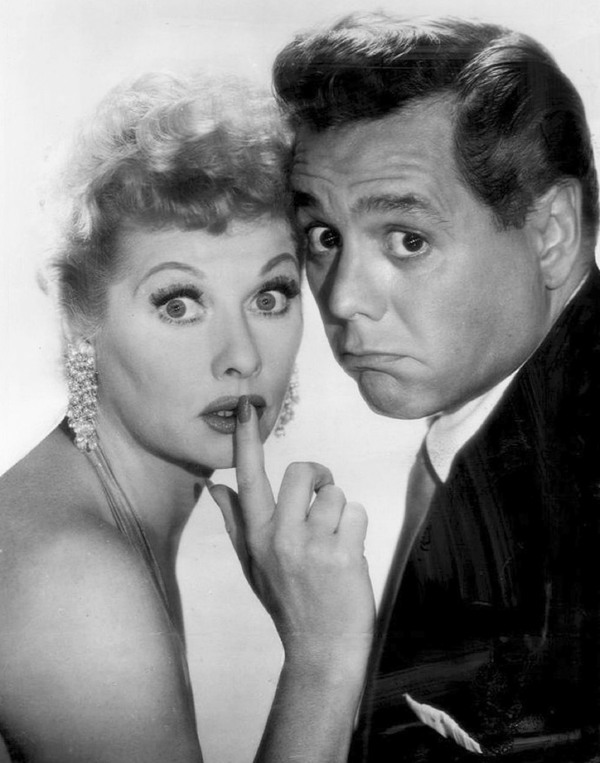
Lucille Ball and Desi Arnaz in I Love Lucy, the role that eclipsed Lucy’s movie career.
The same phenomenon occurred during my research on To Be or Not to Be. As it happened, most of the cast and crew of that classic died within 15 years of its release, and so much of the information about its production that a researcher might otherwise find in film texts written in the 1960s and ’70s was just absent. However, Benny survived long enough to write memoirs and be interviewed, and to have his reminiscences downloaded for posterity in various ways. Yet for all that material on Benny, 99.9 percent of it concerns his radio and TV shows, with a few scattered anecdotes about his mostly misfired film career.
Which brings us to Lucy. There is no shortage of written material about Lucy’s remarkable career, but most of it concerns her Desilu days, not her 1930s B-movie career. Add to that the fact that the likes of Next Time I Marry are hardly ever screened on TV, and there simply hasn’t been an opportunity for it to emerge from the shadows of her domineering TV career.
All the more reason for you to fight the power, seek it out for yourself, and enjoy.