
There is a fairly well-regarded American comedy called Artists and Models. It has Jerry Lewis, Dean Martin and Shirley MacLaine in it, and was directed by Frank Tashlin. This chapter is not about that film at all, but rather a wholly unrelated comedy from about 20 years previously that just happens to have the same name. Raoul Walsh’s 1937 Artists and Models is strictly filler stuff, the kind of thing independent TV stations used to jam into the late-night hours to avoid having to broadcast dead air.
Which is unfair. Artists and Models is quite enjoyable, if you know how to approach it. Problem is, knowing how to approach it requires a bit of context—and that context is generally lacking for contemporary audiences. Encountered cold, it just looks like a crazy mess. Which it is, but there’s a world of difference between a sloppy incompetent mess and a deliberate anarchic mess. But to make the case for why this is the latter and not the former, let’s pick apart what it is first.
Jack Benny is the obvious place to start—he’s the headliner, after all. The conventional wisdom is that Jack Benny’s cinema career was a non-starter except for Ernst Lubitsch’s To Be or Not to Be, but he’s got a few great bits here—and if anything, this seems to have had some vague influence on Lubitsch. For one thing, there’s a scene where Benny thinks he’s been shot that is recreated gesture for gesture in To Be or Not to Be. The finale finds Benny in Renaissance gear exceedingly like his Hamlet costume from To Be or Not to Be.
While we’re listing funny Benny bits, there’s also the moment where he stops to listen to Jack Benny on the radio, or when he carries on a non-sequitur-laced conversation with Rube Goldberg. I mention all these because the cumulative effect is to signal that this is going to be an absurdist star-driven comedy vehicle.
As far as Benny’s part of the proceedings go, that holds true: he plays a promoter named Mac Brewster, who’s in charge of the Artists and Models Ball (a big gala event of some kind). He’s also arranging models for various advertising accounts, including Townsend Silver—the commercial imprimatur of the blue-blooded Townsend family. Jet-setting Alan Townsend (doughy Richard Arlen) believes that the right ad campaign behind his line of silverware will bring urbane well-bred sophistication to the masses—and to that end he wants the Queen of the Artists and Models Ball to be the same person as the Townsend Silver girl.
Benny’s long-suffering girlfriend is Paula Sewell, played by Ida Lupino, and she wants that gig. Benny wants it for her, too, but Alan Townsend shoots the idea down without even laying eyes on her—he wants to use a true socialite. So Paula cooks up a scheme: pretend to be a socialite and get Alan’s attention, so he hires her without realizing it’s the same girl he already rejected. Off she goes to Miami to infiltrate his vacation, and…
Well, here’s where it gets complicated. This plot should play like a screwball comedy—it has all the ingredients: the mistaken identities, antagonists falling in love while traveling together, love triangles, love crossing class barriers. All the boxes are ticked. But while Jack Benny’s comedy chops are not in doubt, there’s a reason nobody hails Ida Lupino as a great comedienne.
She doesn’t even try. She plays her scenes straight, and it shows what a slender reed separates screwball comedy from romantic drama. With her no-nonsense portrayal of what are, in fact, all-nonsense scenes, the film develops a severe case of schizophrenia as it wobbles between Benny and Lupino’s separate plotlines.
If that’s all there was to it, we could just chalk this up to some poor casting or maybe Raoul Walsh not effectively integrating his two stars into the same style. But if you add up all of Jack Benny’s and Ida Lupino’s scenes, you barely get half this film’s running time. In terms of tonal shifts, whipsawing between Benny and Lupino is just the beginning.
Instead, the film skips madly between Jack Benny’s absurdist bits, Ida Lupino’s not-quite-screwball stuff, and various vaudeville routines featuring guest performers. There’s a scene where Martha Raye staggers around like a drunken sailor while Louis Armstrong plays “Public Melody Number 1,” or another scene where Russell Patterson’s marionettes stage a massive musical number that mutates from a Fantasia-style orchestral performance into a Busby Berkeley-esque revue.
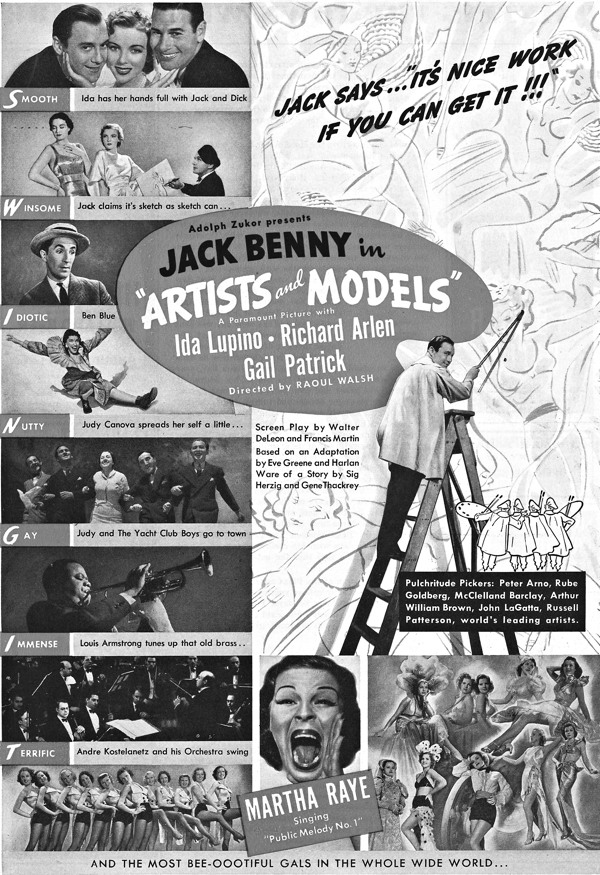
Nineteen thirty-seven magazine ad for Artists and Models.
Some of these vaudeville intrusions are incorporated into the logic of the plot: for example, the opening sequence is a grand spectacle of “let’s do everything we possibly can, all at the same time, for no reason at all” that introduces us to the idea of Jack Benny as an entertainment promoter (here’s another connection to To Be or Not to Be, which opens with a similar rug-pulling gimmick). Similarly, the climax finds Richard Arlen proposing to Ida Lupino, and her Cinderella moment actually happens while the two of them are dressed in Cinderella costumes, plus he actually has a glass slipper—but all that makes “sense” because it’s supposedly part of the big Artists and Models Ball gala finale.
Meanwhile, some of the musical interruptions just happen, suddenly and without explanation, as if the filmmakers grew bored with their plot and decided to do something else for a while.
Let’s take Judy Canova and Ben Blue as a case study.
There are two ways to explain why Judy Canova is even in this movie—(a) the thoughtful way, and (b) the correct way. The thoughtful way would involve the observation that she serves a crucial narrative function in Ida Lupino’s “screwball” story. Like It Happened One Night (which came out two years before this film, and directly influenced the screwball components of Artists and Models), the romance between Lupino and Arlen is threatened at the 11th hour by some stubbornness and hurt pride. Arlen has gotten into his head that Lupino played him for a fool—just because she lied to him about who she was, and manipulated her way both into his affections and into his employ. Consequently the film heads towards its conclusion with the various parties lined up with the wrong romantic partners—someone needs to go convince Arlen to get his head out of his butt and realize that he genuinely loves Lupino and she genuinely loved him. In It Happened One Night this role is played by Walter Connolly as Claudette Colbert’s dad—the plain-speaking guy who cuts through all the nonsense and says the obvious. Judy Canova has that role here.
But that’s just happenstance. The real reason Judy Canova’s in this movie is she was a middlingly popular performer who gets trotted out to do her shtick—which in Canova’s case is loud, brassy, hillbilly comedy.
Canova comes barreling into the movie like a force of nature, right after Ida Lupino has had way too much time to pretend this is a sensitive piece of serious drama. Fast on Canova’s heels is Ben Blue, an annoying comic who tended to play man-baby roles in the Harry Langdon mode, but without Langdon’s penchant for sly transgressive mischief. Blue mostly just twitches and gapes.
Words just don’t do justice to Canova’s and Blue’s big scene together. Bear in mind, neither of these characters have any real connection to the rest of the plot, except for Canova having one useful and relevant line of dialogue later on. They just show up and completely sidetrack everything—seconds ago we were wondering who will be the Queen of the Artists and Models Ball and who will model for Townsend Silver, and now we get (a) an inventor of artificial rain, (b) a boy and girl smacking each other like the Three Stooges, (c) is it love?, and (d) why not sing a song while you’re at it? If you squint, you can sort of force their scene into making sense. As I already mentioned, Judy Canova has a role to play in the denouement, and since both Jack Benny and Ida Lupino end up finding true love at the end, it sort of fits that Judy would also get paired off with a boyfriend. It’s weird for them to sidetrack everything so thoroughly with a digression into artificial rain as a career, and a such a strange song, but there’s no law that says subplots have to be related to the main plot very closely. OK, it’s an oddity, but not yet an incomprehensible digression. But then the puppets start playing.
How?
The puppets are even introduced—they get their own title card, fer crissakes! And they’re clearly on a stage—they’d have to be! They’re puppets! But what stage??? Who’s the audience for this??? Where is this taking place??? The person in the story who stages shows like this is Jack Benny, and he is back in New York. Judy Canova and Ben Blue are down in Miami with Ida Lupino.
And then Ben Blue wanders into the puppet show, dazed and confused. He plays it like a child, unaware of social boundaries, entranced by the spectacle, going where he shouldn’t. He’s invaded the stage. You’re waiting for the stage hands to hook him off the stage before he gets tangled up in the marionette’s wires. But Ben starts interacting with the puppets—he’s part of the show.
Stop.
This is where any flimsy remaining pretense to logic shatters. Ben Blue was introduced to us as a retailer of rain, he’s not an entertainer. He’s a dim bulb—I can buy him getting excited by the puppets and rushing the stage, but then he gets incorporated into the show. However in the real world Ben Blue is a professional entertainer, and he’s in a movie full of professional entertainers—each of whom gets to do their act. Russell Patterson gets to have his puppets perform not because it has anything to do with anything, but because it’s interesting.
This is the key: Artists and Models is primarily a vehicle for vaudeville comics and other performers to do various comedy and musical numbers. There is a loose narrative structure that more or less ties all these bits together, but not completely. The movie isn’t a comedy plot that is variously interrupted, but more like the 1930s equivalent of a sketch variety show like Laugh-In, or Saturday Night Live.
You should keep your eyes out for it because it’s quite fun (Jack Benny’s reaction to being proposed to by Gail Patrick is terrific). More to the point, though, keep your eyes open for similar 1930s comedies that use the structure of vaudeville and variety reviews instead of narrative logic to hold themselves together. As discussed in Henry Jenkins’ excellent but densely written text What Made Pistachio Nuts, the 1930s were full of these anarchic comedies. In fact, a small handful of them broke out and went big, so big they became massive hits remembered for generations even as the context that spawned them was forgotten … but that’s a story for the next chapter.