
Walter Kerr’s book The Silent Clowns is quite possibly the best book ever written about movies. It is certainly my personal favorite. That being said, it sets forth an argument about the legacy of silent clown Harry Langdon that I absolutely reject—namely, that Langdon was dependent on his collaborators, and after Frank Capra left him, Langdon spun out. Mind you, this is also the claim of Frank Capra himself, and has been repeated by other luminaries in the field such as Leonard Maltin. Anyone who argues otherwise is going up against giants.
Before we get into the merits of the claim, there are a couple of important details to note. The first is that Kerr and so many of the writers on silent comedy subjects throughout the 20th century were working from a limited menu of available films from which to draw conclusions. A great number of Langdon’s films were not readily accessible. This didn’t seem at the time to be a severe hinderance, because the ones that could be viewed were the ones most popular and successful, which had emerged from his most productive period. But that logic only gets you so far—you would be on shaky ground trying to draw grandiose conclusions about the totality of Charlie Chaplin’s career on the basis of just his Mutual shorts.
In Langdon’s case, the problem is that if you only review those films that Capra most strongly influenced, you will inevitably come away with an inflated sense of Capra’s importance. Capra, and Kerr and Maltin, put forth an interpretation of Langdon’s screen persona that is fully consistent with his work in Saturday Afternoon and The Strong Man, two films that are indeed strongly influenced by Capra, and then claim that his earlier and later works are the outliers. But if you sit down and watch his entire output, what becomes clear is that he had a consistent set of comic ideas that remained in place throughout his 20-odd years of films, and that if anything the Capra material is the outlier.
Now, you can still say you prefer the Capra iteration of Langdon. That’s a matter of opinion and a popular one at that. But that is a very different position than claiming that Capra created Langdon’s persona for a comedian unable to articulate his own comic identity effectively.
Before we dig too much farther into this, perhaps we need to establish, for the benefit of the newcomers in the audience, just who this Harry Langdon fellow is. According to Frank Capra, Charlie Chaplin said the one comedian he felt intimidated by was Harry Langdon. You always have to be skeptical of hearsay, but it is an interesting thought. According to Mack Sennett, Langdon was a greater artist than Chaplin. Sennett said this in 1928, mind you—years after he and Langdon had parted company, after Sennett had already distributed the last of his stockpiled Langdon back catalog, and long after he had anything left to gain or lose by association with the now-washed up star. And this from the man who had launched Chaplin’s career. (Sennett was also the man who pushed Chaplin away by refusing to meet his salary demands. Sennett balked at paying Chaplin $3,000 a week—that was too rich for him, more than he thought Charlie was worth. Then Sennett signed Langdon for $7,500 a week. That’s more than twice what Sennett refused to pay Chaplin, more than he ever paid anyone else.)
And whether or not Chaplin felt Langdon snapping at his heels, Harry definitely had a fan in Harold Lloyd, and later in Stan Laurel as well. This is the comedian other comedians came to see.
In an interview, Langdon talked about the lessons he learned during his long years—decades—on the vaudeville stage. He said: “One valuable little thing I learned in vaudeville is that you can pretty well control the laughter of your crowd. If things were going well, I’d play along at a fairly slow tempo and keep my voice well down. If the laughs were too few and quiet, I’d increase my speed and raise my voice.”
There’s a cliché about the difference between stage acting and screen acting—that on the stage you have to make everything broader and louder and more expansive so it “reads” to spectators in the back of the theater. When Langdon was on top of his game and everything was clicking, he could turn it all down to the lowest possible setting—he only had to speed up or speak louder when something was wrong in his relationship with the audience. This was how he performed on the vaudeville stage, the lowest, broadest, crudest form of theatrical entertainment. When he ported that aesthetic to the movies, where the camera demands a smaller, more intimate performance, his style of comedy was dialed down to a whisper. Langdon boasted privately of how much pride he took in being able to drag out a gag longer than anyone else.
Most of the big comedians of that era worked with almost no script—they’d show up with little more than a bare-bones premise and ad-lib the rest. Charlie at a health spa. Buster works at a garage. Lloyd at an amusement park. Now, go! That didn’t work so well with Langdon. His world of comedy was a palette of vacant stares and running in circles that only had significance when in some other context—he needed something to play against. Dogs, skunks, monkeys, herds of sheep, exploding cows … and mannequins, wax statues, empty suits of armor, telephone poles, glasses of beer, invisible insects—anything inhuman or inanimate he could inexplicably treat as sentient.
To illustrate this difference, consider a short film Chaplin did for the U.S. government to promote Liberty Bonds for the war effort in World War I. The short is around 10 minutes long and Charlie does it against a black backdrop with only the most abstracted props. His mastery of expressive mime was such that he could make a film that consisted of Charlie and almost nothing else, and have it be meaningful, even funny. But put Langdon in an empty room by himself and you’ve got nothing.
I don’t mean that as a criticism of Harry Langdon, just a descriptive statement of fact. Because, given the right context, Langdon’s bizarre world of inappropriate reactions became sublime.
Here’s another Langdon quote: “There should be a breathing space between laughs, with a gradual development leading up to a laugh. A picture that is one laugh from start to finish becomes tedious. Relief is necessary.”
That’s a bold statement, and it could so easily have been said by Chaplin. There were so many of the silent comedians of the age desperately mugging—Look at me! Look at me!!—especially so at speed-addicted Sennett, that Langdon’s steadfast stubborn insistence on the low-key and subtle is remarkable.
You can see the echoes of Harry Langdon’s legacy in the likes of Jerry Seinfeld and Larry David, Ricky Gervais, the Kids in the Hall, and David Cross—comedians who confidently disregard the conventional rules, deliberately make the audience uncomfortable, and revel in the performance of things not readily identifiable as jokes.
It was a truly unprecedented approach to screen comedy. Not only was he disregarding the usual standard-issue Sennett formula of violence and mayhem, he was flying in the face of every other silent comedian as well.
In her extraordinary study of Langdon’s comic style, film scholar Joyce Rheuban cites Sigmund Freud’s definition of humor. Seems Dr. Freud says comedy is when someone expends an inordinate amount of energy on physical functions but not enough on mental functions. Now, what Freud’s supposed to know from funny is beyond me, but man, did he nail it with Langdon or what?
So, with that as our background, let’s cycle back to Walter Kerr’s take on Frank Capra’s take on Langdon’s comedy. According to their line of thinking, Langdon was a sort of baby-man, a fully grown toddler with all the sexlessness that implies. Kerr in particular asserts that much of Langdon’s comedy came out of this sexual confusion. His prime examples for this are Saturday Afternoon and The Strong Man—two exceptional films, but still just two films. Buster Keaton played a rich man in two exceptional films, The Navigator and Battling Butler, but I wouldn’t go around saying that was essential to his Keatonness.
In fact, far more prevalent in the films of Harry Langdon is an aggressive sexuality. His kisses cause women to swoon in Soldier Man and The King; he is a skirt-chasing womanizer in Picking Peaches, His First Flame, and The Chaser; sexual misadventures on his part drive The Hansom Cabman; and in the vast majority of his films (including Saturday Afternoon) he is a married man. The central gag of Tied For Life is a blue-balls joke about a man unable to get his wife alone on their wedding night—when he finally does get some privacy with her, he’s so potent she gives birth to quadruplets!
I’ll admit that Langdon’s portrayal of this Lothario is absurdly asexual and childlike, but that fits his overall comic approach of inappropriate juxtapositions. In Langdon’s films the simple act of cross-dressing, no matter how poorly done, is treated as a fully effective gender-role-reversing disguise. The implausible womanizer is another joke in the same vein. The idea that his character had no business showing interest in women is simply unsupportable.
The Kerr analysis of Langdon placed such priority on his sexlessness as perceived in Saturday Afternoon and The Strong Man, that the central premise of The Chaser (Harry’s faithless wandering is punished by a judicially imposed gender role reversal) seemed to come out of nowhere. But seen in the larger context of his whole career, The Chaser is the one that more easily belongs, and it’s The Strong Man that seems a misfit.
The Strong Man is also the film that most obviously depicts what Capra said was his intention with Langdon. Capra claimed that Harry needed to be a decent soul in a corrupt world, whose essential goodness saw him through hard times. In other words, Capra described the very basis of more or less all of his subsequent work—he would shape Gary Cooper and Jimmy Stewart into identically-shaped characters in films like Meet John Doe, Mr. Deeds Goes to Town, It’s a Wonderful Life, and so on.
Capra was an artist who believed in a “genuine” America, a small town realm of values threatened by the cynicism of city slickers and intellectual phonies. The problem was that Harry Langdon was one of those cynical phonies! He was a merry prankster who took great joy in sending up the very infrastructure of the movie comedy form in which he worked.
Note that when Langdon was allowed to both write and direct his own short films later in the sound era, he had an attraction to stories about actors trying to perform in a poorly made play: Goodness a Ghost and The Stage Hand are good examples. He was drawn to that extra layer of artificiality, the meta-meanings of inept poseurs struggling to fit in amongst other phonies. But what sells these shorts are small, isolated moments in which Harry’s bizarre, inhuman line delivery makes a joke of something that shouldn’t be funny. There is nothing about the line “I like beer” that is recognizable as a joke, but in The Stage Hand Harry’s out-of-left-field line reading turns it into one.
Or, for another example, in Goodness a Ghost Harry is an aspiring actor struggling to rehearse the line “Did anybody call an officer?” Each subsequent attempt is farther off the mark than the one before—the more he rehearses, the worse it gets.
This is not the kind of stuff Capra was ever going to find funny. But it was where Harry excelled. The two men were fundamentally different in their conception of what made a movie work. Capra built great stories, with carefully drawn characters intended to illustrate his moral principles; Langdon thought ridiculousness was its own virtue and frequently indulged in the 1920s and ’30s equivalents of “blue” material.
To my mind, the defining characteristic of Harry Langdon, the thread that ties him together across the decades, is his indecisiveness. Give him a task, and he runs in every possible direction. If you ever wondered what “going nowhere fast” looks like, check out a Langdon picture.
There is a scene from the Hal Roach short The Head Guy that shows how in the sound era, he found a way to turn that from a visual into a verbal gag. Thanks to some awkward and implausible sitcom style shenanigans, Harry’s girlfriend mistakenly believes he was flirting with some chorus girls and dumped him (there’s that sexual side of Harry again!). In despair, he “cries.” I had to put that in quotation marks because his sobbing isn’t real, or realistic, it is a simulacrum. He knows he is supposed to cry in this situation, but isn’t sure how, so he imitates, poorly, what he thinks it’s supposed to sound like (and there’s that phoniness aspect again!). He starts babbling. “If Nancy don’t want me, then I want to die.” As soon as the words are out of his mouth, his eyes widen in fear. Someone has just threatened his life!
Now, of course it was him, but he spends the rest of the film acting as if he is two people, arguing with himself. He even tries to explain his tortured logic to himself: if Nancy doesn’t want me, then I don’t want to live…. But he gets tangled up in his own words and can’t quite make it to the end of the sentence. So, it’s back to “sobbing” because that’s a simpler expression of despondency.
He tries again, and this time manages to express himself more succinctly: “I scrub for Nancy, and I work hard for Nancy. Nobody else would I work hard for. Nobody but her. And if she don’t want me, then I’m gonna die. I will die, I will die!”
And he pounds the table for emphasis, but … you see, just before launching this speech, he picked up a nail file and started cleaning his fingernails. It’s possible that this physical distraction was what enabled him to marshal his thoughts into such coherence. Without the nail file he couldn’t finish the sentence. But now when he wants to pound his fist on the table as a rhetorical flourish, he has to first set the nail file aside, and that fumbling act causes his fist-pounding to miss punctuating his words by a few crucial seconds.
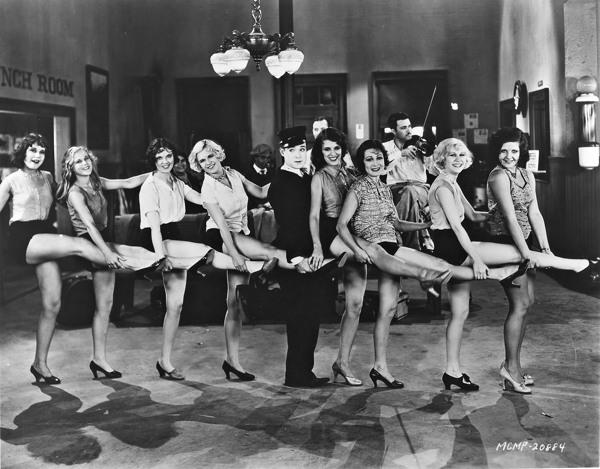
Harry Langdon surrounded by dancing girls in the bizarre comedy short The Head Guy (1930) which swapped visual gags for verbal illogic.
He resumes cleaning his nails, but the interruption completely derailed his thoughts. He keeps talking about suicide, but now his tone of voice is wrong, his emphasis skewed. The idea of suicide was evidently too terrible to contemplate, so now when he talks about dying it’s more like he’s come to think of himself as terminally ill. But this puzzles him (when did I get sick, exactly?) and he tries some more “sobbing” while he tries to retrace his thoughts.
This leads to a sudden change in mood. He looks up brightly and tries to snap his fingers nonchalantly (emphasis on “tries”). He puffs himself up as if putting on a show to impress onlookers. But he’s the only person in the room. Who is he trying to fool?
“Ha ha!” (the laugh is as fake as his cry) and he boasts of getting a pretty girl (which he then changes to “bigger girl” for some reason) and again tries unsuccessfully to snap his fingers, a gesture that doesn’t oblige him to give up the nail file but ends up just as poorly timed. Now he’s expanded his description of his new, better girl to include the fact that she will smoke. But this reminds him of Nancy (because she doesn’t smoke) and his phony bravado is undone.
The rest of his speech—and there is a fair bit of it yet to go—is incomprehensible because during the preceding part he opened his lunchbox and took out a sandwich, and the rest of his rant is delivered while he eats. The act of crying and eating simultaneously initiates a coughing fit, and to clear his throat he pulls an apple from the lunchbox.
“I could jump in the lake I will I don’t want my apple now I don’t want no apple now I don’t want no apple now I’ll eat my apple after now.”
End of scene.
?!?!?!?!
This is verbal surrealism. It is a purely dialogue-based joke, unique to Langdon’s character. No other comedian could have delivered a scene like that, and none would have tried. The effect is more worrisome than funny. It is profoundly off-putting and weird, and I love it.
I haven’t even said anything about Three’s a Crowd yet. It’s been said it’s a great film, just not a comedy. I absolutely consider it a masterpiece, and say so in my audio commentary to the DVD edition, but I’ve never once felt a compunction to laugh in it.
But so what? I don’t laugh during Chaplin’s A Woman of Paris, nor Ernst Lubitsch’s The Man I Killed, nor Leo McCarey’s Make Way for Tomorrow. And if you think any of those films reflect poorly on their makers, well, then we’re going to have to take this outside and settle it.