
The 1930s were chock-a-block with movies like Artists and Models, closer to a variety revue than a narrative experience. These kinds of movies jumble together a bunch of entertainers—mostly comedians, but not necessarily—and then drape the flimsiest of plots over them to provide some sort of rudimentary structure, and then just sit back and let them go every which way. Which, as you may have suspected, leads us straight to Duck Soup.
It’s not hard to fall in love with Duck Soup, the most gloriously anarchic of the most anarchic comedy troupe. Whether this is your first Marx Brothers experience or not, chances are once you’ve fallen in love, you’ll want more—and the most sensible way of slaking that thirst is to go looking for more Marx Brothers films, right? And as you obsessively track down and consume the rest of the Marx catalog, you’ll find as everyone before you has that Duck Soup represents a pinnacle of that anything-goes aesthetic, and that as you move out to the farthest periphery of the edge their films are less unbounded.
There’s an easily diagnosed and marked difference between Duck Soup and the film they made after it, A Night at the Opera. Duck Soup is an unruly thing, and the Marxes’ trademark anarchy extends to the structure and style of the film itself: in one celebrated scene, Groucho and Harpo perform an extended silent comedy vaudeville routine (the fabled mirror gag), which is immediately followed by a trial scene. But Groucho changes sides during the trial, hiring the accused traitor as his Minister of War, only to have the whole scene devolve into a musical number (“All God’s Chillun Got Guns”). Which is bizarre enough, were it not for the fact that the depiction of the onset of war involves such non-sequiturs as Harpo getting into bed with a horse, and stock footage of monkeys rampaging. When Groucho gets his head stuck in a vase (how?), and the response is not to break the vase and free him but to draw his face onto the vase and leave it there, that’s almost the most sensible thing that happens in the movie.
By (sharp) contrast, A Night at the Opera includes the Marx Brothers as wacky characters in a decidedly generic plot. The other non–Marx characters have clearly defined motivations that inform their actions, as opposed to cyphers whose sole purpose is to set up jokes. The Marxes do crazy things, but those crazy things are clearly motivated and tied to the ongoing plot.
According to every history of the Marx Brothers I’ve ever read, this transition is universally understood as a consequence of their moving from the poorly managed wilderness of Paramount to the button-down corporate world of MGM. Not only was MGM infinitely more professional, but their producer at MGM, Irving Thalberg, was a no-nonsense mogul who consciously molded the Marx style to fit the conventional, traditionalist approach of the more august studio.
OK. All of that is true. But … there’s something missing. The wild anarchy of Duck Soup may be the most unhinged the Marxes ever got on film, but when you compare it to some of the other anarchic comedies of the era its actually fairly tame. Consider Hollywood Party from 1934. Here’s the Wikipedia description of this thing: “Hollywood Party (1934) is a musical film starring Jimmy Durante and distributed by Metro-Goldwyn-Mayer. The film is notable for several disconnected sequences that have little connection with each other. Each sequence featured a different star with a separate scriptwriter and director assigned, not unlike Paramount’s If I Had a Million. However young Roy Rowland at 23 is given sole credit by IMDb for the entire production, this film marking his directorial debut which may explain why scenes don’t match or are not correlated to one another.”
What happens in it? Well, Jimmy Durante is apparently the star of a series of Tarzan-like movies, whose box office appeal is faltering because his lions aren’t energetic enough.
That’s the plot.
The film is mostly remembered for Laurel and Hardy’s scene in which they crack eggs on Lupe Velez. There is also a scene with the Three Stooges—that’s right, it’s a movie that includes both Laurel and Hardy and the Three Stooges. But wait, there’s more—Mickey Mouse is in it, too, because apparently cartoon characters can interact fully with live actors in this particular world—Mickey introduces a bizarre animated sequence renowned for its sexual imagery (!). In a film that barely cracks an hour’s running time there are no fewer than eight musical numbers, including Durante’s catch-phrase “Inka Dinka Doo” turned into a song. Mind you, the whole Durante-as-Tarzan thing was a last-minute addition to the movie, somehow, even though it’s the main narrative thread. Which tells you something about how highly the filmmakers rated narrative coherence.
Basically, Hollywood Party is a wild anarchic mess that makes Duck Soup seem sensible by comparison—and we should compare them, because they emerge from the same tradition. It’s harder to see when you focus on watching just Marx Brothers movies, but when you broaden the lens to encompass all of 1930s comedy, you can see that the 1930s had a thriving sub-genre of movies that disregarded narrative in favor of vaudeville-inflected spectacle: here’s some funny people, watch them do their thing. And maybe have some songs, too.
For that matter, consider this: Hollywood Party was produced by … (wait for it) Irving Thalberg! He was perfectly capable of indulging in such unrestrained anarchy when he felt like it. Duck Soup belongs to a bigger family of 1930s vaudeville-inspired absurdities that flourished for several years and then faded away. Coming along in 1937, Artists and Models is already a late-period entry of the form. By the time the Marxes were ensconced in MGM, that mode of comedy filmmaking was no longer in vogue. Thalberg’s Hollywood Party days were well behind him. The Marx Brothers’ films start taking a more consciously narrative bend because that’s where comedy was going overall. 1935 was the key transition year when screwball comedy came into its own.
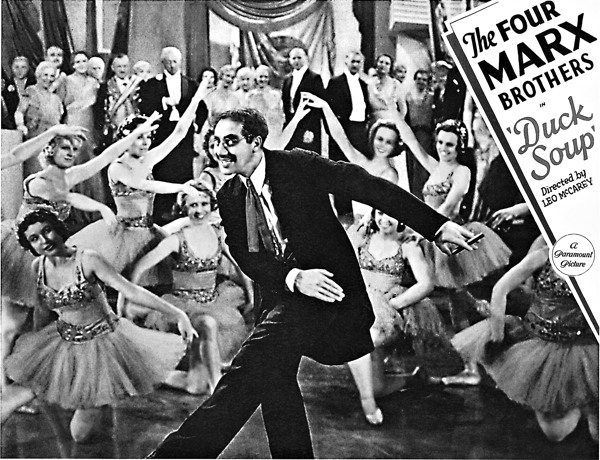
Lobby card for Duck Soup (1933).
Or, put this way: in 1933, Duck Soup shared the screen with the everything-but-the-kitchen-sink version of Alice in Wonderland, Dinner at Eight, Dancing Lady (Joan Crawford and Clark Gable vs. the Three Stooges), Footlight Parade, Gold Diggers of 1933, Hallelujah I’m a Bum, and International House—which all scurry in various ways around the vaudeville revue aesthetic. Whereas in 1935 A Night at the Opera shared the screen with Hands Across the Table, Ruggles of Red Gap, Top Hat, Twentieth Century, and It Happened One Night—all films which married screwy comic behavior to carefully worked out stories.
Watching only Marx Brothers films limits one’s ability to observe how Marx Brothers films related to the culture at large—and distort our understanding. Moving the Marxes from Paramount to MGM wasn’t the most important detail in explaining the difference between Duck Soup and A Night at the Opera. It’s just the one that pops out when all you have is the filmography of the Marxes to work with, and go looking for answers within their personal and professional history.