
Frank Capra is one of the most important figures in this book. While I may take argument with how much of Harry Langdon’s success he allegedly created, there is no disputing he played a significant part in the glory years of one of silent comedy’s great masters. Then, for an encore, he made It Happened One Night, codifying into one film the threads of screwball that had been swirling for years and giving them a commercial imperative. Certainly important things were already developing in the genre thanks to Ernst Lubitsch and others, but the truly glorious It Happened One Night was a deserved blockbuster and unleashed scores of crazy heiresses onto the world. If we set out to chart the course from silent slapstick to screwball rom-com, there’s no better place to start than Capra.
Unfortunately, I don’t care much for the man’s films, especially what I consider the execrable Meet John Doe. Even though I spend a lot of time in this book defending unloved movies, it isn’t the case that I indiscriminately love everything. There are some movies I just can’t abide. Meet John Doe is one of them. So, to paraphrase Dorothy Parker, I don’t intend to say anything nice. Wanna sit by me?
Now you might be wondering: Meet John Doe is on an AFI Top 100 something or other list, what’s my problem? Well, it starts with the opening sequence—Capra opens the film with a heavy-handed sequence of shots of workers, culminating in an even more heavy-handed shot of the phrase “a free press for a free people” being jackhammered off the façade of a newspaper’s office building. So, subtlety is not on the table tonight. Now don’t get me wrong—I don’t mind if a movie has a point of view, but where is this going?
Capra introduces us to three categories of villains. The first is the paper’s owner, who is going to downsize the staff and abandon much of what the paper great just to protect the bottom line. He’s a familiar kind of corporate meanie, who only thinks about his own money. He fires Barbara Stanwyck, who finishes off her last day with a big middle finger-ish gesture to her former employer, by writing an “article” that is really just a totally made-up hoax about a down-on-his-luck guy threatening to commit suicide on Christmas Eve as a protest against economic conditions. That story goes viral, in the 1940s sense of the term, and so Barbara is hastily hired back—not because she proved herself to be a valuable journalist, but because the paper needs her to keep the hoax going (and is willing to pay her hush money not to reveal it is a hoax).
Here we meet the other two villains of the piece. One is the powerful political interests (such as the terrible Norton) who decide that the phony “John Doe” would be a useful tool in manipulating public opinion during an election year. These fat cats are basically the same kind of corrupt bad guy as the newspaper publisher, they just operate on a far bigger scale. But on a smaller scale, Barbara also functions as a villain, because she was the orchestrator of the scam. She was willing to sell out her journalistic integrity to save her job—the same unethical selfishness as the bigger bad guys in the story.
So here we have my first objection. Screwball comedy is laudable in large measure for what it did for actresses. During the 1930s and ’40s, the prospects for actresses exploded, and instead of being just love interests for the male comedians they became the main show. In many ways, Capra’s work on It Happened One Night was key to making that new realm of possibility happen. But Capra then suddenly backpedaled from it. He was not comfortable writing for strong women, and his films seem almost designed to force the uppity female stars back into their places.
Stanwyck was an enormously capable comedienne—and in the hands of other directors she could glow in things like The Mad Miss Manton, Remember the Night, or The Lady Eve. The treatment of Barbara Stanwyck’s character isn’t just an expression of Capra’s sexist discomfort with strong women, it’s part and parcel of the movie’s Us Versus Them ethos. There is a line of thought that appreciates Meet John Doe for its championing of the common man against moneyed interests, a theme as relevant today as in the Depression. The problem is, I don’t really see that in Meet John Doe at all—I see a feint in that direction, but not the real thing.
For one thing, a huge amount of what comes to be known in the film as the John Doe Philosophy was actually invented by Stanwyck in the first place, and she did it in an effort to protect her job against the moneyed interests—if the movie is serious about these ideas, it should be presenting her as the heroine whose triumph we want to cheer. Watching her tearfully apologize to Gary Cooper for failing him (when he was the stooge hired to give voice to her ideas) is just … sad.
More to the point, the thrust of the movie is how the John Doe Philosophy galvanizes, motivates, and inspires “the people.” I put “the people” in quote marks because they aren’t an actual presence in the film (save for those bits of stock footage at the top). The film agonizes over what words will be given to John Doe to say, predicated on the condescending assumption that “the people” can be so easily brainwashed by a charismatic figure. This isn’t just the condescending assumption of the villain Norton—it’s the basic premise of the entire movie. In the finale, our hero John Doe succeeds because “the people” latched on to his inspirational words. “There you are, Norton! The people! Try and lick that!”
If “the people” are such important figures in the film, why aren’t they actually characterized? Neither John Doe nor his hobo friend “The Colonel” are ordinary people, they are insiders in the hoax. However, meanwhile, The Colonel waxes angrily about “heelots,” a concept quickly picked up by the rest of the cast to describe how greedy people are constantly looking for payouts from those with money. The film seems to mean that heelots are manifestations of the me-first attitude that is destroying American society. But paired with the film’s treatment of Stanwyck, and the Colonel’s various diatribes where he praises the simple values of dirt floors and the unstructured freedom that comes from unemployment, the perhaps unintended effect is to imply that what’s destroying America is that the uppity have-nots keep lusting after material comforts. If only they’d be happier with their lot, the Depression wouldn’t be so depressing.
The whole “heelot” business sounds at times uncomfortably like modern-day prejudices against the poor for “demanding” “handouts” (both concepts there deserve their own scare quotes). That’s the problem with Us Versus Them formulations: if you’re not careful you can find yourself defining huge swaths of your audience as Them instead of Us. If you come to Meet John Doe sympathizing more with Barbara Stanwyck than Gary Cooper, Capra can’t do much for ya.
So let me be clear about my own politics: I don’t believe in Us Versus Them. I think “the people” is all of us, rich and poor, have and have not, and that the moneyed interests share the same hopes and motivations as the common man. And this is why I love movies: you can watch a movie made almost a hundred years ago, or one made in the very margins of the film industry, or one made on the other side of the world—or if you want to get really outré, go watch one made a hundred years ago by outsider indies on the other side of the world—and you’ll find that people are people are people, and always have been. The movies I love most are those that embrace that common humanity and tie us together. That’s my biggest problem with Capra—he’s an elitist who hates elites. He wants to be perceived as an important and serious artist making Big Pictures about “the people” but he fails to recognize the people in any of his co-workers or the characters he creates. His films draw up Us Versus Them battle lines, but then manages to drop way too many of his own audience into the Them camp.
Meet John Doe spends over two hours wagging its finger in admonition at its audience, condemning them for being agents of their own economic victimization, for lacking integrity, for failing to appreciate the simple joys of a dirt floor and an empty pocket. It shames Barbara Stanwyck for being clever and trying to keep her job. And then it whips itself up to a rousing finale to claim that somehow the mass of “people” out there will be inspired by its message to make the world a better place, even though actually depicting what that might look like is beyond the film’s imagination.
And the thing of it is, just four years before Meet John Doe there was a screwball comedy that dealt with the same premise and ideas and hit it out of the park. It mopped the floor with Meet John Doe. Here are some the reasons to like Nothing Sacred better: (1) It is a scant 77 minutes long compared to John Doe’s patience-straining two-plus-hours bloat. (2) It is in color. (3) It has Carole Lombard in it. (4) It is actually funny. (5) It is also romantic. (6) But most of all—it lands its satiric jabs without being divisive.
Nothing Sacred concerns an ethically-challenged newspaperman (Fredric March) who is involved in a hoax involving a small-town girl (Lombard) whom the public at large has been misled into believing is going to die imminently. As she becomes an increasingly beloved public figure, and the consequences of her hoax grow more tangled, she and the journalist fall in love and find themselves struggling to find a way to restore their sense of integrity without having the scam blow everything up they care about. So—pretty similar in general principles, you have to admit.
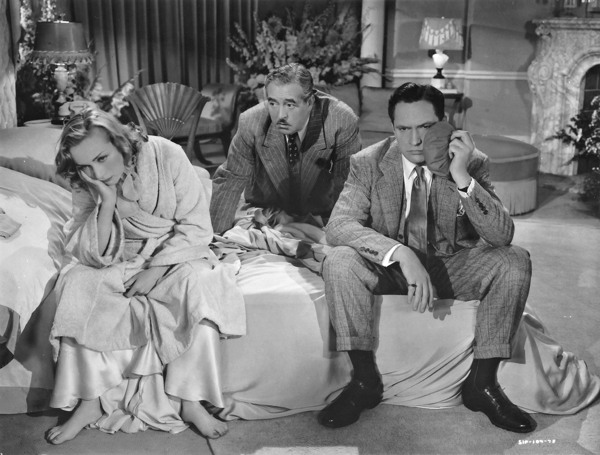
Carole Lombard and Frederic March nurse their injuries as Walter Connolly looks on in Nothing Sacred (1937).
Part of Nothing Sacred’s success lies in the way it implicates everyone. After introducing Fredric March’s sordid schemes in the big city, he is sent out to Small Town America on a mission to find a purer, less made-up story. In other words, the reverse of the Meet John Doe set-up, where the reporter can only keep her job by making up the news. What March finds in Small Town, USA, is that the local folk are even more corrupt and selfish than he is—a brilliant inversion of the usual stereotypes of small town values versus big city smarminess. Then Lombard arrives in the story—simultaneously spinning a Big Lie while also trying not to. Her internal contradictions are a delight to watch. She gets to be both the cause of the all the problems as well as the victim of those problems at once, and in that way allows us to sympathize with her no matter what happens.
In the end, she and March carry the day because in a world full of liars and cheats, they are supremely better at it than anyone else—it’s a victory for smart people (or smart alecks, take your pick).