
Preston Sturges was a born storyteller, he just didn’t know it. For a very long time.
He was also born to make screwball comedies—for a while, he actually lived a screwball plot. He started dating Eleanor Hutton, a proper heiress with a high society family. He dated a lot of girls, but this one struck a nerve. They started thinking seriously about marriage. But when these thoughts were shared with the Hutton clan, there were the usual “Oh my!”s and monocles dropping into wineglasses. The Huttons were sure their daughter was acting up to provoke them, certain this roustabout boyfriend of hers was just a gold-digger. But threatening to cut her off did not deter the boyfriend. Instead, the two eloped—while the papers went mad with the story of the runaway heiress and her playwright lover.
For the moment, let’s ignore the fact that Sturges’ movie-ready romance turned out to be a bust. Instead, let’s spend some time luxuriating in this period of Preston’s life, when he started to find his way into Hollywood, in the most half-assed way possible.
We start with our hero dating an actress (this was pre–Eleanor, but it doesn’t really matter that much. We’re not talking about a man for whom monogamy was that big of a thing). He doesn’t share the name of this actress in his memoirs, but we do know this: she kept picking fights with him, out of nowhere.
Eventually, she explained to poor befuddled Preston that this was all a gimmick. She was writing a play, and was trying out the dialog on him to see how he responded. It seems she was writing this play about him, and wanted the fictional buffoon on stage to be every bit as numbskulled as the real idiot she’d been dating (or something to this effect—remember, we only got Preston’s side of the story).
This triggered Sturges’ most primal “anything-you-can-do-I-do-better” instinct, so he holed up in his apartment and hammered out a play. Well, sorta. He wrote the last third of one—then realized that if he was going to be a professional writer he might need to actually finish the thing. So he ground out another two acts, shopped it around town, and eventually got it produced off-off-Broadway for a whole week. It was called The Guinea Pig. With enough grit and determination, Sturges leveraged the one-week trial run into a proper entrée to Broadway, where he eventually got a backer and mounted his own production in 1929.
But he was still an international roué, though. He’d been one of those for many long years, and a playwright for only weeks. (Seriously, go check out his autobiography—he is perhaps the biggest comedy director in Hollywood pre–Mel Brooks/pre–Adam McKay, but you’ll be at page 267 out of 340 before you get to anything about movies.) So he scuttled off back to Monte Carlo to squander some money pointlessly, and was traveling with a pretty girl (another nameless lass). She wondered, “What are your intentions?” He replied, “Strictly dishonorable.”
He realized this clever wordplay was the makings of another hit play (how it actually played out for the night in question he kept to himself).
Six hard days of writing later (what a workaholic!) and he had a script. He posted it to producer Brock Pemberton, and then full of smugness he boasted to his father that by 11:30 a.m. Saturday he’d be getting an offer. Papa hung his head in exhausted desperation. Preston smiled, and explained he’d calculated exactly how much time would elapse between dropping the manuscript at the post office and the earliest moment Pemberton could have finished reading.
And sure enough, at 11:30 a.m. Saturday the doorbell rang—with the postal delivery guy returning the package for insufficient postage. (waa-waa)
Yes, Preston Sturges told that story in his memoir. Was it true? Almost certainly not, but he did not become one of Hollywood’s greatest comedy directors by worrying too much about what was true.
Eventually, Pemberton did read the manuscript for Strictly Dishonorable and did put an offer on it. It opened in September 1929 to sold-out houses, and ran as one of Broadway’s hottest tickets for a long, long time. Sturges was now a celebrity. He started writing movies freelance (The Big Pond, Fast and Loose) and kept writing plays. But here’s the thing: the plays were flops. Audiences apparently enjoyed them, but critics attacked them. And when I say “critics,” I am talking about a tight circle of Manhattan writers you can count on the fingers of two hands. Their barbed words were powerful enough to make or break stage shows. They preferred to break them, as if keeping Broadway safe for super-perfection was a noble goal requiring relentless vigilance.
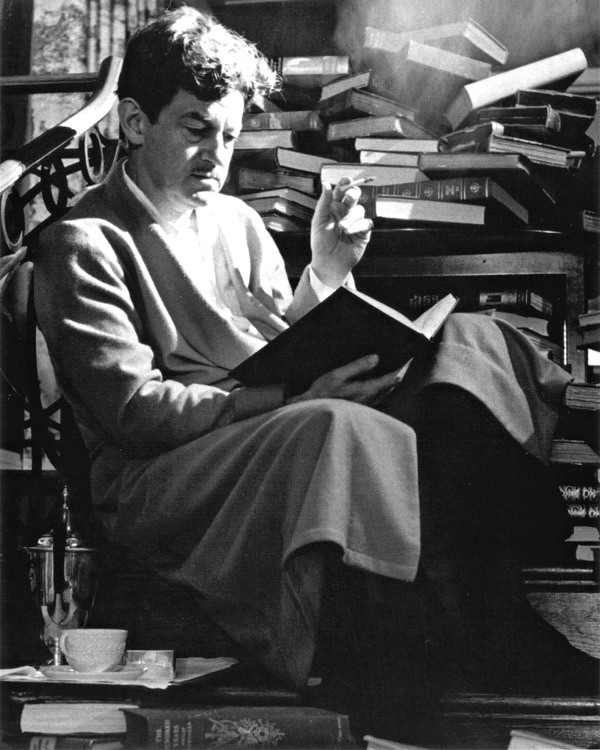
Preston Sturges, a man of potent words.
Meanwhile—those films…. Remember them? Probably not. But they made money. Hollywood sent films out across the nation, which meant no single critic was powerful enough to kill even the stupidest film. You could make films, and enjoy making them—films were critic-proof.
So, Preston Sturges—a brilliant, gifted comedy writer the likes of which come along perhaps once every hundred years—was driven out of live theater and into Hollywood, because that was the only place he could avoid bankruptcy (although, being an incompetent businessmen, he drove himself into bankruptcy anyway).
And his first gig in Hollywood? An uncredited rewrite artist on James Whale’s The Invisible Man. So … there ya go.
Preston Sturges lived a genuinely preposterous life, such that his own biography was nuttier than any of his films. By the time he started writing comedy he had been: an American ex-pat raised in France; heir to a perfume business; a composer and songwriter; a (stunt) pilot for the World War I American Air Service; an inventor; a kept man…. I think I’ve lost track of all the things he did.
This list of peripatetic activities is important because unlike most other great comedians, Sturges did not live for comedy—at least not at first. He found himself writing comedy only in middle age, after having failed at a long list of other careers.
Eventually Sturges came to make Strictly Dishonorable into a film. More Lubitsch than Sturges, the story inverts a standard cliché plot—this time we get a small-town girl torn between two lovers, one of whom is a European roué phony, but the twist is that the roué phony is the good guy, the all-American boy is a jerk, and the girl is the one with sex on her mind.
For half the running time, we watch as Count Gus (yup, that’s his name, Count Gus) maneuvers himself into place to seduce this girl away from her pretentious, abusive, jackass boyfriend—and then, when he’s ready to make his move, realizes that (a) she’s the one seducing him, and (b) she’s a virgin. The gimmick of the thing is that it’s the girl with the dishonorable intentions, and when Gus backs out of taking her virginity (“You are a baby!”) she is furious. His refusal to have a one-night stand with her very nearly wrecks their nascent relationship and ruins all hope of romance!
There’s a lot to like about Strictly Dishonorable—it’s as impressive as early screen comedy gets. The success of the play had made Sturges into a “name,” and catapulted him into Hollywood, where his brilliant comic mind thrived. This success however gave him heart palpitations and soul-searching heartaches. Why? Well, because it was funny—and amusing people by making them laugh has never been treated by critics as being as worthy an artistic pursuit as making them brood over drama. Sturges bought into that prejudice, and fretted that unless he proved himself with something dramatic, he would be dismissed by the critics. In the entire history of the Academy Awards, the number of comedies that have won Best Picture can be counted on one hand; The Golden Globes split out comedies as an entire separate category, and then build up to the grand finale—“Best Picture,” not the comedy one, at the end. The implication being that making people laugh is an also-ran kind of achievement.
Charlie Chaplin never worried about this. He flirted with drama—but even A Woman of Paris is basically a subtle, muted comedy that only pretends to be a drama. Ernst Lubitsch got his start in drama, making Cecil B. DeMille-ish epics, but he shifted gears into comedy and never turned back—and even when he wanted to take on subjects as grotesque and intense as Nazism, he did it through comedies. I could keep going, but you get the point—most comedy-makers are comfortable in their skin and know the power of laughter needs no apologies.
Sturges would get there, eventually, and by the time of Sullivan’s Travels he had. But having worked through that fear and doubt in his younger career gave him the necessary fuel to breathe some personal insight into Sullivan’s Travels. When I first saw the film, I had assumed he was lampooning Frank Capra. Only after learning more about Sturges did I realize he was pulling his own leg—the delusional pretensions that Joel McCrea gets into his head are very much like the ones that haunted Sturges in the aftermath of Strictly Dishonorable.
It’s easy enough to see why you might think this is about Frank Capra—he’s explicitly name-checked, for one thing. And the calamities that befall McCrea as he sets out on his adventure seem culled from Capra movies. But the inflection of these things is off—these are manifestly not how Capra would be doing this stuff. Capra orchestrated everything, characters and situations alike, in a coherent pattern designed to produce a specific moral reaction in the viewer. Here is what’s right, here is what’s wrong, here are the goodies, here are the baddies—Capra lays it all out without shades of gray. Sturges seems to build his films in such a way that all the pieces pull in different directions, for incoherent morals.
What is Palm Beach Story about? Is it about the triumph of romance or the futility of it? What’s the moral of Christmas in July? Are we supposed to celebrate the improbable rise of a dreamer at the hands of capricious Fate, or are we supposed to shudder in horror? Does Hail the Conquering Hero advocate deception, or not? Is The Great McGinty a heroic figure or a monster? And the sexual politics of Miracle of Morgan’s Creek don’t actually seem to have anything to do with what the characters on screen constantly say they do.
Critic Gerald Mast chalked this schizophrenia up to Sturges’ failing as an artist—as far as Mast was concerned, Sturges’ insistence on get-out-jail-free endings was a cop-out born of his refusal to fully engage with the politics of the ideas he toyed with. Which is one of the reasons I read Mast mostly to get my blood boiling (my copy of The Comic Mind is all dinged up from how many times I’ve thrown it across the room). By contrast, James Harvey “gets” Sturges and understands the power of ironic ambiguity (my copy of Romantic Comedies in Hollywood is all weathered and worn from how many times I’ve re-read it in joy).
Sturges’ version of Capra is aware of its own hypocrisy. And by hypocrisy—this is what I mean: Capra’s grand moralistic statements are always taking some abstracted stance about Us vs. Them—for example, in Mr. Deeds Goes to Town, where the battle between Mr. Deeds’ noble soul and the evil political handlers is played out with the idea that if only “they,” the masses, could experience a real politician instead of one all slicked up by machines (another set of “them”), then the country would get back on track. But it’s a vaguely fascist depiction of the American electorate—they are sheep, not people. Real people are messy and contradictory, and don’t do as they’re told. So there’s a hidden hypocrisy buried in Capra’s films, an unacknowledged assumption that Good and Evil make sense as discrete concepts and they don’t overlap.
Sturges sometimes seems like a cynic because he doesn’t buy into that worldview. Sturges’ film sometimes make grand moralistic statements, but they simultaneously undermine them by populating the screen with messily real people who don’t do as they’re told.
Consider the bit where McCrea rewards a tramp’s humane generosity with an out of nowhere gift—one good turn deserves another, so to speak. Capra would leave it off here, leaving a warm, happy feeling in the audience. Or rather, leaving a superficial and self-satisfied moral superiority in the viewer. Sturges doesn’t leave it there, though. He can’t help but stage this “milk of human kindness” in a diner in Las Vegas of all places—and McCrea’s idea of rewarding the man with a $100 bonus comes with a very wise wisecrack about how this is likely to ruin the very man it’s meant to reward. Some good deeds do go punished. Doing the right thing doesn’t always help.
Joel McCrea’s epiphany that making comedies is at least as worthy as making serious dramas isn’t a moral the movie completely commits to. And why should it? Sturges didn’t have a moment of epiphany like this—he tried his hand at drama and was simply better at comedy. Sometimes a cigar is just a cigar.