
Preston Sturges’ Christmas in July isn’t a Christmas movie. But it is one of Sturges’ funniest films, and one where Sturges’ somewhat misleading and occasionally inconsistent philosophy really works.
Sturges, you see, was a dreamer. Like his protagonists, he was a restless soul, full of impractical ideas. He was one of Hollywood’s true geniuses, yet he often directed his energies away from his extraordinary films and onto less promising, far-fetched business ideas. Sturges lacked the ability to perceive the difference between his good ideas and his bad ones, and so he threw himself with gusto into every venture, no matter how absurd.
This was of course the key to his success, the source of his genius. It didn’t just take a visionary artist to make his greatest works, it took a madman who never gave a moment’s thought to the possible consequences. A person who played it safe, who shied away from potentially ruinous ideas, would never have made Miracle of Morgan’s Creek, or Hail the Conquering Hero. But there’s a balance to be struck between clever risk-taking and recklessness. Not every risky idea is a great one, and a person who stakes everything on all of their long-shot fantasies risks losing everything.
Which is where we meet Dick Powell in Christmas in July. He’s an underemployed file clerk who’s in love with co-worker/neighbor Ellen Drew. Marriage isn’t on the menu until their can achieve some financial stability—and to that end, Dick has pinned all his hopes on winning a radio contest. Maxford House Coffee is prepared to write a life-changing check to the listener who comes up with the best slogan.
This is as long-shot a long-shot can get. Thousands of people will be entering this contest—and even if you had a brilliant, ad-agency-quality slogan to contribute, the odds are not in your favor. But Dick is certain he has this thing locked.
He doesn’t just have a brilliant, ad-agency-quality slogan. He has the slogan, one so perfect its perfection will be undeniable.
Here it is: “If you can’t sleep at night, it isn’t the coffee, it’s the bunk.”
Mind you, it doesn’t undermine his confidence that every time he tells someone this slogan, he is then roped into a protracted and defensive explanation: You see, it’s a myth that coffee keeps you awake. So if you’re a coffee drinker and you’re having trouble sleeping, it can’t be the coffee’s fault. That’s a myth. And bunk is a slang term for myth. Your sleeping problem must be your crummy bed—your bunk. Get it? It’s a pun. Oh, what do you know about quality, you philistine!
Thanks to some unlikely plot contrivances, he comes to believe that not only will he win, but that he has won. And the same contrivances cause everyone else to be fooled, too, including the CEO of Maxford House, who dutifully writes the life-changing check. (If you want to see how this happens, see the movie.)
Once Dick gets the check, he goes on a shopping spree to buy gifts for everyone in his life—thus the title of the movie. These fun material goods may make the day-to-day life of his friends and neighbors more pleasant, but that’s not “life-changing” in any meaningful sense. What gives this check it’s transformative power isn’t the dollar value, but what it represents—and the consequent affirmation of Dick’s bizarre, misguided creativity.
“I used to think that maybe I had good ideas and was gonna get somewhere,” he boasts, “but now I know it.”
You can hear Preston Sturges’ own plaint buried in the pain of those words. This is a film from a man who was himself unable to distinguish his good ideas from his bad without the external validation of box office receipts and honors that separated the ideas that made him rich and famous from the ones that impoverished and disappointed him.
Sturges had a habit of giving the most sensible, level-headed thoughts to marginalized characters. His flamboyant main characters have dangerous and unstable worldviews, but their craziness is balanced by the characters who speak sense from the sidelines. That way the movies get their cake and eat it too—espousing one crazy viewpoint, while quietly whispering “don’t listen to that madness.”
Enter Dick’s boss, E.L. Waterbury (played by Harry Hayden). When he gets wind that his employee is sacrificing his paid job to spend his mental energies on cooking up a coffee slogan for a radio contest (never mind how nuts the slogan he thought up was), Mr. Waterbury offers these words of advice: “Ambition is all right if it works. But no system could be right where only half of 1% were successes and the rest were failures. That wouldn’t be right. I’m not a failure. I’m a success. And so are you—if you earn your living and pay your bills and look the world in the eye.”
Of course Dick Powell pays exactly zero heed to this advice, and barrels ahead on his ill-advised path, dragging everyone he knows with him into unintentional deception and certain ruin. Waterbury voiced what I personally believe to be a sensible position—if you earn your living and pay your bills, you’re a success. Powell doesn’t need to win a contest to validate his ideas, because the fact is his ideas really are terrible.
Back when my kids were younger we used to watch American Idol, and I remember being appalled how many people seem to believe they can only validate their existence if they win this singing competition and become a flash-in-the-pan pop-star. But many of them are surrounded by people that love them, bosses who willingly give them time off to pursue their dreams, and enough passable talent that they could probably have a very happy hobby of semi-professional singing or something creative—all of which sounds like a pretty good life to me. But the contestants seem to think all of that is worthless if they don’t win—and just was Waterbury says, nearly all of them don’t win.
Dick Powell simply will not be told that his slogan is (a) unwieldy and wordy, (b) hard to remember, or (c) factually inaccurate. Far from it, he’s argumentative and combative on these points, singularly convinced that coffee actually puts people to sleep (he says a “Viennese doctor” said so). But his conviction is so acute, that when pranksters try to joke with him that despite all odds he did win, the result is that the entire world is warped around him as if this improbable fact was true. It suddenly becomes harder to persuade anyone of the actual facts than to go thoughtlessly along in the craziness unleashed by his “winning” slogan. And then, one solitary sane person emerges in the maelstrom to offer the sage advice that being content with your lot in life is the best way to enduring happiness, as opposed to wishing for miracles. But his advice is laughed off and repeatedly ridiculed—despite the fact that it is plainly correct.
The brilliance of this film is the way it manages to convey the an imminently sensible position while depicting its complete opposite—an attribute it shares with the film Sturges should be most remembered for, if it were up to me, Palm Beach Story—a profoundly anarchic comic masterpiece that wholly abdicates any responsibility to make a lick of sense.
The extent to which Palm Beach Story abandons all pretense to conventional narrative structure is presented in the opening title sequence. I say “presented” instead of “revealed,” because there is no chance whatsoever that anyone viewing this movie for the first time will recognize the significance of what is shown in the titles.
On a second viewing, after you have witnessed the bizarre deus ex machina solution Sturges uses in place of a sensible finale, sure, then you can see how Sturges the magician blatantly stuffs his aces up his sleeve right from the opening frames. But I refuse to believe that any human being in all of history has ever watched these opening titles cold, and then said to themselves, “Gee, I wonder when we’re gonna see what happened to that other lady?” And if you’re reading this without having seen (or remembered) the movie, and that remark made no sense at all, then you’re more or less in the position of the people in the audience, watching this movie pretend to be a sequel to a movie that doesn’t exist. Because that’s what those opening titles look like—for all the world like a recap of events from a previous adventure. The rapid-fire staccato of images, periodically freeze-framing on a pratfall or slapstick sight gag, comes out of nowhere and barrels along too quickly to fully register. That, and credits are superimposed over it all, further reinforcing the impression that you are expected not to study these images but to gloss over them—they are the to remind you of the highlights of the last film. Of which, of course, there is none. If this is Palm Beach Story, then it’s prequel must have been something like ”New York Story,” in which Joel McCrea fell in love with Claudette Colbert. Apparently that faux-quel ended with their wedding (attended by lots of falling and crashing into things), and they lived “happily ever after.”
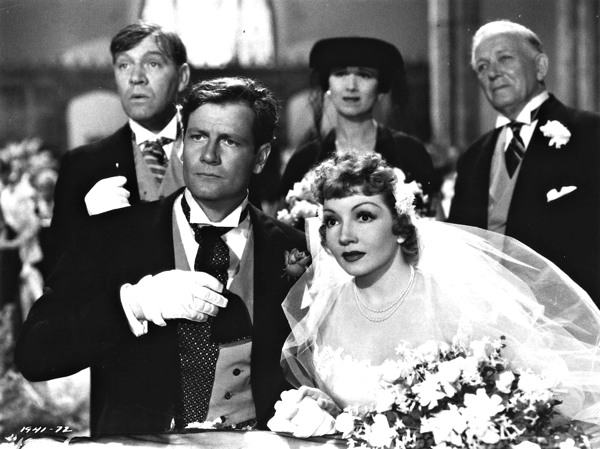
Palm Beach Story (1942) begins where most romantic comedies end, with the wedding (of Joel McCrea and Claudette Colbert).
Or did they?
And that’s where this movie begins. This is something of a bold move by Sturges, for a romantic comedy.
As we’ve discussed, the rise of romantic screwball comedies marked a rise in the significance of female comedians, specifically an equality between the male and female comedy co-stars. I’m not going to say that the rise of female comedians as equals caused the structure of screwball comedies, or that the structure of screwball comedies caused the rise of female comedians as equals, but I can say with confidence that the two are closely related. Think about it this way: if you’ve got two comedy leads in a film, one male and one female, and you want to give them more or less equal amounts of screen time and comic business, then there are worse ways to anchor the central dramatic conflict of the story than on their relationship to one another. You have them meet cute, and then combat each other in funny ways for about an hour and a half, until they realize that the things they hate about each other are things they love about each other. Fade out.
We can call this the apart-apart-together model.
There are other ways to pull this off—the Thin Man movies begin with a married couple whose relationship is never in danger, and just puts the two of them into mortal danger instead, tracking down killers and conspiracies. But without Thin Mannish style danger, having your romantic couple start the movie off together is a problematic stance to take. If you choose to have the dramatic conflict be a romantic one, one that puts their relationship at risk, such that you go for a together-apart-together model, you threaten the very structure of your story. For the together-apart-together model to function, you presumably need to make the central dramatic conflict convincing enough to mount a meaningful challenge to the relationship. The more credible the challenge, though, and by extension the more effective the dramatic conflict, the more work the movie has to do to resolve that conflict and reunite the lovers. These two loved each other once, they know what being together is like, and they’re seriously considering walking away from that.
By contrast, the apart-apart-together model sets the bar lower. They just need to realize they’re in love, not overcome the one barrier that’s strong enough to undo that love.
Which brings us back to Sturges and Palm Beach Story, which opts for a together-apart-together model but gleefully defies the very storytelling logic I just outlined. The gimmick here is that the force that tears them apart is exactly the same force that would keep them together or could reunite them—they never stop loving each other, they never stop wanting to be together.
So what’s pulling them apart, you ask? What’s pushing this husband and wife toward divorce in Palm Beach?
Joel McCrea is a dreamer, which is a nice way of saying he’s down on his luck. His peculiar ambition is to construct an urban airport in the center of New York City by stretching powerful steel nets across the skyscrapers, so that planes can land safely in the middle of a city.
This looney invention encapsulates the Sturges touch. Listening to McCrea describe this plan, it all sounds perfectly reasonable. His scale model is impressive, and you might well sit in the audience nodding your head approvingly, and wondering why, so many decades after this movie was made, why hasn’t anyone gone and built this thing yet?
And then, on reflection, realization dawns: the idea is completely bonkers. How would planes safely navigate through the buildings? The noise would be unbearable for the poor citizens of the city, who would have to resign themselves to never seeing the sky again, thanks to the airport that now hovers permanently over their heads. I could keep going with objections to the idea, but why bother? No, wait, one more objection—why does the thing cost exactly $99,000? Even the price tag is ridiculous.
And that’s Sturges in a nutshell.
Preston Sturges lived a life so absolutely implausible and so stuffed with absurd events that if someone had set out to make a completely honest bio-pic about him, one that didn’t stray from the facts one bit, it would have been laughed off the screen as even nuttier than his comedies. He made screwball farces because he wrote from what he knew—and the weird thing is, Palm Beach Story is actually kind of autobiographical in places—just not in the places you might think. The crazy airport scheme, the wastrel rich cougar flitting from man to man, the relationship that tears itself apart because the woman wants to see the man succeed—these are things Preston yanked from deep in his soul and turned into frothy entertainment. He turned pain into laughs, mostly because his pain wasn’t recognizable to outsiders as anything real.
In a Sturges movie, the craziest people are made to sound the most becalmed and normal. And, the lone voice of reason in a Sturges film is made to sound foolish. This is the corollary of the proposition that Sturges makes sensible ideas sound foolish and crazy ones sound reasonable: Sturges’ movies spend most of their effort advancing ideas and values contrary to what he actually means. His films are jam-packed with slapstick chaos and machine-gun dialogue, but their greatest comic power comes from irony. They are manifestly not about what they are about—as we shall see with Palm Beach Story.
McCrea’s absurd airport idea is faltering, and the couple can’t pay their bills. At which point, Claudette Colbert decides that since she’s an attractive and shapely young woman and there are lonely rich guys out there, the best way to help her hubby is divorce him, seek out a sugar daddy, and funnel the cash back to McCrea so he can become a successful entrepreneur. And when Colbert explains her idea to him, it sounds completely sensible, an iron-clad proposition. How could anyone object?
So, off she trundles to Palm Beach to execute this scheme. Within hours she has hooked Rudy Vallee, playing the third richest man in the world. He is utterly delighted to spend money on her, and is so sold on the self-evidently brilliant urban airport idea that he remains committed to it even as Colbert keeps changing her story about whose idea it is—is it the brainchild of her cruel husband, described as a vicious wife-beater, or the intellectual property of her brother, “Captain McGloo?” (Funny names are another Sturges trademark. In the film, Colbert has to come up with a name for her “brother” on the fly, and misremembers his mother’s maiden name McGrew.)
In short, Colbert’s plan has worked exactly as she said it would. In one scene, she cooks up a crazy scheme, and in the very next scene she pulls it off. What kind of storytelling is that? Where’s the conflict?
Well, the conflict is in whether she should be doing this at all. She is successfully executing a very bad idea, that will hurt a lot of people.
Or will it? McCrea has followed his wife to Palm Beach hoping to stop her, which is where the whole McGloo thing came in. Having told Vallee that her husband was a vicious wife-beating lout, she passes her real husband off as her brother, and then he finds a sugar momma—Rudy Vallee’s sister Mary Astor thinks Captain McGloo is the very picture of desirable manliness, and she is prepared to pay for his companionship.
So what does our dreamer hero really want out of life? Comfort, riches, abundant sex, and professional accolades—or does he want to hang on to his screwball wife and live from hand to mouth instead? So much for happily ever after—the opening titles show us a wedding, and then the movie shows us two possible outcomes. They both have their good points, and they both involve some compromise. You can’t have everything—you just have to choose which something you want.
In other words, the movie is a romantic comedy which drives aggressively to this precipice: romance is the bunk. Living happily ever after with your sweetie isn’t on the menu—you can have the living happily ever after part, or the with your sweetie part, but not both together. This is a bleak message for a romantic comedy. The schizophrenic attitude is so bewildering, the audience gets to this point in the story and has no idea what they’re rooting to happen now. Do we want Claudette to succeed in her plan—and thereby make this appealing rich dork really happy, and give her (ex-)husband the very success he’s aspired to? Or do we want Joel to reveal the truth, and thereby deeply wound everyone and destroy everything?
Sturges gets out of this impasse by suddenly announcing that the rules have changed. It’s like playing a game of chess to the brink of checkmate, and then loosing because your opponent hits a home run. What game were you playing?
But Sturges’ get-of-jail-free-card of an ending doesn’t change the point of the preceding 90 minutes—it just lets you walk out of the theater happy, and maybe unaware that you just watched a deeply romantic story about the impossibility of romance. The plot may be anti-romantic, but this is a Sturges film—and as such, it isn’t about what it seems to be about. The tone, the mood, the overall experience is one of love triumphant—a message that somehow comes across despite the abject inability of the rest of the movie to even remotely believe in it.