
Modern Love was a 1929 feature comedy from Universal that starred Charley Chase and Kathryn Crawford, produced during the awkward transition into sound filmmaking. It was made as what they called a “part-talkie,” in which it was a predominately silent film with talkie sections. If you’ve seen Charlie Chaplin’s Modern Times, you’ve seen the style.
For many years this treasure was believed lost, at least in part. In 2010, intrepid preservationists did the hard work of pulling all the surviving material together to completely restore the film to its original splendor, and premiered it at Slapsticon. I was very fortunate to be in the audience and I am very grateful that I had the presence of mind to fill a notebook with notes while I watched.
Since I have to assume I’m writing to an audience who wasn’t with me that evening, let me recount the premise: Charley Chase is married to a working spouse with a better paying and more promising career. It pains his masculine identity to admit that he’s “inferior,” but any rational economic calculation would conclude that Kathryn Crawford needs to keep her job.
And there’s the rub: this was an era when married women weren’t expected to work, and without the protections afforded by modern laws, the only way she can be sure of hanging on to that job is by concealing her marriage. And while Charley has several incentives to play along (her salary, for one, and not having to admit to being the lower paid spouse is the other), this is a tough pill to swallow.
Chase and his wife keep separate names (gasp!) and residences. Much of the comedy of the film arises from their efforts to keep their relationship under wraps—they are wed in secret, and concoct bizarre excuses to put forward an alternate explanation for anytime they appear together. In one scene, Charley is forced to play “butler” to Kathryn’s dinner party.
If you’re getting vibes of Tracy/Hepburn pictures, or Cary Grant’s I Was a Male War Bride, then go to the head of the class. This was a beachhead for the coming breed of screwball comedies that often premised themselves on gender wars issues. In fact, comedies based on challenging gender roles continue to be a driving force in Hollywood, we’ve just traded away from a model in which women acting competent is seen as threatening to one in which the norm is the professional, responsible woman playing opposite a juvenile man-child.
In the screwball era, the function of this kind of comedy was to emphasize a distinction between socially constructed love and romantically oriented love. Marriage and all the legal and moral structures that surrounded it are the social constructs of love–focused on social standing, convenience, and how one is seen. By contrast, there is romance—illogical, unruly, defiant, and focused on what a person feels. The real relationship between Charley and Kathryn is a thing of trust, companionship, and genuine romantic love, and yet what they have to hide is not love, but their marriage.
What we have here is a prototype of the romantic comedies that would come to dominate the movies in the aftermath of the transition to sound. Yet it stars Charley Chase and positions itself as a silent comedy in his wheelhouse. This may have been produced by Universal, with Chase “on loan” from Hal Roach, but the movie revisits several set pieces that Chase had developed in his short films at Roach.
In short, Modern Love is a trial run for a new kind of sound comedy, one that draws as much from Lubitsch as from Chaplin. Comedy did lead in this direction, and if this film hasn’t spent so long out of public view it might be hailed as a key missing link between slapstick and screwball. All the while, it is clearly a Charley Chase vehicle. Many sequences feel familiar from his shorts, and his character is a generic office worker, just as he was in his short films.
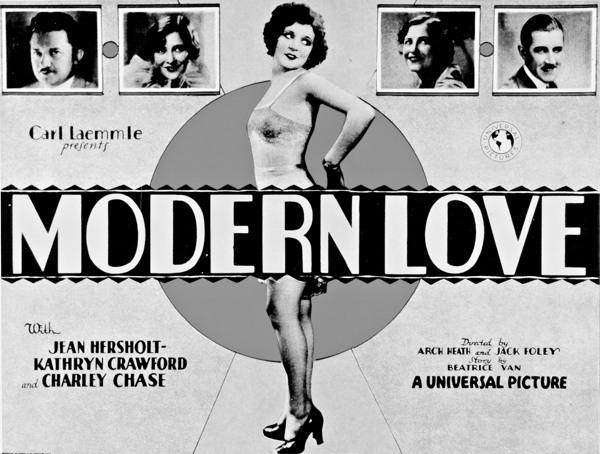
The lobby card for the 1929 part-talkie feature Modern Love highlights Kathryn Crawford over her more established costar Charley Chase.
Which is a way of saying, Charley Chase was naturally on the path of an organic evolution from silent slapstick to talkie romantic comedies. So, what would it have taken for him to continue on that path and finish the journey?
In my estimation, he’d have needed two things.
One. A full-fledged co-star.
To make this genre work, he needed at least a Thelma Todd (if you need to, flip ahead to next chapter to see her opposite Cary Grant, and evaluate how well she fit into the screwball tradition). Screwball changed the comedy landscape by elevating female performers to a place of equality if not priority. Kathryn Crawford is OK, but she doesn’t have that star power that the genre demands. Thelma Todd worked with Chase and he had hoped to establish a lasting screen partnership with her, but there are perhaps more apt selections. I’d have loved to see him playing alongside Jeanette MacDonald, or Claudette Colbert.
Two. Screenwriters.
The romantic comedies of the 1930s were defined by writers more than directors, more than actors. Ben Hecht, Norman Krasna, maybe Robert Riskin—these are the true comedians behind screwball. Perhaps this is why these films didn’t get the same adoring critical attention as slapstick. Film scholars fall over themselves to write about Chaplin and Keaton and Lloyd, but comparatively few invest the same effort in writing about screwball. Critics generally prefer directors and stars over writers, because it’s too damned hard to figure out what writers do.
Chase had the stuff to be a romantic comedy star. Maybe not a first tier star, but a reliable presence. Modern Love points the way down a path that, for reasons discussed in the previous chapter, Chase was not allowed to follow. But the path was there, for others to exploit. And just a couple of years later, the ingredients of Hal Roach slapstick and Ernst Lubitsch bedroom farce would again be combined, in something that toyed with the ideas of Chase’s comedies but turned them into something new. And out of that would come a new kind of comedy star, a man born Archibald Leach, who would do the things that Charley Chase never did.