
We come upon three men and a naked lady.
The lady is Thelma Todd, denuded as she often was in her brief screen career.
One of the men is Roland Young, a womanizing roué who has brought her home in this state. The other, Charlie Ruggles, is his mostly useless sidekick. The third man? Well, that’d be Thelma’s husband—known to be a fiercely jealous man. He is also an Olympic javelin thrower (yes, that’s right). Oh, and he has a quiver of javelins with him.
This, ladies and gentlemen, is the screen debut of Cary Grant. It is not an especially auspicious performance—Grant is quoted in numerous sources as disliking his contribution to this film. But it is for our purposes an extremely illuminating one. Here is a film that behaves like a modern dialogue-driven romantic comedy, but which is comprised of the DNA of silent comedy. Here is a missing link between one animal and the other—a glimpse into the evolution of talkie comedy. And it all hinges on Cary Grant.
The film in question is a Pre-Code comedy called This Is the Night, made in 1931 by director Frank Tuttle. In addition to the four stars we just met, there is a second female lead, played by Lili Damita. As a group, these five characters are caught up in a web of overlapping love triangles, mistaken identities, deceptions, and compromising positions. This is what they used to call “sophisticated farce,” which is to say it involved lots of double entendres and a European setting. Ernst Lubitsch was making some of the very best of these bedroom farces, but Tuttle’s This Is the Night is a pleasant enough entry in the canon.
The story of course begins with Thelma Todd getting her dress caught in a car door and ripped from her body—throughout the film, Todd keeps losing her clothing as a running joke.
It is the immediate fallout of this embarrassing incident that threatens to expose her relationship with Roland Young to her threatening caveman of a husband, Cary Grant. And so, in the heat of the moment, Charlie Ruggles comes up with a plan to save his friend. It is a ruse worthy of George Costanza: Ruggles makes out as if Young is already married, and all the things that Grant is picking up on that are making him think the rogue is carrying on with his wife, are really just symptoms of his being married to … um, married to … hang on…. Oh yeah, married to this girl, Lili Damita!
Damita is in fact an actress they hire to play the role of Young’s wife, and she’s contracted to come along on their trip to Venice to maintain the lie.
The contours of this story are probably easy enough for you to predict, regardless of whether you’ve caught this rarity before: the enforced intimacy between Young and Damita will kindle a genuine romance between them. What begins as a purely commercial transaction, and one rooted in dishonesty at that, blossoms into something pure and true. The rogue will settle down at last—here is a woman worth giving up everything else for.
It is easy to appreciate this as an example of the faux-Lubitsch “sophisticated” farce genre of the early talkie era—all the conventional elements are in place, from the European setting to the light operetta songs that blanket the soundtrack. But at the same time, this is familiar silent comedy stuff.
For example, the running gag of Thelma Todd losing her dress. The opening scene is a virtual photocopy of the opening scene of Laurel and Hardy ’s silent short Double Whoopee. For that matter, throughout her run of two-reel shorts at the Hal Roach Studio, Thelma Todd routinely got caught in states of undress. If she didn’t take her clothes off, it wasn’t a Thelma Todd film. Later in the film, Ruggles and Young interrupt their scheming to stop and get drunk at a Venetian café, in a scene that owes much to similar drunk-act scenes in Laurel and Hardy pictures like Their Purple Moment.
In fact, I should mention that This Is the Night is in fact a genuine remake of an actual silent comedy, Good and Naughty directed by Malcolm St. Clair in 1926 (St. Clair was the only director other than Buster Keaton credited on Keaton’s run of silent shorts; he collaborated on Harold Lloyd’s first talkie Welcome Danger, and finished his career directing Laurel and Hardy ’s late period features like The Big Noise). Sadly, it looks like Good and Naughty is lost to posterity—certainly it is unavailable for easy viewing now, so I’m not in a position to compare the two directly.
Without access to Good and Naughty, let’s turn our attention instead to what real estate professionals might term a “comparable”—that is, a film of similar ambition and tone, from roughly the same period—for example, Bebe Daniels’ Miss Bluebeard from 1925.
Daniels had been Harold Lloyd’s longtime onscreen foil until she branched out on her own. In Miss Bluebeard, she plays a French actress (very much like Lili Damita’s character in This Is the Night) who is pushed by contrived circumstance to pretend to be married to a rich playboy (again, like This Is the Night) while she also cultivates a friendship with his goofy sidekick (more parallels), and the vague sexual hostility of the fake marriage eventually gives way to genuine romantic attraction (you get the point).
In other words, the two films share a similar agenda, but the ultimate effect is very different, and it is the addition of the soundtrack that makes This Is the Night the more enjoyable and ambitious of the two. Now, it’s a bit unfair of me to pick some random film out of the ether and say, Ahem, this one isn’t as good. But, you see, I didn’t pick Miss Bluebeard randomly out of the ether. In fact, Frank Tuttle directed both pictures—I selected this to see how the same director, working with substantially the same comic material and plot, responded to the addition of sound.
Take for example a joke structure shared by both films. In Miss Bluebeard, the playboy character is played by Robert Frazer, and he’s fake-married to the French actress played by Bebe Daniels. The more Frazer’s heart sings for Daniels, the more his friend Raymond Griffith (serving more or less as the Charlie Ruggles analogue in this film) tries to cover up Frazer’s tawdry past to her. When one particularly noisy ex-girlfriend shows up, Griffith doesn’t want Daniels to know anything about it. But she heard some commotion—Oh, that? says Griffith, that was just a cat.
It’s a poor lie, but the situation is made worse by the sudden entrance of Frazer, who was alleged to have just disposed of this pesky cat but knows nothing whatsoever of this lie. To keep the ruse going, Griffith has to silently signal Frazer, while he’s talking to Daniels, what the essence of the cover story was.
Now, a similar scene appears in This Is the Night. Cary Grant, suspicious of Lili Damita and not at all willing to accept the story that she is Young’s wife, grills Young about the circumstances of their wedding. Young extemporizes, claiming for example they met in Cincinnati. Later Grant gets some alone-time with Damita, absolutely clueless about the lies Young’s just spun about her immediate past. Grant starts chatting with her—and Young realizes that the jig is up if she contradicts what he’s just said. So poor Young struggles to clue Damita in, while she struggles to interpret his unhelpful clues.
Something crucial shifted in the joke structure once sound was added. In Miss Bluebeard, the comedy is inherent almost exclusively in Raymond Griffith’s contortions and silly mimicry as he tries to signal silently to Frazer. We are aware of Frazer’s dilemma in trying to convincingly speak about this stuff while trying to make sense of Griffith’s behavior, but the joke is all in Griffith’s nutty attempts to mime being a cat. But once you add sound, the punchline in the joke switches hands. The joke structure has mutated, and now the joke is at least partially if not mostly in Damita’s attempts to interpret the clues, not just in Young’s attempts at charades. Damita’s mistaken interpretation of Cincinnati as “I was living in sin. I was naughty” is, you have to admit, a lot funnier than watching Raymond Griffith act like a cat.
Miss Bluebeard is not a bad film, but it is hampered by the lack of a soundtrack. The film is constantly interrupted by title cards, and feels stagey and claustrophobic. It is not an especially visual concept—not compared to the outsized comic antics of Chaplin or Keaton. There’s a nice bit of characters coming in and out of doors and just missing each other, which apparently Griffith improvised on the set. But it amounts to a small fraction of the overall running time of a film that otherwise seems desperate to say something, but lacks the ability. And for that matter, the scene that Griffith allegedly improvised is borrowed largely stroke-for-stroke from Charley Chase, who’d been doing this kind of farce for years by this point.
The specter of Charley Chase haunts both films—this was his métier, and it’s an almost an insult he was left out of This Is the Night. The film is so close to being plagiarized from his playbook, he might as well have been an official part of it. The premise is not far off from Chase’s 1922 short Too Many Mammas, in which a group of men and women are constantly swapping partners like a sexed up game of hot potato in an effort to collectively deceive one another about who’s actually with whom.
But for all that, it is not clear exactly where in this thing you’d fit Charley Chase. And the more one thinks through alternative casting scenarios, the more something weird about this movie bubbles to the surface. Charley Chase could theoretically have played the Charlie Ruggles role, but Ruggles did it so perfectly there’s no advantage to recasting him. One can imagine Chase in the Roland Young role—they have a similar effete fussiness—but now all of a sudden the world starts to appear upside down. Why in the world is Roland Young in this role in the first place? I’m not saying he isn’t excellent. He is terrific throughout. But the character is supposed to be the man that Thelma Todd is choosing over Cary Grant. In any rational universe, Thelma and Cary would pair off in the first scene and be done with it, and Roland wouldn’t even enter into it. Roland Young has been deliberately miscast—and much of the fun of the movie lies in the ironic gap that opens up between who this character is apparently meant to be according to the logic of the story and the actual prissy nerdlinger he is.
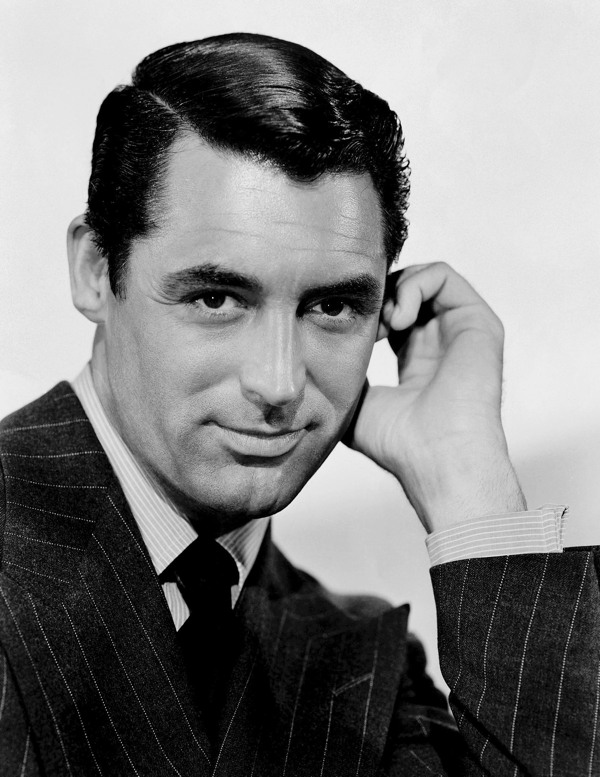
Cary Grant’s ironic delivery and detached attitude undermines the literal meaning of his dialog, contradicting or enhancing it.
Now that we’ve broached the subject of deliberate miscasting for comic effect, it’s finally time to take stock of Cary Grant. Whatever dismissive nonsense Grant may have spouted later, the fact is he oozes charm and steals every scene he’s in. Like Lucille Ball in A Girl, a Guy, and a Gob, he is blatantly operating in a whole other league to his costars—this is the debut of a star. That being said, he is also completely wrong for this role.
His character is supposed to be a brute of a man, an athlete known for throwing objects at great distances, a controlling man with a fearsome temper. And what we get is Cary Grant—with a suave James Bond–like cool, a voice of cultured erudition, and constantly winking at the audience. Every line is delivered with a sarcastic inflection. It’s not that we can’t picture him chucking spears—it’s that we can’t picture him chucking them seriously.
Grant’s ironic delivery allows him to insert an additional layer of commentary into his dialogue. He says the words that the script gives him—and thereby conveys the strictly literal meaning of those words, plain and simple. But because he says them with this detached attitude, he also undermines that literal meaning, contradicting or enhancing it.
This is something about screen comedy that changed with the arrival of sound, and in order to see it clearly, let’s take a look back at another Bebe Daniels silent comedy from 1928, Feel My Pulse, directed by the great Gregory La Cava. This film finds Daniels more in the ex-Harold Lloyd vein, in a plot that has echoes with Lloyd’s Why Worry and features a lot of physical slapstick and stuntwork by Miss Daniels. The premise is that she is a rich hypochondriac who heads off to a sanitarium she owns in order to recuperate. Little does she know that while she’s been living the germophobic life, her sanitarium has been taken over by bootleggers. When she arrives, the rum runners decide to pretend to be doctors and patients to fool her.
It is a romantic comedy, and true to the screwball form there is the classic triangle. Daniels is the runaway heiress, doing increasingly nutty things; There is the good boy, played by Richard Arlen; And then there is the king of the rum runners, played by William Powell. And it is Powell’s performance that concerns us here.
William Powell and Cary Grant were similar kinds of performers in the 1930s—each one specialized in the charming rogue, but in different inflections. Grant had that transatlantic voice, an accent that screamed of culture, the impossibly handsome looks, and was often cast in roles where these marks of class and class were at odds with the social standing he was alleged to have. Grant as gangster, as soldier, as con man.
By contrast William Powell had a wild sort of look about him. He had a voice like single malt Scotch and a suave manner somehow equal parts immensely cultured and rough. In the glory days of 1930s romantic comedies, he was a king. William Powell was the 1930s equivalent of Fonzie. He was untouchably cool. In any of his 1930s films, Powell would have been the default romantic lead for a picture like this—the story would be about Bebe Daniels ending up in his arms. Sure he’s a violent gangster, so what? He’s a charming gangster—or at least, he could be. The trick however is the way Powell’s sardonic charm undercuts whatever literal awfulness the script has him say. But in 1928, when Feel My Pulse was made, no one had yet heard Powell speak. Instead, his dialogue is rendered in title cards. The film shows Powell’s character as a ruthless criminal, and the things he says and does are monstrous. Funny, but monstrous. Without Powell’s inherent sarcasm to undercut those lines, they stay on that literal level—Powell is the bad guy.
The film has a lot of fun in its final reel, with Bebe Daniels confronting the entire gang and singlehandedly defeating them. She channels the best of Harold Lloyd as she brings total slapstick chaos to bear on their operation—and while Richard Arlen is the good guy she ends up with, he doesn’t save her—she saves him, in a nice touch. Feel My Pulse can’t effectively end any other way—to have her end up with Powell would have been bizarre. Powell is unambiguously the villain. Except, if you were to remake this film in the sound era with the exact same cast and without changing any of the dialogue, Powell’s naturally sarcastic delivery would turn his “villain” into a charming rogue.
This was the most significant gift that sound gave comedy. Sound made it possible to layer two different sets of meanings onto the same scene. Once we get actors like William Powell and Cary Grant delivering their dialogue with wry, ironic distance, all of a sudden, it becomes possible for a movie to do two things at once. It can chug its way through a literal series of plot steps (this happens, then this happens) while also commenting on, contradicting, undercutting, and otherwise lampooning those very things. A person with Grant’s kind of sarcasm can have his cake and eat it too.
When critics called these things “sophisticated comedies” they mostly just meant it involved lots of double entendres and a European setting. Snicker snicker, let’s make some crude jokes about the size of Cary Grant’s “javelin.” Ha ha, this is Beavis and Butthead circa 1932. But the real double entendres come every time Cary Grant speaks—double and triple entendres, quadruple and beyond. And let’s be clear—sound is key to this. You can have irony in silent film, sure, and you can miscast on purpose to play with the disconnect between the literal meaning of a character and the specifics of the actor’s performance. But there’s a ceiling on how far you can go with it—whereas the ability to deliver dialogue in such a way as to convey the words but also consciously slip out of synch with those words depends on actually hearing the actor’s voice.
It’s not that silent comedy was incapable of irony, merely that the limitations of silence made it tricky. The arrival of sound opened up new possibilities to explore ironic humor, and the ascendancy of performers like Cary Grant and William Powell made that into widely popular and increasingly common form. The strictures of screwball comedy, by distributing the comic responsibilities across a larger cast, provided opportunities to indulge in quirkier or more unpleasant characterizations because they no longer had to completely anchor an audience’s sympathies. Put all these things together, and sound comedy had the tools to do things silent comedy didn’t.
This Is the Night does very little with this power. It is at best an amiable way to spend a long hour. To really take advantage of what you could do with this technique would depend on having a much more nuanced screenplay than This Is the Night. But let’s just say that a truly gifted writer—maybe a writer/director who specialized in how his words came alive on movie screens—set out to do the very things that an old-timey silent comedy would have done. Would it be possible to translate, say, the crudest, most primitive kind of violent, anti-social Keystone havoc into a genuinely sophisticated and entirely dialogue-based romance? Is that even possible? And if you did, would the result live for the ages as one of America’s best comedies?