
We began this conversation 50-odd chapters ago (and I agree, some of them were pretty odd). I started out with a question: why did silent slapstick disappear? It was a trick question, of course—slapstick didn’t really disappear, at least not all at once.
For the benefit of those of you who opted to skip the preceding chapters, or who suffer from one of those Memento-style memory impairments, here’s a quick summary:
• Some of the great practitioners of silent slapstick saw their careers falter for unique personal reasons;
• Some of the great practitioners of silent slapstick kept on truckin’ well into the middle of the 20th century;
• The advent of sound film gave comedy filmmakers tools with which to emphasize irony; and social and aesthetic changes ushered in a new approach that prioritized female-centered ensemble comedies that explored cultural tensions between the classes, a genre identified as “screwball.”
Which begs a different question: why did screwball disappear? The 1930s and early 1940s were chock-a-block with runaway heiresses and wacky dames in a constant battle of wits with disreputable journalists and various rogues. They brought up baby, learned the awful truth, and insisted nothing was sacred. Then what?
One answer is that screwball never did disappear. Just as slapstick never really died, neither did screwball.
Billy Wilder’s Some Like It Hot is as definitive a take on the screwball form as anything we’ve discussed so far, and it came along in 1959, a chronological anomaly like Charlie Chaplin making Modern Times in 1936. Frank Tashlin’s Will Success Spoil Rock Hunter? from 1957 is no mere throwback, but a thoroughly mid-century rethink of the genre. The year 1998 brought John Cleese and Charles Crichton’s superb A Fish Called Wanda; the Coen Brothers updated (and upstaged) Frank Capra’s legacy with 1992’s The Hudsucker Proxy; Amy Schumer’s 2015 Trainwreck used screwball’s style in service of a sort of slapstick feminist pseudo-memoir.
Meanwhile, much as The Jazz Singer and the arrival of talkies posed a technological disruption that changed Hollywood economics, the competition between cinema and television forced filmmakers towards making splashy, Technicolor widescreen spectacles. In response, television became a natural home for screwball—what else was I Love Lucy than a 90-hour-long screwball epic played out in weekly installments on broadcast television over the course of six years?
There were also social and aesthetic issues at play. For one thing, the Depression-era obsession with pitting the Haves against the Have Nots in romantic combat lost a lot of its allure as the economy rebounded.
More significantly, the Second World War called most able-bodied men into service in one form or another, and women found themselves taking places in the working world that were previously unthinkable (or at least largely unthought). This set of conditions challenged wounded male egos and unresolved social misogyny. Screwball offered brassy, liberated women who outshone their male counterparts—and returning GIs came home ready to show those brassy, liberated women back to their place. The conditions of the Second World War made the very ethical foundation of screwball seem suspect. Insecure men trying to reassert their dominance in a postwar world were a lot less inclined to find the antics of screwball heroines appealing.
As far as comedy goes, the 1940s took a hard swerve back towards the male-dominated, solo comedian or comedy team-based, vaudeville-inflected slapstick. You can’t tell me that slapstick died when sound arrived, when the biggest box office draw of the 1940s were Abbott and Costello.
Say what you will about Abbott and Costello, when they were on their game they were outstanding. Audiences loved them for a reason, their classic routines have stood the test of time, and they have left a lasting influence on American comedy that can be measured in the likes of Jerry Seinfeld and Larry David. They were also lazy wastrels given to unseemly petty in-fighting. My first insight into how dysfunctional they were came in off-handed and back-handed comments by the likes of Groucho Marx or Buster Keaton. Eventually I came to understand what Groucho and Buster were hinting at—here were a pair of movie stars who had the clout to force Hollywood to their will. They could have demanded and received a level of creative autonomy that Groucho and Buster could only dream of, but instead they could barely be bothered to show up to their own set on time and deliver their lines semi-competently. They put the minimum amount of effort into making their films, while indulging the most pointless and fractious grudges against one another. Watching their films is an exercise in squandered opportunities: it’s like discovering that yes, Superman landed on Earth from Krypton, but that instead of becoming either a crusading journalist or a planet-saving superhero, he was content to become a pretty good bowler, but never even won a municipal tournament.
In 1942, two of the top 10 box office draws were Abbott and Costello pictures (and Bob Hope claimed another two). Meanwhile, Palm Beach Story and To Be or Not to Be—hailed earlier in this book as absolute pinnacles of the screwball art—did not even rate. It should not escape your notice that Palm Beach Story and To Be or Not to Be are films that directly challenge prevailing values, and demand their audiences be actively engaged in thinking about the sexual and political morals they lampoon, whereas Abbott and Costello made cheap jokes intended for no more permanence than the passing moment—the movie equivalent of Cheetos.
Whether by accident or design, the move away from screwball back to a slapstick ethos in the 1940s was a marked retreat from the 1930s’ pre-feminist inclinations towards women’s lib.
Consider Theodora Goes Wild, an underrated gem from 1936. Prior to this film, Irene Dunne was a dramatic actress who looked down her nose at comedy; after this film her career swerved hard into comedy. Dunne stars as Theodora Lynn, a mousy church-going spinster bookworm from the suffocating small town of Lynnfield. That name’s no coincidence—her family founded the town and has dominated it since. As such, her behavior is closely watched and judged by her aunts, the town gossip, and an entire community of tongue-clucking busybodies.
And she has a secret.
Theodora, you see, is none other than “Caroline Adams,” best-selling author of an incendiary novel called The Sinner (think the 1930s equivalent of Fifty Shades of Gray). The Lynnfield Literary Society has worked itself into a book-banning frenzy over The Sinner, which is a little awkward because Theodora sits on the Society herself. If these self-appointed guardians of morality knew she and Caroline Adams were one and the same, the fallout would ruin her life and potentially the lives and happiness of everyone she holds dear.
Into this powder keg of a situation breezes the artist behind The Sinner’s book jacket, Michael Grant (Melvyn Douglas at his smarmy best). He knows her secret, and what it’s worth to her. He exploits that knowledge to blackmail her into spending time with him. Which would be pretty unpleasant behavior, if it weren’t for the fact she actually does enjoy spending time with him.
For roughly the first hour of the movie, this is how it goes: Michael and Theodora do silly, childish things together, argue worldviews and philosophy, debate the merits of small town values versus big city thrills, and shuffle awkwardly to keep Theodora’s secret identity under wraps. Oh, and they play house with an Asta-like dog standing in as an ersatz child.
It’s too much for her to bear. Everything she enjoys, Theodora does in the shadow of fear; the people she loves are turned into antagonists that she has to deceive. This is no way to live, and it breaks her. In one gloriously cathartic outburst, she tells off the clucking hens of the town that she is no longer willing to hide her love for Michael, and she is unwilling to feel shame for it. Read what metaphors into it what you will—it’s a form of coming out, a person declaring they are tired of being bullied into hiding who they love.
As satisfying as the scene is, it’s not enough. Theodora “came out,” but only by exposing one of her many secrets—and easily the least explosive of them. The opening titles made a promise to us: Theodora is going to go wild. One self-righteous speech does not equal “going wild.” And the film has a good 40 minutes left to go.
Theodora discovers that Michael is not the free spirit he pretends. He is trapped in a loveless marriage with a shrewy witch but cannot divorce her without damaging the political career of his wealthy and well-connected father. He spent all this time convincing Theodora to escape the confining mentality of her small-town, but he is a prisoner of the same need to please others.
It is here, in the back half of the picture, that this otherwise mild-mannered amusement turns into a sharp-edged satire. It is the screwball equivalent of Safety Last! Just as Harold Lloyd spent the first two-thirds of his iconic comedy carefully establishing the plot logic that would then oblige him to scale a skyscraper with his bare hands, Theodora Goes Wild spends its first two thirds boxing its heroine into becoming “Caroline Adams” for real.
Theodora outs herself publicly as the author of The Sinner, starts dressing herself as the vampish man-eater everyone seemed to think she was, and proceeds to invent as many outrages as possible around herself. She becomes a walking sex-scandal, a sort of Jezebel-meets-Midas for whom everything she touches turns to scandal. If a few minutes have gone by without someone leveling a new charge of dishonor her way, she gets itchy.
And it is so joyous to watch. Irene Dunne can’t suppress her giddy smile, like that of a toddler who has discovered how to use a bulldozer. The sheer thrill of destruction is intoxicating.
Like some avenging angel, she buzzsaws her way through both New York and Lynnfield, tainting everyone she meets with scandal until no one is left to presume moral authority over anyone else. She systematically deprives everyone of the ability to judge, and does so while forcing everyone to confront the worst, most exaggerated caricature of herself. When finished, she can discard the Caroline Adams persona and go back to being herself, secure in the knowledge that there’s no one left to give her stick about anything she does.
The gossipy matrons of Lynnfield mistakenly think they can just stare at her “and she’ll fall through the floor from the shame.” They haven’t realized that Theodora is now bulletproof, a slut-fabulous superhero. There’s no stopping a woman who no longer cares what other people think of her.
As powerful as Theodora Goes Wild is, I do not think it is especially funny. You’ll be pretty deep into this movie before anything recognizable as a joke occurs. Although this might seem like a liability for a comedy, frankly I find Theodora far more enjoyable than Bringing Up Baby, which is wall-to-wall jokes but is utterly exhausting to sit through.1
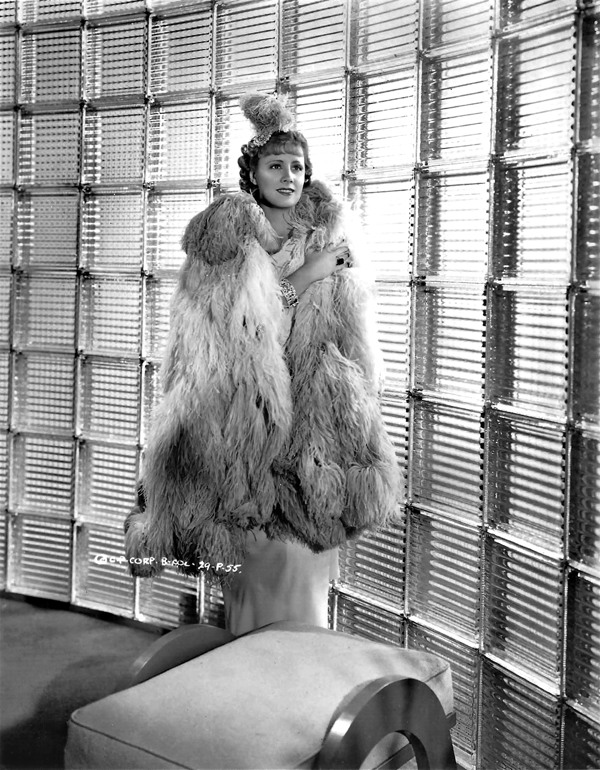
Irene Dunne puts on her battle armor in Theodora Goes Wild (1936).
Nevertheless, I have always held a soft spot in my heart for the many charms of Theodora Goes Wild. It revels in a tension between the coastal elites and fly-over country that is still very much a fault line in American life, but does so by emphasizing how much more important are the things those communities share in common rather than their obvious surface differences. Theodora is a sort of proto-feminist, a rambunctious rule-breaker who came from a small town and independently established herself as a big city success in a man’s world. I assumed these virtues might shine through, even if the rest of the film wasn’t all that funny, when I forced my family to watch it with me.
And “forced” is the right word. To be clear—my family are veteran watchers of classic movies. My wife and both kids have all happily sat through any number of silent slapstick films in theaters and at home—if I’d insisted on watching Safety Last! they’d have been quite content.
Because here’s the thing: Theodora’s rampage was successful. She and all the other heroines of the screwball era helped rewrite American mores, to create a new kind of society in their wake. Charlie Chaplin’s A Woman of Paris is hard to appreciate today because the social values that drive all of its drama have changed, to the point that the plot no longer makes a lot of sense. The same problem plagues Theodora Goes Wild. Far from “going wild,” Theodora seems to go mild. In one scene she lays waste to a sitting governor’s political career—and she does so by simply engineering a paparazzi snapshot of her in the governor’s company. That’s it. That’s the extent of that “scandal,” time to move on to her next conquest. The world of Theodora is so very quaint.
Meanwhile, although the world of Safety Last! is substantively less like ours in many respects, the very style of silent film helps make it seem less so. Silent film, like opera or comic books or musical theater or the Muppets, is a highly stylized aesthetic experience. There’s not much point complaining in a Muppet movie that Kermit is just a puppet—you have to accept a certain amount of buy-in to the premise when you buy your ticket. In other words, you sit down to a silent comedy already predisposed to accept a fair degree of variance from your own world and experience. Some aspects will feel familiar and will connect to you emotionally, some won’t and will be interesting to remark on, others may slip by unnoticed.
By contrast, we are far less likely to find the aesthetic style of a screwball comedy like Theodora Goes Wild from 1936 as especially foreign. It’s in Black-and-White and paced more slowly than more modern films, but by and large Hollywood has spent the last century determined to adhere to a consistent, mostly realistic aesthetic model. And the more cues we get telling us that the film is supposed to feel “normal,” the weirder its variations become. It’s awfully hard to imagine what a 21st-century remake of Theodora would look like—how one could possibly adapt a story about weaponizing shame for a society that no longer feels it.
Let me share an anecdote: When I was producing my DVD compilation of the restored films of Harry Langdon, I had gone to my bank to take out a loan to help finance the project. I sat down with a banker and started to explain what my company did, and what this specific project entailed. She listened, and nodded her head politely. But she was puzzled. “Silent comedies? How does that work? How do people hear the jokes?”
Every once in a while I find myself getting dragged into some arcane argument with other slapstick nuts like myself (the sometimes controversial stances I take in this book should clue you in to why that happens to me a lot). And when the arguments get heated—over such trivia as the proper frame rate for silent comedies, or whether that’s really Mal St. Clair as “Deadshot Dan” in Buster Keaton’s The Goat—I like to remember that as passionate and fanatical as we can get, there are a great many Americans who don’t understand how a silent comedy could even exist. How d’ya hear the jokes?
And they outnumber us.
And it is at times like that when I curse the nostalgia merchants.
When I first pitched my Harry Langdon DVD project to Image Entertainment, back in the early part of the 2000s, their senior management weren’t too impressed. The only way to do what I was proposing was to spend a lot of money (see my encounter with the banker above), and even my most conservative budget figures were horrifically underwater from their most liberal sales projections. They had a track record with silent films on disc—a deep history of data that told a single story: there are about 3,000 silent movie fans in the United States who would buy DVDs. It didn’t matter if the silent film in question was some obscure title or the restored Mutual shorts by Charlie Chaplin, it didn’t matter if they put in promotional efforts or not. The sales targets were as predictable as the tides. I wasn’t prepared to agree to that logic, and was convinced that it was possible to connect to a new audience, a newbie audience.
Spoiler alert: I failed. In the end my sales figures on the Langdon set were indistinguishable from sales of slapstick compilations which I never even bothered to advertise or promote at all. And, yup, my numbers lined up with what my distributers had pessimistically projected.
I bring this story up as evidence that I’ve been giving this problem a lot of thought, and trying to put my money where my mouth is. In promoting the Langdon set, I gave a few interviews to newspapers and radio, and I presented live screenings in several cities—and in these appearances, I was always careful to define Langdon’s legacy in terms of contemporary comedy. I invoked Monty Python and Pee Wee Herman, Steve Martin and Sacha Baron Cohen, Jerry Seinfeld and Larry David.
It was a calculated strategy—on one hand I was keen to sneak these references into publicity materials and blurbs to increase the likelihood that my disc would pop up in Google searches for these other comedians. But that sounds manipulative and dishonest, when my main motivation was sincere—Langdon was an anti-comedian, who performed a kind of 1920s performance-art comedy built around subverting familiar comic forms, and emphasizing discomfort and embarrassment. The best way to describe this kind of comedy is to reference his contemporaries who play in the same sandbox.
I also attended a number of film festivals and conventions, and found that my “sales pitch,” so effective when talking to people who didn’t know silent comedy and had never heard of Langdon, provoked an entirely different response from film geeks. I was surprised how many hardcore fans of slapstick comedy expressed such hostility and revulsion to contemporary comedy.
It is not a zero-sum game—liking one doesn’t preclude liking the other. Now, to be fair, I think that pop culture in this country can seem very ageist at times. Outside of a handful of major cities, there is no longer a concept of revival screenings of older films. Black and White movies scarcely get shown on TV at all except by channels such as Turner Classic Movies, and silent films are often banished to late night timeslots. So, it wouldn’t be hard to take from this a feeling that American pop culture believed that anything old is bad and anything new is good—and if you resisted that formula, it could be a reflexive act to just invert it: anything old is good, anything new is bad.
It’s ludicrous when you put it like that, and obviously indefensible, but there are film fans who seem to adhere to that very rubric. Yet as I went from conversation to conversation at places like Cinefest and Cinecon and Slapsticon and so on, promoting the Langdon set, I encountered a shifting definition of what counted as “old” and “new.” For one person, any pop culture later than 1958 was worthless and to be avoided. For another, 1966 was the line in the sand.
I got the feeling that the magic year was whenever the speaker came of age—crossing that threshold from carefree youth into the burdens of adulthood. The pop culture that succored you on one side of that divide would remain touched by nostalgia forever after—the pop culture that assaulted you in the later years would only make you feel old.
The nostalgia merchants are an exclusionary force, their hostility to contemporary entertainment only sends the signal that if you like modern music and TV, then this oldster stuff isn’t for you. Nostalgia is the enemy of building new audiences.
Nostalgia was especially an enemy force in promoting the films of Harry Langdon, since his work had been mostly out of circulation for years and what critical reputation he had was mostly negative. Chances are, if you’d heard of him before, you had a bad impression—I absolutely needed to cultivate an audience of newbies and outsiders.
I don’t deny that nostalgia is a powerful force, and the warm glow of happy memories can forgive many a flaw in some old movie. But my objection to nostalgia as a selling point for movies is that is a death sentence. If the only thing you have to say in some movie’s favor is that it appeals to those who grew up with it, once that audience grays and dies, there’s nobody left. If you didn’t grow up with it, there has to be some appeal made to explain why, out of universe of competing forms of entertainment, you should choose to let this one in.
And the irony is, the silent comedy fans I’ve met in my life—well, the oldest of them are in their ’60s and ’70s. And 70 years ago was already after silent comedy had ended as a form. In other words, even the most nostalgic amongst us jumped on this bandwagon after it had left the station. If we could be drawn into a passé form, then why do we distrust the ability of others to follow?
I used to do a presentation at elementary schools, in which I would bring my 16mm projector and screen and show the kids how the moving images are actually sequences of tiny still pictures. Then, I’d thread up and present the very first public film show, duplicating the Lumière Brothers’ premiere, starting with Leaving the Factory. Then I would show Charlie Chaplin’s The Immigrant, and the third film in the set was a rotating slot—Laurel and Hardy’s Big Business, Buster Keaton’s One Week, it depended on my mood. From the teacher’s standpoint, it was an hour’s worth of science, history, and social studies disguised as an entertaining distraction. From my standpoint, it was proselytizing.
And it worked—more than once I’ve been stopped in public, years afterward, by some kid who recognized me. They come up and say, “Hey, you came to my school and showed that Charlie Chaplin film!”
Let me pause here to let that sink in. I’ve been stopped by little kids—less than 10 years old—who remembered Charlie Chaplin’s name. These are kids who will not grow up to be bankers who don’t know what silent comedies are. All it took was one afternoon, one film, just a single exposure—and that gateway drug was enough to bring Chaplin into their lives.
During my promotional tour to publicize the DVD box set collection of the silent films of Harry Langdon, I had engaged Chicago’s Portage Theater to screen a package of Langdon’s silent shorts to be accompanied by live music from a local jazz band. Being keen to bring new audiences to silent comedy, I really wanted people to come to the show with their families. I brought my niece Haven … but being distracted by my responsibilities hosting the show, I failed to give her any useful context or preparation for what she was about to see. Haven was four at the time—she had never before seen anything in Black and White, and certainly never seen anything silent.
The house lights dimmed, and the movies began. First up was The Hansom Cabman. Langdon wakes up with a wicked hangover, to discover he also now has a furious fiancée he’s never met (sober).
Haven scrunched her face up, staring at the screen, trying to make sense of what she was seeing. It was funny, and she was laughing in all the right places, but she was obviously worried. Finally, her face brightened as she figured it out. She grabbed my sleeve, and excitedly whispered, “They’re doing something tricky with their mouths. They are talking, but you have to be in the movie with them to hear it.”
I’ve been studying and writing about movies in one form or another my entire conscious life, and I’ve never heard a better explanation of silent film. And she came to it all on her own, without help, in a matter of minutes.
It gets better! On the way home, she asked whether Harry Langdon was a child or a grownup. Give that girl the gold star! Take that, Walter Kerr!
All I did was take her, I never shoved this down her throat, never pushed her. All I did was provide access, the first introduction. There are many in the classic film community who wring their hands over some misplaced worry that today’s generation isn’t sufficiently interested in old movies. Pshaw. Of course most of them aren’t. Neither are they all that enamored of opera, or baseball, or the Theater of the Absurd, or utopian literature, or Jeopardy!, or any other of the almost endless niche appeal cultural pursuits humanity has thought up over the years. But some of them are, and those that do find their way to the pleasure of old movies will be captivated for life. And all it takes is mere exposure. Nothing else, just exposure.
Someday, decades from now, those kids will have their own nostalgic memories for these films—but if that’s all the movies can claim, then they’ll have been mostly forgotten long before that day. A movie made close to a century ago that can captivate a youngster’s attention all on its own terms is a movie that doesn’t need nostalgia to thrive.
Slapstick and screwball never died. Every single movie described in this book still exists. Go watch ’em.