
We have gathered here today to discuss a landmark of American screen comedy.
It is a film about a reporter, and he is a reprehensible example of the most caricatured excesses of his profession. He is selfish and callous, gleefully exploiting the sufferings of others because it makes good copy. He has his eyes on a girl, but she’s already involved with another man—a decent citizen, who will become the butt of our protagonist’s abuse. The reporter will do everything in his power to punish this rival, including framing him for various crimes. Although this character’s behavior is unambiguously villainous, he is not the villain of the film—he’s not quite its hero, either, but he’s the central anchor of all that happens, and we in the audience are not expected to boo him but to relish in his monstrous actions. All this awfulness is presented for our entertainment.
But here’s the riddle: what movie am I talking about? Is it Howard Hawks’ His Girl Friday, starring Cary Grant? Or Mack Sennett’s Making a Living, with Charlie Chaplin? Ah, there’s the rub—and therein lies our tale.
Admittedly, if you fell for the Charlie Chaplin of The Gold Rush, sitting down to Making a Living must feel like a bait and switch. Not only is the whole Tramp persona not yet in place, but the very notion of making Chaplin into the heroic figure with whom we are expected to sympathize was actually going to be years in gestation. Instead, the first film Chaplin made for Sennett belongs to a wholly different tradition, one that Keystone had turned into a profitable formula: exaggerated parodies of Biograph-style melodramas, in which all the characters are turned into grotesques.
The entertainment value of such things was meant to lie in the transgressive thrill of watching people behaving badly. Keystone stars were expected to spend their screen time kicking each other in the pants, and trying to cheat, rob, or attack each other.
But let’s take a moment to consider what this transgressive thrill was all about. Because it was genuinely transgressive. Movie audiences were unprecedented in the way they commingled races, classes, and other social divisions. Other forms of entertainment had higher ticket prices and assigned seating, to keep out the riff raff or at least control who was sitting next to whom. Movies were cheap, and the hoi polloi could find themselves side by side with illiterate immigrants. This is what got moralists of the age so hot and bothered about movie censorship—the mixed audiences presented a socially volatile situation and the stuff shown on the screen could provoke reactions in parts of that crowd.
So what did Keystone go and do? Make the most aggressively provocative stuff they could think of, that’s what. They lampooned authority, ridiculed the most basic and universal social values, and reveled in sex and violence. They sold themselves as outsiders attacking the establishment—and outsiders they were. Chaplin himself was an immigrant who knew from poverty: in his recent memory were bouts of homelessness and serious want.
Chaplin’s poverty was the most extreme example, but the rosters of silent comedies were stuffed with the poor, the outcasts, the migrants and immigrants. And this makes perfect sense—if you came from the middle class or privilege and had an interest in show business, you wouldn’t go into movies in the 1910s. It was too unproven and risky. You’d opt for the established businesses like Broadway, where the prestige and money were better and more importantly where there was some guarantee of stability. Movies were a novelty and no one knew when the bubble might burst. Only the people with nothing to lose and everything to gain would take that kind of gamble—and so Hollywood filled up with the once-poor, the ex-desperate, the nouveau riche.
And they sold rebellion to the masses.
This is the context in which Making a Living has to be understood. The grotesque behavior of its characters and its unrelieved nastiness wasn’t about promoting antisocial attitudes, but providing a safety valve by which those sentiments could be vented publicly and defused.
His Girl Friday is by no means a remake of Making a Living (it is a remake of a previous film called The Front Page, which was an adaptation of a play by the same name, but that’s not what interests us here). Just putting it alongside Making a Living seems an incongruous juxtaposition. Making a Living is a silent film, that runs about 10 minutes or so. His Girl Friday is so packed with talk, so overstuffed with dialogue, that even at 90 minutes it feels like it takes four or five hours to watch. Not only does every character talk at an exhaustingly accelerated pace and change topics on a dime, but in any given scene there may be multiple such supercharged conversations overlapped on top of each other so the viewer gets whiplash just trying to follow it all.
On that level, the difference between the silent comedy and its talkie cousin would seem to be an uncrossable gulf. But as we noted above, the basic story being told in each film is fundamentally the same set of story beats … so there is something else here at work that needs our attention.
The antisocial comedy of Making a Living existed within the context of the film industry and audience of the 1910s, but His Girl Friday is a work of a corporate Hollywood, an established institution in its Golden Years. The rock and roll aesthetic no longer applies. But what do we find in this film?
It is a romantic comedy, for one, which means (as we’ve been discussing) that it makes equal room for Cary Grant’s costar Rosalind Russell, and the thrust of the story is about bringing them (back) together. When we first meet her, she is happily engaged to a decent, upstanding man, and looking forward to the “normal” suburban life of an American housewife. Her fiancé Ralph Bellamy may be a tad naïve and boring, but he’s the kind of person I aspire to be: trusting, forgiving, loving. He recognizes the allure Rosalind’s career had and is willing to adjust his plans to give her a chance to pursue one last story. He admires Cary Grant’s charms, he accepts many of his tribulations with equanimity. Sure, he sells life insurance—but even there he does so because he says he wants to help people (although, he sheepishly admits that he’s not helping them much while they’re alive).
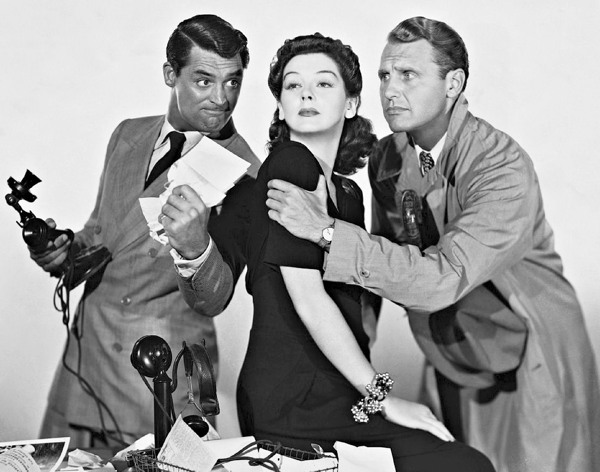
Cary Grant, Rosalind Russell, and Ralph Bellamy do the institution of the press no favors in His Girl Friday (1940).
And what does he get for all this? Insulted to his face, manipulated, robbed, thrown in jail repeatedly for crimes he didn’t commit, forced to tarnish his own reputation and seek bail from his colleagues back home, his mother is very nearly killed, and in the end he loses his fiancée to this tawdry world.
That’s the happy ending? That she breaks up with him? Sends him back home, penniless and lovelorn with his bruised and injured mother? That’s what we were rooting for?
Along the way, of course, there’s the case of soon-to-be executed murderer Earl Williams. His fate is tossed around casually—he is just a pawn in this game, and whether he lives or dies has nothing to do with justice and everything to do with the cynical machinations of powerful people, including Cary Grant and Rosalind Russell. People will be shot, some will have their livelihoods threatened or destroyed, bribes will be paid, people will be conned, and an innocent woman will throw herself out a window. And yet none of these calamities and calumnies will strike our heroes in any way as tragic or unfortunate.
Rosalind Russell hears a siren in the distance, her ears prick up. “That sounds like a swell fire.” This, our hero.
It isn’t as if Howard Hawks was a ruthless cynic who thought this was how people ought to behave. Nor Cary Grant nor Rosalind Russell, nor the writers Charles Lederer or Ben Hecht. These people were not monsters.
If we step back far enough and try to take in the broadest view, we can see that the message of the film isn’t necessarily so cruel: it tells us that people will be happier doing what they love, and they’re more likely to love doing what they’re good at; People who share the same interests and attitudes are probably a good romantic fit; The world is a dangerous place, and smart people who think fast have a better chance at surviving it.
It’s hard to disagree with any of that.
But then when you get down to the details, on paper at least it sounds like this film is a cesspool, right? But that’s not how it plays at all. These may be the worst people in the world, but they are immensely entertaining to watch, and His Girl Friday deserves its lasting reputation as a comedy classic. The key to its success is the ability in dialogue comedy to say and mean two different things at the same time.
His Girl Friday does several things towards this end, and all of them are dialogue-based. One is a sense of self-awareness: the movie knows this behavior is reprehensible, and Rosalind Russell’s character is the key conduit by which that self-recrimination is conveyed.
Then there’s self-referentiality. One of the most celebrated jokes in the film (kept in place over the objections of the studio) describes Ralph Bellamy’s character as looking like, well, like Ralph Bellamy.
Things like this are a way of winking at the audience, at maintaining that ironic distance necessary to present this story and have it feel like a delicious satire instead of a tragedy.
Cary Grant especially, as discussed in the prior chapter, is an absolute boon to anyone who wants to make ironic comedy. He has the rare ability to be enormously charming and seductive no matter what he says, and so he can be given a role that in narrative terms functions as the villain, but which his performance treats as the hero. Cast Jimmy Cagney or Peter Lorre in this role and suddenly you’ve got a very different movie. As Alfred Hitchcock found out the hard way, it doesn’t matter what you’ve written, Cary Grant can’t play a villain: he’ll come across as the hero no matter what.
His Girl Friday succeeds in a way that Making a Living cannot because its characters are capable of being emotionally engaging and attractive while at the same time being unpleasant and villainous.
It’s not that Chaplin isn’t capable of being charming—that would be a stupid position to take. And it isn’t the case that Chaplin can’t be charming while behaving badly—again, his body of work belies that. But Chaplin’s films require a significant amount of effort to establish him as a bad-behaving good guy, and need to shift his behavior within the film into that “good” space to maintain the audience’s sympathies. His Girl Friday briefly flirts with having Cary Grant do something noble and selfless in its finale, only to discard that idea and ridicule it.
And so this is where I’ve been driving throughout this discussion of the nexus between silent comedy and talkie comedy: it isn’t the case that sound killed silent comedy. Sure, some of the great silent comedians who dominated screens in the 1920s saw their careers hitch up, but let’s be careful about sweeping generalizations: Keaton’s personal troubles (a rotten marriage and the alcoholism it triggered) were a greater hurdle for him than MGM’s corporate policies (as we’ve seen, MGM was clearly amendable to making the kinds of movies Keaton should have been making, if he hadn’t been drinking himself to death at the time). Chaplin continued to make great films well into the 1930s and ’40s, and then blew up his audience goodwill with his own personal problems (a tendency to rob the cradle, coupled with an affinity for Marxism at a time when Red baiting was a popular sport). Roscoe Arbuckle was done in by the notorious scandal well before sound came along. Charley Chase made the change to sound with aplomb but found his career hindered by studio politics. And then there’s Harold Lloyd, who wasn’t held back by sound in any meaningful way, in fact willingly embraced it, and then showed an ability to adapt his comedy to the new aesthetics of screwball comedy.
The list goes on, but the point is, the conspicuous examples of silent comedy stars “undone” by sound are really better explained as individual cases of unique circumstances. Meanwhile the traditions of slapstick marched on just fine.
The advent of sound gave comedians and filmmakers a set of tools to do the things that silent comedy had already been doing, but do them more efficiently.