
Times change.
A 21st-century audience simply cannot watch something like A Florida Enchantment the same way the audience of 1914 did. Our modern perspective is forged by living and functioning in a world with a different set of notions about race relations and gender roles. Dealing with this issue, however, is one of the thorniest aspects of trying to cultivate interest in old-timey comedies.
Despite these festering wounds, I love silent comedy, and I do not wish to watch it slide into cultural irrelevancy. The only way to keep these films and these comedians even marginally, passingly, culturally relevant is to keep bringing new audiences to them—and the sadly plentiful racist gags that recur throughout these films are a significant barrier to that.
But not all racist gags are created equal. Consider what ought to be the third rail of American comedy—blackface. Touch it at your peril. It was a blackface gag in A Florida Enchantment which brought us to this topic, but for a moment let’s step outside the world of silent slapstick to watch how blackface was handled in the 1976 Richard Pryor/Gene Wilder buddy picture Silver Streak.
Director Arthur Hiller had been reluctant to work with Pryor—the comic’s reputation had preceded him, and Hiller was worried he’d be difficult. And, just once, he was.
The scene in question occurs when Pryor’s character is trying to help get Wilder’s character safely past the various federal agents who are out in force looking for him. He takes a can of shoe polish, a gaudy jacket, and a radio and tries to disguise this red-haired Jew as a black man. Gene Wilder rubs shoe polish on his face and leaps into the broadest, most cartoonish racial caricature he can summon. That’s a given. What happens next determines the context of this gag, and how the joke is pitched.
As written, the script called for a white man to enter the bathroom while Wilder was blacking himself up and accept the ruse, believing him to be black. That’s where Pryor drew a line. Although Pryor didn’t articulate what bothered him about the staging, it’s easy enough to figure out: in this version, the joke centers on the implication that this absurd racist stereotype is close enough to the truth about black people that it’s convincing. It gives audiences a place to laugh at black people.
Pryor instead suggested an alternate staging—why not have a black man come in instead, the shoeshine man for example, and immediately see through the incompetent disguise. “You must be in a lot of trouble,” he could say, and shake his head in disappointment at the world. Then, when Wilder later manages to fool the cops with this blackface act, the joke isn’t directed at black people, it’s directed at Wilder’s character and the foolish white people who can’t see past the fake skin color.
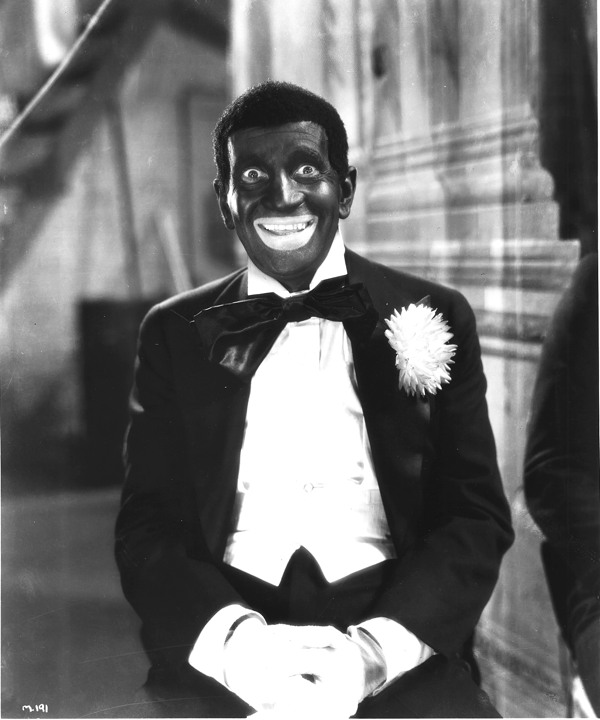
In addition to his blackface routines in The Jazz Singer (1927), Al Jolson made an entire film about blackface minstrelsy with 1930’s Mammy.
Pryor had to basically go on strike to force Hiller to shoot it his way—but he was right. Pryor’s version not only rehabilitated the ethical stance of the joke, he just plain made it funnier. It was one of the bigger laughs of the movie—a signature moment. A small tweak, but one that shifted the focus of the joke in a crucial way—and it’s to Pryor’s credit that he saw how to rescue the scene with such a subtle change.
With that example as a guide, let’s return to the realm of silent slapstick to examine how certain jokes are pitched, and how those nuances change the hurt.
Let’s start with the simplest, and least horrendous, of the jokes on offer—one I’ll call “The Black Reveal.” A good example can be found in Buster Keaton’s Seven Chances. Buster has to get married in a few hours or forfeit an inheritance—so he’s desperately proposing to every woman he sees. The proposals and rejections get faster and faster as he goes. As he walks down the street, there’s a woman ahead of him in a fur coat and fancy hat. He speeds up to meet her—and stops abruptly upon seeing that she’s black. No proposal is made—it is to be taken for granted that she’s not an option.
Of course, thanks to miscegenation laws, it was literally and legally true in many places that she was not a prospective bride, but I’m wrestling here with reconciling what these movies meant to their audiences at the time of their manufacture with how we watch them today.
As a silent comedy, this is a form in which nearly all of the jokes must be expressed in purely visual terms. Not only that, but since comedy depends so much on pacing, the joke not only has to land entirely visually, but it also makes a huge difference how long it takes the viewer to process what they’re seeing. If the punchline depends on rapidly revealing to the audience that once again Buster’s hit a matrimonial dead end, then having the “wrong woman” be a different skin color is a convenient visual shorthand that gets the joke across quickly.
We can see that in the numerous variations of this joke throughout the same film, what matters is the quick reveal, not the racial component. Earlier in the film Buster spotted a woman on the far side of the room. As he sat next to her, she lowered her newspaper to reveal—a baby on her lap! Moments thereafter he finds what he believes to be a possible bride—but once she’s removed her hat and coat she turns out to be a child, not a grown woman at all. (I should also mention that just before his encounter with the black woman, he tries to propose to a woman on a bench until he realizes she’s reading a Hebrew newspaper.)
There are different ways to handle this “joke” that show different degrees of tolerance and sensitivity. In His Marriage Wow, Harry Langdon performs his variation on the same gag. Harry leaves his wedding in a typically Langdonian state of disorientation and gets into the wrong taxi, next to a black bride. Instead of the scene being about his reaction to her, however, it’s about her reaction to him. She immediately starts screaming at this unwelcome intruder and hammering her fists on him until he leaps from the moving vehicle into the arms of his actual bride. Not unlike Richard Pryor’s fixes to Silver Streak, this was a way to deliver largely the same visual gag but pivoted so as not to be about laughing at the minority character but laughing with them.
Nevertheless, the essence of the Black Reveal is the concept that on sight, based solely on skin color, one can make conclusions about a person’s place in society, their capabilities, their worth as a person. It may be a visual shorthand, but that visual shorthand is the very basis of racial prejudice.
Of all the Black Reveals I’ve seen, one stands apart from the others and deserves a separate mention of its own. It occurs in the Charley Chase short Isn’t Life Terrible, in which Charley sets out on an epically disastrous family vacation. Early on, he accidentally takes the hand of a different girl instead of his daughter’s hand, and only later realizes he’s taken the wrong child along and left his own daughter behind alone. And, perhaps because the skin color difference helps telegraph the joke best in the accelerated pace of this two-reel silent short, sure enough the wrong kid on his arm is black. In any other film of the era, that would be the punchline—a quick “a ha!” reaction as he sees the girl is black, some quick panicked double takes, and then move on. But Charley Chase has set up the premise so that there’s no way to swap the kids back again, so after that first “a-ha!” gag, the black girl stays in the film as his ersatz daughter. Suddenly the joke has changed—instead of being about the reaction to her skin color, it becomes an extended sight gag. More to the point, the sight gag isn’t at her expense, or to do with any racial stereotypes—it’s just indulging in the visual incongruity, back in the days of racial separation, to see a white family with a black child. She continues to be treated as their child, though, as if skin color is just a mask…1
Which brings us to Racial Joke #2: “Swapping Colors.” This can refer either to white characters getting blacked up or black characters getting whiteface on.
Once again I’ll lead with a Keaton example, this time from College. Buster’s character has to disguise himself in blackface to get hired as a waiter. When the girl he loves and his romantic rival come in to eat, he only escapes the humiliation of being recognized as their waiter because he looks black (sort of). In other words, once again here’s a situation that’s using the racial angle as a visual shorthand—in a modern comedy, you could have a similar premise but have the comedian use other means to hide their identity (a fake accent, for example, or other sort of disguise).
Also notable, Keaton’s shuck-and-jive routine is contrasted directly with the actual black waiters and waitresses around him who seem perfectly competent at their jobs. Keaton, meanwhile, catastrophically misunderstands the in/out system of the kitchen doors, can’t take or deliver orders correctly, and seems generally unsuited to any aspect of the job. As with Pryor’s redo of the blackface gag in Silver Streak, this blackface sequence ends up doing nothing but making fun of Keaton’s character, not the African Americans he’s trying to pass as.
One comedian who used blackface (and whiteface) extensively was Larry Semon. I’m not sure I’ve ever seen a film of his that didn’t at some point have a white character get a bucket of paint dunked on his head, or a black character get coated in white flour. Or both.
I’ve never quite known what to make of Semon’s seeming obsession with this kind of joke. I definitely get the feeling he thought there was nothing funnier than seeing a person who appeared to have changed skin color. But exactly what made that funny is up for debate. Is it because changing races is so transgressive, that just to think of the taboo is hilarious?
Racial Joke #3 is “The Scaredy Black.” The idea here is linked, on some level, with the role played by supporting comedians of all races to help their top-billed stars land the jokes. The slapstick shenanigans of silent comedians needed someone to react to them, to help the jokes go bigger. Comic performers like Edgar Kennedy or Jimmy Finlayson basically built their careers on making funny reactions to the havoc unleashed by the likes of Laurel and Hardy. So, it’s not necessarily a bad thing that there were so many black performers like Spencer Bell, Curtis McHenry, and “G. Howe Black” whose paychecks came from making funny double takes…
Except, all these black supporting players were there to act scared. Edgar Kennedy got to simmer like a pot set to boil over, Homer Simpson’s “D’oh!” is the direct descendant of Jimmy Finlayson’s annoyed grunt. There were an array of ways to react to slapstick, unless you were black, in which case abject terror was all that was on offer. And since it traded on longstanding stereotypes of black Americans as superstitious and ignorant, no matter how brilliantly Bell and his colleagues sold their scaredy acts, they reinforced an oppressive system.
Fans of slapstick comedies have a reflexive defense that seeks to minimize the hurt inherent in these images. “You have to watch these films through your 1920 glasses.” For example, in his book The Funny Parts, film historian Anthony Balducci makes the claim that back then “everyone was fair game as long as a stereotype served the plot or made people laugh.”
The problem with that defense, however, is it speaks from a position of unacknowledged privilege. No matter how stupidly a white comedian behaved, it wouldn’t incline audiences to think of white men as inherently stupid. There are simply too many disparate pop cultural representations of white men (rich, poor, dumb, smart, heroic, villainous, decent, cowardly, etc., etc.) that no particular representation holds any special power.
But minorities—be they racial, religious, sexual, what have you—get such infrequent representations, how they are portrayed in those limited roles takes on disproportionate weight. And when those portrayals conform to existing prejudices, it only serves to reinforce those attitudes, in an endless feedback loop.
The way the media depict minorities is fundamentally part of this—the images of black men in the media have a direct influence on the life expectancy of a black man caught up in any interaction with a cop. To argue that everyone is equal game for stereotypes is to suggest that stereotypes have an equal effect on all people, which is demonstrably untrue.
There is another problem with the reflexive defense of “Slapstick comedians were equally opportunity offenders. Everybody got theirs.” That’s sometimes true, but not always, and the devil is in the details.
By way of illustration, consider Charlie Chaplin’s The Immigrant (by the way, one of my very favorite films of all time. If my house ever catches fire, I’m running back in to save my print).
The Immigrant came out in June 1917. Now, just four months earlier, Congress passed the Immigration Act of 1917. At the time, the country was gripped by the same asinine xenophobia and nativism as it is today, and there were politicians then who whipped up anti-immigrant scapegoating for their own benefit.
President Wilson vetoed the thing, but the groundswell of anti-immigrant hysteria was enough to override the veto and get the Immigration Act of 1917 into law. The Act declared most of Asia as a “Barred Zone,” forbidding immigration from the entire region. It enumerated the types of “undesirables” who would be barred from any country: “homosexuals,” “idiots,” “feeble-minded persons,” “criminals,” “epileptics,” “insane persons,” alcoholics, “professional beggars,” “mentally or physically defective persons,” polygamists, and anarchists. And it imposed a literacy test to exclude the uneducated.
Notice how many of those “undesirable” character types describe Chaplin himself, or his screen persona? This did not go unnoticed. The biggest movie star in the world knew firsthand what it meant to be unwanted and adrift, to be hungry and destitute, to be distrusted. He knew alcoholism and madness first hand. He made a living playing criminals and beggars. And so, he made a movie.
It happened backwards. He’d been working on a film about slapstick shenanigans in a restaurant. As he improvised on camera, he hit upon the idea that it would be funny if his character had never been in a restaurant before, and this opened up whole new avenues of jokes. As the thing developed, though, he realized it was funny without making a whole hell of a lot of sense. He needed some context. He needed a first act.
And so, working backwards to justify a situation in which a grown man has his first encounter with a restaurant, he decided his first act would be about watching this guy immigrate to the United States.
But here’s the sheer brilliance of the set-up: Chaplin gets a lot of sharp jokes in about the very things the xenophobes were anxious about. The film shows a boat full of poor people, who don’t speak English, who eat weird smelling food, and bring various diseases and criminal activities with them. If you’ve got a chip on your shoulder about immigrants, this film has jokes that come from your perspective. Only, they don’t quite land the way they seem to be aimed.
Instead of appearing like a mass of dangerous unassimilable others, the immigrants in the film are portrayed as sympathetic people. For all the differences that are depicted, they are fundamentally like us. Audiences had been watching Chaplin cavort through two-reel shorts for three years by this point, and there’s little in The Immigrant they hadn’t seen in one form or another before. These people aren’t so different after all, the film seems to whisper.
Charlie Chaplin was the world’s most highly paid entertainer. The entire film industry has been reshaping itself around him. Put his name on a film and it will turn a profit, simple as that. He’s so marketable, films that have exactly nothing to do with him are using lookalikes to try to buffalo audiences and cash in on his appeal. In other words, he has power. He can do literally anything and the audience will follow—so he plays an immigrant. He plays an immigrant who can’t read and has no money, one who is clearly willing to at least consider theft and murder even if he doesn’t go through with it.
Under the law that was just passed, this guy would be barred from entry. The most popular performer in the world uses his bully pulpit to show that, if you’re going to draw up lines of us versus them, he is choosing the “them” side. Chaplin is siding with the outsiders, the excluded, the unwanted. This isn’t casual or coincidental, this is the politics of the personal.
He doesn’t have to do this—he’s already in. He’s safely integrated, he’s rich and powerful and comfortable. If he wanted to, he could poke merciless fun at those smelly foreigners and their funny accents and we’d all laugh with him, at the powerless and the downtrodden. But this is an artist who has always chosen the path of mercy, and inclusion.
Meanwhile, Chaplin’s chief copycat, Billy West, dropped a needless little nugget of racist comedy into his 1917 short The Hobo. West plays the caretaker of a train station, and nestled in the middle of an otherwise quite well-made and amusing short film, he meets a “black” couple who have come to collect their children. The adults are white actors in crude blackface, and the wife of the couple is an enormous man in drag. The children are a gaggle of about a dozen kids, who have evidently been stored in a locked storage bin with a handful of air holes. After releasing the kids from the locker, Billy West gives them a huge watermelon to eat while sitting on the train tracks.
I know, hilarious, right?
There’s no tolerance there. It’s just pointing and laughing at the other. It’s just mean spirited, and the very essence of the joke presupposes a division between the people being pointed at and laughed at, and the people doing the laughing.
Back in 2008 I somehow managed to attend three separate theatrical screenings of the exceedingly obscure silent comedy Uncle Tom’s Gal starring Edna Marian. There’s a cruel irony in the fact that the film gods saw fit to preserve this horrifyingly ugly monstrosity for posterity while films like Laurel and Hardy ’s Hats Off vanished off the earth. I know it’s wrong for a film geek like me to ever wish for a film to be destroyed, but all I’m saying is, if a film had to be destroyed, I’d rather live in a world that still had Hats Off but had lost this.
Some background: the book Uncle Tom’s Cabin was in its day intended as an anti-slavery tool, and by depicting the terrible reality of slavery in the South helped encourage abolitionists. Problematically, the novel’s depiction of the slaves was also tainted by stereotypes that later became so vilified that the book became more notorious for its racist content than its anti-racist agenda—in other words, the book Uncle Tom’s Cabin became a victim of the very cultural shift we’re talking about here, left behind by a society that moved on.
In the short comedy Uncle Tom’s Gal, a movie company is making a film of Uncle Tom’s Cabin, and for no reason at all has decided to shoot on Edna’s farm. She’s an avid movie buff given to daydreaming of being a star, and she insinuates herself into the production. Early in the picture, Edna sidles up the camera with Hollywood glitter in her eyes. Already, the film is starting to offend on several levels: first is the way the horrifying caricature of slavery itself (with such lines as “Now you charcoal babies belong to me” and the image of the plantation owner brutally whipping his slave) is just jarring to find in a comedy. This was the problem with the book Uncle Tom’s Cabin—the text itself hits wrong notes and raw nerves. Problem #2 is that the “filmmakers” have cast white actors in blackface. And problem #3, is the way movie-struck Edna reacts to all this racial cruelty with giggly, giddy glee.
What’s she smiling about? It sure looks like she’s getting off on watching a black man being whipped. That can’t be right, can it? Surely she’s just excited by the prospect of being so near a film crew … but that’s not what it looks like.
Soon, Edna fully insinuates herself into the movie and is cast as the leading lady … in some of the grimmest, meanest blackface you’ll ever find.
At each of the screenings, the hosts screening it gave some variation of the apology “This movie was made in the 1920s, things were very different back then and this will be very un–PC comedy. So, put on your 1925 glasses to enjoy this.”
I get what they were trying to say—that films like this are artifacts of a different world that operated under different values and we cannot fairly expect things from the past to fit with the way we think about things now. Or, to cast out another hypothetical for use as an analogy—what if a future society decides that images of men dressing up as women constitutes a horrifying gender-based hate crime. Suddenly, old episodes of Monty Python’s Flying Circus and The Kids in the Hall would be tainted with negative cultural associations that they do not now have. Most of the time The Kids in the Hall handled gender issues with great sensitivity and nuance, not only better than other comedies of the 1990s but better than most dramas. If a future society were to re-interpret those images with negative connotations, it would fundamentally distort what the original was meant to convey.
Fair enough, but you cannot say that Uncle Tom’s Gal wasn’t offensive in 1925, that people weren’t hurt or humiliated by the dehumanizing imagery. What you can say is that the people who found it offensive or who were humiliated by it were not in a position to voice their discomfort openly. A mainstream audience of whites were permitted to laugh at this, to vicariously mock blacks, and never have it questioned. Yes, in today’s PC culture that joke crosses a line that hadn’t been drawn in 1925—but saying the line hadn’t been drawn openly isn’t the same thing as saying there was no line.
It’s more comforting, certainly, to tell ourselves that these old comedies were harmless. But ignoring someone’s hurt doesn’t erase your guilt. Nelson from The Simpsons once described “a victimless crime” as “punching someone in the dark.” Mean-spirited jokes that poked fun at ethnic minorities, at gays, at women, at foreigners—these jokes had victims. And in the pre–PC days, those victims were effectively silenced, which gave the illusion of no victims. But notice how the people who usually say, “It’s all in good fun” are the ones making the joke, not the ones receiving it.
When I go to classic film festivals, or revival screenings, or other gatherings of film geeks, what I see is a crowd of predominantly white, middle-aged men. People who look like me. Showing a film like Uncle Tom’s Gal doesn’t do much to open that tent to people who don’t look like me. And when people who do look like me debate how offensive this stuff is, we do so at a remove—we can never really know how hurtful a stereotype is, if it isn’t our stereotype.
I’m no censor. That Billy West scene I described above—the one with the family eating watermelon? I’m the guy who restored that film and published it on DVD under my own label. Real censors don’t usually go out of their way to show you the thing they want to suppress. Even though I find that joke deeply offensive, I didn’t cut out the scene (although I could have and few would ever have known the difference). Instead, I made a point to buttress that short with what I considered counterexamples—I packed in some Ernest “Sunshine Sammy” Morrison shorts.
When he was less than eight years old, he was sharing the screen with Harold Lloyd—arguably, upstaging Lloyd. He went on to be the primary supporting costar to Snub Pollard, and then producer Hal Roach gave him a fulltime contract. It was the first long-term movie contract given to a black actor in Hollywood. Roach started hiring other children to surround Morrison in his own starring series—and this is how Our Gang began.
Eventually, Morrison got too “old” and Our Gang continued on without him—so when the Little Rascals did their version of Uncle Tom, called Uncle Tom’s Uncle in 1926, it was up to Joe Cobb to put on the blackface and be whipped by Mikey Daniels. Because that’s what you want from comedy, right?
When I watch Morrison, what I see is a sharp-minded kid who adheres to no stereotype. But that’s just me—not everyone saw him the same way. As the Civil Rights era dawned, Morrison was shoved aside—along with so many other black comedians of his era, who were perceived by a new generation as having been Uncle Toms themselves.
Such as Mantan Moreland—a brilliant comedian whose presence enlivens many an otherwise trashy B-movie. Moreland almost always upstaged his costars—we’ll encounter him again later in this book, stealing the attention away from Lucille Ball. Comedians of that caliber are few and far between.
The curious thing about Moreland is he had two discrete personas. One was more in the mold of the dumb black servant, a role he played—and ennobled—in films like King of the Zombies (you should absolutely watch this movie, but only because of him; if he weren’t in it, it would be justly forgotten). But that was in movies aimed at whites. At the same time he also performed live and in low-budget films aimed exclusively at black audiences, with a different shtick. Left to be himself, Moreland’s comedy was sped up to a crazy degree. He and whatever comedian he’d be with at the moment would banter back and forth so quickly they trampled all over each other’s lines, running out ahead of the dialogue and racing off into oblivion. It was a singular act, depending on a razor-sharp comic timing that would exhaust almost anyone.
Moe Howard loved Moreland’s double-talk act. When Shemp died, and the hunt was on for a new third Stooge, and under pressure to push the Three Stooges away from violent slapstick and into dialog comedy, Moe proposed Moreland. The execs at Columbia rolled their eyes and patiently explained to Moe that under no circumstances were the Three Stooges to be integrated.2 Joe Besser got the gig instead (in the parallel universe where Mantan Moreland joined Moe and Larry after all, the Stooges kept making shorts long after the Moe-Larry-Joe combo fizzled out).
Moreland later complained that the worst thing to happen to him professionally was the Civil Rights era, as he was shoved into obscurity by a generation that felt instinctively embarrassed by him.
So, here I am, 21st-century white guy, looking back at Morrison and Moreland as examples of black comedians whose acts don’t strike me as racially problematic, and whose memories I wish to rehabilitate in the face of this overly sensitive backlash that suppressed them … but who am I to say that Mantan Moreland wasn’t offensive? If it was blacks in the 1960s who said he was an embarrassment, what gives me any authority to disagree? Even if I could draw a line between “these comedians were offensive Uncle Toms selling out their race” and “these comedians subverted the system,” the result would be to lend support to the notion that some comedians from the past deserve to have had their careers destroyed, their films suppressed, and their names forgotten.
But these kind of arguments fly above the level at which most people engage with movies—and certainly the level at which kids engage with movies. The problem with letting the unreconstructed sexual and racial attitudes of the past out today without some kind of filter, is that they propagate their worldview into younger viewers. I know that makes me sound like I’m more worried about today’s kids being corrupted by watching too many old movies than by watching the anything-goes stuff of contemporary TV, which must make me sound insane, but since I spend so much time trying to cultivate new viewers for old movies, it’s an issue that weighs on my mind.
Black faces appear rarely in silent comedy. When they do, they are the butt of mean-spirited jokes more often than not. At best, and this is pretty rare, they are neutral figures in the background. This is unfortunate, and because it’s in the past we can’t change it. Acknowledging it is better than trying to pretend it wasn’t hurtful.