
Marie Dressler’s 1914 comedy feature Tillie’s Punctured Romance is a hugely important work in film history—just about any film reference will tell you so. Here’s what Wikipedia has to say: “Tillie’s Punctured Romance is notable for being the first feature-length comedy in all of cinema.” Wow. I mean, right? Just wow.
Except … it’s hard to give credit to Tillie’s Punctured Romance for being the “first feature-length comedy in all of cinema” when there was another feature-length comedy released four months earlier, on August 10, 1914. And you want to know the best bit? This earlier film, arguably the true first comedy feature in film history, is a gender-bending treat that suits today’s mood much better than the fusty old melodramatic complications of Tillie’s Punctured Romance.
The film in question is A Florida Enchantment by Sidney Drew. It is fabulous by many measures, but let us uncover its fabulousness in stages:
The story begins when Lillian Travers (Edith Story) makes a surprise visit to her boyfriend Dr. Cassadene (Sidney Drew). The surprise is on her when she catches him in what sure seems like a comprising position with a wealthy widow. He makes the requisite apologies, they make up, but it all goes pear shaped again when he blows their next rendezvous, once again caught with the same widow. She gives him a third chance—and as she comes out of her house to meet him, there he is, entangled in the clutches of three fawning women. If this were any other movie, you’d expect Lillian to blow her top and walk out on him, continuing the cycle of sit-commy complications that you’ve come to expect by this point.
This is where things veer sharply off course.
Lillian comes into the scrum of clingy ladies and gives Cassadene the cold shoulder. Instead, she plants a big wet one on the respective lips of the pretty young things. What Cassadene doesn’t yet realize is that there is no point in his apologizing. She just isn’t that into him anymore. His sweetie has taken a weird drug that changes people’s sex. She’s started growing facial hair, and developed an interest in women.
She fakes the disappearance of “Lillian” and adopts a new identity as “Lawrence Talbot.” Yep, werewolf fans, she beat ole’ Lon Chaney, Jr., to that name, and helped establish its pedigree as the name for a person with metamorphic abilities.
Eventually, the farcical complications of Lillian/Lawrence’s transformation implicate Cassadene, and he takes the same drug—and instantly becomes a mincing, preening stereotype. For those of you who don’t know of him, Sidney Drew was a master of awkward comedies of social manners. Given his fussy mannerisms, it’s a short hop to feminizing him all the way.
To be clear—these are very broad stereotypes. But what’s striking is that the stereotypes are not played hurtfully—they are simply used as an efficient visual shorthand to get the admittedly offbeat idea expressed quickly, without words, in a film with a tight running time.
Role reversal comedies are a genre unto themselves, and this early example of the form plays by much the same rules as Tootsie or the like. But to find this kind of gender-bending comedy in 1914 is startling. The sexual stereotypes are clumsy, but you could condense this film down and restage it as a Saturday Night Live sketch today.
A Florida Enchantment was based on a book by Archibald Clavering Gunter. With a name like that, you know it’s gotta be old. The book was written in 1892 (if you’d like, you can find the text online for free), and by the time Sidney Drew got to it, it had already been adapted into a play.
Sidney Drew was an established stage performer from a prominent theatrical family—he’s the uncle of John, Lionel, and Ethel Barrymore. In 1911, much to the snickering of his Barrymore clan, he joined the flickers and started making short comedies. By 1913, he was one of the leading lights of the Vitagraph company, where he specialized in domestic farces. Thanks to his fame and talent, he was in a position to exert some professional control over his work, and A Florida Enchantment finds him not only starring, but producing and directing as well.
Let’s linger on that—as I’ve mentioned before, there is a line of thought among some film historians that would have you believe that this kind of auterist comedy was the sole province of Charlie Chaplin, Buster Keaton, and Harold Lloyd—indeed, that their status as the “Three Geniuses” derives from their unique role as the sole Hollywood clowns who made their own films. Yet here we find a largely forgotten name, Sidney Drew, exercising that kind of personal artistic vision as well.
His auteurship continued—and by 1918 he’d started his own production company (the VBK company) to make comedies for Metro.
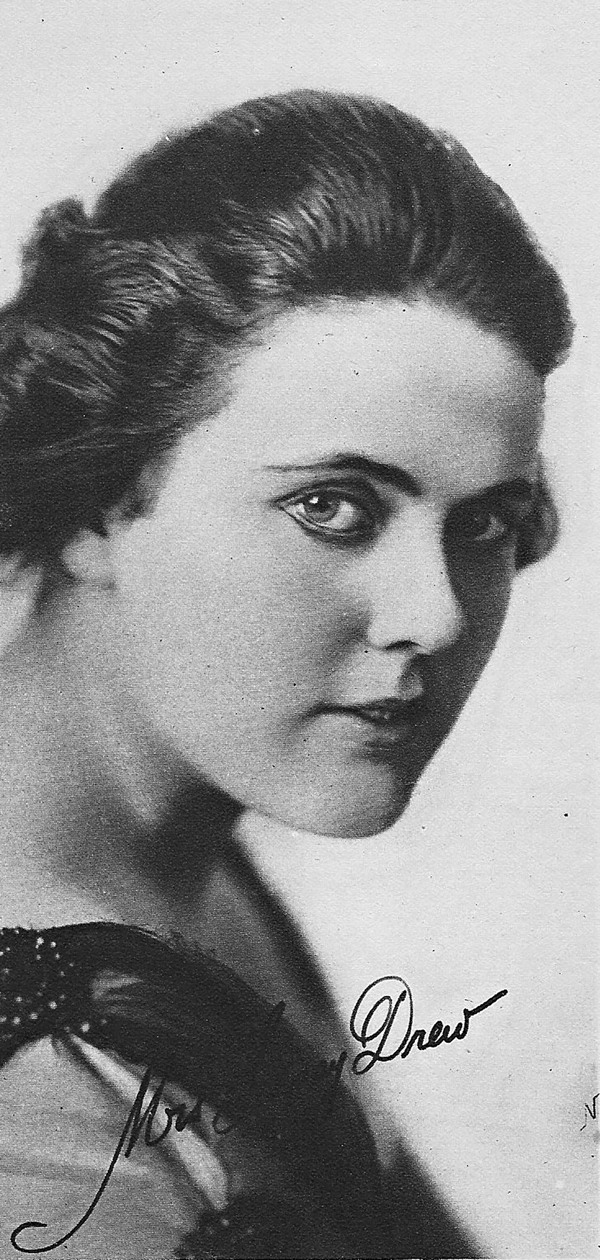
A Florida Enchantment was released about a month after Sidney Drew got married to one of his co-stars, Lucille McVey (using the stage name Jane Morrow). She plays “Bessie” in the film. She fairly instantly graduated to bigger things—marrying Drew and becoming “Mrs. Sidney Drew” in his continuing cycle of short comedies. This is significant because the “Mrs. Sidney Drew” role had been a component of Drew’s act all along, dating back to his days on the stage. The original Mrs. Drew, Gladys Rankin, was also a screenwriter (more gender-progressivism from the Drew clan!) and an integral part of Drew’s life, both at work and at home. Her death at the end of 1913 was a horrible, tragic loss for Sidney.
Edith Storey (left) shows Jane Morrow a good time in the ground-breaking gender-bending comedy A Florida Enchantment.
Her passing was a cruel blow, and the speed with which he remarried should not distract us. He set out to make A Florida Enchantment while he was grieving—and its story, about a couple who decide to soothe their heartache by remaking themselves as new people, carries added poignancy with this knowledge.
As for whether this counts as the “first feature-length comedy in all of film,” we can debate that if you want. Because to be fair, some of the historians who venerate Tillie’s Punctured Romance as some kind of significant landmark are circumspect about how they phrase it, inserting qualifying words to gerrymander Tillie away from anything that might challenge it—Mack Sennett had that film before cameras in April 1914, and was finished as of July 1914, before Enchantment was finished.
It may be the first feature comedy, but who knows. I just happened to see A Florida Enchantment at a film convention more or less by accident, without knowing anything about it beforehand, and so I have to admit that there may yet be other worthy discoveries still buried. No point sticking my neck out to make claims I can’t back up.
The primary reason anyone still watches Tillie’s Punctured Romance is its alleged status as the first American feature comedy. Actually sitting through it is a bit of a chore. Tillie has an excellent cast, but they don’t get to do anything all that funny. Perhaps in 1914, its style and content connected more viscerally with audiences, but very few people today find Tillie especially entertaining.
Which means the best part of this anecdote is, the fact that Sidney Drew got there first isn’t even the best part of his accomplishment. Being first is a fairly drab kind of triumph, the sort of thing that appeals to a Guinness Book of World Records mentality. Drew’s film does something much cooler: it’s still funny today.
Indeed, there is some evidence the film works even better with today’s audiences than with 1914 ones. Variety hated it so much in 1914, its reviewer wrote that the film should never have been released at all. And the fact that it is virtually unknown today, compared to Tillie, suggests that it wasn’t a huge popular success in its day. But no matter—it works perfectly today, and with one exception needs no apologies.
That one exception though is for the blackface. (Deep sigh.) What can I tell you? It’s set in and was filmed in Florida, and the characters have black servants. White actors were cast in these roles, and made up to look black. The racial stereotypes aren’t any worse than usual for the era, but just putting someone in blackface has so much negative baggage already, the damage is done.
That being said, though, this is a film about the slipperiness of identity. Men become women and vice versa—why not swap races while you’re at it? And this brings us to one fleeting moment of near-redemption:
Lillian has forcibly administered the sex-change drug to her maid, and the man-maid immediately makes a pass at the other maid. And in this sequence there is a brief moment where the man-maid (played by Ethel Lloyd) starts to powder his/her face aggressively … and we have the possibility of having a white actress playing a black man pretending to be a white woman. There is no payoff, but there are times I fantasize about that scene continuing, Ethel layering fake whiteface on top her blackface, and playing a woman as a man as a woman…