
Every written thing, in the end, is destined to collapse into dust, and even the hand that writes it is reduced to a skeleton. Lines and words fall from the page, they crumble, and it’s from these little dust piles that little rainbow-colored beings spring out and start leaping. The vital principle of all metamorphoses and all alphabets begins its cycle over again.
—Italo Calvino, Collection of Sand
If you have a secret, either conceal it or reveal it.
—Arab proverb
BLUES BROTHERS
The Blues Brothers weren’t the only ones on a mission from God. So, too, were a few solitary inventors, whose achievements we’ll take a look at now. Only rarely are scripts born from the mind of a single person and in a single sitting—and when it happens, like it or not, we brush paths with the transcendental. The creation of any script is mythical, invariably tied to some story of divine intervention, perhaps its own Genesis. So it was for the Egyptians and the Mesopotamians, and with the Chinese, too, we encountered similar inspirations. It’s odd, but it’s precisely in those cases where a script is invented solo that the intervention of God, or the gods, becomes inevitable. You’d almost think that we humans were incapable of doing it on our own.
What we’ll be examining here, however, are not inventions in the truest sense, like those we explored in previous pages, but reinventions, adaptations of preexisting systems with varying degrees of exposure and comprehension. They’re also constructs, writing systems designed ad hoc, and therefore artificial instruments. This gives us reason to reflect on the underlying motivations, which vary widely among our lone-wolf inventors. What is it that inspired them? The desire for secrecy, to reveal a prophecy, or else the ambition to create an inclusive tool with a clear goal in mind? Buried enigma or universal language? We shall see. In all of these cases, I’ll say right off, the true inspiration is not so much God as it is the plain old alphabet.
Our lone cowboys of writing, though driven by different motives, have something in common: they are all visionaries, prophets, in the spiritual sense, but in the earthly sense, too. They are not, at least not all of them, your typical polished academics, experts in their field, but they nonetheless demonstrate a remarkable gift for linguistics and a very, very keen sense of intuition. A few of them are totally illiterate, and yet no less brilliant for it. And of all the things they might have invented, it shouldn’t surprise us in the least that the challenge they took upon themselves was writing. Invented scripts are magical, steeped in mystery, with secrets to conceal. Invented scripts are a test of our cognitive abilities. They’re a dare, and like all dares they’re irresistibly magnetic. Though that’s not to say, at least in these cases, that they’re any less artificial. Invented from an armchair.
MIGRAINE
Even a headache can lead to a script’s invention. I present to you the abbess Hildegard of Bingen. Born more than nine hundred years ago, she spent practically her entire life in the confines of a monastery on an isolated hill in the Rhineland. In her more than eighty years on earth, she composed music, illuminated manuscripts, essays on biology, botany, medicine, theology. Hildegard is one of the few identifiable musical composers of the medieval period. And a woman, at that. From her stone cell, known also as “the tomb,” she dispensed advice, organized the lives of her fellow sisters, and, above all, she had visions. Her visions were strange, since Hildegard seemed to see the world in a radical Technicolor 3D—dissociative hallucinations, lights and auras mixed with excruciating pain. She described everything in minute detail, illustrating what she saw in almost Chagall-like visionary drawings (though with a medieval touch).
Hildegard also provided us with an interpretation for her sickness: she attributed it to a divine revelation encompassing all five senses, “a ferocious light of extreme brilliance,” as she put it. In a word: God. The neurologist Oliver Sacks, however, retroactively diagnosed her with a hellish case of chronic migraines, of the sort that can drone on for more than seventy-two hours. And it may be, in this case, that science wins out over religion. Hildegard isn’t the only one who’s experienced these kinds of visions.
Those who’ve suffered them describe a phenomenon that could very well explain what Hildegard went on to create: thoughts that emerge in a cryptic wave, the decoding of a creative message, a secret. Hildegard was able to channel her hallucinations into a concrete idea. One hell of an idea. Hildegard seized that torrent of thoughts and put it to real use. At forty-two years old, she received a message telling her to write “what you see and feel.” And so she invented a script with twenty-three signs, a revelatory alphabet. Litterae ignotae, she called it, and she used it to record a lingua ignota. Hildegard’s alphabet is a highly intellectual, highly erudite secret code, drawn directly from Medieval Latin (fig. 26).
What practical use did it serve? We have no idea. Perhaps she intended her litterae to be an unbreakable code, an enigma hidden beneath sacred letters, a guarded secret. Or perhaps Hildegard was more ambitious and wanted to create a universal communication system, steeped in God’s message. A means of spreading His word around the world. We’ll never know, because with all that Hildegard left us—first among which, her marvelous and deeply felt chants—she gave us no indication of the purpose behind her script. What we do know is that Hildegard could not have invented a script and a language (of which we possess only a few lines, based upon Latin grammar) in the throes of hallucination. Her design is articulate, studied, lucid. A shame, really, for something so elegant and refined to be totally useless.
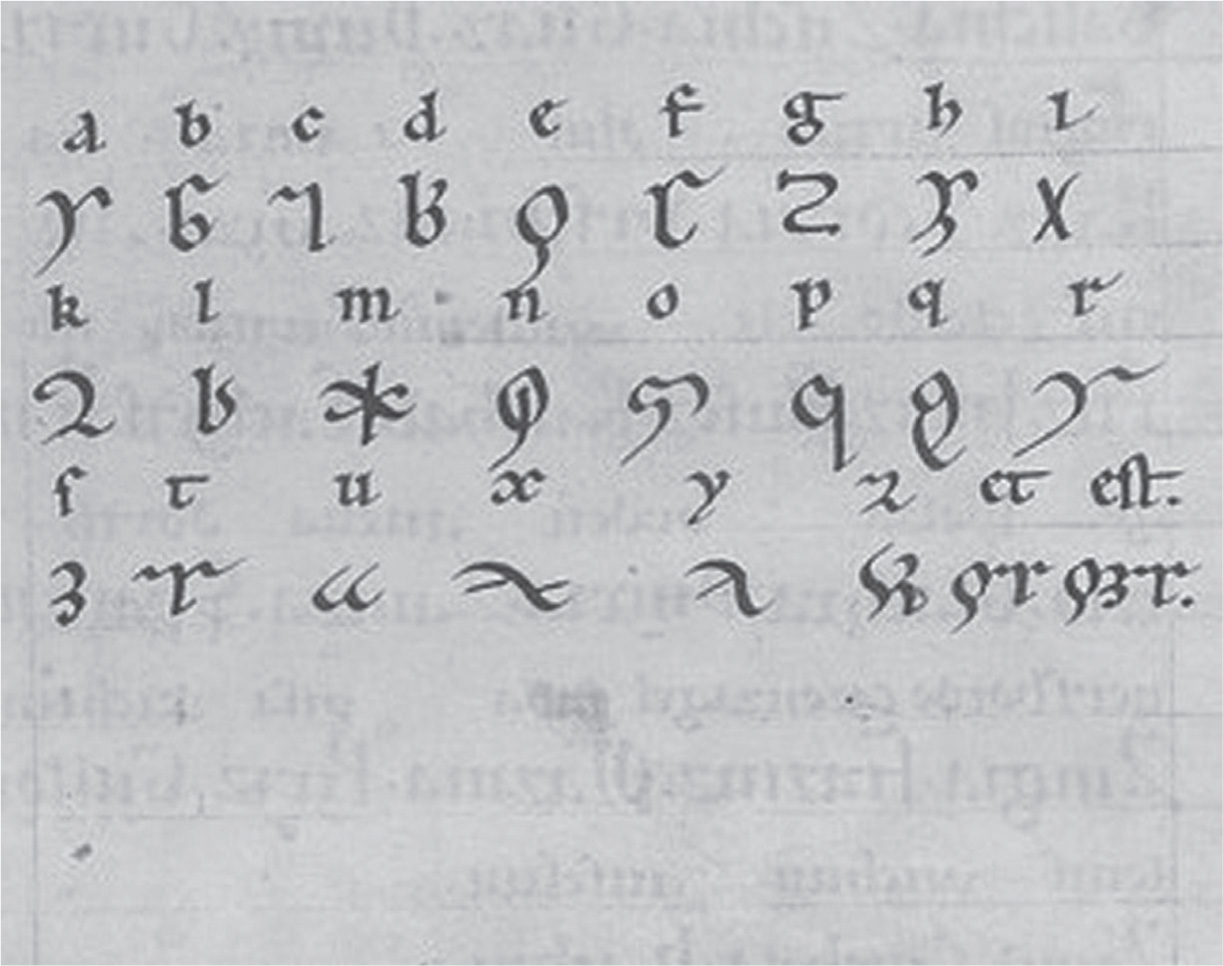
26. Hildegard of Bingen’s alphabet, the so-called litterae ignotae
THE ALCHEMIST
A two-hundred-page book, and no one’s ever read it. Carbon-dated to the fifteenth century, the manuscript goes by the name of a Polish bookseller, Wilfrid Voynich, who purchased it in 1912 in Villa Mondragone, southeast of Rome, where the Jesuits kept rare manuscripts. The book is meticulously illustrated with fantastical images: chimerical plants and flowers, silhouettes of nude women, a profusion of alchemical diagrams (fig. 27).
At first glance, the images can seem to be an incoherent hodgepodge, but a more careful look reveals that the manuscript is divided into themes: botanical, the zodiac, medicine, drugs, curative baths (hence the naked women), recipes. It almost appears to be an encyclopedia of the current science, a medical manual when medicine was still tied up with alchemy, astrology, leaves, herbs, and roots. That we can deduce this theme at all we owe solely to the illustrations, since the writing, with its sinuous and fantastically elaborate characters, found in no other text, is illegible. A well-encrypted code, it would seem.
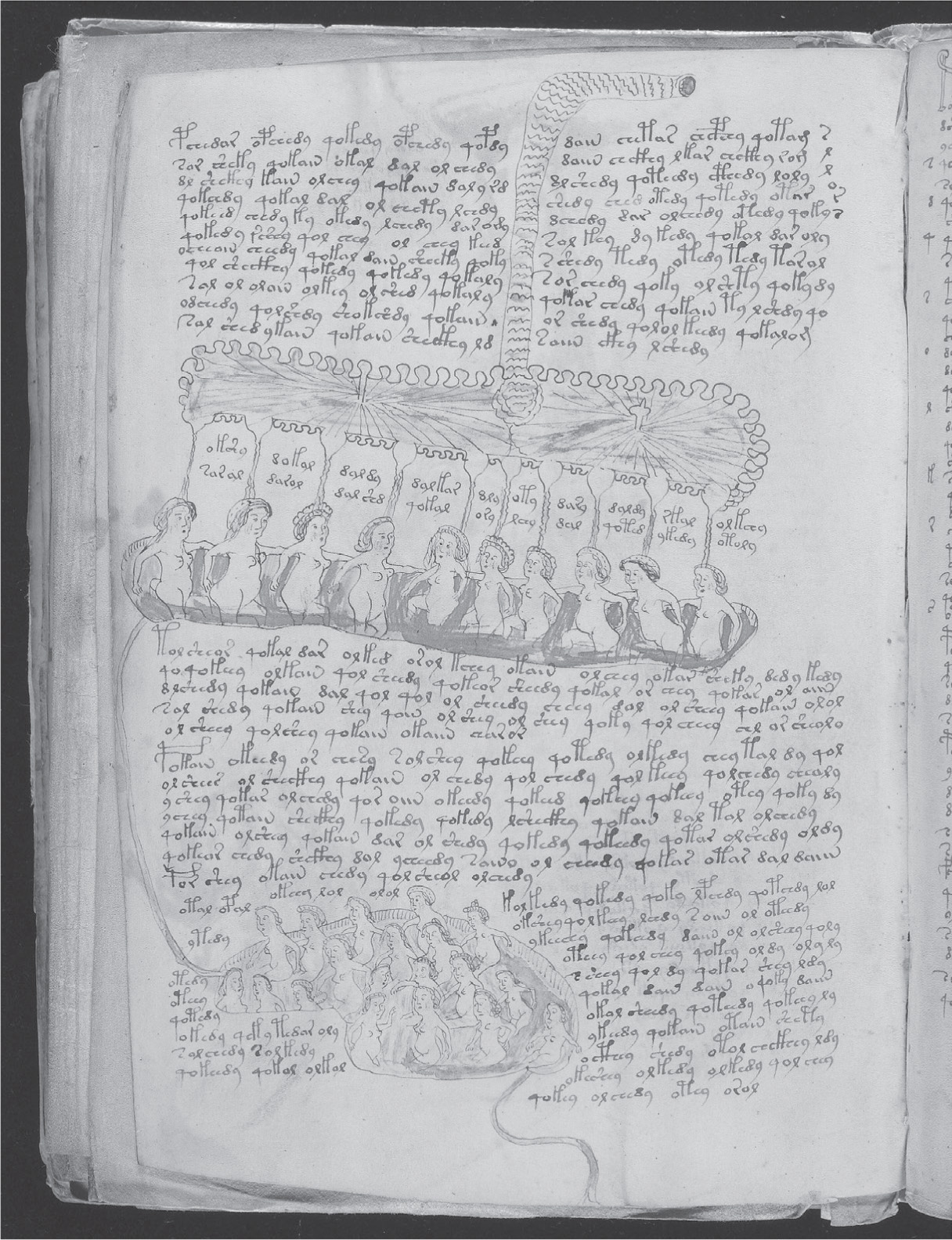
27. A page from the Voynich Manuscript depicting the “bathers”
Human beings have always sought ways to encrypt messages: military communications, love letters, state secrets. There are numerous ways to go about it, from the cipher developed by Julius Caesar, who employed an extremely simple substitution method, where each letter in the plain text is shifted a certain number of places down the alphabet (“a” becomes “b” and “b” becomes “c,” for example), to our modern-day cryptosystems, generated by supercomputers, like the one-time pad (OTP), which are impossible to crack. So where does the Voynich Manuscript sit along this spectrum of decoding possibilities?
It’s a difficult question. We know that the writing system is alphabetic, since the inventory includes just thirty signs in all. The total number of characters, however, sits around one hundred and seventy thousand, interspersed with an entire universe of graphic details (at least a million!). One hundred and seventy thousand is no small number—with modern decryption technology, deciphering the Voynich Manuscript is not quite like putting a man on Pluto. It should be possible, but so far even our modern methods have fallen short. Why is that?
Explaining the problem is simple—the trouble is finding a solution. Let’s consider the characters, the whole lot of them. Let’s look at how they’re distributed. In any natural language, the distribution is never random: certain signs, for reasons related purely to distributive probability, appear more frequently than others (z versus a, to give just one example, is a similar case across all languages). Likewise, in any natural language, the distribution patterns are never completely formulaic; repetition cannot be a pervasive or dominant factor. In natural languages, distribution finds its sweet spot: not too many repeated formulas, not too much randomness. It’s what’s known as a power law. In the Voynich Manuscript this law is obeyed, the rules are respected, the distribution is similar to that of English and Latin. And yet we still have no solution.
This should give us real reason to fret: we’re in all likelihood dealing with a natural language, and yet the key to unlocking its meaning remains unfathomable. Can we exclude the possibility that there’s some kind of trick behind it? That the script is as artificial as the language? The Voynich is an artistic manuscript, bursting with imagination and wit. It’s a valuable manuscript, illustrated with the most prized pigments, its nuanced colors still vibrant after nearly six hundred years. It’s a one-of-a-kind piece, enclosed in an equally extraordinary goatskin cover. It is also, most assuredly, a work of great ingenuity—one that’s been eluding and deluding us for six hundred years. For all of our technological advancement, we still haven’t managed to pull back the veil. Even our recent attempt at using “machine learning” was celebrated too soon: a complete bust, in the end. All in vain.
Let’s proceed by elimination. The author is not Leonardo da Vinci, or the forger-alchemist Edward Kelley, or Jacobus de Tepenec. We know from 14C dating that they lived during the first half of the fifteenth century (between 1403 and 1438). A few of the architectural illustrations would lead us to believe that the book originated in northern Italy—as evinced by the swallowtail merlons on the towers, typical of that region. But we’re only guessing. Whoever was behind it, they really pulled one over on us: the manuscript has still not been deciphered, and perhaps never will be. Poor Wilfrid Voynich spent his whole life trying, and he died without having made even a millimeter of progress. I can smell his frustration from here. Though at least his surname, if somewhat undeservedly, has become a piece of history.
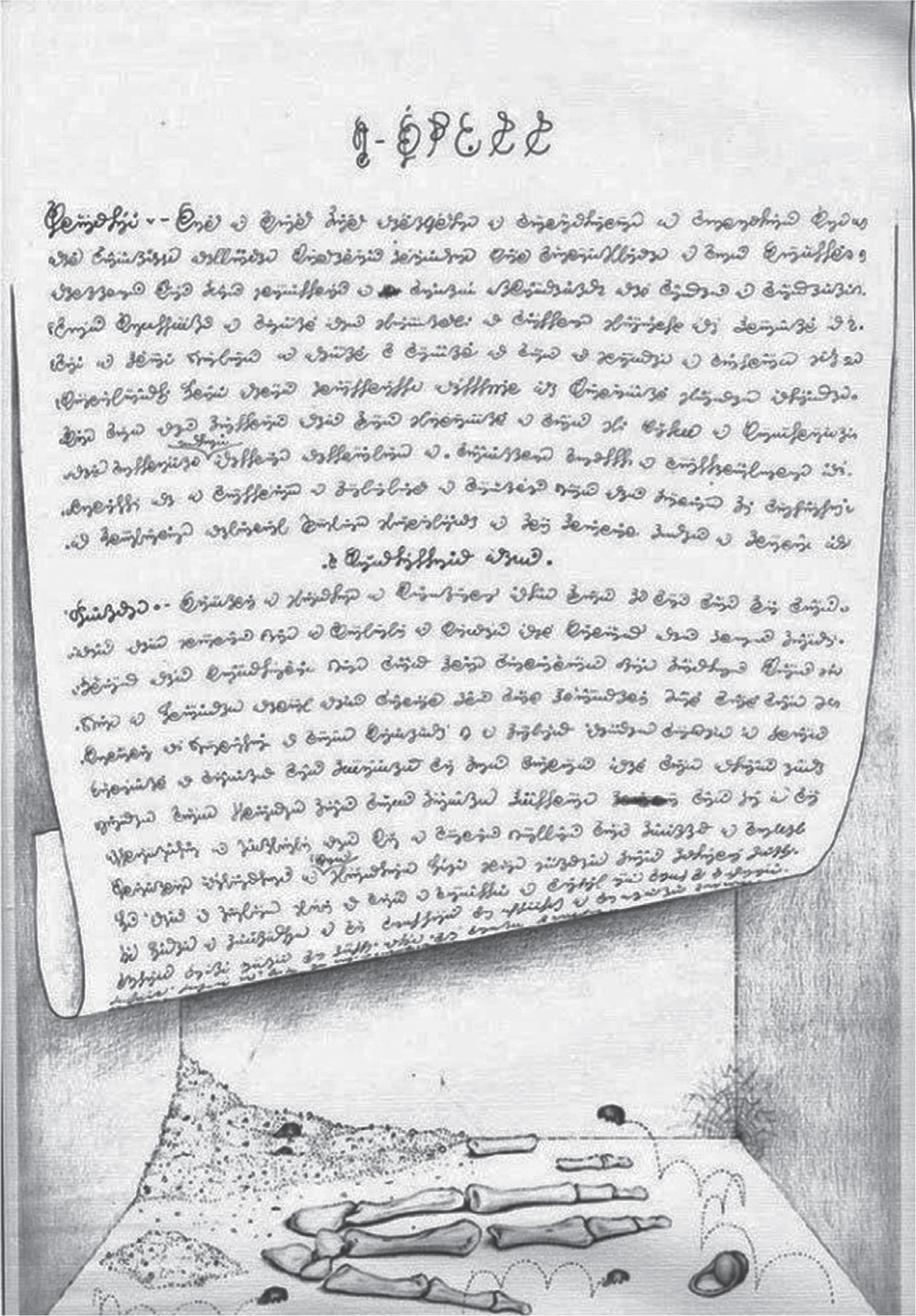
28. A page from the Codex Seraphinianus
THE ASEMIC
Now take the Voynich, throw in some testosterone, a shot of steroids, and a heavy pour of Valpolicella, and you’ll have yourself the Codex Seraphinianus (CS). In bringing it up, I’m whisking you away on a digression, since the CS has nothing to do with invented scripts. Or better yet, it has everything to do with invention—just not with scripts, per se (fig. 28).
In 1981, Luigi Serafini produced an illustrated encyclopedia of an imaginary world. In it were images of all that you might find in an encyclopedia, accompanied by scribbles meant to imitate writing—though writing they are not. My aunt Carmen, my grandmother’s sister, did the same whenever she met with her spiritual guide, whom she called the wise Ibar: she’d write a random string of signs, one linked to the other, in an inspired, dreamlike scripta continua. Unlike my aunt Carmen, however, who was merely scribbling, Serafini was creating art, and the effect is clear and beautiful in its disorientation, and in the surreal and unexpected harmony of the world he envisions.
In the preface to the final edition of the CS (brilliantly titled Decodex), Serafini fills us in on the work’s origins. By pairing imaginary images with equally imaginary texts, he explains, he was adopting the gaze of a small child, who looks at a book’s markings without yet understanding how to read them. It’s an imaginary regression to the state of wonder that comes from first encountering the mystery of writing. I, too, have memories of myself in that preliterate phase. Learning to read is one of the most magical things that a human being can achieve.
Thanks to Serafini’s honesty, however, the spell of unknowing is broken. Unlike the author of the Voynich, the author of the CS tells us openly that his writing is asemic—that is, that it contains no hidden or encoded meaning and is not the transcription of a language at all. It’s writing, yes, but it’s hollow writing. The signs have meaning, but that meaning is theirs alone. No point in thinking of this work as a reflection on writing: art is not something that can be deciphered. It simply is.
THE WIZARD
After our enchanting stroll with the CS, it’s time we dive into the tales of two men who have little to do with Hildegard’s culture or the naturalistic erudition of the Voynich Manuscript. Hildegard was overflowing with love for the divine, and the author of the Voynich was obsessed with detail—our next two protagonists, however, are illiterate, unschooled, simple. But they, too, burn with a passion. And their passion is to combat the white conqueror’s abuses of power and to reassert their own identity. We’ll start with the wizard.
Sequoyah was a silversmith born in Tennessee, right around the time when the American colonies were declaring their independence from Great Britain. In these years so crucial to the fate of the New Continent, Sequoyah was busy fighting for a different independence, that of the Cherokee people. He would go on to become a hero, still celebrated to this day, though not without having suffered along the way. Sequoyah looked on with astonishment as he observed white men writing, and though he was illiterate he recognized the competitive advantage that this skill gave them. They used these “talking leaves” to communicate: and this was the source of their power. It was essential to create the same thing for the Cherokee people, to give voice to their language, to invent a writing system so that the Cherokee leaves could talk, too.
And in the process of inventing it, we’ll see, it’s as if Sequoyah retraced the entire course of writing’s history in a single lifetime—with his first, preliterate attempts, his missteps, his persistence, molding and remolding his creation. At first Sequoyah invented a logographic system, where each sign corresponds to a word, but he soon ran into a structural problem that we’re all familiar with by now: too many signs, too many abstract meanings, too many words representing “ideas.” This logographic approach wasn’t cutting it. So what did he do next?
During the year he spent refining his experiment, Sequoyah neglected to tend the fields, his friends mocked him, his wife threw the pages with his invention into the fire and accused him of witchcraft: to everyone else, this writing business was the work of the devil.
Sequoyah was undaunted. Ten years later he completed his work: a polished writing system that fit his language like a glove. Guess what type? A syllabary. Eighty-five signs, whose forms—though lifted from the Latin, Greek, and Hebrew alphabets, all scripts and languages he couldn’t understand (he could stumble his way through English)—gave voice nonetheless, and with great precision, to the syllables of the Cherokee language. The first Native American script in northern America (fig. 29).
It would take some time before the syllabary was accepted. But Sequoyah had grit, tenacity, and above all, a plan. He taught the syllabary to his daughter, whom he then wheeled around as evidence, demonstrating just how quickly and accurately she could read a message transcribed with the syllabary. He created a “media circus” around the event and, before long, his efforts paid off. The syllabary was officially adopted by the Cherokee Nation, the percentage of literate Cherokees outgrew that of the local whites, and his success story went on to inspire some twenty other solitary inventors to create writing systems, from Alaska to Liberia.
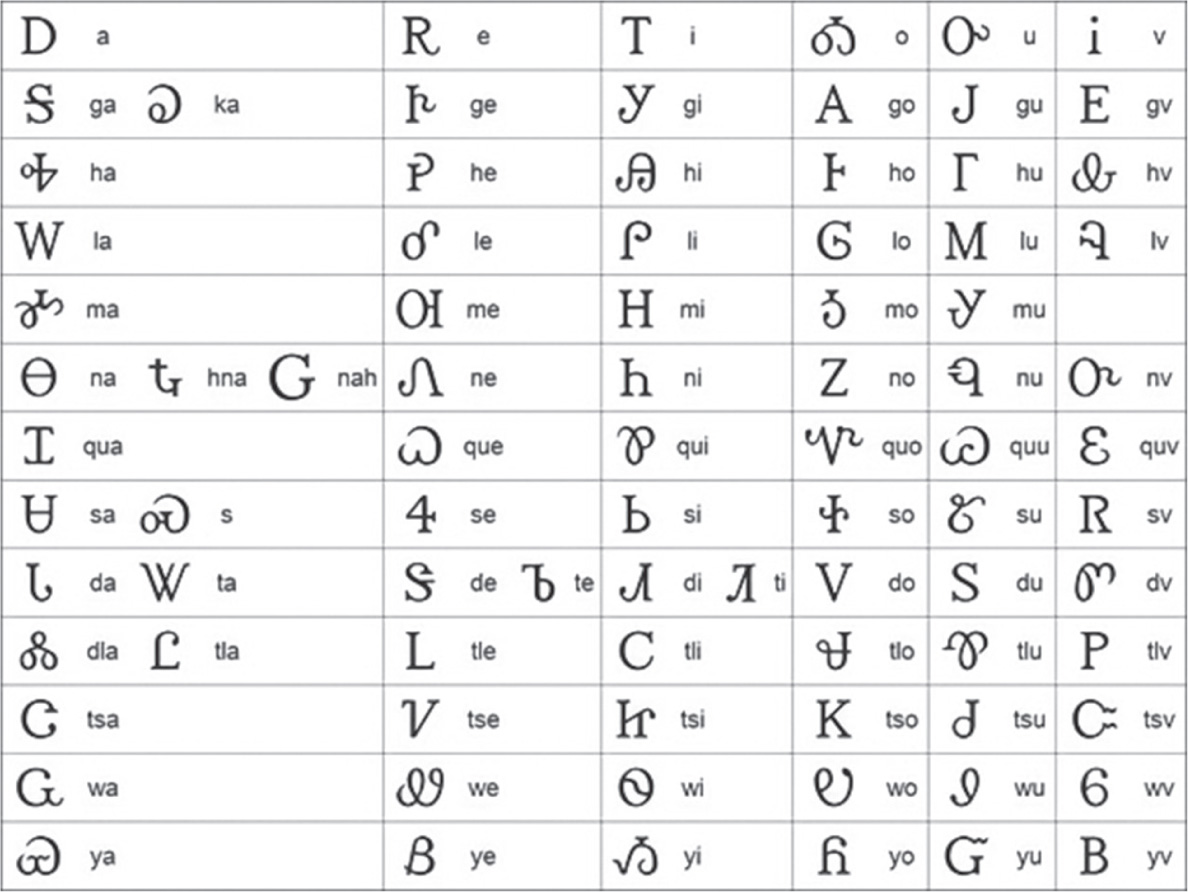
29. The Cherokee syllabary
And that’s not all. The Cherokee syllabary is still in use today, but above all it stands as a foundational ingredient in the group’s linguistic, cultural, and social identity. Now they, too, have their talking leaves, and they’ll never look back. Sequoyah is a national hero.
Sequoyah’s story is a lesson to all of us who have ever dreamed a dream and committed our lives to making it come true. Sequoyah’s story also reminds us of our obligation to understand who we are, to view our identity as a strength and not a weakness. And more still—Sequoyah’s story speaks to anyone with the courage to fight against those who refuse to believe in science, who refuse to defend and nurture it every day of their lives. Sequoyah’s story is a joyous exhortation to all of those who fight and, in the end, find a way to win.
THE ILLITERATE
A century or so later, on another continent, we come upon a farmer in the mountains of Vietnam, on the border of Laos, Shong Lue Yang, intent on weaving wicker baskets. Shong Lue Yang grew up knowing neither how to read nor write. He hunted squirrels and he had visions. One night, in 1959, two mysterious heavenly figures appeared in his dream and, amid an opium cloud, revealed a script. They urged him to teach it to the Hmong and Khmu peoples, so that they, too, could join the modern world and free themselves from the regime. Thus was born the Pahawh Hmong script.
Even more elaborate than the Cherokee script, Pahawh Hmong is a semi-syllabary composed of complex syllables, each in a sequence of three letters: a rime, a tone indicator, and an onset (kau, kai, kee). Normally syllables work the other way around: onset, tone, and rime. Shong Lue decided to put the rime up front, even though we still read the syllable in the standard order, with the consonant at the beginning. This inversion tells us that Shong Lue placed more importance on the rime, the syllable’s vowel sound. Which is what makes this script semi-syllabic, a typology known also as an abugida, or an alphasyllabary, in which the vowels are always transcribed, but not necessarily the consonants (fig. 30).
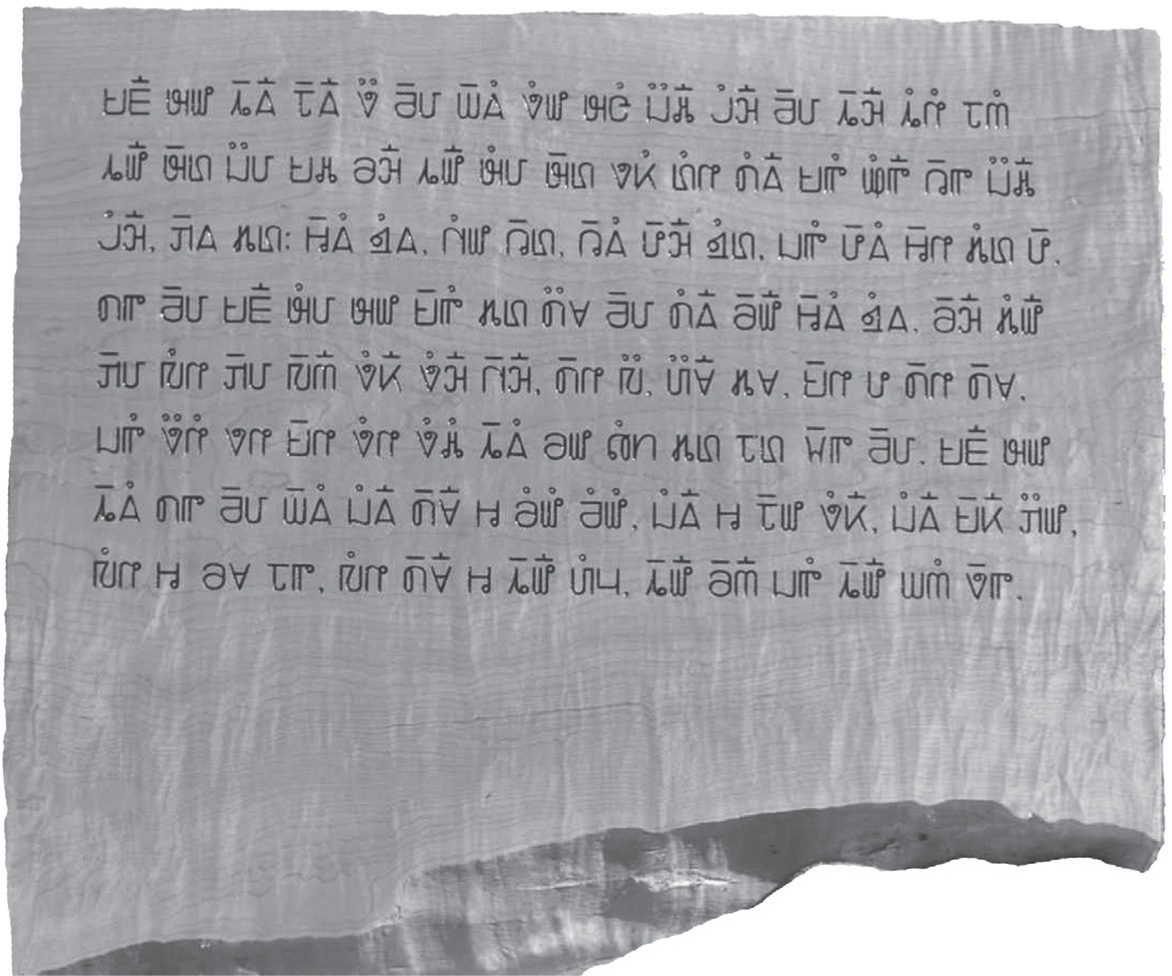
30. An inscription in Pahawh Hmong
What’s truly astounding is that Shong Lue created four progressive versions of this script, each one more linguistically advanced than the next. From revision to revision, the syllabary grew more refined, following the incredible intuition of our squirrel hunter. In the history of the world, we find no other example of such a refined innovation growing from a place of pure illiteracy. Even the least spiritual among us must admit that the human mind, with all its plasticity, is capable of miraculous things.
Shong’s revelatory dream soon gave rise to a messianic movement, and Shong was heralded as a spiritual leader, with hundreds of loyal followers who learned his script and awaited his divinations. Like Lady Hao, Shong Lue Yang saw the future. Another hero who brought light and understanding to an oppressed people—a renowned figure to this day, just like the “Mother of Writing.” From illiterate farmer to cultural icon, Shong Lue acquired too much power in too short a time. His wasn’t a happy ending—he was murdered by the Communist regime. Of course, the textbook visionary that he was, he predicted his own assassination.
There’s an important lesson to draw from these stories, which is that we should stop thinking of writing’s invention as an extraordinary event. As something difficult, obscure, abstruse, rare. Examples abound of scripts created by solitary inventors, from every region of the world, revealed through dreams and visions, through the linguistic ingenuity of lone creators, or through the pure creativity of an artist.
The most recent cases—including dozens of scripts invented in western Africa, and still others in Alaska, Liberia, Cameroon, Suriname, Burma, the Philippines—are the responses of the colonized to their colonizers, who perceive writing as a status object that the latter can employ to oppress the former. In these cases (though perhaps not in all of them), writing takes on a fetishistic quality, emanating from the power held by others. To create it, to manipulate it like an object, is to seize that power.
Then there are those “revelatory” cases where writing is shown to be a divine substance, the word revealed, an ideological mission. In these interstices so charged with meaning, so material and spiritual at once, there’s room as well for senseless writing, as if it were a “thing” to display in all its allusive, forbidden, untouchable power.
Writing that comes as a revelation is never revealed in full: dig and dig as long as you please, you’ll still be turning up secrets.