
POKÉMON
Secrets still plague us even when we’re dealing with isolated branches—scripts with no evolution, no offspring, no future.
You may not be familiar with Pokémon. Me neither. But two kids once showed me a kind of encyclopedia listing all the different Pokémon characters, divided by “race,” region, and paths of development. The Pokémon world is Darwinian, with species struggling to survive, with selection and evolution. It’s a complicated realm to explain, but I discovered two fundamental things: 1. There seem to be endless types of creatures, all with special powers; 2. There are certain types of creatures that never evolve, that never get stronger, more powerful, more skilled—they simply stay the same. Which, when it comes to Pokémon natural selection, is bad news.
One of these hapless victims of poké-volution goes by the name of Unown (spelling sic), a Pokémon belonging to the Psychic “race” (don’t ask). Unown is shaped like an eye, with appendages that make it look like a letter of the Roman alphabet (think of anthropomorphized letters, but again, don’t ask me why), and comes in twenty-eight forms, one for each letter (plus a question mark and an exclamation point), which are meant to resemble an ancient script (just go with it). When together as a group, it turns out, the Unown are capable of altering reality. Too bad they live rather isolated lives, trapped in their dimensions, stuck to walls like ancient inscriptions (this is the description verbatim).
As paradoxical as it may seem, the Unown Pokémon is the perfect lens through which to view our next experiments.
The time has come to speak of isolated beings, beings that never evolve, that remain barred from all development. These are systems that dawdle, that trip over themselves, and remain completely illegible as a result. We’ve come to the isolated branches, the most indecipherable systems of all, the childless, the truly inexplicable. The strangest scripts in the world.
We’ll examine three of them, from different periods, from different regions: the New World, the Old World, and the very old world. We’ll move from the most recent to the most ancient, traveling backward in time.
INCA PARADOX
The Inca are most often remembered not for what they had but for what they didn’t have: the wheel, iron, a written language. This third lack has given rise to a paradox, the Inca paradox. Could it be that the largest pre-Columbian empire in the Americas existed without a jot of linguistic notation? Could someone have created the magnificence of Machu Picchu without a single sign to describe its beauty?
The answer is yes, it’s possible. And if it’s true that the Inca Empire is the only primary state not to have developed a writing system like the ones we’ve seen thus far, it’s also true that it has left us something that perhaps exceeds them in technology and imagination. It’s time we start thinking outside the box, looking beyond the same old flat signs. It’s time we let our imaginations roam—at least for a bit.
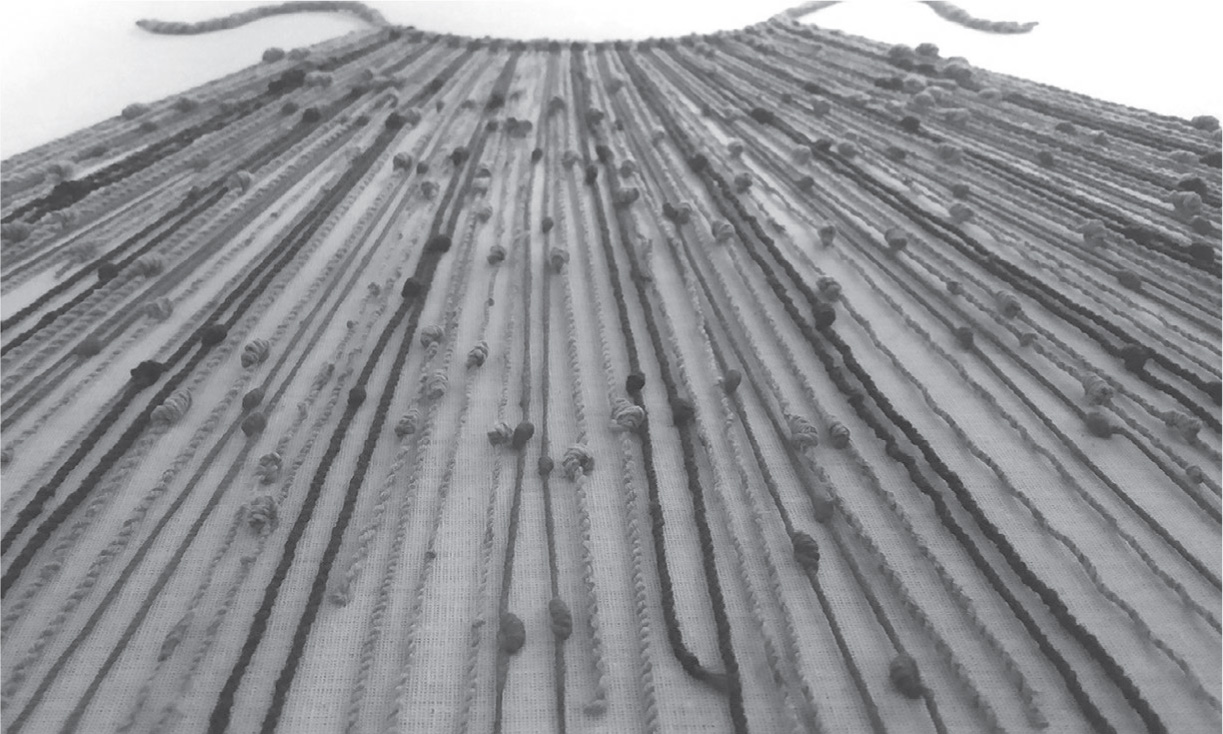
The Inca left behind a three-dimensional system, a 3D “script.” And I use quotation marks here because we shouldn’t be thinking about it in conventional terms: not as simple signs engraved or inscribed or stamped on a flat surface. No. The Inca speak to us through objects. They left us a corporeal system, an extension of their fingers: long, colored cords made of the wool of alpacas or llamas. Rows and rows of cords, all strung together like charms on a necklace, all covered in knots. Picture thousands of strings, and tens of thousands of knots, a rainbow filled with messages. These are quipu (fig. 31).
31. An example of a quipu
Up until the calamitous arrival of Francisco Pizarro, quipu were used to govern an empire. For nearly two hundred years, during the fifteenth and sixteenth centuries, mathematical notations, calculations, calendars, taxes, censuses—all were tied up rationally and precisely using these Technicolor cords. And there may have been narrative works, too. Getting a firm grip on just how these quipu function linguistically, however, is no small task. There are innumerable knots that we must analyze, tied by different people, for different purposes, and spread across a vast region situated in the middle of the Andes. To get a clear sense not just of the details, but the reasoning behind them, is extremely difficult.
The most popular theory, at least up until recent times, is that quipu are mnemonic devices and nothing more, no different than the way we use rosary beads to count prayers. Quipu masters (or quipucamayocs) used them as a means of refreshing their memory, to keep track of the information they were recording. Or so the theory goes. Seen in this light, they would appear to be closed systems, comprehensible only to the quipu wizards who created them. But what would be the point, if it were such a hermetic device? We’d end up right back in the barren stretches of Hildegard and Voynich Manuscript territory.
Maybe there’s something more behind them.
To understand how quipu function, we have to go back to being children. In school, we learn to count by using the objects around us—wood blocks, Lego, a toy abacus. We learn addition and subtraction by adding and removing objects from a pile, and by staring at our ten fingers. Then, when we learn to write and do arithmetic, we immerse ourselves in written numbers, which are abstract and two-dimensional. And this moment, though you’ve probably forgotten it, is the moment we lose our sense of a number’s concreteness. We come to realize that 10 means “ten units of something,” in a dimension with no physical objects to represent them. Abstraction takes hold of us. Without even noticing it, we all at once become platonic observers of the “idea” of number. Counting with your hands starts to feel like something primitive, infantile. Go figure.
TALKING KNOTS
The quipu system has the enthusiasm of a little kid, because it’s still attached to its wood blocks, its Lego pieces. Though for all its concreteness, it’s anything but primitive. The knots are used to tabulate data, following a base-ten system: the number 10, in this way, is a physical, tangible, multidimensional thing, made up of ten knots. Which makes a quipu something like an Excel spreadsheet: rows and columns and numbers, sums and totals. Not a mnemonic system, but a physical system of data representation. Not a rosary to help us rattle off mechanical litanies, but an abacus with thousands of beads, to count, to move, to manage. A physical, concrete system. Though, while Excel is fairly easy for us to read, the quipu system is, in short, another story.
Because quipu aren’t limited to numbers. A third of these knotted necklaces are narrative. It’s hard even to imagine that a story could be told using a series of colored knots that represent numbers, but it is so. Names, places, genealogies, songs—all are recited like so many zip codes, credit-card numbers, telephone numbers, yellow, green, and blue numbers. Because numbers, for the Inca, speak not only of quantity but of quality. I know, it’s not easy to grasp, but let your imagination run free a little.
The knots are 3D, so they have form, direction, relative position, color, thickness, multiple configurations. Each element carries a different meaning: far from the body, close to the body—these distances affect what quantity is recorded. A three-dimensional Sudoku. Multivalent, multi-referential, and yet at the same time precise. According to Spanish accounts from the mid-sixteenth century, quipu were on par with the Old World’s most complex scripts. One Jesuit missionary tells of an Inca woman who brought him a quipu bearing her entire life story. In knots. Incredible.
Indeed, the details of how this could have been possible are lost to us, since we don’t have the legend that reveals the links among these elements (dimension, thickness, color, number, direction, etc.) and their precise meaning. We’re in need of a decoder, an Inca Rosetta stone to unveil the correlations. But even without it, with this partial view of things, we can still draw a few conclusions.
BETA SOFTWARE
Have you seen the movie Arrival, where Amy Adams plays a linguistics professor employed by the U.S. government to translate an alien language and its enigmatic script? The aliens use a peculiar communication system, which involves squirting out circular figures like cuttlefish ink. Evanescent and ethereal, these figures quickly dissolve, leaving no trace of the message. Amy Adams studies them, and eventually comes to understand them. She deciphers their cuttlefish clouds. The film is much better than my description of it, with its muted, rainy-day tones and its almost dreamlike rhythm. There’s one thing that’s of interest to us, however: the aliens’ signs are semasiographic.
Semasiography is a system of conventional symbols—iconic, abstract—that carry information, though not in any specific language. The bond between sign and sound is variable, loose, unbound by precise rules. It’s a nonphonetic system (in the most technical, glottographic sense). Think about mathematical formulas, or music notes, or the buttons on your washing machine: these are all semasiographic systems. We understand them thanks to the conventions that regulate the way we interpret their meaning, but we can read them in any language. They are metalinguistic systems, in sum, not phonetic systems.
There are those who argue that semasiography should not be considered a form of writing in the strictest sense. If that’s true, does it mean that we should be thinking of the quipu as a kind of beta software, a rough draft, prehistoric, the first phase in the development of alphabetization? Do the quipu, in other words, make the highly civilized Inca somewhat less civilized, with their roads that stretch for miles, their majestic buildings, their territorial conquests?
Absolutely not—and I don’t just say that because I’m victim to the Freudian defect of overvaluing a beloved object. Strapped with governing such a vast population, taking a census of so many individuals, managing so many public affairs—because of all these necessities—the Inca decided to use an open system, one that transcended a single language, that could be most widely understood. A system that could unite them as a group.
Nevertheless, the jury’s still out. And in all honesty, there simply aren’t enough quipu experts to reach a definitive verdict. We scholars, too, like the Inca half a millennium before us, must come together as a group. Several digital catalogues have been created, which may one day lead to a breakthrough. Harvard’s Gary Urton, with his Khipu Database (KDB), seems to have pinpointed the name of a village, Puruchuco, represented by a sequence of three numbers, like a kind of zip code. We can’t rule out the possibility that this is a richly phonetic system, but we’re still a long way from proving it.
To fully understand quipu, we must shed our preconceived notions of what defines writing. And stop mistaking our lack of imagination, our bias toward the “already seen,” for the gaps in our knowledge of the civilization we’re studying. We must keep an open mind with quipu. It may well be our limited sense of imagination that’s blocking us from understanding them. Whatever the case, for all its ingenuity, the quipu system bore no offspring. It died recording its tabulations of the Inca people, giving its last few kicks in the years after the Spanish conquest.
And that’s where its circle closed. Who knows if it would have had a future, if it would have become a clear, true script, had Pizarro not razed everything to the ground. I wouldn’t put my money on it, but you never know.
DARKNESS
Just as promised, we’re heading back to the Old Continent, to Crete, and back in time, to the age of the Aegean scripts, four thousand years ago. We must return, because hidden among these scripts is another branch, perhaps an isolate, perhaps not, but certainly the most mysterious of all. And like all the most hidden and impenetrable mysteries, it’s right there before our eyes, hiding in plain sight. Along with Cretan Hieroglyphic and Linear A, which we’ve looked at, there’s a script that’s infamous among experts and wildly famous to everyone else. In Greece, it’s a much abused and inflated emblem, like the Eiffel Tower in Paris or the gondola in Venice. Its image is everywhere—stamped, printed, painted, drawn, copied, prey to what is often the most gimmicky marketing and consumption—part of an idea of “Greekness” that has nothing to do with actual Greeks.
The Phaistos Disk. Phaistos is one of the great Minoan palaces, and its disk was retrieved there in the early twentieth century by an Italian archaeologist, Luigi Pernier. No archives were found in the palace—nothing like the grand archives excavated at Knossos, in the island’s north, brimming with tablets of Linear A and Linear B; nor like the archives of Linear A tablets found at the Hagia Triada site, a settlement just to the south of, and contiguous with, Phaistos. At Phaistos there seemed to be no trace of writing at all. Though how could that be possible, Pernier asked himself—how could such an imposing and monumental palace, with its regal and grandiose staircases, contain only a few scattered inscriptions?
It was 1908, and the final dig was set to take place. Their funds for exploring the palace were running out. A tough moment for Pernier. Not least because, according to others around him, he was consumed with envy for his rival archaeologists and their sensational discoveries. Pernier needed his big break.
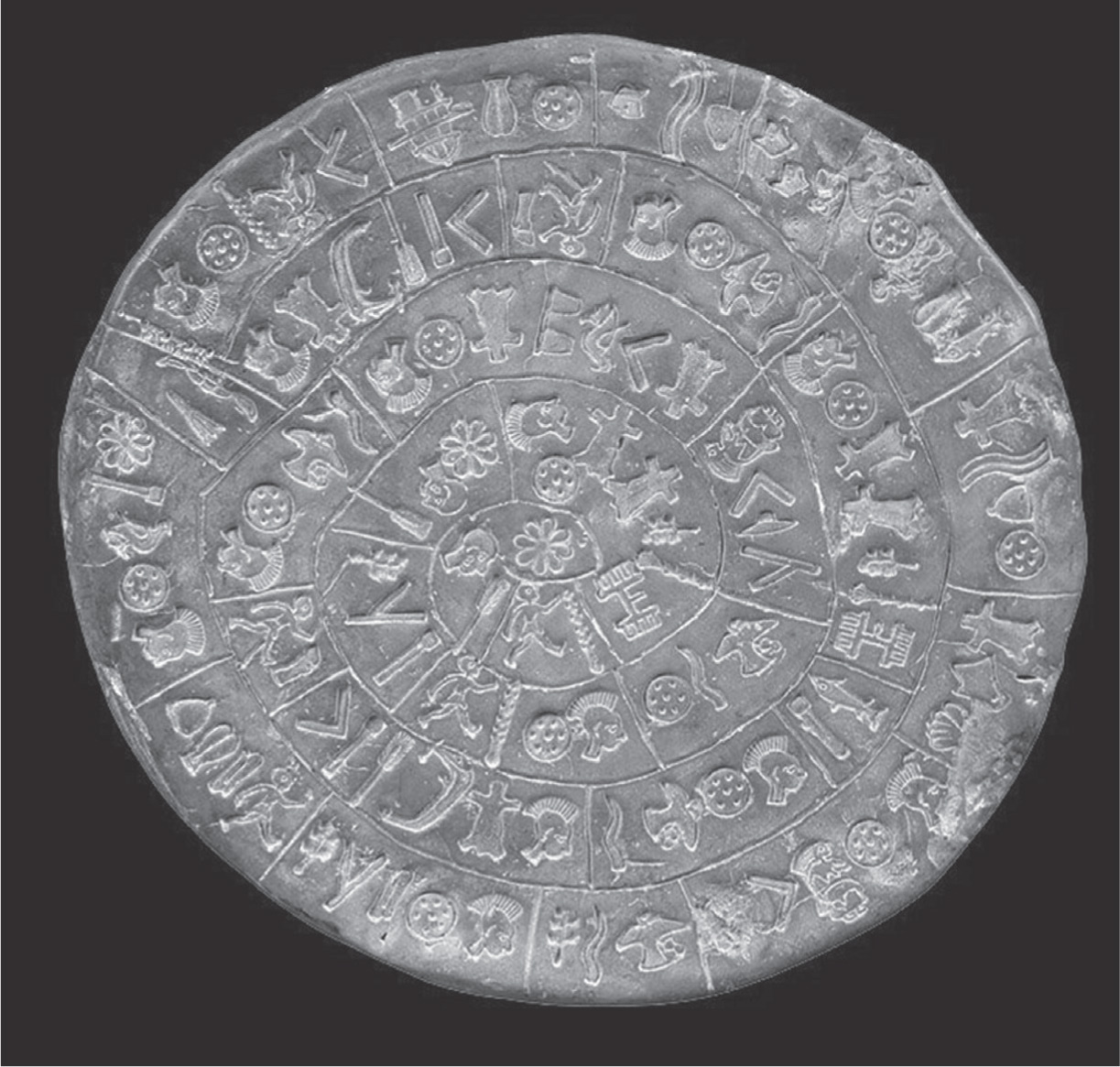
And that’s exactly what he got. His discovery of the Phaistos Disk was heralded by all, rivals included, as the find of the year. Phaistos quickly gained wide notoriety. The disk astonished everyone. It was like nothing before seen (fig. 32).
How is it that such a small object—sixteen inches of humble clay—became the island’s icon, the gondola of Crete? What makes it so magnetic? The answer is simple, and it’s there in the crossword you do on Sunday morning, in mystery novels, in all the true-crime series on TV, in the stubborn and unrequited love that keeps you glued to your phone, waiting for a message. The answer lies in the shadows, in life’s blind spots, in the rush of engaging our analytical capacities, in all our predictions and expectations of what’s to come. The answer is the most alluring of all mysteries: the desire to grasp what we don’t know, to get there before anyone else. To intuit, to probe. To decipher.
32. One side of the Phaistos Disk
We’re easy prey for the unknown. It binds us to the future. And the more something is shrouded in obscurity, the darker the corner, the more desperately we want to turn our flashlights on it.
Even the tiniest object, like the Phaistos Disk, is all it takes. We’re hooked. A spiral of illegible, incomprehensible signs lures us into hypnosis. And the enigma lies not only in the script, but in the circumstances surrounding its discovery, its history, the doubts about its authenticity. All that revolves around the Phaistos Disk speaks of bewilderment, of trap doors and unsolved puzzles. It feels almost like a game of Clue, with a dose of Scrabble.
CHUTES AND LADDERS
What’s the first thing that happens when you have a little luck, like our Luigi Pernier? The rumormongers pounce, of course. It’s no more than a fraud, I tell you! A disk forged from the resentment of a bitter and envious archaeologist, desperate for glory. No chance that it’s authentic. Pernier is swindling us all. The disk is a fake.
Might the rumormongers have a point? Is it really a fake? Good question. Let’s case the situation: first we have an Italian (and therefore suspicious) archaeologist, caught up in a competitive environment; then we have a cash-strapped excavation campaign, down to its last drop of funding. In such a bind, one forged discovery could turn things around. And anyone who operates in the world of academia knows that it’s much easier to poison the university well with wickedness and envy than it is to keep the waters clear with collaboration and dialogue.
But enough with the rumors. Let’s look at the facts. What’s really going on here? The disk is most certainly unusual, with its perfectly stamped symbols, its smooth and well-shaped rim. It looks like it could have been made yesterday. Even if it isn’t, it sure does seem like a fake. And there are those who still believe it is, even among colleagues who are experts in the field. The archaeological context in which it was found, however, is solid and trustworthy. And so is its dating, attributable to the same period in which Cretan Hieroglyphic and Linear A coexisted on the island, even if in different locations. The disk was discovered near a tablet engraved in a very archaic form of Linear A. Taking all of this into account, and with the skeptics’ blessing, we must conclude that Pernier never forged anything, that the disk is “good,” as the slang goes. It’s time we bury this fabulous tale of deceptions and hoaxes, this rumor, under all the layers of useless academic diatribes.
Enough with the tall tales. Let’s pose some legitimate questions: What purpose could such a disk have served? And what’s written on it?
The Phaistos Disk is not an administrative text. Its spiraling symbols recall those of another disk, from a later period, this one made of lead and inscribed in a language that to this day remains all but incomprehensible, Etruscan. Pernier cites the Magliano Disk right off the bat in his excavation report, as if to say, “full disclosure: I didn’t copy anything.” The two objects are very similar, though it’s merely a strange coincidence. Etruria and Crete have no historical connections, and the dates are simply too far apart.
What if it’s a race game, then, a kind of Chutes and Ladders? Among the thousands of interpretations, this, too, has been suggested, believe it or not. The Egyptians played a game called mehen, on circular tablets, where the track follows the shape of a coiled snake. Mehen, in fact, means “coiled one,” the snake-god, and the track along its body marks the passage from life to death. Our modern-day Chutes and Ladders is of course less solemn, and rather less macabre. Might the Phaistos Disk be a relic of Cretan amusement, the work of some scribe bored with compiling lists of wool and sheep? I highly doubt it.
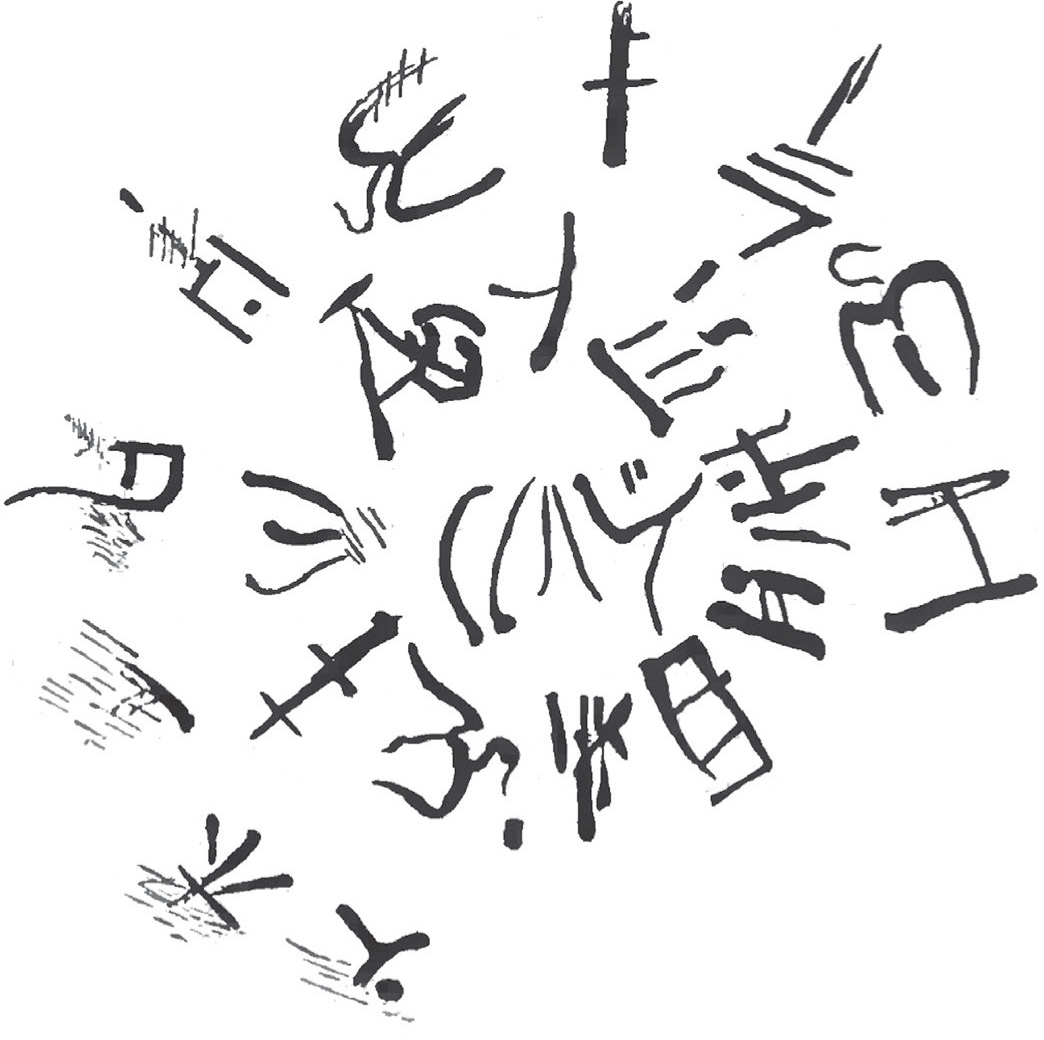
And it may be that the disk is a less isolated case than we think. Spirals were not unknown to the Minoans: we find them on rings, for example, with Linear A circling around the setting; or on your basic conical cups, the inside painted with a spiral of Linear A (fig. 33). No easy task, painting signs around the inside of such a deep goblet—and not easy to read, either. Though nothing is less legible than this disk. Its inscription—since, at the end of the day, it’s an inscription that we’re talking about here—is an inscrutable crossword puzzle, an impossible challenge.
Here again, we’re prey to the unknown, and this time we have no choice but to concede the victory. There are certain things we must admit that we don’t know, that we can’t know, that we’ll never know. So, shall we throw in the towel?
33. Spiral inscription in Linear A (from the inside of a cup)
BLACK SWAN
A spiraling series of symbols, on both sides, nearly all recognizable: men of various sorts and in various poses, a woman, a fish, a flower, a jar, axes, a bee, a dove, and many other figures, some of which are repeated. The Minoan world, all right there. And yet these symbols bear only a vague resemblance to Cretan hieroglyphs. Where do they come from? And what are they doing on this disk?
Nested in the mystery of this object are two other mysteries. The first is that it was baked purposefully at a high temperature to ensure its longevity. An unusual occurrence, given that the Linear A tablets and clay documents with Cretan hieroglyphs were conserved only because they were “burned,” cooked in the fires that destroyed first the Minoan then the Mycenaean palaces. Baking the clay renders the tablets almost indestructible. It is therefore merely a happy coincidence that these objects were salvaged and arrived to us in near perfect condition. Let’s call it the serendipity of the Aegean epigraphers.
The second mystery is that the signs are not engraved in the clay. They’re stamped. The first printing—centuries before Gutenberg and his movable type, which wouldn’t come until the European Renaissance of the fifteenth century. This disk is ahead of the game, with its characters all in a row, arranged in a circle. A precursor with no historical continuity, because the Cretan molds were used to stamp no other object. The Phaistos Disk is a unicum.
Two hundred and forty-two signs, in sequences of clearly and intentionally divided words, which tells us that this is in all likelihood a true written language. Though if that’s the case, are we looking here at a syllabic script, like Cretan Hieroglyphic and Linear A, or a logographic script, where each sign indicates a morpheme (which is to say, a word)? The first possibility stands on better ground, but there aren’t enough total signs to validate the hypothesis. And that’s precisely the curse of a unicum. There’s no way to prove or disprove anything. Not only is it an isolate, it’s a black swan: rare, one of a kind, even, impossible to ignore, and cursed.
Cursed because it bars us from applying the scientific method—meaning that no one, not ever, will be able to decipher it. With subtle English irony, the philologist John Chadwick—who helped Michael Ventris decipher Linear B—wrote the following about the Phaistos Disk: “If King Minos himself were to reveal to someone in a dream the true interpretation, it would be quite impossible for him to convince anyone else that his was the one and only possible solution.” Period. End of story. We’re back to start in our game of Chutes and Ladders, with a dead-end track where no one wins. As they say in Rome, alla fine del tunnel ci sono solo i fari del camion: the only light at the end of the tunnel is the light of an oncoming truck.
BESTIARY OF THE INDUS
There are things much darker than tunnels. In the history of writing, as in life, with its distant and nebulous memories, the farther back we go in time the blurrier our perception. Yet the circumstances we find in the Indus Valley in 3000 BCE are no darker than what we encountered in Crete with its disk. You might say the two are pitted against each other in an all-out battle for who’s the most indecipherable and isolated. So shrouded are they in darkness, you could distill them into Vantablack, the latest generation, which absorbs nearly 100 percent of all visible light. Pretty daunting.
We, however, operate under the conviction that if a script was codified by man, man can just as well decode it. Humani nihil a me alienum puto, Terence (the situation called for a flashy quote). Shall we go hunting for a glimmer of hope?
The script developed by the civilization of Harappa and Mohenjo-daro came into being very early on, almost contemporaneously with Egypt and Mesopotamia. At its height (2600–1900 BCE), the Indus Valley, which stretches from modern-day Pakistan to northern India, boasted a remarkable number of settlements, many of them small villages, though a few cities, too. It was only a hundred years ago that we discovered this magnificent culture—a sensational discovery, in that it pushed back the origins of Indian civilization by thousands of years, which up until then were dated to the rule of Ashoka, two hundred years before the birth of Christ.
Digging through the origins of this region, we can gain a sense of whether the Indo-European influence was already present, even then, five thousand years ago. If indeed it was, the implications are important to us as well, to our own origins, which are “Indo” as much as they are “European”—thousands of years old and descending from the ancient Neolithic migrations of peoples relocating to the east (India) and west (Europe).
But things are still unclear. The Indus script may indeed be hiding other, more ancient origins, buried among the Dravidian languages, and not the “Indo-Aryan” languages, which are linked to the later Sanskrit. But here we must be careful. In history’s wide embrace, these linguistic attributions are often tinged with nationalistic overtones: the purity of the Aryan race, Indo-Sanskrit continuity, identity flaunted as if one could trace a direct lineage to the present.
Gaining an understanding of this script will help us to be more careful, to refrain from making brazen, biased equations, such as identity equals language, or language equals ethnicity. No such equations exist: the long path to the present day was carved by men and women on the move, by migrants, who left one home and went looking for another. Who spoke to one another and couldn’t understand, who strove to communicate. And who did all of this repeatedly and in various combinations—migrating, forming new settlements, striving again and again to communicate.
Language and writing should never be linked to ideology and politics. When we decipher a script or examine a language, we do so for no greater purpose than to discover something we didn’t know before. These aren’t tools to be used for manipulation, to feed an ideological confirmation bias, or to throw a smoke screen over history.
But excuse me, I digress. You’ve now heard my plea against co-opting language for political ends. Science, and scientific data, bow to no flag.
Meanwhile, we’re still stuck with a real head-scratcher. The Indus script is a mess of grand proportions—we can’t even agree on a definition of what it is (talk about our inability to communicate!). We call it a script out of convenience, though the debate about its status has been raging, sometimes viciously, for years. Academics are litigious, though generally mild-mannered, creatures, and yet when it comes to the Indus Valley Script (IVS) they turn into regular gladiators. Grab your popcorn.
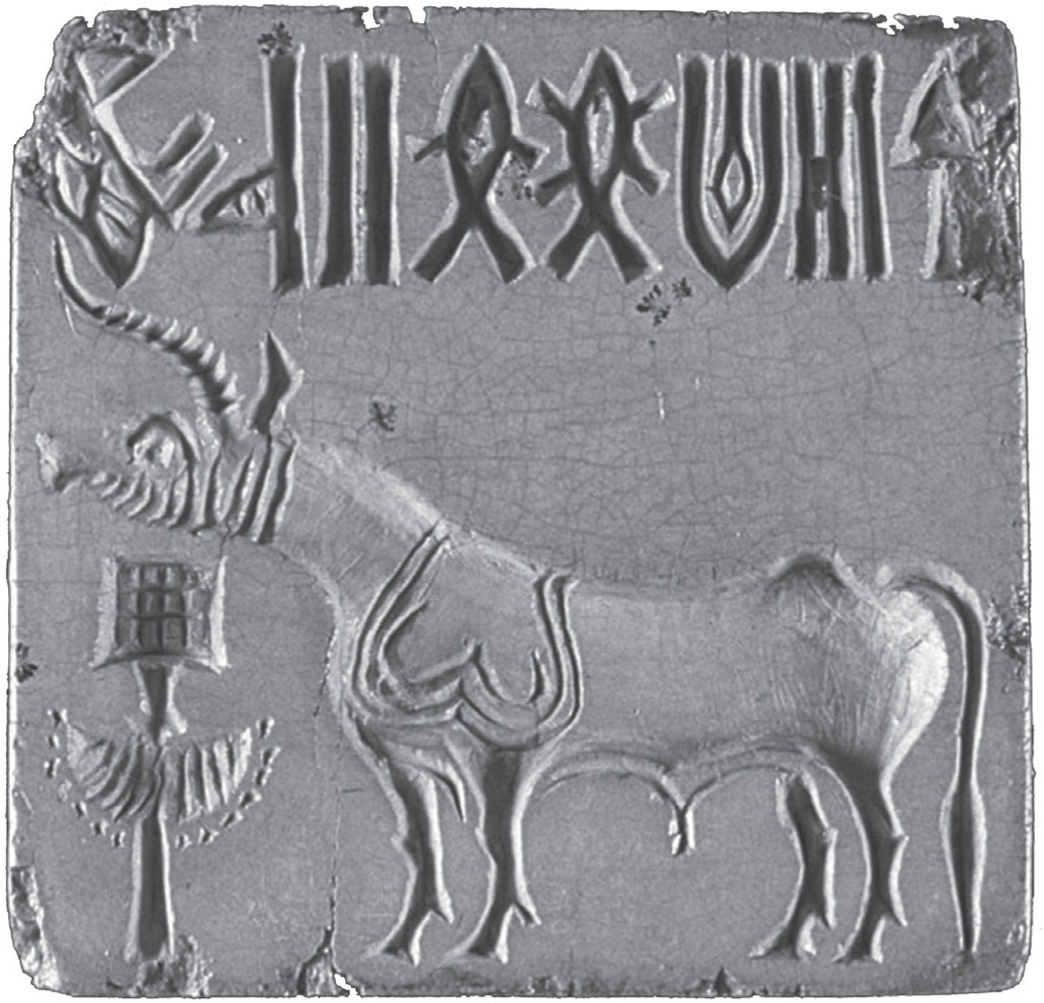
The majority of the “inscriptions” are found on small stone seals, only one or two inches in diameter. Nearly four thousand of them have survived—which, to those of us used to scant evidence, feels like an immense treasure. The problem is that each seal bears only a few signs, typically around five or six. And always accompanied by the figures of perfectly recognizable animals: rhinoceroses, elephants, tigers, water buffalo, zebu, and other imaginary creatures, including one that resembles a unicorn (fig. 34). Here and there we find humanlike figures in yoga poses, which may represent divinities.
34. Indus Valley Script, inscription with “unicorn”
Remember our Cretan Hieroglyphic seals? No, no connection at all with these seals from Harappa—too distant in time and place. But they can help us understand the nature of the problem. With the Cretan seals, we asked ourselves the same question, “writing, or not writing,” and there, too, we dealt with signs that seem like ornaments, brief and formulaic sequences. In other words, we had our doubts, and there are those who still express resistance through gritted teeth, but we hope to have put things to rest by now. The situation here is similar, the only difference being that with the Indian seals, as you’ll see, the signs are schematic, linear, and not all are icons, which means they resemble a “formal” script somewhat more than they do images. But the problem persists. And furthermore, how do we explain that Indus bestiary (minus the cobra, however)? What’s it doing among such carefully traced signs? What are these animals: religious, political, genealogical symbols?
ENTROPY
Popcorn. Enter the gladiators. One team claiming it’s a script, the other team, no. There’s a bit of everything involved in the tussle: attempts at decipherment, algorithms, a touch of nationalism, even one or two veiled insults. Down in the arena is a mix of computer scientists, neurobiologists, archaeologists, historians, and linguists—and so begins a battle to the death.
Team NO contends that the inscriptions are not inscriptions, the signs not signs, the language not a language. The sequences are too brief, too repetitive. Too many of the signs are too rare, they appear too infrequently. Still others appear only once. “Too much” and “too little” are the mantras of nonlinguistic systems. We’ve already seen this applied to the Voynich Manuscript. When nonlinguistic signs enter the mix, they do one of two things: 1. They don’t follow a sequential order at all; 2. They follow one too strictly, and are therefore too rigid. Natural languages are Aristotelian, they fall somewhere in the middle of these two extremes. They’re flexible creatures.
Team NO, in short, believes that the IVS is indeed a system, just not a system of sounds.
So a system of what, then? The answer, I have to admit, is a bit simplistic. Se non è zuppa è pan bagnato, as my high school Latin teacher would say: if it isn’t soup it’s wet bread (an idiom not so unlike the Shakespearean “a rose by any other name”).* Here, according to Team NO, are what these cursed signs represent: family and clan emblems, heraldic symbols, random religious symbols. Which would make them similar to the Neolithic symbols of the Vinča culture from southeastern Europe (around modern-day Serbia and Kosovo), or to a few of the emblems from Mesopotamia that represent gods (sun, moon, stars). Far too simple, am I right?
Far too simple. At least in the eyes of Team YES, who have thrown themselves headlong into computational computer science theory. Their game plan is to determine the probability that specific signs will follow other signs in a sequence. In “normal” languages, words or characters follow one another in an almost predictable manner. U comes after q, etc. There is, however, some flexibility to this structure—what we call conditional entropy. It’s a scary name, but the underlying concept is simple. If I can grasp it, you’ll have an even easier time.
Question: Can we identify statistical regularities? In other words, does the IVS bear a coherent underlying structure? To determine this, we look at the behavior of natural languages, like Sanskrit or Sumerian, and compare it to a sample of nonlinguistic DNA. The IVS, we find, veers closer to the languages and farther from the DNA. This alone does not prove that the system is linguistic, but it does give us a positive indication that the symbols weren’t just, well, pulled out of thin air, to put it in the bluntest terms possible (no need for ten-dollar words here).
After which, Team YES—now going straight for the jugular—lands a hell of a blow: they take all of the symbols and analyze them according to their positional distribution within the inscriptions. This statistical approach, known as a Markov chain, helps determine if a sign is used more frequently at the beginning or the end of an inscription, checking for repetitions and correlations between signs that fall just before or after other signs. The Markov chain proves helpful even when the inscriptions are incomplete: once we’ve determined the statistical distribution, we can fill in the holes, as long as the sequences demonstrate even a small measure of repetitiveness. Not bad.
So what does Team NO have to say in response? That it’s all just wishful thinking; that entropic analysis proves only that the system is neither peculiar nor rigid, which we already knew, and that “even heraldic symbols or astrological signs or Boy Scout badges have a coherent structure.” Then Team YES counters, and so on, and so forth—for years! I mean it, years. And the reviews publishing these arguments aren’t rags, either, or the Podunk Paleography Gazette, but some of the top scientific journals. Ah, those cryptographers, a difficult breed!
In the midst of all this academic squabbling, one final question remains: Was the IVS adapted from a preexisting writing system or was it invented from scratch? More likely the first hypothesis. Which bars us from counting it as the world’s sixth invention, after Egyptian Hieroglyphic, cuneiform, Chinese, Mayan, and Easter Island’s Rongorongo. We do have evidence of trade between the Indus Valley and Mesopotamia (especially with the Elam civilization) during the third millennium BCE. We’ve even found seals inscribed with the IVS in Mesopotamia and the Persian Gulf. This alone does not prove a direct transmission, but it certainly puts a bug in our ear.
Whatever happened to the IVS, after the height of the Harappa period, is anybody’s guess. And we know even less about the fate of the Harappa Mohenjo-Daro civilization. This may well be the writing system that’s attracted the most attempts at decipherment, and just as many failures. No mere isolated branch—the IVS was hacked clean off the tree. And with this rather autumnal image, we’ll end our bout of forced isolation and head out for a little fresh air—with company.