
QUARTET
The next aspect of science is its contents, the things that have been found out. This is the yield. This is the gold. This is the excitement, the pay you get for all the disciplined thinking and hard work. The work is not done for the sake of an application. It is done for the excitement of what is found out. Perhaps most of you know this. But to those of you who do not know it, it is almost impossible for me to convey in a lecture this important aspect, this exciting part, the real reason for science. And without understanding this you miss the whole point. You cannot understand science and its relation to anything else unless you understand and appreciate the great adventure of our time. You do not live in your time unless you understand that this is a tremendous adventure and a wild and exciting thing.
These are the words of the physicist Richard Feynman, during one of the three lectures he delivered at the University of Washington in 1963.* Nearly sixty years ago. And I can’t think of a single word I’d add today, to express the joy of discovery, lest I spoil the cake with a rotten cherry.
Though what I can do is attempt to explain what Feynman was getting at. It’s a quartet of emotions, and they combine to seize both hemispheres of the brain. They are: disorientation before an abundance of possibilities (this is where you normally make a list, or at least we list-o-holics do); the bittersweet taste of doubt (next to the list we write yes, no, maybe); the shock at finding an exception to the rule, which is mostly vexing (oops, maybe the rule is wrong?). And then there’s the fourth, the most beautiful: the awe we feel when we land on an elegant solution. At last. That’s it. That’s the one! This fourth emotion is rare. And when it comes, you feel like a little kid again, hopping on a bicycle for the first time.
These four things, here . . . they keep you up at night, they jolt you out of bed in the morning, with a pyonpyon (remember that one?). Anyone who does research is well familiar with this quartet’s music, or has at least seen the score and pines to one day hear it. To experience, if only once, the fourth movement. But how do we get there?
We’ve made our way, at last, to the present day and the current state of scientific research. To get here, we traveled through invention, with its long shadows and obscure origins. Now it’s time to examine the methods we’re currently using to solve our still unsolved mysteries, or at least to shed a little more light on them. And though we’ll be speaking of the present, of current scientific studies, of the rigor of modern-day methods, this tale will launch us into the future: it’s time to start looking ahead and hop on that bicycle. It’s time to talk about decipherment.
DONALD RUMSFELD
Speaking of trends that latch on to our culture, do you remember the weapons of mass destruction in Iraq, the ones that were never there? It was 2002 and the U.S. secretary of defense at the time, Donald Rumsfeld, addressed us with the now immortal phrase: “As we know, there are known knowns; there are things we know we know. We also know there are known unknowns; that is to say we know there are some things we do not know. But there are also unknown unknowns—the ones we don’t know we don’t know.” He sounds a bit like the Pokémon we met earlier.
Rumsfeld was lampooned from all sides, since it’s only logical that we can’t know we don’t know a thing we don’t know. And yet the phrase has stuck—he even built an autobiography around it (Known and Unknown: A Memoir), and others made a documentary (The Unknown Known). The idea of things that we know we don’t know is not a political smoke screen tactic, however. It’s lifted wholesale from an analytical technique known as a “Johari window” (fig. 37).
The name Johari is a combination of Jo and Hari, the first names of its two founding psychologists, Joseph Luft and Harrington Ingham, who developed it in the 1950s. The window is a technique that people can use to understand their relationships with themselves and others. There are four quadrants. Those on the left represent the things we know about ourselves: if something is known both to us and to others, it’s out in the open; if it’s unknown to others, it’s a façade, a mask we wear and wear knowingly. The second column, on the other hand, represents the things that we don’t know about ourselves but that others see or perceive—our weak points, in other words; as well as, lastly, the things we don’t know about ourselves and that others don’t know either—the unknown unknown, terra incognita.
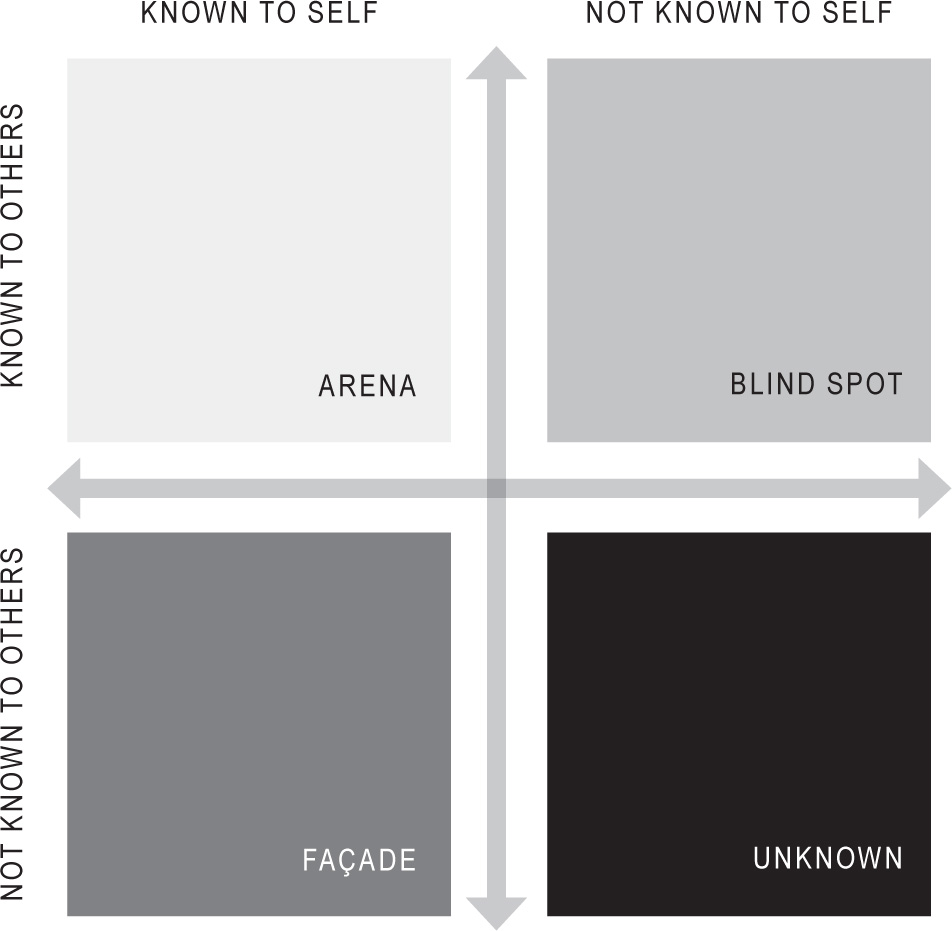
37. The Johari window
For the little game we’re about to play, I’d like to apply this window to the relationship between the world’s scripts and languages. Just as “us” and “others” are two different entities, so “language” and “writing” are two separate things. Even so, it remains a common error to mistake one for the other. But there’s a stark difference between language and writing. Especially when you’re talking in terms of decipherment. Because you don’t decipher a language. You decipher a script. So, by replacing “us” and “others” with “languages” and “scripts” on Johari’s “dashboard,” we can visualize the reciprocal relationship between the two and the correlation between what’s known and what’s unknown (fig. 38).
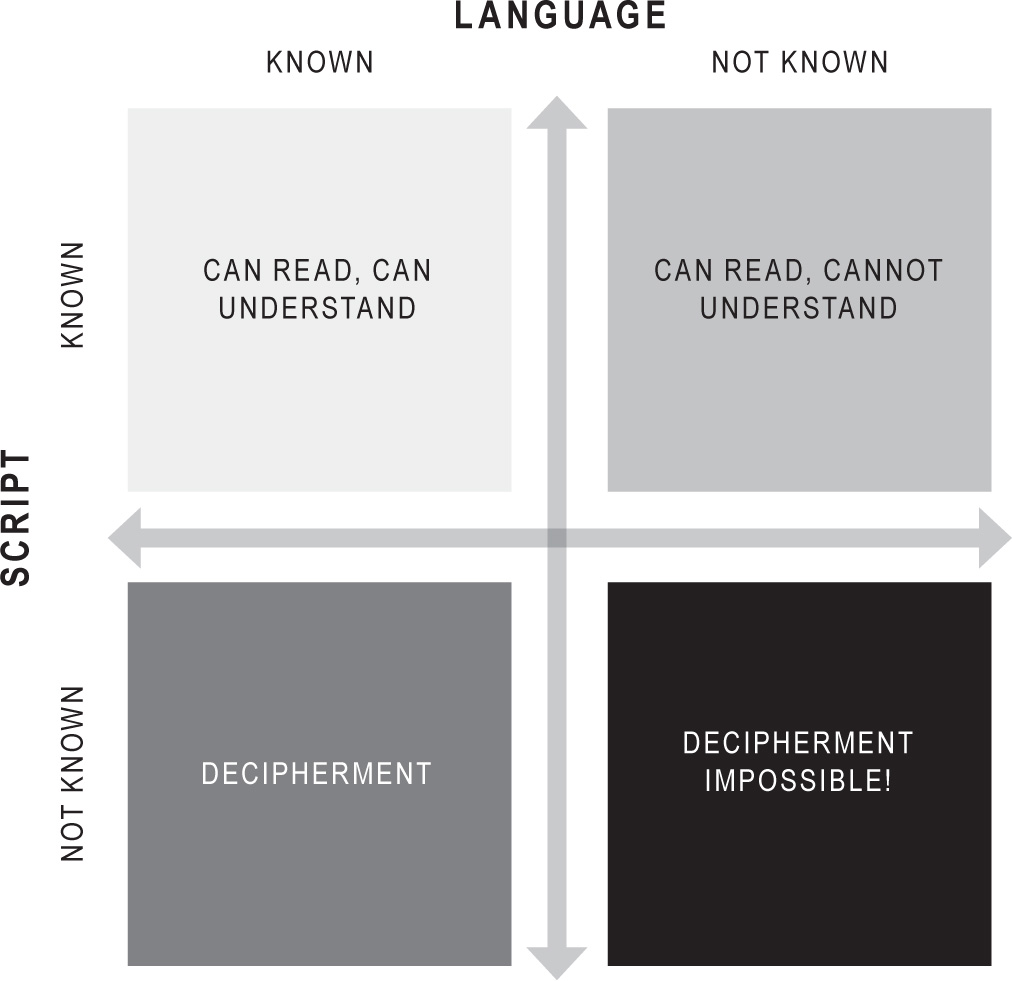
38. The Johari window reconfigured to show the relationship between language and script
In the landscape of possibilities, if we’re able to both read the script and understand the language, we’re in the arena of the transparent: what you’re doing right now, for example, by reading these words and understanding their meaning in English, is a perfect illustration of this type of comprehension. If, however, the script is known but the language is not, all we can do is read, without understanding the language: as is the case with Etruscan. We can read it, since it’s written in a modified version of the Greek alphabet, but we’re not able to reconstruct its grammatical structure.
If only the script is unknown, and we suspect that the language is known, decipherment is still possible: we can apply phonetic values to the signs, and subsequently identify or confirm their linguistic basis. If, on the other hand, both the script and the language are equally unknown, it’s a decipherer’s nightmare, since there’s little that can be done, apart from finding an analogous or sister language, where phonetic values have already been applied to the signs.
The first case—known script and known language—is in broad terms the equivalent of a translation (if the script stays the same but the language changes) or a code-switching (if the script changes but the language stays the same). For me, this is about as interesting as watching paint dry.
The second case—known script and unknown language—is more a question of linguistic reconstruction: a job for the hard-core linguists, the comparative or traditional philologists. Let them work in peace—we’re talking some painstaking stuff.
The other two scenarios, however, are where we get to have our fun. And no small dose of it. Because the third and fourth cases are surrounded by a host of various factors, numerous crossword puzzles to be solved. Every undeciphered script has its own characteristics, its own idiosyncrasies and peculiarities, its own flaws. And the flaws are the most fun of all. Once we figure them out, we’re on a beeline to that childish glee of hopping on a bike for the first time.
Like Tolstoy’s unhappy families, every undeciphered script is, well, undeciphered in its own way. Which is precisely why each must be examined through a lens all its own, and accepted with all its defects. Literally, it must be taken for what it is: problematic. In the words of our old pal Donald (Rumsfeld again, not Trump): “You go to war with the army you have, not the army you might want or wish to have at a later time.”
ANY OTHER STONE
A hieroglyphic inscription’s appearance is true chaos. Nothing is in its right place. There is no relation to the senses at all. The most contradictory objects are placed side-by-side, generating monstrous combinations.
—Jean-François Champollion, Précis du système hiéroglyphique des anciens Égyptiens, 1824
The first step in battle, even before leaving, even before stepping foot off the military base, is to take clear stock of the available data. We go to war with the army we have, but we must know that army well, soldier by soldier. This means understanding which quadrant in the Johari window the script falls into, determining whether it has any kindred or similar scripts in its orbit, whether it’s part of a potentially identifiable linguistic family, whether we can reconstruct its historical background and propose some basic hypotheses regarding its use. Some cases are easier to contextualize than others, but this doesn’t make the decipherment any simpler. Our army is made up of human beings, and human beings are constantly making bad judgment calls.
As it turns out, the history of decipherment is riddled with blunders, errors, and, above all, prejudices. One example alone provides more than enough proof.
If I ask you for the world’s most famous case of decipherment, I know exactly what your answer will be: the Rosetta Stone. And it’s probably true; it probably is the most sensational decipherment. The Rosetta Stone, deciphered by Champollion in 1822, is a bilingual, trigraphic inscription—meaning that it records two languages using three different writing systems: the Egyptian language, using hieroglyphs and the demotic script, and Greek, using the alphabet.
Prior to decipherment, the reigning view was that Egyptian hieroglyphs were “sematographic,” meaning that they recorded ideas, not sounds. Champollion himself agreed. But something felt off to him. You can sense as much from the epigraph earlier, taken from the Précis, where his frustration is almost palpable: How could this script function ideographically? With its strange icons and figurative symbols, how could it express a language “through a string of barely interpretable metaphors, comparisons, and enigmas”?
The script’s iconicity was its own downfall. Its own hidden trap. Images couldn’t possibly represent sounds. We’ve heard that one before, haven’t we? Alas. Champollion made the logical, intuitive, simple leap: he’d already read the proper names of the pharaoh Ptolemy and of Cleopatra on the stone. It wouldn’t make sense if this phonetic usage was limited to the writing of anthroponyms, it had to apply to the entire text: it was not some secondary usage, it was the writing system’s very “soul.”
You see? Years and years of prejudice and misunderstanding about iconicity meant years and years of lost time before finally reaching the goal. And this isn’t the only time in decipherment’s long history that we encounter this same stumbling block. Remember the delay in deciphering the Mayan script—thanks, yet again, to a misunderstanding of iconicity? And the seals with their Cretan hieroglyphs? Same problem. And the Indus Valley script? Ditto. Could it be, alas, that we’re the ones looking at things through the wrong lens?
This gives us clear indication that in the more fortunate cases, such as Egyptian hieroglyphs, having a bilingual or trilingual text does indeed help with decipherment, but only if we don’t fall prey to the power of suggestion.* We’re all experts at complicating our own lives, at digging up obstacles that were never there in the first place. We love nothing more than to stick our paws in the mix and screw things up. Even when the material puts us at an advantage, we still go beating our heads against the same old preconceived notions and prefabricated ideas. We are all (not just those of us obsessed with undeciphered scripts) masters of confirmation bias. It is mankind’s most formidable intellectual enemy.
And it’s an enemy that strikes indiscriminately—infecting us with a desperate need for every fact and piece of data, the entire truth, to conform to an idea that we already believe in. It’s an error in inductive reasoning that we fall for with alarming ease. The world must readily adapt itself to what we already think we know. It’s the poor mountain that must always go to Mohammed, even when the mountain has every reason to stay put.
When this is the reality, it makes little difference whether we have the Rosetta or any other stone, whether it’s bilingual, trilingual, or quadrilingual, if we can’t manage to analyze the data with neutrality and patient detachment. If, instead, we embrace the ataraxia of objectivity and approach our scripts with the impartiality and open-mindedness they deserve, we’ll very quickly find ourselves passing through the first checkpoint of the scientific method.
And it’s even better if we have one other thing on our side: a little luck.
SCRATCH AND WIN
Luck, as in anything else, plays no small role in decipherment. And it’s even more necessary in those cases where no bilingual (or trilingual) text is available at all. However, as Pasteur said, chance favors only the prepared mind. The prepared mind, in our case, is a mind well trained in the rigor of observing phenomena. Who knows how many details pass before us—if only we took note of them . . . we might even make our own luck.
It seems that somewhere between 30 and 50 percent of all scientific discoveries are accidental. From lysergic acid diethylamide, which was originally used to treat migraines (imagine what Hildegard might have invented under the influence of LSD), to sildenafil, a onetime treatment for pulmonary hypertension now used to address a very different kind of problem faced by men in the heat of passion. The serendipity of an unexpected discovery awaits only those with the eyes and brain to seize it. To read the signs well and act in accordance. It doesn’t happen to just anyone. It takes preparation, a feel for opportunity, and a healthy dose of stubborn determination.
Luck, in short, looks no one in the face—it’s up to us to recognize and scrutinize it when it crosses our path. It’s up to us to interpret the clues.
In the late 1940s, a scholar at Brooklyn College in New York, Alice Kober, took a passionate interest in Linear B, eventually ceding it every minute of her free time. Alice smoked like a chimney, and she was known to file the note cards with her analytical diagrams in her empty Lucky Strike cartons (she had no problem clearing the space). So thoroughly did she study the inscriptions on the tablets that, before long, she arrived at a sensational discovery. On the other side of the ocean, Michael Ventris was just as taken with Linear B, sidelining his career as an architect to dedicate himself full-time to deciphering the script (which he’d achieve a few years later).
In the meantime, Alice Kober had the lead. In every aspect: her study methods, her intuition, her ability to seize her own good luck. She understood that the language hiding behind Linear B is inflected, with endings that change according to case, gender, number, like Latin, like Spanish (lupus, lupi, lupo, lupum, etc., or, in Spanish, beso in the singular, besos in the plural). She recognized roots, suffixes, and all without reading a thing, without applying phonetic value to a single sign. She rejected, and rightly so, all unfounded speculation; she cut no corners.
But Linear B is a syllabary, therefore the suffixes attached to the roots follow a particular grammatical pattern (fig. 39).
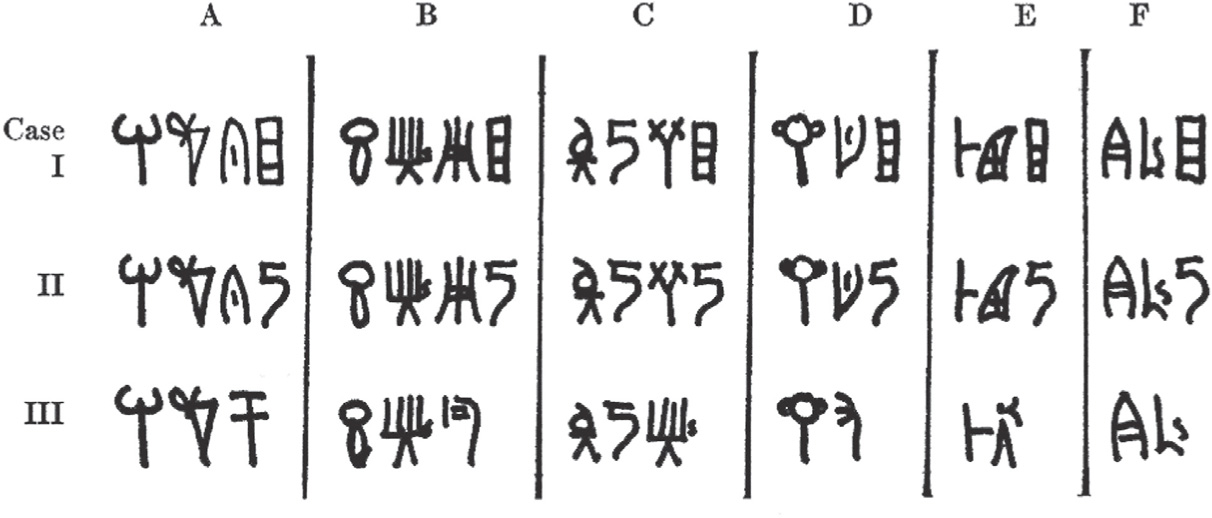
39. Alice Kober’s triplets, Linear B
By looking at an example in Latin we can get a clearer sense of how these suffixes function. Let’s take the word dominus (meaning “master”) and divide it into syllables, following the declension:
do-mi-nus
do-mi-ni
do-mi-no
The final syllable begins with the same consonant (“n” in this example), but the vowels that follow change according to the case (here “u,” “i,” and “o,” for the nominative, genitive, and dative, respectively). This must mean that if we take a different word, for example,
po-pu-lus
po-pu-li
po-pu-lo
the final syllable’s consonant will remain the same, and the vowel will again change according to the case. And here Alice gives proof of her brilliance. She recognizes that the suffix’s vowel changes in vertical position, down the line of a single word’s declension (because the case changes, -nus, -ni, -no or -lus, -li, -lo), but stays the same in horizontal position, from word to word in the same conjugation (domi-ni, popu-li), where instead it’s the consonant that changes. She constructs a tentative grid, same vowel, different consonant. She outlines a pattern of correlations. She lays the foundation.
Michael Ventris was an incredibly lucky man. Without Alice’s intuitions, who knows if he’d have been able to decipher the script as he did, applying phonetic value to nearly all of the signs (and we’ll look at how in a moment). Alice died just before his decipherment, unfortunately. Followed by Michael himself, only two years later, at the age of thirty-four, in a car crash (there have been mentions of a possible suicide). Two stories cut far too short.
Though when it came to deciphering Linear B, both had their share of luck. And luck, in this case, meant the serendipity of having (multiple and highly regular) patterns of repetition at their disposal, which allowed Alice to construct her mute grids of declensions. With no bilingual text available, with no concrete idea about which language might be lurking behind the script (Ventris himself, some fifteen years earlier, was convinced that the culprit was Etruscan, not Greek), the system may well have proved an impenetrable little fort.
Michael Ventris, I repeat, was a very lucky man. Kober’s “triplets” (let’s call them little “hat tricks,” why not?) provided him with a major assist in his decipherment. And Kober, in her turn, showed great intuition, by trusting in her own eye and its magnetic attraction to all repetition. Repetita iuvant, as they say—and sometimes they iuvant a great deal.
THE GOLD
We’ve looked at three preconditions for a potential decipherment: the script-language relationship, with its varying degrees of “unknown”; the competitive advantage of having a text in multiple languages; and the serendipity of having inscriptions of a certain type (repetitive, schematic, coherent). Now we’ll turn to the factor that many hold to be the most important, perhaps the sole variable that makes the difference between the abyss of failure and the joy of that fourth state of happiness (the bike, the child, etc.).
The quantity of texts. That’s the whopper, that’s the gold that Feynman’s talking about at the beginning of this chapter, because in quantity lies the entire potential of discovery. With a large enough quantity of texts, words, signs, even a monkey could decipher the script. Right? Well, not exactly.
Let’s look at two cases on opposite ends of the spectrum, which, coincidentally, happen to be the Phaistos Disk and the Indus Valley Script. The first has fewer than two hundred and fifty signs in total, the second has thousands. Both remain undeciphered today, and probably will forever. How can that be?
In the case of the disk, we’ve yet to find any clear correspondence with other related systems. Those who’ve tried to trace it back to Cretan hieroglyphs or to Linear A have had little to show for their efforts: mere vague similarities don’t get you very far. And we run into the same problem with the second case, too—splendid solitude—though the sheer quantity of texts should give us hope. Only it doesn’t.
Quantity is a fundamental factor, but without quality it won’t necessarily get you to the finish line. Isn’t that the way it always is? Size counts, but it’s never enough on its own. Etruscan stands as a sobering reminder to all those who believe in the macho, “big data” approach to decipherment. All those who so confidently take the bait, sure they’ve got it made, without ever stopping to consider the hook.
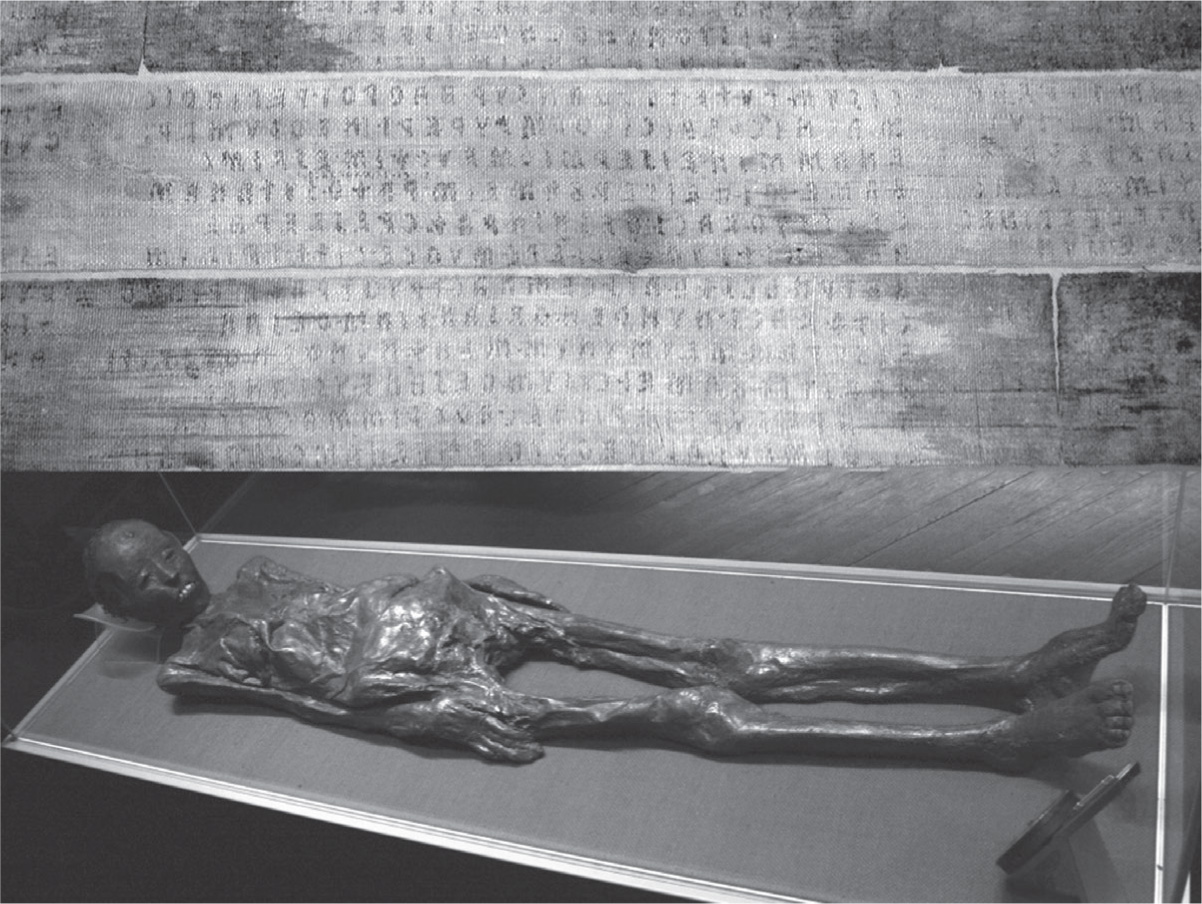
40. Liber Linteus Zagrabiensis, “shroud” bearing a long text in Etruscan
Take a glance at this skeleton (fig. 40), held at the Archaeological Museum in Zagreb. When discovered, it was found wrapped in a linen “shroud” bearing 281 lines in Etruscan. In those 281 lines are more than 1,300 words. A motherlode. And that’s just the longest text—there are another ten thousand, of varying length. A true jackpot of signs.
And yet here we still are, wondering which family this language belongs to, trying to reconstruct a morphology, to patch together a grammar. What is it that’s causing this stalemate? The quality of the texts, unfortunately. Votive dedications, epitaphs, enchantments, names engraved on ladies’ mirrors. Some of the texts are even bilingual, though it has hardly helped. The Etruscan texts are beautiful, don’t get me wrong, and so, too, are the inscribed objects, extremely important for archaeologists and historians alike.
So yes, it’s true that quantity holds the balance of power, we can’t deny it, since it allows us to methodically confirm or refute hypotheses about how to read or identify a language. It’s decisive because it helps us to reconstruct a script’s skeleton and a language’s paradigms. But this leaves us no less high and dry with our Etruscan skeleton in Zagreb: the problem, paradoxically, is not the amount of gold, but the cut of the metal.
TEN COMMANDMENTS
Dear Sir or Madam . . .
For your consideration, I enclose my proposed decipherment of . . .
So begin many of the emails that land in my in-box. I’ve already mentioned this phenomenon, and I know it’s common in the field. The notes that come my way typically revolve around the Phaistos Disk and Linear A, or else Cypro-Minoan, though I’ve seen my share of other, more impassioned cases. Like the one on the outer-space script, brought to our planet after aliens abducted an earthling; or the one on the universal galactic language, from which all human languages descend. And that’s not the only thing that’s “out there” about these correspondences, as I’m sure you can imagine.
John Chadwick, whom I mentioned earlier, served as Michael Ventris’s co-pilot in deciphering Linear B in the 1950s. In one of his last letters, he wrote, “I’d be obliged if those of you who come up with solutions would, kindly, not send them to me.” Chadwick graded my written exam on Linear B in 1998, just before his death. His kindness showed through even in his most critical comments, in that very English way of being gracious and scathing in equal measure.
With much less grace, I took it upon myself to put together a list of the top ten things not to do when trying to decipher a script, should such a perverse idea ever cross your mind. The ten commandments of decipherment. In no particular order, though with extra emphasis on the final point, here you have them:
Now that we have a sense of where to depart from, and of how we’ll need to prepare ourselves mentally to face the voyage, it’s time we step off the Jetway, taxi out onto the runway, and try to get this thing off the ground.