
REACHING AN AGREEMENT
The experiments we’ve looked at thus far have brought one critical point into focus: inventing (or reinventing) is relatively easy. It’s standing the test of time that’s difficult. For something to stick around, as we’ve seen, it must be repeated, spread, proliferated. And to do so successfully requires a certain harmony of intentions.
This harmony can arise only from a group committed to maintaining, growing, and nurturing a cultural object such as writing: the group plays a critical role in institutionalizing its growth. There’s nothing automatic about it. Which is precisely why our solitary inventors, whether intentionally or not, never saw the fruits of their invention flourish, either over a wide territory or through the centuries. The diameter of their creative circle stretched only so far.
To guarantee a writing system’s success, then, it’s essential that the members of a group come to an agreement—and, even more important, that they stick to that agreement.* In the meantime, as with all things that develop, endure, and evolve, the script will change organically, even at its graphic essence: its signs will take on new forms over time.*
That said, reaching an agreement, as we all know, can be one of life’s greatest challenges. We’re always missing one another’s intentions, explaining ourselves the wrong way around, flubbing the message. Human communication is a magnificent mess. So what can we do to start finding some common ground? Let’s try adopting a little group spirit. Let’s step into the living laboratory where codes are first created.
To understand how we communicate in social situations, we could attempt to reconstruct the birth and evolution of graphic (and therefore only written) symbols, as if these are events that we can observe “in vitro.” This isn’t quite the same as re-creating writing’s invention on an experimental level, in a controlled environment, free of all surrounding noise and interference. As we’ve already seen, the past is full of holes and noise. Reconstructing the moment of invention, wherever it may have taken place, would be like trying to reconstruct footprints in the sand. Nothing tangible remains of those moments, nothing we can truly recover.
Through experiments on the creation of graphic symbols, however, we can retrace the birth and evolution of a shared code. How do we arrive at these symbols? How does the sharing process of these graphic systems function? And what happens to these symbols when they’re passed repeatedly from person to person, thus simulating the effect of generations? And still more: How do they develop their graphic form, as they undergo this “ricochet” process?
These experiments are a kind of concentrate, since they contain all the layers of transmission in a short series of trials—they allow us to envision how we develop symbols and attempt to communicate them effectively. In these experiments, it’s as if we’re compressing the back-and-forth of a communication process that typically, in the “organic” evolution of symbols, unfolds over the course of gene rations. Through them, we can glimpse a concentrate of interactions between human beings exchanging messages.
We’ll see that a few of the strategies are strangely (or perhaps not so strangely!) similar to the invention of writing. And to get writing standing on its own two feet, it takes a whole lot of dialogue. If you think about it, to get any exchange, any collaboration, any relationship standing on its feet, and standing sturdily, it always takes heaps of dialogue.
BRAD PITT
Where do symbols come from? Emblems, logos, graphic codes? It’s a question I posed at the very beginning of this book. The experiment we’ll look at here, conducted recently by cognitive psychologists, attempts to provide an answer.
The participants take seats around a table. Without speaking to one another, and therefore without using language (otherwise it’d be too easy), they must pass on a series of messages. All they have at their disposal is pen and paper. They must communicate, in writing, a complex or abstract concept, one that’s difficult to “draw,” like “soap opera,” or “museum,” or “parliament,” or “Brad Pitt.” The game works a bit like Pictionary. The “directors” of the experiment oversee the behavior of the “actors,” monitoring the communication system that develops through repeated interactions.
Three things become immediately apparent: 1. The more the message is repeated, the more successfully it’s communicated (repetita iuvant); 2. The symbols, at first, take on graphic and highly iconic forms, and over time grow less iconic, less detailed, ever more abstract; 3. After multiple interactions, the same signs come to be used to express the same meanings; therefore the participants’ behavior aligns, it converges, growing ever more harmonious.
These three factors drive us toward the birth of graphic symbols, which consists of a fixed set of shared signs. And we can trace this dynamic evolution. Over the course of the two-person experiments (dyads), for example, the drawing for the concept “museum” begins with a plethora of details: the figure of a dinosaur on a platform, with visitors staring up at it. By the sixth exchange, the symbol has evolved, and all that’s left of our poor T. rex is its spine (fig. 35).
This tells us that the more social interaction there is, the more times the participants repeat this exchange, the closer they align around the message’s form, to the point of shedding nearly every indispensable detail. If we interfere a bit with the simulation, namely by adding a group of passive observers, and we then ask them to identify the symbols developed by the active participants, we find that the passive group is a little lost. They can’t keep up with the development; they can’t take part in the sharing of the message.
The graphic symbol for “Brad Pitt” suffers an even worse fate than our dinosaur (fig. 36). The Brad experiment is not merely dyadic, or an interaction between two people, but is conducted with several people in a communication network. The group, divided into four laboratories of eight people each, simulates a mini-society: the participants exchange messages in pairs, until everyone in the group has interacted with one another, building a communication web. And what happens to Brad Pitt is even more surprising than what happens to T. rex.

35. The graphic evolution of the symbol for “dinosaur”
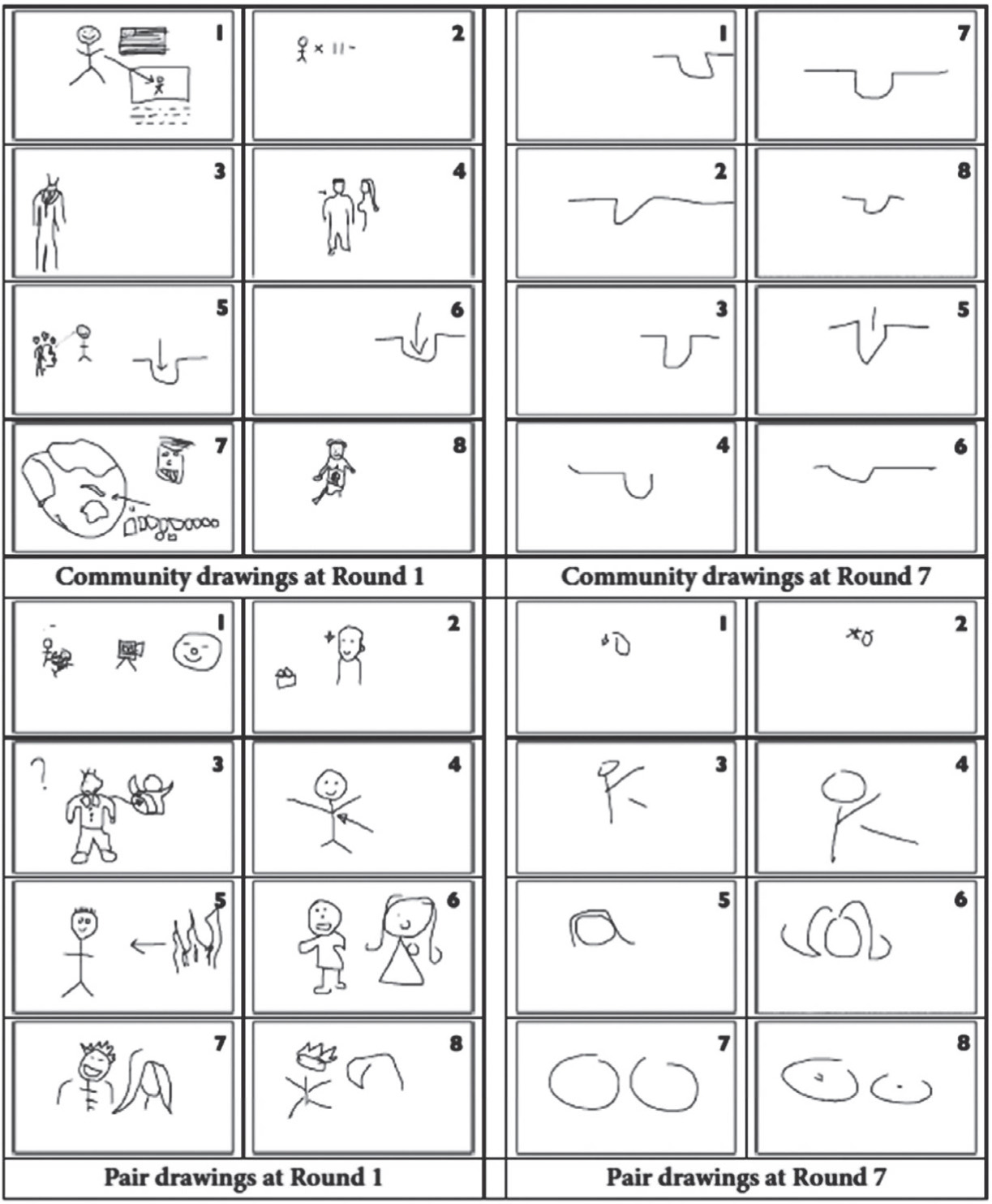
36. The graphic evolution of the symbol for “Brad Pitt”
Things start off just fine for Brad: many depict him with a woman, perhaps because of his quintessential good looks, perhaps to reference Angelina (the article was published before their divorce). What’s surprising is that others use a rebus to identify him. Next to their portrait, they add another drawing of a pit with an arrow pointing into it, or else of an armpit, again with an arrow.
And gradually, exchange after exchange, the symbol begins to morph from its iconic and detailed origins to something more schematic and minimalist, until at last it’s stripped down to the bone, just the sketch of a pit or an armpit. Poor Brad, only the “pit” of him remains.
So what do we learn from all this? We learn that even A-list actors, as “iconic” as they are at first, can be reduced to but faint images of themselves in the dynamic process of social interaction. That little by little, symbols go about simplifying themselves, once the message has been received and absorbed. That ultimately it’s the interaction between human beings that determines a symbol’s evolution, via the instructions we pass back and forth to one another in the chain of graphic communication. And that when we take away interaction, leaving symbols to evolve on their own in a long soliloquy, the code becomes a closed system and, rather than shed details, acquires more and more.
And finally—surprise, surprise—we learn that in establishing a convention, a shared code, we again turn to the all-powerful, universal, and instinctual rebus. This should perhaps help us to understand even more how vague a concept the “pictogram” is: language, the sound we make with our tongues, even if we shove it out the door, will always climb back in through the window. We must always give a name and a sound to things. Even when we think we’re just scribbling.
ALIGNMENTS
The better, the shorter, the easier forms are constantly gaining the upper hand.
—Charles Darwin, The Descent of Man, and Selection in Relation to Sex
Our scribbles, from the Paleolithic to today, all move in a clear direction. While it’s true that graphic systems generally shed their iconicity over time, it’s not always true that they shed it completely. There are cases, like Egyptian hieroglyphs, where iconicity is maintained for centuries, even if those same hieroglyphs were also evolving in parallel toward a cursive script, known as “hieratic.” So, too, with the Maya, who clung to their little faces and icons with even greater tenacity, without ever creating a parallel, more “agile” and linear form of writing.
Such devotion to the icon amounts to a strategy—a culture’s means of preserving its sense of writing as an artistic, figurative, evocative object. The icon, in writing, acts as an interface with art, and this is a framework worth jealously guarding. Here we’re obviously talking about forced, intentional traits, the expression of clear cultural preferences (speaking of traditions that endure!).
If we instead surrender ourselves to the natural force of evolution, we begin gradually, and inevitably, to shed iconicity. Once a code or a system is established, once it all becomes habit, the pressure on iconicity, on detail, on ornament, begins to let up. It’s only when a system is “new” that details are necessary, when the code is still open-ended and the message must be recognizable.
When the system becomes closed, complete—when we’ve agreed upon its traits and its boundaries—we can finally relax. And this relaxation is what allowed the alphabet, for example, to so quickly drop its realistic and “pictographic” forms: the ox head, the house, water, the delta—the physical characteristics, that is, of the words being represented. Our A, our B, our M, our D all hide the legacy of these figures, a remnant of iconicity, though they’ve long since conformed to the conventions of the line.
We must be careful, however, to avoid the usual, simplistic interpretations of this evolution. The loss of iconicity is not linked to industrial demands, to standardization, democratization, or the need to write more, or more rapidly. It’s not a question of mechanics and “intensity of use,” but one of coordination, interaction, alignment.
Iconicity ceases to be necessary because the group’s collective vision and the graphic system are at last aligned: the script is agreed upon, a done deal. Inessential details are no longer necessary to get the message across clearly. So long to all the trappings and trimmings—we can now afford the luxury of simplicity, without fear of botching the message or misunderstanding one another. The same thing happens with logos, which grow simpler and simpler over time, and yet remain equally recognizable. Have you noticed? And the same will happen with emojis, which will continue to grow simpler, as you’ll see (though we’ll speak more on this at the end of the book).
To align, when speaking of a group, means to line up, etymologically. In this case—in the life of a system of graphic symbols, that is—it indicates the almost inexorable drift toward the line. With lines we began and to lines we’ll return.
SCRABBLE, CHESS, AND SCRIPTS
The experiments we’ve looked at reveal just how important social interaction is in the birth of graphic symbols. The greater the harmony, the simpler the system becomes. We don’t even need language to get our message across successfully. All it takes is a chalkboard or a sheet of paper and something to draw with.
This isn’t the only context in which language plays a marginal role. Something similar happens when scripts are transmitted from group to group. When they’re adopted, readapted, reinvented.
When a group adopts a script, it doesn’t necessarily mean that they all understand the language being modeled by that script. They take the model and that’s all. Think back to the Cherokee we looked at earlier: Sequoyah understood very little of the alphabet, and yet he used it successfully as a “mold” or matrix for a new writing system. In this process, the script behaves a bit like a board game. Both are governed by rules that must be followed and instructions that must be explained. And, in both cases, the practice can be transmitted either by a “director,” in what is known as oblique transmission (from one person to many), or in cooperation, known as vertical transmission (from person to person), though it’s always a social, interactive process. Scripts and games are always part of a dynamic, group exchange of actions and reactions.
Both also undergo changes in their most fundamental elements: whether signs or rules, in time both are subject to alterations and substitutions. Games and scripts evolve, in other words, with calibrations, transformations, adjustments. They’re the mice in the great laboratory of social communication.
And there’s no such thing as an optimal state for either, a point of maximum perfection, at which you can say, “great, the experiment is now flawless, we’ll never do any better.” Like all things created by man, it’s plagued by some woodworm or weakness: a redundant sign, an extra pawn, an oversight in the rules. There’s a crack in everything, as Leonard Cohen said, and that’s how the light gets in.
The important thing is that the language is never the protagonist. We always think of writing as a vehicle for language, an instrument, a technology. And in a certain pragmatic sense, that’s precisely what writing does: it carries language on its back. Saussure, on the other hand, the father of linguistics, thought of writing as something parasitic, something subordinate to language. And he was wrong. Writing has a parallel, independent life of its own. A script can notate several languages (just think of the alphabet, which records hundreds, all very different from one another), but a language can be notated in several scripts (Greek is one example, written with the alphabet, Linear B, and the classical Cypriot syllabary). The two tracks can be interchangeable, but they always run parallel.
Writing is an object in itself. When it comes to transmission, its passage from one person to the next, language has very little wiggle room. Writing, with its signs and their forms, roams across the world and is selected, used and reused, transported and remodeled, and, especially, adapted to other languages.
It’s a similar story with board games. They’re transmitted and exchanged by different groups, and they often function as a social lubricant to aid with integration. Language is not an indispensable factor. A board game can be explained merely be watching other people play. When the “foreign” observer grasps the mechanics of a game or a script, everyone involved, observers and participants alike, smiles with satisfaction, even if they can’t understand one another.
Learning to recognize another’s actions, mirroring, imitation, reciprocity: board games and scripts are pawns on a most human chessboard, where winning and losing count for very little. What counts, what’s truly fun, is recognizing the other person’s moves and gaining a firm grasp of the exchange.
BETTER TO BE IN BAD COMPANY
So wherein lies the secret to an invention’s success? Not in its longevity, which is contingent upon the survival of the group that uses it. Not in solitary invention, which often dies before it even gets off the ground. The secret to success lies in a group’s ability to align itself, allowing for the harmonious communication of a shared code of signs. And invention is a long, multi step process, dependent on social cooperation, group participation, the ping-pong of exchange, cohabitation, and the need to make ourselves understood.
A script’s success does not lie in its simplicity, its graphic agility, its structural economy, or how easy it is to learn. Its success lies in repetition, diffusion, in the social cooperation of those who use it. In the enduring force of interaction.
Success does not lie in the spark of discovery, or in the short-lived drive toward a script’s creation. This is only the beginning, which the discoverers themselves may not even be aware of. Success lies in everything that comes after: the meticulous, laborious construction of an agreed-upon set of conventions. As well as in waving goodbye to any useless, superfluous elements, details, familiarity, iconicity, to make room for the essential things, without which we cannot communicate.
Success lies in adapting, organizing, perfecting each symbol until the system is closed and clear. But the final goal is not to reach some optimal state. No such optimal state exists. Just as there’s no such script that’s perfectly molded to a language’s every sound. In fact, because writing systems crystallize and become conventions, they always bear within themselves a number of defective or redundant elements. Such is the case with all scripts, no exceptions. In English, for example, there are several ways to produce the sound /k/ (hard “c”): k as in “kite,” c as in “card,” and ch as in “character.” The reasons are historical, tied to the alphabet’s passage from Greek to Etruscan to Roman (our metalinguistic board games). And yet here we are, still alive and able to understand one another all the same, defects and redundancies included. In other words, better to invent in “bad company” than alone.
Human interactions, at any rate, are always imperfect and riddled with problems. And writing, as a product of these exchanges, is by definition an equally imperfect system. But none of these shortcomings or imprecisions spoils the broth. Nothing can stop the greatest invention in the world from relaying (however imperfectly) the most important thing in the world: our desire to be understood.