
Undeciphered. A code unbroken. Crete left us four scripts: Cretan Hieroglyphic, Linear A, the Phaistos Disk, and Linear B. Only one, the last, have we managed to interpret. How is that possible? How is our knowledge so limited? How could it be that we understand so little about this island’s languages? Is four thousand years all it takes to bury the whole lot of us in silence?
FACE FORWARD
There’s far too much about our origins that we still don’t understand. Languages, names, migrations, cultural encounters. Without a deciphered, comprehensible script in hand, we remain cut off from the richness and particularity of the details. Archaeology can help us to understand ways of life, styles, cultural preferences, the material things. The mind, however, gifts us the exactitude of thought.
It sounds like a paradox, but the more thoroughly we here in Europe explore our own backyard, the less we understand. The very first scripts to emerge on this old continent are its most impenetrable forts. Insurmountable walls stand between us and the secrets of our origins. Who invented the first European script? Which language (or languages) did it record? In other words, and in short, where do we come from?
The concept of Europe is of course a historical construct, composed of various layers of occupations, heritages, traditions, and a fair share of mystification. The European identity has long been celebrated and scorned in equal measure, because its borders are fickle, its colors too faint. Digging back through millennia to piece together a sense of identity is no easy task, because identity is a fluid, changeable thing. Questions of “belonging” are always a source of dispute. And often, rather than embrace this complexity, we assault it, precisely because it rests on shaky ground. We’re in desperate need of roots.
So where do we turn, if we’re looking to claim some sense of kinship? As Greek myth and its ideal geography would have it, the first place to search is Crete, given that the mother of the island’s King Minos bore the name Europa. Europe is Crete, Crete is Europe, from the dawn of time, on the wings of fable. Roots.
The Ancient Greek language throws in a hand, too: eurys-, “wide,” ops-, the root for “face” (though this etymology may have been drummed up to make the name more comprehensible). Europe and its wide gaze on the world, overseeing all, from Greece onward. Still others contend that the name is Semitic in origin, tying it to the West: ereb, all that looks westward.*
I guess that means it’s face forward, then, eyes fixed on the Occident. Except our eyes are closed, since we still don’t know with any certainty where we come from. Europe the shapeshifting concept, a continent with no clear sense of its original languages, and all of us Europeans the result of a dubious concoction of cultures.
Even Homer spoke of Crete as a cultural melting pot, resounding with a jumble of different languages. He puts this in the mouth of Ulysses, who lets on to poor Penelope that he’s the descendant of Minos himself. Crete, he tells her, is filled with countless peoples, countless cities, languages on languages—Achaeans, Eteocretans, Kydonians, Dorians, Pelasgians. But who are all these peoples?
Let’s fumble around in the dark a bit, though not without some optimism. If Crete is the dawn of Europe, aren’t we bound, someday, to catch a glimmer of hope? And where else but in the Cretan texts that we still don’t know how to read?
PIONEERS
Let’s start here, then, from Crete. Let’s start from the beginning. We’re in a four-thousand-year-old cemetery. In the middle of the Mediterranean’s fifth-largest island, after Sicily, Sardinia, Cyprus, and Corsica. Once again, its name is charged with mystery: Crete. We’re not sure where it comes from, perhaps an ancient Anatolian dialect, *kursatta, meaning “island”—an instance of antonomasia.*
Which would mean that Crete wasn’t just any old island, but the island. Though let’s not lend it too much importance: it also feels like the kind of name that someone who hasn’t seen very many islands might come up with. Imagine an Anatolian used to seeing Samos or Mytilene. Crete would seem like an enormous continent. Crete = Europe, like a continent. But how does Anatolia factor into this? It’s now commonly believed that Crete, thousands of years ago, was slowly but inexorably colonized by Anatolian migrants. Our chaotic melting pot, with all its unthinkable fusions. But more on that in a second.
On the tombs in this cemetery are seal stones made of bone—tiny, intricately carved. An exquisite example of miniature art. Here we have the first European inscriptions. And they’re strange. Some of the signs are familiar: a double axe, a vase. Others are abstract already—it’s not clear what they represent. The seal stones were designed to stamp clay nodules, but they were precious objects. Objects that may have been used solely for display, to indicate one’s social status, later to be buried in the tomb along with other status symbols—a fly-shaped pendant, an Egyptian musical instrument. “Pay attention to us,” these objects plead.
The dead in the cemetery at Archanes speak to us of their wealth, their intelligence, their exclusivity. They manipulate signs. They write down a phrase, a sacred formula perhaps, and they repeat it. There are only a handful of seal stones, but they all bear the same five signs. And it’s not just any phrase. It’s a mantra that will enjoy a long history on the narrow stretch of island that is Crete. The dead of Archanes know how to distinguish themselves from others. They know how to compete, to experiment. They are pioneers.
AS GOOD AS NEW
In this fertile ground, Europe’s first script takes root. Scripts, in the end, account only for so much. The years pile up. Nowadays there’s a European Parliament with a very different set of problems to confront. But how fascinating it would be to roam the linguistic labyrinth of the so-called Archanes formula, to explore its five signs, to grasp just how these icons and symbols were chosen and transformed into a meaningful phrase, an important message, a group’s identity—untouchable, solemn, sacred.
It’s from these five repeated signs that we made our way to the first full-fledged script. But how did we get there? What did Minos’s Cretans have in mind at the outset of their creation? An invention from scratch? A spin-off of Egyptian hieroglyphs? Did the Cretans draw inspiration from Egyptian culture, already nearly a thousand years old? Were they copycats? Or did they look around and draw upon their own environment, their own objects, tuning in to the sound of their own cognitive gears? Which is to say, did they act upon a true flash of intuition, with no outside help? Did they invent?
We still have no clear answers to these questions. But that hardly matters. The writing system that grows out of the Archanes formula is as good as new. We call it Cretan Hieroglyphic but it’s nothing at all like Egyptian hieroglyphs. New signs, new symbols, new palaces erected along the shores. The mythical Minos, with his labyrinth and his sacred bulls, Minos the pioneer of the Cretans, ruling over all from the palace of Knossos, scanning the sea with his “wide” gaze (Europe!). He’s already cosmopolitan, our Minos. He can write, and he invents a formidable script.
But the Cretan Hieroglyphic script is not hieroglyphic. We refer to it as such only because we suffer from Egyptian imprinting—and it’s a misleading model. Hieroglyphic means nothing more than iconic, figurative, image-based. Like all writing systems throughout the world that have been poorly defined as hieroglyphic (from Mayan to Anatolian), it’s a system that relies on clear reference points, signs that are recognizable at first sight: eyes, legs, hands, pots, plants. Other signs are considered abstract, geometric, linear.
And this iconicity is of great interest to us. Understanding it will help us pry open the stubborn window onto our origins. And it’s a topic we’ll revisit, since it points to why drawings played such an important role as a springboard to writing’s invention.
HOUSE OF CARDS
The expression seal the deal, as we know, means to make a pact, reach an agreement, conclude a negotiation, to seal it shut. In Crete, sealing transactions was more important than writing poetry. Cretan hieroglyphs are found almost exclusively on bureaucratic documents. There is no literature, no fiction, no science. There are no stories or histories. A small, elite group of citizens functioned as palace managers, overseeing all agricultural and industrial production. Little else mattered to them, in these mini-states with maximum bureaucracy.
And they enjoyed creating objects in miniature, like seal stones, just as their recent predecessors had done in Archanes, following in the same tradition: tiny, intricate, highly skilled relief carvings. And signs. The first signs of a bona fide European writing system. Language, fixed in place at last.
These seal stones offered very little room—enough for brief formulas, which often appeared in similar sequences and may have been used to indicate the bureaucracy’s top officials and their various roles. The unrepeated words might then have been the officials’ names, but these are only guesses, however well informed. In a way, the seals were a kind of functional, personalized gemstone. A valuable ID card.
The engraved seals were made of colored semiprecious stones, in a prism or pendant shape, which were worn around the neck like amulets, or as charms on a bracelet. For whoever wore them, they were a symbol of power, signaling that person’s ability to read and write and their important administrative role. As well as helping them to stand out among the crowds that gathered around the palaces, during ceremonies, at banquets.
Upon entering a palace, one walked through halls and rooms frescoed with scenes of processions, religious symbols, dancing figures. Then on into the grand courtyard, where a large but select group would gather. The who’s who of Minoan society were easy to spot—the women with their flowing, ornate skirts, their breasts exposed, wearing gaudy golden jewelry. We have fewer depictions of the men, which should by no means lead us to envision a matriarchy or some early strand of feminism (a conclusion as bold as it is unfounded). The seal stones were a bit like our modern-day business cards, ivory card stock printed with fancy fonts and flourishes. The intellectual set flaunted their seals, though their function was more or less the same—to legitimize one’s role in society, facilitate trade, ratify a proposed transaction. To keep everything under control.
And this control extended beyond the material—it was tied to perception. For the Minoans, as for us, appearance was fundamental: the upper classes were required to wear the proper clothes, adhere to the latest trends, plaster the walls of their homes with elaborate frescoes. Visiting a palace was not so different from the way we aspirationally scroll through Instagram or window-shop online, spending hours on Net-a-Porter without actually buying anything. Climbing the social ladder was, as ever, strictly tied to conspicuous consumption. And the result? The proliferation of a “palace style.”
In the Cretan culture of four thousand years ago, bureaucracy reigned all but supreme. Though the instruments used to practice it, like writing, also carried a notable symbolic and personal significance. Engraving your name on a precious object, leaving your signature, distinguishing yourself in public—these were all meticulously curated strategies. Owning a seal with your name imprinted on it held much more appeal for the upper classes than, say, wearing a signet ring with your family crest does today, since Minoan seals were both a sign of your social position and a functional object, used to stamp important documents. Mini-monuments to status, wielded by the attentive landlords of a palatial housing complex.
STRAY CAT
When you think of the Minoans, what images come to mind? The labyrinth, the Minotaur, bull-leaping, perhaps? Do you remember the myth of Pasiphaë, Circe’s mystical and unfaithful sister? Pasiphaë was Minos’s wife, punished by Poseidon for neglecting to offer him a sacrificial bull. Not just any bull, of course, but the most beautiful bull in the world, with a hide as white as snow. Her punishment comes as a kind of Dantean contrappasso: Pasiphaë falls victim to the charms of the bovine hunk. And to help her satisfy her desire, the architect Daedalus builds her a wooden cow disguise. The queen commits a beastly act of adultery. Thus is born the Minotaur, a ferocious hybrid of a creature, who winds up trapped in the labyrinth. The bull is also central to the myth of the rape of Europa, Minos’s mother, violated by Zeus in the guise of (what else but) a bull.
Minoan bull, Greek bull, the image keeps turning up, because the Minoans find a place for it wherever humanly possible: in palaces, in houses, their walls covered with monumental horns and bucrania, scenes of bull-leaping, miniature calves. Crete is littered with real and metaphorical horns.
But cats, on the other hand . . . In Cretan iconography, cats hold a special place. Not something to constantly show off, like bulls, no. They’re a very different kind of protagonist, of a more, well, feline subtlety. In palace frescoes they figure as predators, though the scenes evoke the pastoral peace of a pleasure hunt—the cats are shown trotting around, almost playing with the birds and pheasants they should instead be pursuing. Even the famous Minoan “snake goddess,” though she bears knifelike serpents in both of her hands, has a cat on her head. I’m not kidding—she wears a cat on her head like a trophy.
It’s on seal stones, however, that cats really come into their own. There, amid writing symbols, we find them with their tails curled up and their big eyes bulging open, as if sketched by Walt Disney himself (fig. 3). Carved with a lathe into the seal’s surface, they seem like a beautiful decoration, exotic almost, unmoving. And mute. Though, as we’ll discover, their sound can still be heard.
For years and years, these engraved cats were mistaken for a design element. But they’re no mere decoration, no simple frill. They’re a sign, through and through.
The cat has a long history in Crete. We find it on the clay tablets of yet another Cretan writing system—it, too, like Hieroglyphic, undeciphered: Linear A. Linear A is a syllabary with some ninety signs, along with an almost infinite series of logograms. That two very similar writing systems were created and used on the same island, in more or less the same period, is nothing short of remarkable. In fact, the two scripts even overlap: Linear A and Hieroglyphic coexisted on the island for nearly two centuries, though we don’t have a clear sense of their “kinship”—whether they record the same language or two different languages. That said, the two systems are similar at the graphic level. Their signs look alike. And they may have even more in common than we think, though that will require more research. In one aspect, however, they’re markedly different: the seals. When carved into seals, Cretan Hieroglyphic is almost always limited to icons. When writing on clay, on the other hand, everything changes: the signs become slender, angular. Linear, in other words. And here Linear A has the upper hand. It’s precisely this linearity that will bring Linear A its success: over time, Cretan Hieroglyphic dies out on its own. It is supplanted, substituted, absorbed. Lines and their simplicity win the day.
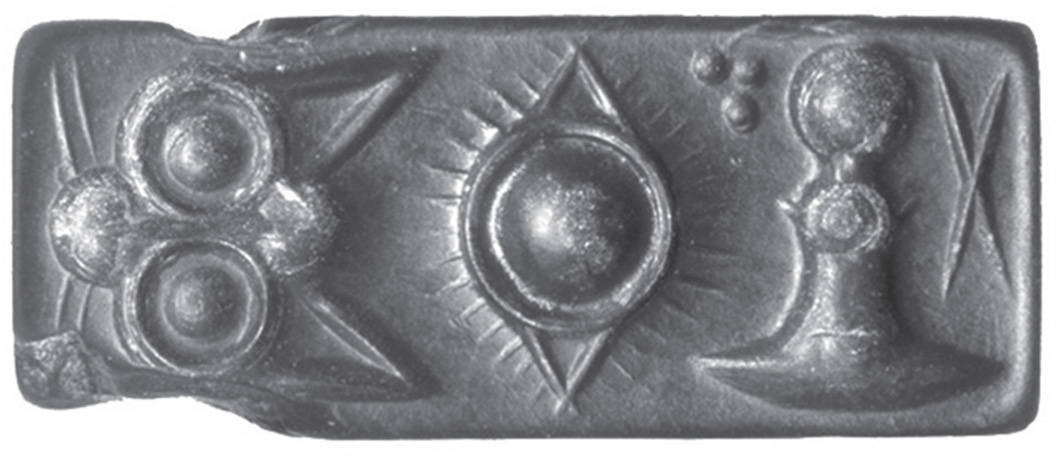
3. A jasper seal stone, carved with Cretan hieroglyphs, including a cat (first on the left)
And such is the destiny of our cat—to become linear, tenuous, schematic: the skeleton of a cat (fig. 4), as we find it on Linear A tablets. So bare-bones did the symbol become over time that tracing it back to its origin—the cat icon featured on seal stones—proved to be an undertaking. Academics tend to entrench themselves in their own ideas: once something is defined as a drawing, it stays a drawing. Which was precisely the problem with Egyptian hieroglyphs, before Champollion broke the code: “It’s not writing,” went the mantra, “they’re only drawings.” And the same again with Mayan glyphs: just drawings. When meanwhile the key—the road to finally deciphering them—was right there in the signs’ iconicity.
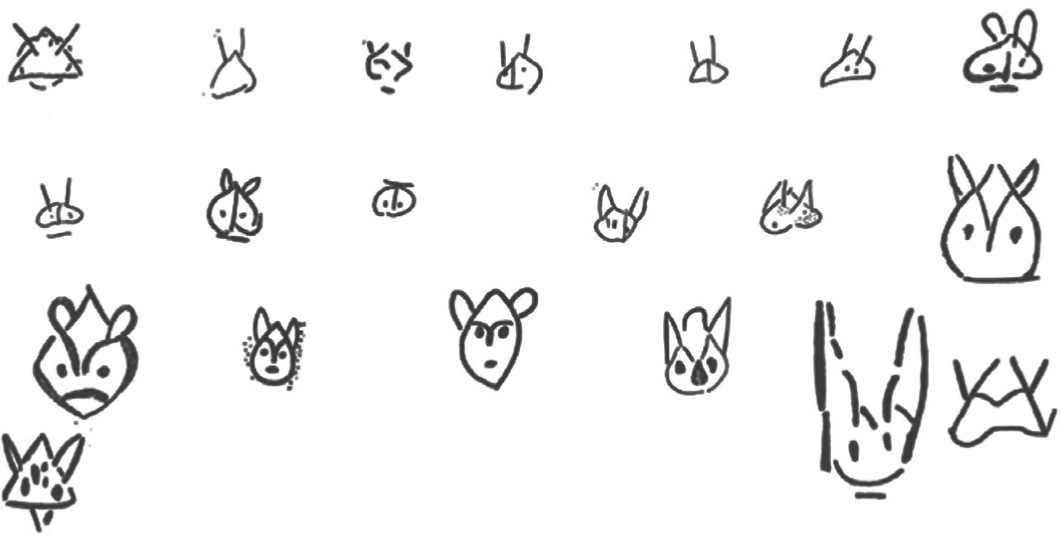
4. The evolution of sign A80 (the syllable ma) in Linear A
It’s time we restore dignity, then, to the cat’s meow. On seal stones a cat corresponds to the syllable ma. We know this because we find the same sign in Linear B, which descends (as its name so unimaginatively suggests) from Linear A—though unlike A, B has been deciphered. In Linear B the syllable ma is linked to the image of a feline, here represented by a grossly simplistic sketch of a cat’s snout. Only the most essential elements remain. Poor cat, indeed, but a miraculous feat of distillation. A coup of contour. The human mind is made up almost entirely of images. But sounds, too. We’re visual and auditory creatures, remember?
Across many of the world’s languages, we find one splendid thing in common. It’s surely an outlier case, but the sound made by a cat is almost always represented in the same way. This won’t work with other animals. An English rooster goes cock-a-doodle-do and an Italian one chicchirichì! A Russian dog goes gav and an Indonesian one guk. Cats, on the other hand, are universal: they can meow in English, miao in Italian, meo in Vietnamese, myau in Russian, and so on and so forth. The differences are minute. This is true (incredibly!) for ancient languages, too. And by now you probably get what I’m driving at.
If I were a Minoan cat—with my beautifully open and simplified syllables, nearly all consonant-vowel pairs, as in Linear B (and Linear A)—what noise would I make? If I were a Minoan cat, I’d go ma. A resounding maaaaa, then, in the face of all the Minoan bulls that roamed the palaces.
SYLLABLES
It’s time now we clear up a few things about the most important element in language: the syllable. There’s something mysterious about syllables. Do you ever find yourself dwelling on the syllable as an inexhaustible source of mystery? Not likely. Nobody in their right mind thinks that way—but I do. And I’m not alone. I can still picture one of my old professors—her pencil lodged (invariably) between her teeth, her dusty, frumpy skirt, her air of utter pitilessness: “For a linguist, the syllable is one of the hardest things to describe.” Those were the days.
But the fact is, she was right. If I say huh, we can all agree that it’s one syllable, but so is strengths, with its nine letters. Like the word vowel with its deceptive vowels, the syllable is a slippery entity. Yet our very ability to communicate relies on it.
At the root of all this is a biomechanical issue: we open our mouths gradually wider when we pronounce vowels and regulate the flow of their sound. The longer we hold the vowel, the more forceful it becomes. If you open the window and scream stooooooooop, the force of the sound is sustained by that extended oooooo. (Texans, with their characteristic drawl, know a thing or two about this.)
Primates do the same thing. They use warning calls. They open their mouths and vocalize. They’re able to make themselves understood, to give directions—but these sounds remain strictly vocalizations, because they’re too rigid and exact: they don’t combine to create compositions, they don’t extend beyond what they are. And that’s precisely where our expressive capacity lies: we know how to combine small entities of sound into complex architectures like words or grammar. And then we throw in one extra element: a symbolic meaning. By symbolic I mean nonindexing (sound + alarmed gazelle = a leopard is approaching, a fixed expression that indicates one thing and one thing alone); I mean fluid, free, divorced from context.
The words beware and leopard work well together in the moment of alarm, when danger strikes your safari tour, but their individual expressive potential, as words taken on their own, can be reconfigured and reconstructed elsewhere. They’re open-ended. We humans hate closed circles, communicative short-circuits; we’ve learned to play pretty well with the Lego blocks of expression. Each of these blocks is a syllable. And that’s where it all happens—whether it’s the moment we start doubling up syllables and repeating ma ma and pa pa, at around twelve months old, or the moment we invented the first writing systems (all syllabic), around five thousand years ago. The syllable is of staggering importance in our desire to express ourselves, whether in speech or in writing.
That humanity ever landed upon the alphabet (in which each unit of sound corresponds to a single letter) was a matter of sheer good fortune, a cultural epiphenomenon, an unlikelihood of incredible consequence. The ancient Greeks cleared the way for their vowels (in a sea of Phoenician consonants), and thus created a democratic and economic product, destined for a success that was never guaranteed. But the alphabet is nothing more than an artifice, a brainy, sophisticated thing, like democracy or philosophy. We think in syllables, communicate in syllables, sing in syllables, and it was in syllables that we invented writing.
LOST LANGUAGE?
O fortunate Crete!
—Idomeneus, King of Crete,
Wolfgang A. Mozart (for the music, at least)
Not all Cretan syllables are so mysterious. Earlier I mentioned Linear B—let’s talk about it, at least for a bit. The truth is, Linear B isn’t of all that much interest to us, since it’s been deciphered. For now, we’ll spare it only a few measly lines. Though we’ll come back to it, I promise, since it’ll be of help when we look at the process of deciphering scripts.
So then, Linear B. This script records a very archaic Greek dialect, more than three thousand years old—the period during which the (so-called) Mycenaean palaces were in control of continental Greece and part of the island of Crete. Which meant that in Crete, after Cretan Hiero-glyphic and Linear A, they (also) spoke a form of Greek, and they wrote using a syllabary, Linear B, not the Greek alphabet (still long from being adopted).
We know that Linear B records the Greek language because an English architect, Michael Ventris, deciphered it in 1952. It remains the first and only case of “internal decipherment,” based solely on a statistical analysis of the script’s signs, with no reliance on bilingual or trilingual texts.
For instance, both the Rosetta Stone and the cuneiform inscriptions of Persepolis include texts written in languages that are far better known: without the sections in Greek on the Rosetta, and without the Old Persian in Persia, we’d have had a much more difficult time reading Egyptian hieroglyphs and Babylonian, respectively. Having a little “outside” help makes life much easier. But with Linear B, miraculously, there was no need. And it’s also the first case where the results are well established, and not the fruit of linguistic imagination and delusions. That Linear B has been deciphered is now an agreed-upon fact.
(Unlike with the Phaistos Disk and the Voynich Manuscript [which we’ll look at later], both the subject of a steady stream of emails in my in-box, their authors eagerly pressing me for my advice or my backing. What these decipherers à la page all have in common is their presumption: never are their claims to have deciphered this [or that] script accompanied by a request for me to critique or disprove their method. They want only ratification. Which is why even we industry insiders proceed with caution. We’ll soon see how finicky, fussy, and fastidious the work is for those who study undeciphered scripts—the daily grind of counting signs, checking and rechecking the data. A great way to lose your eyesight, it turns out, along with a neuron or two.)
So what to do, in the end, with the Aegean scripts from Crete that remain undeciphered, Cretan Hieroglyphic and Linear A? What hope do we have of following in Michael Ventris’s footsteps and producing some real results?
There are many possible paths, and we’ll get a closer look at them when we talk about decipherment techniques. Likewise, there are just as many doubts, which I bear with pride. There’s only one thing I’ll say with certainty. Our work, today, has one competitive advantage that has long been undervalued: a collaborative spirit. Toward Crete, for the love of the search, as Thales said. Together, I’d add.
Forget the lone individual on a hunt for glory. Collaboration is at the root of every modicum of progress ever gained, whether that door was opened with a battering ram or with the elegance of a carefully cut key. The wall that stands between us and interpreting, understanding, and embracing the first European languages, in the end, will fall. And even if the languages hidden behind Cretan Hieroglyphic and Linear A seem lost to us now (or perhaps just one language, equally lost?), no one can deny us the hope that we’ll one day find them. Ancient languages we can reconnect with, like old friends. Or unknown languages, which we must labor to reconstruct.
Let us wish just one thing for ourselves, in the meantime—with a poetic, not a scientific, spirit, for a change: that their sound prove enrapturing, as full and fluid as music. Which is just how I hear it in my imagination or on sleepless nights: as rich with emotion as the Cretan chorus in Mozart’s opera Idomeneo—named for the king of Crete, grandson of Minos. A tale with a happy ending. A fortunate tale. And a chorus, not a lone voice.