
MIXTURES
The time has come to sail from Crete, even if we’ll soon be back, to explore one of its most famous mysteries, the Phaistos Disk. For now, though, let’s hop islands. We don’t have far to travel. Welcome to Cyprus—island of everyone, island of no one.
It’s hot here. You can see the Troodos Mountains in the distance, rolling down toward the sea, the land red with copper and iron, the sun pitiless and harsh, even in February, with snow still spattered on the mountain peaks. There’s the smell of cypress in the air, cypress and dust.
I’m here to view the Cypro-Minoan tablets, to photograph them, study them, catalogue them. For months, I’ll fly back and forth. And in the end, I’ll write a book. It’s 2012. It feels good to escape to Crete—Italy, where I’ve returned after nearly twenty years in England, seems more like a half relative, a stepmother, a place I cling to in search of roots.
As anyone who does research for a living knows, to stay put is in some ways to surrender, an almost passive act. A researcher must be mobile, ready to leave, to follow the current, slip from the confines of stability. I know this is subjective—there are certainly researchers who stay in one place—but for me, at least, research and travel are synonymous.
I leave with a precise aim: to see the Cypro-Minoan inscriptions and, while I’m there, to take in the smell of lemons, which in Cyprus are bitter and ubiquitous. Cyprus is a land of strong smells, the smell of borders, sand, and asphalt, a scent I’ve known for years now. It’s both sleep-inducing and violent. The rhythm of life decelerates, but violence stirs in the air like a fine dust, on this island conquered by all, colonized one day, liberated the next, and still divided.
Divisions make little sense in general, but this is even truer in Cyprus, which has always been a melting pot: of ethnicities, colors, religions, foods, all in an ordered disorder. Cyprus runs on its own logic—it’s a functioning Greece, so they say.
Cypriot vocabulary is littered with English and Turkish terms, a Greek dialect with a mixture of archaic sounds and pleasant, rounded sounds, which seem to dance between the tongue and the roof of the mouth. The coffee there is tagged with various adjectives: it’s Turkish, or Cypriot, or Greek, or Arab, but it’s always the same coffee, a thick brew made in a small long-handled pot called an mbrikia, allowed to sit and form a sediment, bitter as lemons. And Cyprus has many languages, too, which have been spoken there over the centuries. In modern times, a Greek dialect, and Turkish; in antiquity, a different Greek dialect, mixed with Phoenician, though still distinct, each with its own writing system.
If we dig even deeper into the past, we find what is perhaps an even more ancient language, in a secluded enclave: Eteocypriot. Eteos, meaning “true” Cypriot. The mother tongue. Very few inscriptions are preserved from the first millennium BCE, or nearly 2,500 years ago. We can read the Eteocypriot language because it was written using a Cypriot syllabary, known as the classical Cypriot syllabary (or Cypro-Greek), which in the same period also recorded a local Greek dialect, Arcado-Cypriot. One script for two languages, then—one Greek and the other clearly not. The mother tongue appears to be unknown: so what’s going on here?
To make sense of it, we must travel even farther back in history, to 3,500 years ago—a time when the island was vibrant and prosperous, with urban centers on its shores and a geopolitical system under which no person ranked above any other. A heterarchy, with power divided up equally, and where the island’s abundant copper (which in Latin was aes cuprum, derived from the name of the island itself) was a valuable trade resource throughout the eastern Mediterranean. The Minoan Cretans, who were expanding across the Aegean as far as the coast of Anatolia, seem to have made frequent visits to Cyprus as well, even if in their passing they left very few traces of their culture. One of these traces is their writing system. The Minoans’ Linear A was adopted to record the Cypriot language, and perhaps one other language as well. The Cypriot language and the Minoan script melded together, and the resulting mixture was Cypro-Minoan. The script of the island of everyone, the island of no one.
1-2-3
I mentioned the possibility that Cypro-Minoan might be the script of more than one language. It’s still up for debate. In the 1970s, this was the theory in vogue among the few scholars in the world who studied it: Cypro-Minoan represents not one script but three. They based their evidence on the fact that some inscriptions seemed to have signs that were absent in other inscriptions, and seemed to be written in a different way. Examples of these divergent signs are found on four tablets.
(And I don’t mean four tablets, give-or-take. I mean only four tablets—two of which, it should be noted, were glued together. So four tablets, then; three if you count this collage [fig. 5].)
In short, these four tablet fragments were set aside in their own group: the way they’re inscribed seems to be a departure from all other inscriptions (CM 1), so it makes sense to call them by a different name (CM 2). We then take all of the inscriptions found outside Cyprus, which are also rare, and give them a third name (CM 3). There you have it, 1-2-3. Three subgroups of the same writing system. I should be diplomatic here, but it’s a pretty illogical breakdown, is it not? I find it all perplexing. And I’m not the only one.
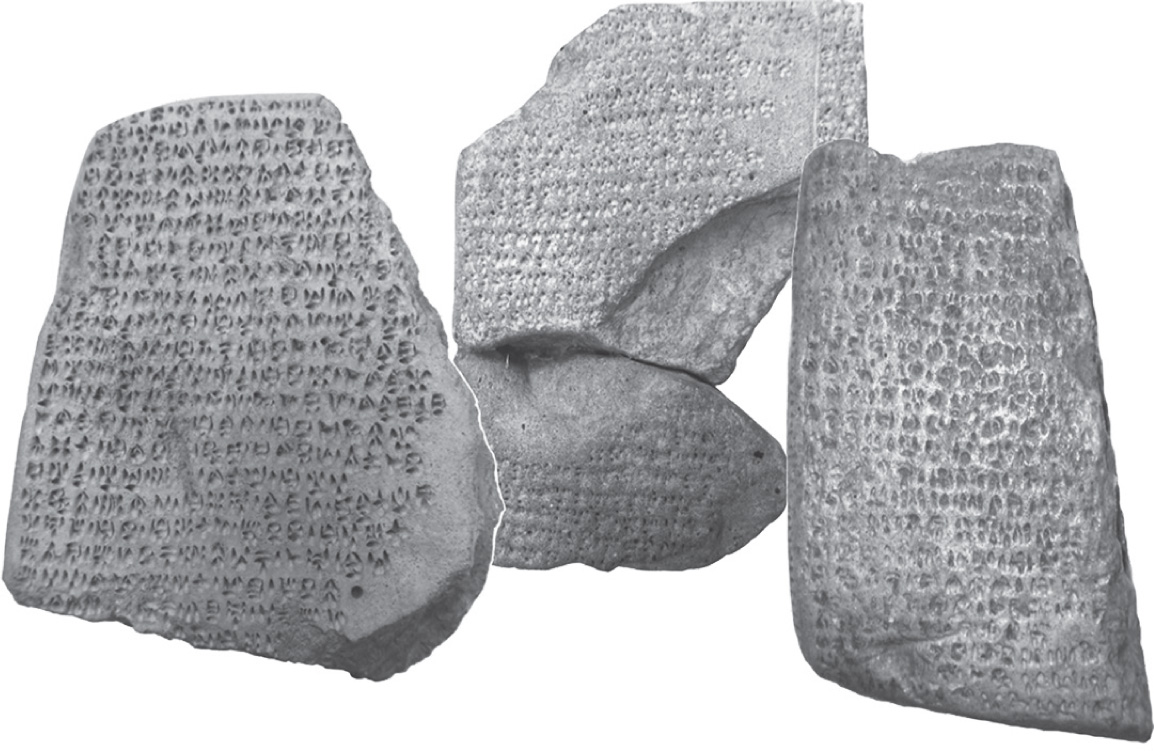
5. The four tablet fragments inscribed with Cypro-Minoan
All in all, this script currently amounts to fewer than three hundred inscriptions. To break it down into different subgroups is counterintuitive. Nevertheless, in academia as in politics, divide and conquer. Never mind the fact that this 1-2-3 breakdown implies that we’re dealing with three different languages, one for each of the script’s subgroups.
This fragmentation, in recent years, has sparked a revival of scholarly interest. It’s a kind of giant brain teaser, fueled by the most powerful question a scholar can ask: What if we’re wrong? Our trusty scientific method—we test the hypothesis. Applied to Cypro-Minoan, this question translates to “What if this breakdown isn’t helping?” A critical mass of scholars is now on the case. And it’s about time.
In the end, it may simply be that Cypro-Minoan only appears to be three different scripts. Given how varied it is, inscribed on a host of different materials—silverware and bronzeware, golden jewelry, ivory plaques, clay objects—perhaps the markings vary in accordance with the material on which they’re being made? It also seems that there were several different “scribes,” each with their own handwriting—different people writing in different styles. As if the script were not standardized, regulated by a central bureaucracy. Perhaps Cypro-Minoan was just a bit “freer”?
And therefore different from the inscriptions found in Minoan and Mycenaean palaces. In Cyprus, they wrote freestyle, no bureaucrats to speak of. Failing to take this freedom into account is an error commonly made by scrupulous, and biased, scholars, who merely want confirmation of things they’re already familiar with, like the palaces and their ordered and uniform tablets. Just because the model for the writing system in Cyprus is blatantly Minoan doesn’t necessarily mean that the modus operandi is Minoan as well. Let’s face it: the Cypriots, in the end, proud and diverse as they are, have always gone their own way.
Must we proceed with caution, then? We have no choice. Cypro-Minoan remains undeciphered, therefore no one can say precisely how many scripts, or how many languages, it represents. But the suspicion that the number is one, not three, is worming its way ever deeper into the morass of scientific publications in the field. We’ll pick up the discussion again in the chapter on decipherment. For now, we’ll have to withhold our judgment.
MINE
One thing we do know for sure: Cypro-Minoan was never used for management purposes. In this aspect, it differs greatly from the Aegean world. The Cypriot tablets, though few, bear extensive texts: they appear to be narrative in nature, not inventories of goods and products. This is highly interesting, and it confirms the fact that, though the Cypriots of the Bronze Age did indeed adopt another culture’s writing system, they employed it to their own ends, which were by no means the economic tab-keeping of what we might call the Minoan Federation or the Cretan Ministry of State Property. That these somewhat tedious affairs were dealt with on different materials, such as parchment or papyrus, and that they never made it down to us—due precisely to the perishability of those materials—is another matter entirely. But we’re much more practical than that. We have no interest in building hypotheses on the basis of invisible materials.
Let’s try an imaginary experiment (or somewhat imaginary, anyway). Say we have before us an undeciphered script. A few odd inscriptions that we can’t understand, recording what may be one or several languages. What can we draw from these mute texts, and from the script’s subgroups, 1, 2, and 3, which we can’t even catalogue? The prospects aren’t exactly rosy. You can’t squeeze blood from a turnip, as my grandmother would say. Nevertheless—and still quoting my grandmother—the beauty of imagination is that you can try to understand even without knowing how to read. Using your common sense, of course.
Shall we give it a shot? Let’s give it a shot. Let’s pretend we’re Agatha Christie, on the trail of an elusive killer.
CLUE 1: Cypro-Minoan is written—engraved, painted, inscribed—on an incredible variety of objects, as we’ve noted. Metals, clay, ivory, earthenware pots. Nearly all of these objects are culturally significant and crafted with attention to aesthetic detail: (“beautiful,” we’d call them, but beauty is a murky concept; best not to project it on the tastes of the ancients). In any case, we’re not talking about commonly used tools or utensils.
CLUE 2: Writing is added to valuable objects to lend even more value to those who possess them. Doing so gives one a competitive advantage in society. This phenomenon is invariably linked with the desire to be seen. My object is embellished with something as rare and precious as writing (just like me, right?). Excuse my slang, but I want to be clear here: writing is rare and reserved for the few, and is therefore a way of making an object more badass. What’s missing from my beautiful golden ring? Why, only that final, badass touch: i.e., an inscription.
CLUE 3: And what will my inscription say? You’ve probably already guessed it . . . it’s so banal. What else would it say except that this object belongs to me. It’s not yours, not public property, it doesn’t belong to the local or central government. It is mine and mine alone. Hands off!
Three clues make for a good start, but there are still other facts we can glean. Let’s take a look at the texts on these precious objects. They’re brief, a few words at most, since it’s hard to fit an epic poem with three hundred lines of blank verse on the side of a pot. Now look a bit closer. Some of the sequences conclude with the same sign. And that sign can mean only one thing, since it appears as the final word with remarkable consistency. What is it? It probably indicates property, to whom the object belongs, the name of its owner: “This ring belongs to Tom, or Dick, or Harry.” Anyone who wrestled with a little Latin in school knows that this is the genitive case, although we can’t simply claim that the genitive exists in Cypro-Minoan, since we’d have to take it for granted that it’s a language like Latin, with declensions and cases. Much safer, in fact, to assume that it’s inflectional, like all Indo-European languages. But can we even claim that Cypro-Minoan is Indo-European? I wouldn’t dare. Giammai, as my grandma would say—never ever!
What we can say is that this insistence on indicating one’s ownership—literally branding the object—was a bit narcissistic. We have no trace of any Mycenaean or Minoan scribe attempting to leave their name on anything, not even a humble administrative document. Industry, not ego, was the obsession in the pre-Greek Aegean—the system of production, not social rank. Meanwhile, check out these Cypriots, well ahead of their time, attuned to public image, PR whizzes who know how to manipulate writing as if it were a status symbol. Personalizing their luxury goods, showing off. Who knows what they might have done with Instagram.
THE KING’S MARBLES
Cypro-Minoan was a game reserved for the elite, not the people. The people, in truth, have never had an easy time claiming space for themselves in the annals of history—and even when they manage it, they’re always being overshadowed by the kings, the commanders, the names of note. In Cyprus, they had an even harder time. Getting a clear sense of what village life was like there is difficult, and the funnel only gets narrower—we find evidence of the elite in the cities, in their residences, in cemeteries, in the grand sanctuaries and grand workshops dedicated to the “god” copper. Copper was their only true source of wealth, their principal means of trade with the eastern Mediterranean, almost as if it were a form of money in a society with no market or currency.
Cypriots were born to be merchants—as they have been for nearly four thousand years now. They’re expert traders. They’re entrepreneurs. They know how to conduct business, to coordinate, to unite industry and power in order to take full advantage of their prized metal. Without copper, there’s no bronze. So the Bronze Age, for the Cypriots, is first and foremost the Copper Age. They understood this perfectly—and they made sure to cash in on it. The “god” copper is sacred because it means industry, and industry means wealth.
This coordination, all in the name of copper, can be witnessed in their writing. As evidence, we have nearly one hundred fired clay spheres, all of roughly the same diameter (two centimeters), and all of which bear rather scant inscriptions—two words on average, often just one (fig. 6). The briefest of texts on the tiniest of spheres, and yet rivers of ink have been spilled in trying to understand them: What could they have been? What was their purpose? Toy marbles? Weights? Votive tokens? Sling bullets? It’s amusing to explore the many interpretations, to imagine all of the archaeological minds at work, their philological-neuronal gears turning in pursuit of the most elusive explanation. Think of all the energy and creativity expended on the strange case of these tiny Cypriot spheres!
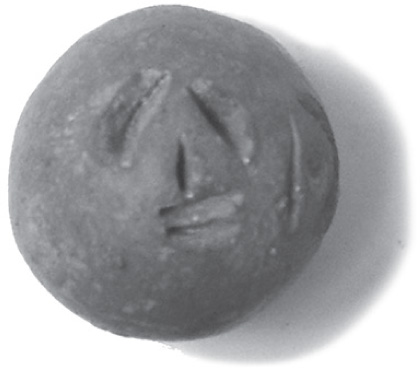
6. Clay ball inscribed with Cypro-Minoan
I lean toward good old common sense. Look at the following figure of miniature soccer balls, used for drawing the tournament brackets in the Champions League (fig. 7). Now look back at the Cypriot balls. Are you catching my drift? Sorting! The simplest explanation is always the most persuasive, and oft entimes it’s the only shoe that fits, like Cinderella’s glass slipper. If these spheres were indeed used for sorting, what would be inscribed on them? Another lob of a question—soccer hadn’t yet taken hold in Cyprus. Obsession with status was their preferred pastime.
The clay spheres were fired intentionally, to make them durable, to preserve them. Important stuff, here—no small beans. What, then, is more important than a noun? A proper noun? Precisely. Inscribed on the spheres were proper nouns or official titles, public appointments. The former designated that specific person, and no one else, a matter of exclusivity; the latter indicated that it was someone of importance, recognizable via their societal role. But what were these roles? And how can we be so sure that these were truly proper nouns?

7. Champions League draw
Because we have the proof, says Agatha (me). On those “badass” objects that we discussed earlier, a few sequences show up repeatedly, and they include the sign of the “genitive” (indicating the owner). That same mark of possession is nowhere to be found on the clay balls, which might instead bear the equivalent of the “nominative” case, or the subject. When these spheres were dug up—at least in the city of Enkomi, the area of the island that has been most thoroughly excavated—they were found in religious and industrial contexts. We already know that the sacred and the industrial worlds were tied up in a kind of all-in-one complex of copper workshops and sanctuaries, meaning that the people named must have been active in that realm. Illustrious figures, at the tip of the social pyramid. A priest, a high-ranking official, a king?
Whether or not there’s a king involved is hard to prove, but we’re now convinced that at the very least we’re dealing with the upper crust of Cyprus in that day. The members of this aristocracy would be sorted for the purpose of some kind of activity, perhaps religious, perhaps political. Whichever it was, we can’t say with any certainty. But that it was a public event, an important event, an event of display, seems beyond question at this point.
Not so different from when we select the brackets for our modern-day soccer tournaments, or for March Madness. But there are ancient examples, too, such as in Magna Graecia and in Sicily two thousand years ago. The Cypriots, however, seem to have been the first. Sorry, Champions League. (Go, Cyprus!)
ALMOST THERE?
And go, Cypro-Minoan. Because if we manage to decipher any of the as-yet-undeciphered scripts, Cypro-Minoan is in the pole position. And here’s why.
Do you remember Eteocypriot, the mother tongue of the first millennium BCE? We discussed how it is written using the classical Cypriot syllabary, which we have no problem reading. And though we still struggle to piece together the structure behind Eteocypriot, since so few texts have survived, we can however boast of one small success: we’ve recognized its “genitive.” And its genitive seems to be precisely the same genitive that’s used to indicate ownership in Cypro-Minoan inscriptions. Same case, same inflection, same function. Eteocypriot survived from the second to the first millennium BCE—and this mother tongue may well be the language hiding behind Cypro-Minoan.
That’s all that I’ll say for now.
Cypro-Minoan is not the first European script; if we don’t count the Phaistos Disk (a black swan, as we’ll see), it’s the third chronologically, after Cretan Hieroglyphic and Linear A. Cyprus is no hermit’s hideaway, it’s a planet of “oriental-occidental” voices and aromas like no other. And it’s bound to yield more surprises, with its distinctly Mediterranean mixture of ethnicities and scents, languages and sounds, lemons and coffee. And these surprises are just around the corner.
INTERMISSION
What’s not around the corner, however, is the other end of the world. And before journeying halfway around the globe from the Mediterranean, I’d like first to pause for a digression. What I’d like to tell you about are three “i” words that I hold very dear: the first is islands, but that much you already know; the second is ideas, which sometimes come and sometimes don’t; and the third is INSCRIBE, an acronym I’ll explain to you here in a second.
Let’s start with ideas—elusive, wavering, at times unfaithful, like lovers lost and confused in the landscape of their amorous possibilities. If you’re stuck between chasing after a hesitant lover or a fleeting idea, the latter is always a safer bet.
I’ll soon be off to chase them down on a private and deserted island. And I’m not talking about some radical chic vacation, but an experiment. My trip will be free, no taxes or hidden fees, and, more important, no frills. A Swedish entrepreneur offers up his home to groups interested in developing an idea in a place far from all civilization, with no electricity, no comforts beyond four walls and a roof over our heads, and, possibly, a refrigerator. One precious week of the year, the occasional hammock here and there, and a few square miles of Swedish greenery.
This is the island of ideas, and it can be reached only by a rowboat large enough for six people—leaving behind, back on land, the constructs of everyday life, the world and its practical matters, our clingy electronics, and all thought of obligation, in order to make room for a different, freer kind of thinking. A week to think in silence is a luxury (in this case luxury-free). I’ll write and reflect on writing, and as a group we’ll put our heads together and continue in our quest to decipher the world’s undeciphered scripts.
Speaking of my group—I present to you INSCRIBE. We’re financed by the ERC, the European Research Council, therefore by the European Commission, though I won’t be receiving any kickback for having waxed poetic about Europe earlier. The grant I received was to fund a research group focused on the invention of writing. INSCRIBE is an acronym for Invention of Scripts and Their Beginnings. Our aim is to reconstruct writing’s invention using an analytical method that draws on several different disciplines—linguistics, archaeology, anthropology, visual perception and cognitive studies, the Digital Humanities. One of our goals is to discover just how many times writing has been invented throughout history, since the precise number of inventions has not yet been clearly established.
But that’s not all. Our team is also committed to deciphering the undeciphered languages you’re already familiar with—Cretan Hieroglyphic, Linear A, Cypro-Minoan.
Beyond these Aegean scripts, we study two others that remain undeciphered, which may or may not have been invented from scratch: one is the Indus Valley Script, and the other is Rongorongo, from Easter Island.
And it’s to this last script that we’ll turn our attention now. Let’s leave behind the frog puddle of the Mediterranean (to Plato we’re “like frogs or ants around a pond”) and brave the ocean. The calm and benevolent ocean.