
MARKETING
Egypt is an unusual place. In an ancient world where few knew how to read or write, and so little has survived of the little that was written, Egypt gifted us with rivers of words, and not a single one out of place or redundant. In its graphomania, Egypt sets us swirling in an eddy of images, narratives, portraits of great men, tales of the dead who went toe-to-toe with eternity. To give you a sense of the breadth and intensity of this “Nile” of words, here’s a literary comparison: if writing itself were a writer, Egyptian hieroglyphs would be Leo Tolstoy, who wrote without pause, no matter when, where, or how small the detail. Tolstoy was a graphomaniac, and so was Egypt four thousand years before him. And just as Tolstoy brought his characters to life, the Egyptians did the same with their writing. Egyptian signs are infused with a vital spirit: to erase a written name was to murder that person; to scratch out the sign of a dangerous animal was to render it harmless. But here we’re talking about Egypt at its pharaonic height. The early days were different.
All beginnings, in truth, are arbitrary, often mysterious, and sometimes accidental. It’s difficult, if not impossible, to point out the precise moment in a process that marks its beginning. And so, unlike Tolstoy, and unlike Egypt in its later years, the invention of writing in Egypt is a laconic affair, almost stenographic. The first hieroglyphs, strangely enough, bring to mind one of the great Tolstoyan protagonists, so expertly drawn in his reflective and laconic nature as to seem a portrait of the author himself: naturally, a human being who writes much can’t help but be a human being who speaks little. With just one scene from a novel, we can understand the first hieroglyphic inscriptions: when Levin asks Kitty to marry him for the second time.* Levin writes his marriage proposal in code, scribbling on the table with a piece of chalk. He uses only the first letter of each word (w y t m i c n b d t m n o t). She understands instantly (a skillful decipherer, that Kitty)* and accepts, replying in the same way, initial by initial.
Sometimes (and only sometimes) it takes so little to understand each other.
The earliest hieroglyphs are not all that different from Levin’s marriage proposal to Kitty. We’re on a hot and arid desert plain, not far from the Nile. It’s 1988, and a German archaeologist and his team discover an enormous tomb (Tomb U-j), composed of twelve interconnected rooms. The impressive tomb is located in an equally impressive cemetery, although architecturally speaking it’s the most elaborate, prominently positioned at the center—preeminent. We’re in the vicinity of Abydos, and the necropolis goes by the name of Umm El Qa’āb, “mother of pots,” after all the ceramic pot shards littering the area.
Centuries later, not far from here, the Egyptians will construct the temple of the pharaoh Seti I, father of Ramesses II. But in this moment, 3,320 years before Christ, there’s still no trace of pharaohs. Keep this date in mind, 3,320 years before Christ, more than 5,000 years ago. We’re still in Predynastic Egypt, and in the tombs at Abydos we find abundant evidence of something else, something far more important: a first (though still debated) attempt at writing.
These earliest symbols appear on pottery, seal impressions, and some three hundred ivory tags the size of stamps (fig. 14), with a hole in the corner so that they could be strung to various goods, such as textiles, leather pouches, or pots. The signs found on these labels are reminiscent (to a certain degree) of the Egyptian hieroglyphs that we’ll find in droves in later periods. And it’s these signs that interest us in particular.
Also of interest are several important pottery vessels from the East, with traces of resinated wine and figs, sealed shut using impressed seals. Predynastic Egyptians drank sweet wine, wine of a certified quality, sealed to guarantee its authenticity. Not so different from the modern labels we find on bottles of wine or any other product we’re trying to market. The seal represents the brand, and to launch it, all you need are a few words and an image. Think about the logos everywhere around us today. It’s precisely the same.
These artifacts are buried with the dead and for the dead, to uphold their memory: they seem to speak to us of who they are, to tell of their affairs. Among them may indeed be the king of Upper Egypt, Scorpion I, his arachnid emblem engraved repeatedly around him, to celebrate his legacy as king. These labels are the ancient equivalent of keywords in modern marketing: an expression of quality, authenticity, ownership. At Abydos we find the prehistory of the brand, and, perhaps, the true beginning of writing’s invention.
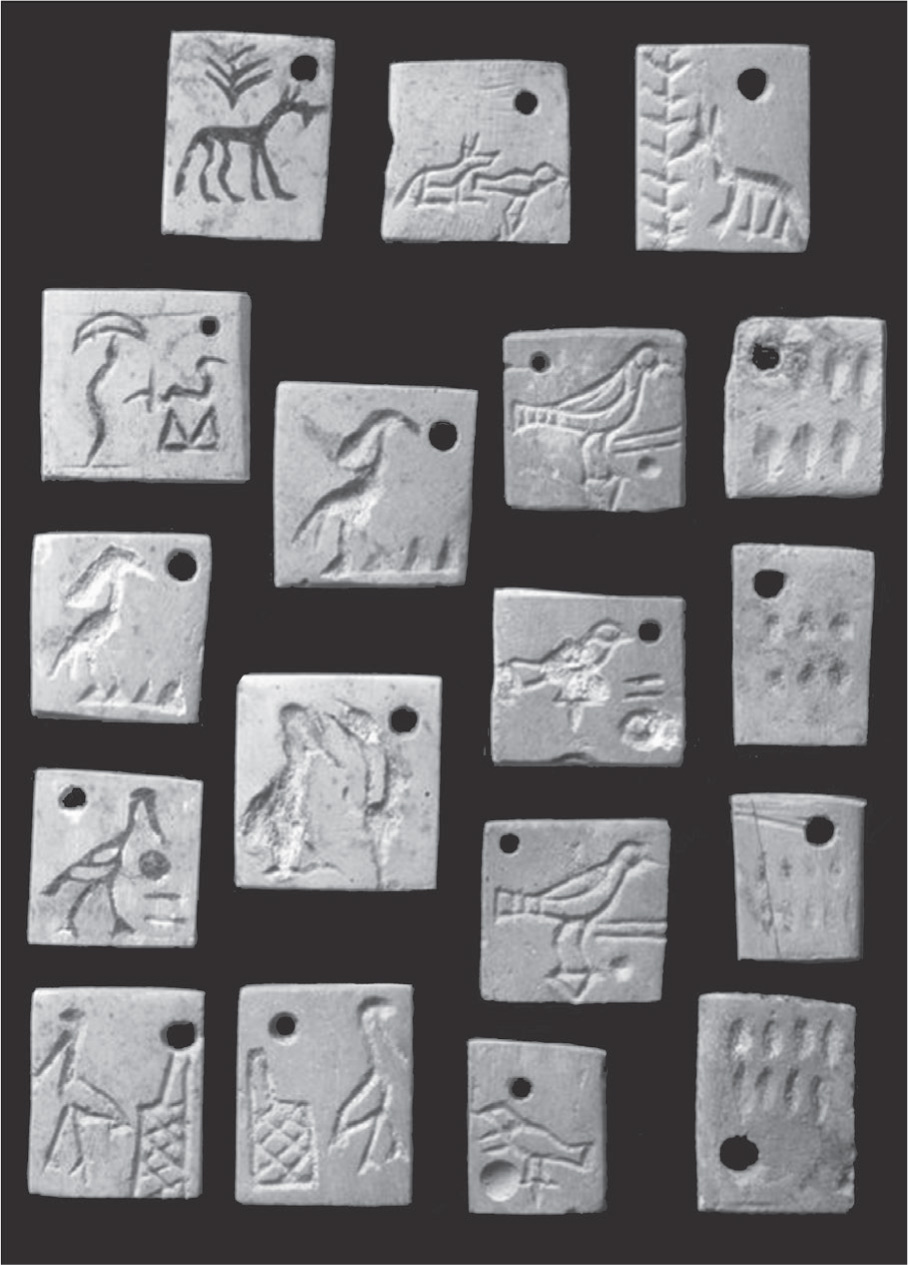
14. Labels inscribed in Ancient Egyptian, Tomb U-j at Abydos
THE GRAMMAR OF CREATION
Though the ivory tags found at Tomb U-j in Abydos bear only a few sparse symbols and brief sign sequences, the tags themselves are numerous. The engraved signs depict the forms of animals, plants, men, and mountains, as well as linear and geometric symbols. Among the various categories attested, some are linked to the celebration of power, be it divine or temporal, and to the quantity and variety of the material goods recorded. Some signs seem to form a kind of narrative—there’s even suggestion of a human sacrifice. These representations are unusual, since even though some symbols do resemble the hieroglyphs found in later periods, the same can’t be said about all the rest, which are without parallel. How are we supposed to read them? And then, as we know, labels weren’t the only type of engraved object. We find more than a hundred inscriptions on pottery, painted with ink, using signs such as scorpions, fish, falcons, and boats.
Are we here in the presence of a full-fledged script? Is this where the invention truly begins? The debate, of course, is ongoing, and the stakes are extremely high. Here’s why. If the inscriptions found at Tomb U-j represent a fully formed script, then we’re going to have to overhaul our traditional view of how writing was invented—a view that’s been gospel for years, taught in schools, passed down from generation to generation. Mesopotamia would have to be knocked down a peg—no longer number one, no longer first in the invention of writing. A new order would have to be established.
I relish these debates, especially when the underdog topples the favorite by just a few points. So let’s get down into the details. The material isn’t easy to interpret, and it’s limited (though not scanty). But the system of symbols seems to possess its own logic and coherence.
Mixed among the figures of humans, reptiles, and mammals is one other sign that will enjoy a long life, the serekh, depicting the niched façade of a palace, topped by a falcon. This sign is a heraldic emblem that always represents the king. The combinations of these signs on the tags vary—a trait that’s indicative of a writing system, not just a simple set of drawings. It’s as if the Predynastic Egyptians buried in this tomb adopted their preexisting iconography for another purpose, to represent something else: combinations of sound. Highly recognizable, iconic symbols, emblems, rearranged with linguistic dexterity. Or at least that’s how it seems.
There are those, on the other hand, who maintain that the similarities between these signs and the later script are extremely limited: just a few birds, some water, maybe a cobra. A few uniconsonantal sounds, in other words, only coincidentally related to the “classical” hieroglyphs. A random, icon-based system, with a loose connection at best to the later symbols. An inspiration, in short, the groundwork, but not a script. It lacks the sufficient level of form and structure to be one.
There is, however, a method, an order to these ancient tags. They’re trying to communicate something precise, something beyond the snapshot of information we get from a drawing. They are charged with words. They speak to us, and not just in any old way, but in Egyptian. Names and designations seem to be recorded using single signs, signs reminiscent of logograms. But that’s not all: in some cases, one sign helps us to understand another, lending information about its sound or meaning. Let’s look at an example: a combination of the sign for elephant and the sign for mountain, which we’d render with the toponym ʒbw, Elephantine. The place indicated by the two signs is not Elephant (ʒbw) + Mountain (hʒs.t), but the city of Elephantine (ʒbw). In other words, we’re already in the early stages of the rebus: the mountain sign tells us that we’re dealing with a toponym, a place name, and not just an animal. The sound is the same, but the semantic category is different. Rebus.
We find this little trick on other tags, too—and not just toponyms, but names of people, along with other ingredients that aren’t quite clear to us but that nonetheless fall into coherent sequences, mixed in with figurative symbols. There’s a logic behind them, and it shows. So to say that we’re still “behind the curve” of writing is a little ungenerous. And there aren’t just signs! There are numbers, too. And these numbers, even though they don’t appear together with signs on the labels, but separately on their own labels, still give us an important sense of just how cognitively advanced Predynastic Egyptians were. Numbers, as we’ll see in Mesopotamia as well, are the trusty co-pilots in the early race to the first scripts: they pitch in, help steady the craft, guide the way. In Egypt, they were already using a base-ten system—a system that remains in place to this day and that here seems already well articulated.
The seal impressions, meanwhile, make for a rival attraction. They include no signs associated with a script, but are done in the same style as the ivory tags. They follow the same compositional logic and serve as a decorative counterpoint. They’re flattering, in other words—the perfect companion piece for the tags and their hieroglyphic-style signs.
All, in short, would seem to indicate that we’re in the presence of an early go at written language, hieroglyphs in embryo, just waiting to take flight. Invention, liftoff! Though you know better by now—invention happens in stages. It’s a slow process of accumulating the necessary linguistic understanding, of selecting the proper form for each sign. It’s a lever effect, one of those simple machines that allow for movement in one direction only. Like the teeth on a gear, turning gradually and steadily. We’ll call it the ratchet effect, if we’re being technical. And with the ratchet effect, there’s no turning back.
ENCROACHMENT
And there’s no slowing this machine down—the gears, in fact, only keep turning faster, their teeth moving ceaselessly around and around. In the span of a hundred years, still early in the First Dynasty, writing spreads and is used to complement the iconographic decorations on ceremonial objects, like the famous tablets or votive slabs such as the Narmer Palette (fig. 15). Names, as ever, are the main focus of the inscriptions, along with other related terms that refer to the current rulers. The inventory of hieroglyphs grows and solidifies, becoming a fully formed system in a relatively brief period of time. And all the mechanisms are present, even if longer, more complex syntax doesn’t come until later.
The aim of this writing is clear. The Egyptians took great pride in calling out the identities of their rulers, celebrating their prestige with gusto and a profusion of hieroglyphs. And hieroglyphs, given their iconic nature, never come alone: they work in tandem with images, iconographic compositions. These two elements, writing and image, are constantly encroaching on each other’s territory, in a powerful “visual” dance. It’s as if the hieroglyphic writing acts as an exhibit of monumentality, to celebrate the important names, while the images seem to work to make this intention all the more apparent, in a truly harmonious choreography. What’s amazing, and rare, about it all, is that neither of the two elements steals the show: hieroglyph and ornamentation lean on and rely on each other, as partners. Finally, a relationship with a little equality.
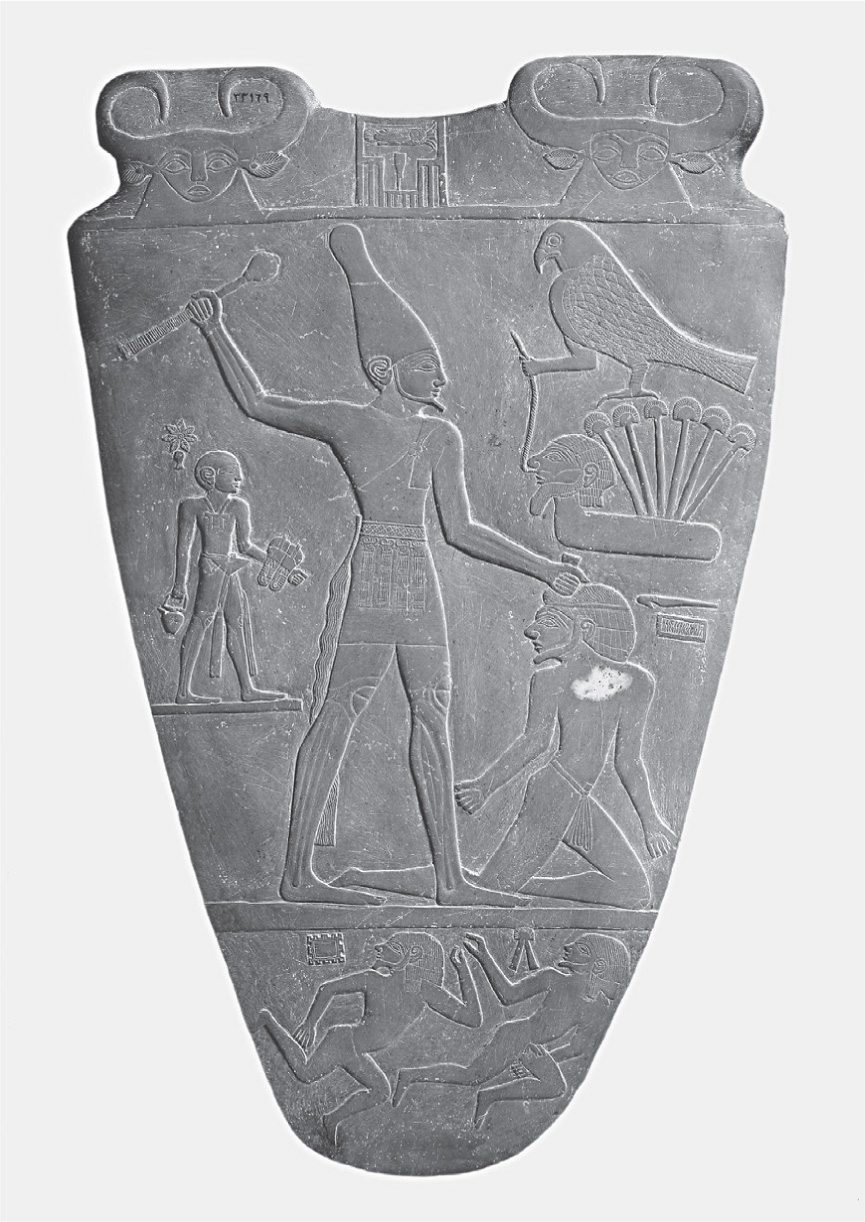
15. The Narmer Palette
But this act of encroachment doesn’t stop there. It continues beyond the borders of Egypt. It invades the birth of writing as a whole. We’ve already mentioned one other instance of encroachment: the possibility that Egypt may have invented writing before Mesopotamia. As I noted, the jury has yet to issue a final verdict, even though the evidence is stacking up. And if it turns out to be true, it would mean that Egyptian hieroglyphs preceded cuneiform by nearly a century—which, when you think about it, is no small matter.
But there’s still one other realm that hieroglyphs invade, and it’s one of fundamental importance, because it’s the realm of causality—the very purpose of writing’s existence, from the beginnings of its invention. Mesopotamia, in its role as the presumed first inventor, cast a long shadow over the general reasons for which writing came to be invented. As we’ll see, the Mesopotamians, in order to govern their palaces, were forced to keep detailed records of their mechanisms of control. Bureaucracy reigned supreme, a highly complex mechanism even at its very outset. And here again come our bureaumaniacs, clambering in through the windows, after all we’d done to boot them out the door. But let’s hold them at bay for just a minute longer.
In an Egypt busy molding itself into a pharaonic kingdom, writing is impertinent. It pokes its head in, to serve as a foil, to call attention to the VIPs. It slips between the cracks of images, forming a syntax of individuals, a pyramid of names. It’s obsessed with celebrity. The classic image we have in our heads of the Egyptian bureaucratic state is based on an Egypt that would come into being only much later. And even when writing is employed in service of the state, it nonetheless remains anchored to its underlying ideological framework, as we can see in the self-representations found at tombs from the Old Kingdom.
Celebration. We must rid ourselves of the idea that societies, in order to become the Leviathan that is the state, cannot survive without developing methods of control tied inextricably to the linguistic formalism of writing. Because they can, let’s face it—especially when we take the narrow, limited, constricting view of writing as a tool used merely for controlling, not creating, accounting, not celebrating.
THE STONE GUEST
This book, as I’ve said from the outset, is not a book on the alphabet, the one we all know, the one you’re reading right now. I’ve purposefully avoided it, though I’m aware that it’s been hovering around like the Commendatore in Mozart’s Don Giovanni. The alphabet is uncontainable, pervasive, even more present in its absence. We Westerners—and we’re not alone—are so caught up in our alphabetic superiority complex that we’ve sanctioned its creation as the only valid currency in human communication, the bread at nearly every dinner table. And there’s no doubt that its genealogy, its family tree, traces an incredible success story, the rise of a nearly global empire. With few exceptions, all the alphabets in the world—not just the Roman alphabet (our own), but the Greek, Cyrillic, Arabic, Hebrew, and Thai alphabets, too—were cast in the same mold. And that mold is the Egyptian hieroglyphic script.
The alphabet won its place in history because it is revolutionary. Even I have to admit it, and I’m a little biased, but the evidence is clear. It has a limited number of signs in its repertoire, each letter corresponds to a sound (known also as a segmental system), it’s relatively easy to learn, it’s convenient, flexible, comfortable. It is, without question, the Occam’s razor of scripts. The Maserati of writing systems.
Though it’s also true that history takes its liberties—it doesn’t always follow a clear and linear path toward simplicity. The course of history is filled with crossroads, with paths that fork at random, with potholes, curves, and, yes, accidents. That we eventually arrived at the alphabet may well be because we missed another turn along the way, because we blew past an intersection, because other cars traveling just as fast were thwarted by a pothole. We arrived at the alphabet, to the detriment of all the numerous other forms that writing has taken throughout history—the variations and modulations and adaptations. And so far it’s worked out for us. But the winner isn’t always the one who deserved it most. The alphabet won, yes, but you’d never have predicted it based on its beginnings.
We’re in the desert of the Sinai Peninsula, 1900 BCE, nearly four thousand years ago, though the date may have been a century or two later. It’s not the most hospitable of places: the Egyptians have installed an outpost there, a mine for extracting turquoise, along with a temple dedicated to the goddess of turquoise (and of miners), Hathor. Hathor protects all. Even the workers who came from the Nile Delta, and who spoke no Egyptian, only a Northwest Semitic dialect (called Canaanite). We know this because of inscriptions—some forty of them, carved into rock or small objects like statuettes—found along the path that led to the temple. The inscriptions make use of Egyptian hieroglyphs, though not to record the Egyptian language. They record the Canaanite dialect. In short, the hieroglyphic signs were adopted for a different language, repurposed to represent that language’s sounds. The hieroglyph depicting the head of an ox, for example, is given the Canaanite name ‘alp (“ox”); the hieroglyph depicting a house takes the Canaanite name bayt (“house”); the hieroglyph depicting a stick is given the Canaanite name giml (“stick”), and so on.
An ingenious experiment, carried out on the margins of institutional culture, far from the city, by an unlikely group of half-illiterates intent on celebrating a goddess and increasing the wealth of the Egyptian kingdom. It’s almost incredible that the origins of our alphabet (aleph, beyt, giml) could be so humble, so unassuming, so lacking in fanfare.
Though it’s true, of course, that little steps make the big steps possible. And it’s also true that the Greeks were the alphabet’s first real publicists, many centuries later. But this small beginning, this first bud of creation, might have finished in the scrap heap just as naturally and unpredictably as it came into existence. Things could have gone very, very differently. And all it would have taken was one fork in the road. One wrong turn.
SLIDING DOORS
Allow me to tell you a story, to illustrate a point. And forgive me if I warp the plot a little to suit my needs—I hereby grant myself poetic license.
Gwynethpaltrow 1 catches the subway at the last second. When she gets back home, she catches her boyfriend in the act of cheating. She kicks him out of the house, gives herself a chic, ’90s-style pixie cut, becomes a successful entrepreneur, and finds the man of her dreams. Gwynethpaltrow 2, however, misses the subway, goes on dating her traitorous boyfriend, does little to nothing with her life until one day she’s struck by a bus. I present to you the Gwynethpaltrow 1 and Gwynethpaltrow 2 of the alphabet: Abgad and Halaḥam. Both are derived from Proto-Sinaitic, both are attested at least five centuries later, and the alphabet both use is formally the same. The only difference is the order of their letters.
To explain: there exist tablets that bear the abecedarium—the sequence of letters—in the proper order. These tablets were a learning tool, for teaching students how to read and write the letters of the alphabet. They functioned as a literacy textbook. The abecedarium presented two letter sequences: one, called Abgad, followed the North Semitic order (alep, bet, giml, dalet), and the other fell in a different sequence, the so-called South Semitic order, or Halaḥam, a name derived from the sounds of the first four letters (he, lamed, heth, mem).
The common link between these two alphabets is a city in Syria called Ugarit. In Ugarit, toward the end of the second millennium BCE, centuries after the rise of the Proto-Sinaitic alphabet, the population spoke a North Semitic dialect, very similar to Phoenician. Schools taught this local language, Ugaritic, using abecedaria inscribed with wedge-like signs, not unlike those used in cuneiform, as we’ll see (fig. 16). Their writing style was similar to Mesopotamian, but the letters’ sounds were local, Semitic. And it was in Ugarit that these two different alphabetical orders, Abgad and Halaḥam, came together—coexisting, if only briefly, in the same schools.
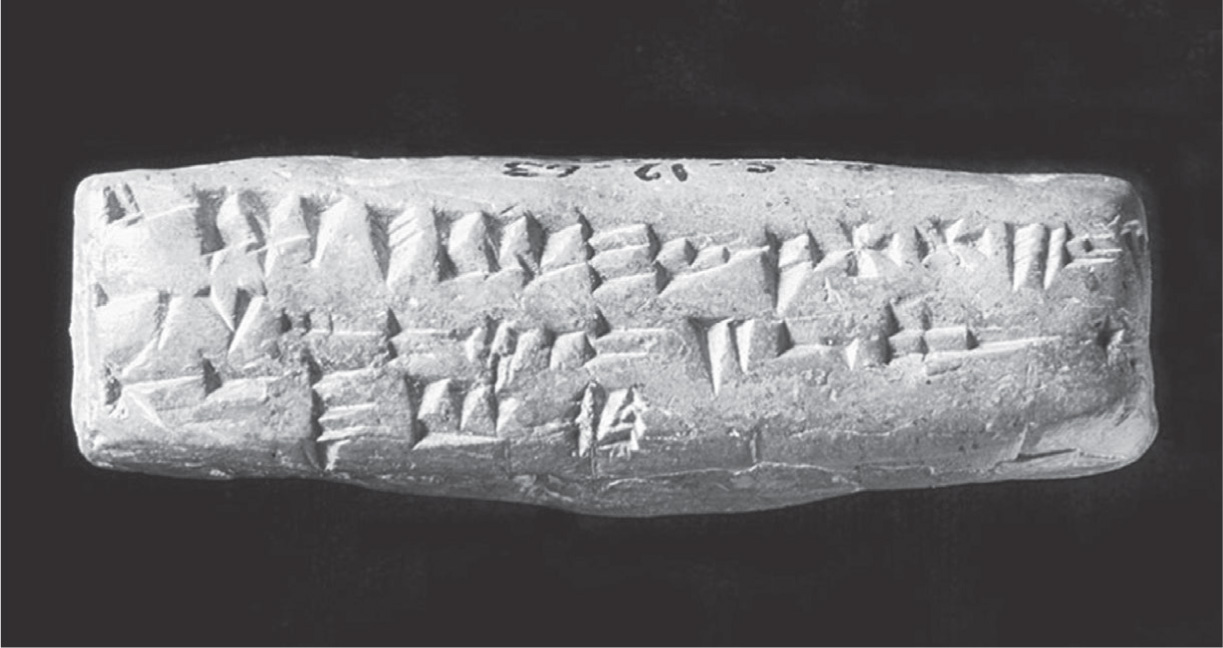
16. An abecedarium in Ugaritic cuneiform, Ugarit, Syria
But a gust of wind, a twist of fate, an unexpected fork soon sets them on different paths and destinies. Abgad is taken up by Phoenician merchants. It becomes a successful entrepreneur, hawking its economical, practical, and highly efficient product. It opens franchises all across the world, is adopted by the Greeks, and learns to speak hundreds of languages over the centuries. It becomes Mr. Alphabet.
Halaḥam departs from Ugarit, heading south, and is trampled beneath the caravans of the Arabian Peninsula, lost between the desert dunes—the only trace left of it a few measly headstones, engraved with sparse inscriptions. Beautiful, but provincial, peripheral. Soon to be the pet project of bookworms and bespectacled professors whose hearts race whenever they see a rare inscription (me). Halaḥam is destined for oblivion, despite itself. Halaḥam is a victim of chance: one bad throw of the dice. Which brings us to our stone guest, who yells at Don Giovanni: “Repent!” But Don Giovanni repents nothing. And he dies all the same.