
Let’s circle back to our two overarching stories and introduce the second. The first story dealt with islands, creation, the fate of undeciphered scripts, with all their mysteries and dark corners. And we’ll revisit them later, when they serve as our guinea pigs in the deciphering laboratory. For now, let’s talk about success stories, stories of growth and expansion. Let’s talk about states and cities, scripts that we can read (with a few exceptions) and languages that we understand. Let’s talk about real inventions.
According to current anthropological models, a state and its writing system are always considered to be interdependent, one a function of the other, like the chicken and the egg (even if we don’t know which comes first), twin forces in the upward drive toward civilization. The prevailing (and adamantly held) view is that complex society—which culminates in the state (or the city, understood as a micro-state)—cannot not develop an equally complex writing system. Following this logic, we’d have to say that a city can’t function without a writing system, and a writing system without a city is doomed inexorably to die. Which would make the city and writing an indissoluble binomial that demonstrates just how articulate, complex, skilled, and cognitively “advanced” human beings are. Right? All clear?
Except this model doesn’t work. It’s true that the great cultures of antiquity—Egypt, Mesopotamia, Mesoamerica, China—all sooner or later invented a script. And all, it seems, in an independent and autonomous way, without external input. Four flashes of genius, four inventions (we’re almost certain). But this doesn’t mean that writing is an essential factor in determining a culture’s complexity. Quite the opposite. As we’ll see, the world is teeming with magnificent cultures that never produced a writing system, and, alternatively, writing systems that took root in the fertile loam of society and came bursting up unexpectedly, green and vibrant, right through the middle of a strip of asphalt. The felicitous results of who knows what kind of creative-alchemical combinations, sprouting in the most unlikely of places.
It always pays to proceed cautiously with models and categories—all it takes is one faulty link, one exception, one unique case, and the logical chain is broken. In the words of the physicist Richard Feynman, the exception proves that the rule is wrong. But that hasn’t stopped us from organizing the world into neatly defined categories by taxonomizing life (what have you done to us, Aristotle?). Symmetry and order create a sense of control, of peace. We humans feel less like animals when we use our rationality to systematize, to tidy up our surroundings, creating a false sense of security, slapping a Band-Aid over the unpredictable. It’s tough, isn’t it, embracing true beauty, the beauty of chaos? And it’s even tougher to sit back, hands folded, and resist our obsessive impulse to organize.
Which is all to say that a state/city and its relationship to its writing system must not only be correlated but measured in reciprocal relation to all of the other factors that, very clearly, play a role in defining a culture’s complexity (trade, urbanization, social stratification, skill specialization, subsistence economy, and our old pal writing, of course). The question is: Are there universal patterns, certain ingredients that are essential to cultural evolution? To get to x, do we first have to go through a-b-c-d, etc.? And are we capable of measuring all this, of making a list of essential ingredients, conditiones sine qua non?
There are two types of people in the world: those who make lists (to-do lists, to-not-do lists, shopping lists, bucket lists) and those who don’t. From what I can tell, we list-makers are a robust crew (there’s a notebook on my desk with OBSESSIVE LISTS written in gold lettering across the cover). I, it goes without saying, belong to the category of hard-core list-o-holics, perhaps not in the top percentile, but somewhere up there. It would seem that a third of list-o-holics write their lists in code, using acronyms that make no sense to anyone else (I’m one of them, naturally). True list-o-holics write exclusively by hand—making lists on the computer is like studying on Wikipedia: nothing sticks. It’s all gone by the morning. Plus, what about that triumphant satisfaction you feel when you press your pen to the page and cross out an item with a nice fat line? Wiped from the list. Completed. And there’s nothing like reading back over a list of crossed-out items to set the universe straight. Even just writing about it now I feel a little better.
Though it must be said: lists do make us feel good, but it’s only a placebo effect. And they don’t always work. So, are cities and writing on the list of ingredients that make up a complex society? Let’s find out.
BUREAUMANIA
Many too many are born: the state was invented for the superfluous! Just see how it lures them, the many-too-many! How it devours them, and chews them, and rechews them! There is nothing greater on earth than I, the regulating finger of God.
—Friedrich Nietzsche, Thus Spoke Zarathustra
A little anthropology lesson. Social complexity has three levels of development. The most advanced is the state, followed by egalitarian society and then stratified society under the rule of a leader (a “chiefdom”). The earliest states, the most ancient, took shape on their own, with no other similar entities there to influence them. They developed by accumulating layers of complexity, by slowly acquiring the ingredients on the list of items necessary for their growth. And if they’re the most ancient, that means they’re at the very root of statehood—the primitive egg to the complex chicken of society. Their development is therefore original, pristine. We call them “primary” states. From zero to state, with no one butting their nose in.
A primary state does develop in contact with others—trade enlivens a state and helps it grow—but its foundation is authentic; it happens in one place and nowhere else; it germinates, grows, stratifies, and expands. It has a well-defined center that controls the rest of the territory. Centralization brings with it strategies and norms for exercising that control. The more territory a state covers, the more forcefully must the center exert its power. When human beings expand, we tend to create some pretty perverse things, such as bureaucracy. To maintain control, the central authority invests itself with rules—it bureaucratizes (truly, the word may be even uglier than the thing itself). The birth of bureaucracy is thus tied to the birth of the state.
We can get a closer look at primary state formations through archaeological evidence found in Mesoamerica, in the Oaxaca Valley and at the site of Monte Albán, where bureaucratized institutional buildings and temples were constructed around 300–100 BCE (the same years as Rome’s expansion, more or less). In the early centuries of the first millennium CE, we see a similar expansion in Peru, on the northern coast (Gallinazo culture). Much earlier, around the midpoint of the fourth millennium BCE, Egypt (the Naqada period, I and II) and Mesopotamia (in Uruk, modern-day Iraq) were developing neck and neck, expanding their territories, constructing palaces and centers of power. A few centuries later (3200–2600 BCE), the same phenomenon occurred in the Indus Valley, with the birth of the Harappa culture; and in central China, not long after (1800–1500 BCE), at Erlitou, in the Henan region, along the Yellow River.
Six cradles across the globe, each the fruit of an independent cultural tradition. Six nuclei of complexity, six bureaucratic hubs. Bureaucracy, however, doesn’t function as a system of oral commands communicated over wireless phones. It depends upon a network of delegates and the broad transmission of information—it depends upon the concreteness of messages. Which is why the birth of bureaucracy means, in the end, the birth of writing.
The ingredients on the “complexity list” are often interconnected. We can now say, with near scientific certainty, that wherever there’s a state with a population of more than ten thousand, you can bet there’s a writing system. One appears just as the other is rearing its head. We’re not sure which comes first, but the catalysis is reciprocal. Both seem to be phenomena brought about by the forces of environmental selection (demographic growth, agricultural production, storage of goods, etc.), just like punctuated events in Darwinian evolutionary development (the term punctuated, in fact, is taken wholesale from biology and here applied to anthropology).
A domino falls, a fuse is lit, a perfect storm of factors brings about a change. There’s no keeping track of evolution’s inner workings—it’s a machine that speeds up and slows down as it pleases, but it never stops. Between these periods of evolutionary upheaval (the birth of primary states and the birth of writing, in our case) come long periods of stability, during which everything remains more or less the same, in a reassuring homeostatic equilibrium. God rested on the seventh day because, in the turn of a week, he’d brought about a real revolution. (And there was writing. And it was good.)
AN IMPERFECT MATCH
Though of course, that’s not the case. Empires, civilizations, cultures have existed without a writing system, and writing systems have formed like pearls in oysters, with no warning, no territorial expansion, no clear purpose. And if we remove its bureaucratic function from the equation, the role of writing seems to lose its value. So how do we frame it, then?
There are indeed certain factors that favor the invention of writing, but they aren’t all necessarily connected to rampant bureaucracy. Writing’s birth involves elements of chance, aspects that lists and models and rigged equations can’t categorize or explain. Some marriages work even when friends and relatives are placing bets at the ceremony on when (and not if) the couple will get a divorce. It’s the same with scripts—some scripts, anyway. All of a sudden they’re celebrating their fiftieth anniversary, against all the odds. Or else they’re like nags at the racetrack, leaving thoroughbreds in their dust. Let’s take a look at them, why don’t we, these underdog champions, these quixotic Rocinantes. There’s one thing that’s clear, at least: they’re far more interesting than a boring bureaucratic list.
Archaeological and ethnographic data can help us paint a clearer picture of just how writing systems formed in unexpected places (unexpected, at least, if we’re following outdated models).* Right off the bat it’s clear that scripts flourished outside the institution of the bureaucratized state, that they were vibrant and, above all, highly creative. I’ll cite only a few examples, each brimming with insights.
We’ll start with the runes. In the Norse saga Edda, with its king-sorcerer Odin, the runes are the magical inscriptions carved into the tree of life, Yggdrasil, by the Norns, beings who spin the thread of man’s fate. (I first encountered these tales in elementary school, and the idea that their script was “secret” made me wild with joy.) The alphabet, in technical terms, goes by the name of Futhark, and is very clearly adapted from the Roman alphabet, with a few Etruscan touches. Evidence of it can be found on thousands of objects engraved in Denmark and northern Germany during the second century CE (fig. 10). Spells, divinations, fortunes, predictions—the full panoply of magic. And no central government to speak of.
Then there’s Tifinagh, an ancient consonantal script (like Arabic), which is still used today to record the Berber Tuareg languages in North Africa. These populations were most certainly not structured at the state level, nor did they develop a specialized governing class. Not only is Tifinagh beautiful, it seems to be no more than vaguely influenced by Phoenician, in the shape of its signs. One other unique, and therefore fascinating, aspect is that the Tuaregs belong to a society where communication is principally oral, based largely on memory. Writing, there, does not carry the same function that it does in other cultures. It seems to have been invented for fun, for puzzle-making, for the occasional inscription or graffiti. Just take a closer look: it’s like something out of a science-fiction film. Beautiful, simple, and free of any strict purpose (fig. 11).
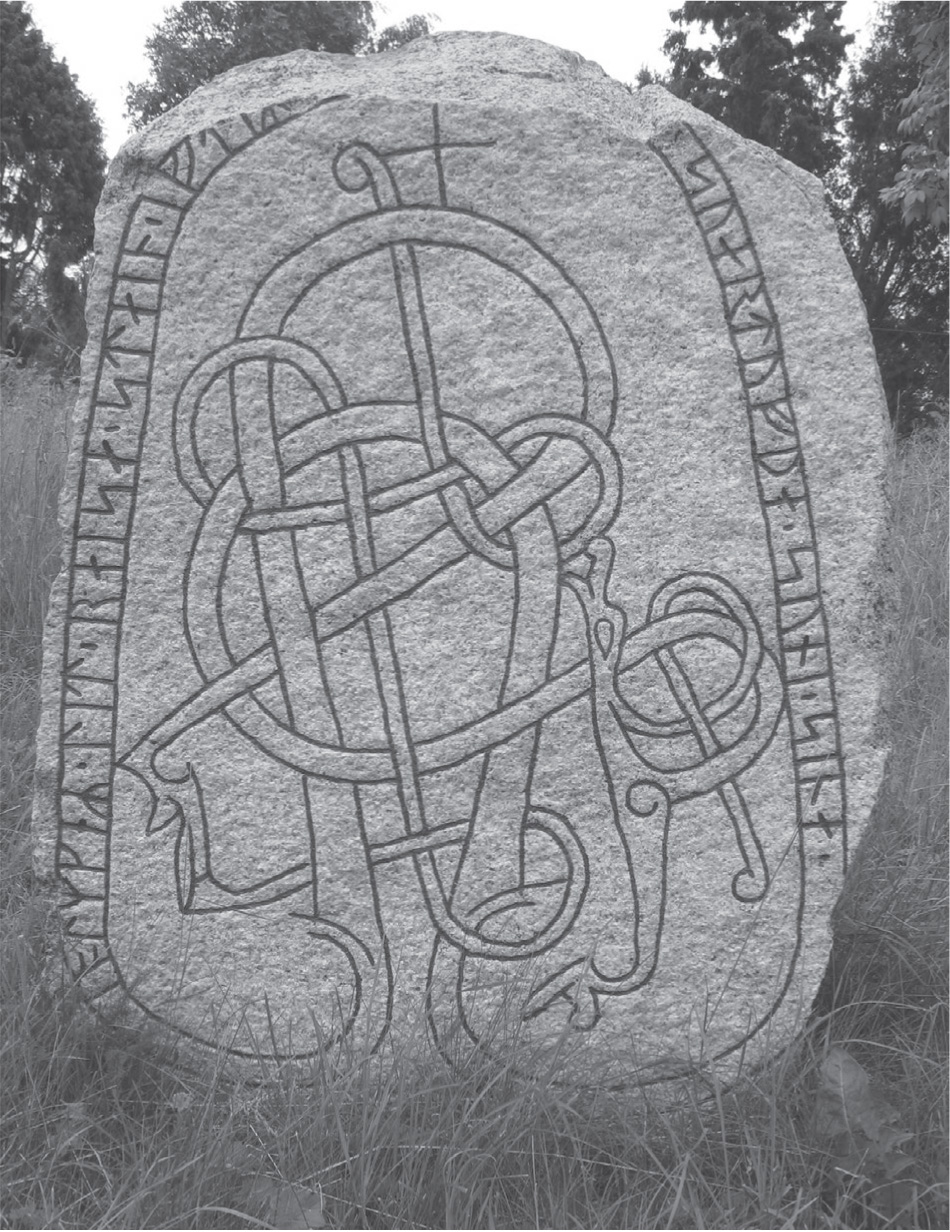
10. An inscription in Futhark, in Ärentuna, Sweden
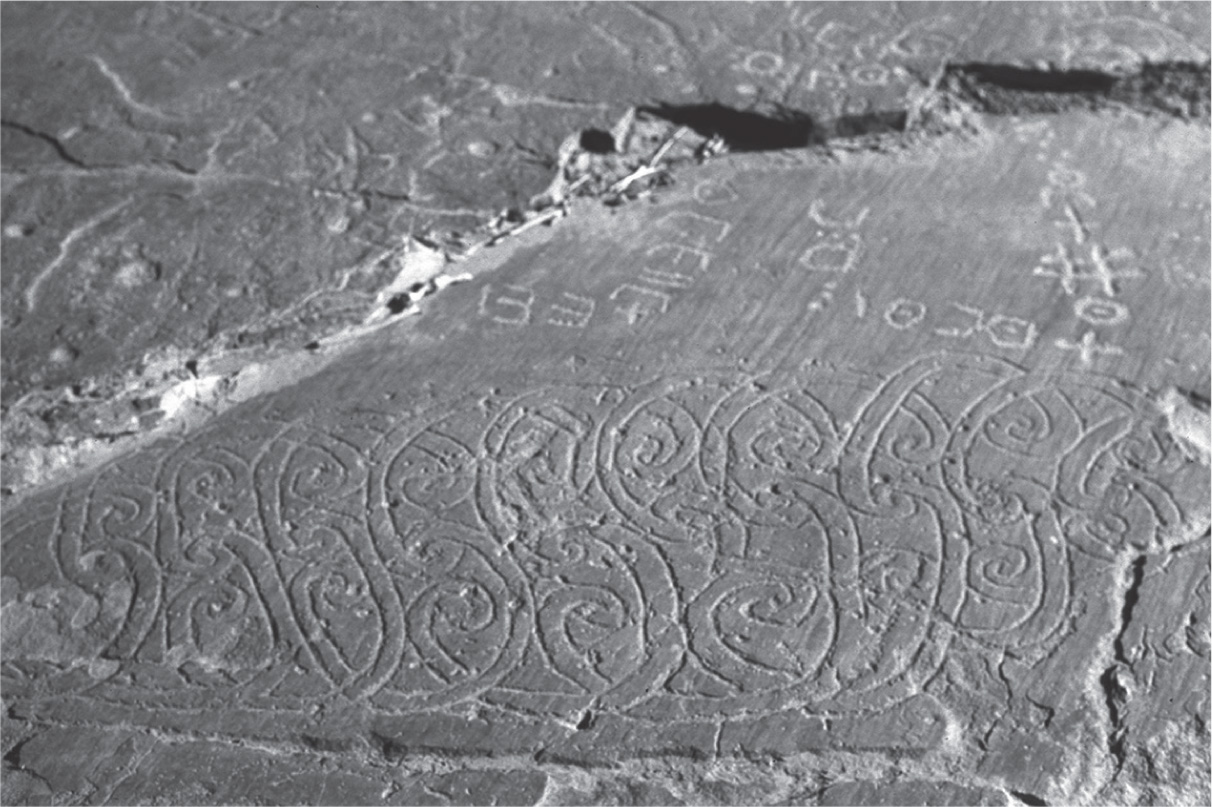
11. An inscription in Tifinagh, in Algeria
On the African continent there are at least fourteen sub-Saharan scripts, created by groups that wanted their own writing system, even before launching independence movements. And then there’s China, where, in the southwest region at the foot of the Himalayas, the Nakhi are an ethnic minority—and a small one at that, compared with their Tibetan neighbors to the north. Yet, a thousand years ago, the Nakhi created something miraculous with which to inscribe their religious texts: a highly iconic, logo-syllabic writing system, Dongba. If you visit Lijiang, in Yunnan Province, you can see it in action, since Dongba is in the midst of a fascinating revival. You’ll find it on shop signs and street signs, even though almost no one knows how to read or write it. It carries a social and political value. It’s a manifesto, a means of expressing their Nakhi (and not Chinese) identity. Look how they’ve altered a modern Starbucks sign (fig. 12)—which bears no fewer than three scripts: Dongba, in small lettering, up at the top, followed by Chinese, and then the roman alphabet. In the Dongba text, the first sign is three stars (star), the second sign a flower (or bbaq), and the third sign a dog (kee). Even an American coffee shop can take on a Nakhi flavor.

12. A Starbucks sign in Dongba (Nakhi), China
Then there are the Caroline Islands in Micronesia, in the Pacific, where the local populations, beginning in the 1900s, invented a syllabary to record their language, Woleaian. It was not, alas, destined to survive. But if we look carefully at the script (fig. 13), we find incredibly inventive elements—not least its reworking of the Latin alphabet, on which its signs are based, and a series of completely new signs, invented from scratch, whose syllables were developed on the basis of . . . you guessed it . . . a rebus. The syllable pu, which in Woleaian means “fish,” was shaped like a fish, shrü was shaped like a fishbone, lö like a bottle, ngä like bamboo, warr a canoe. And that’s precisely what the Carolinian signs were used for, to decorate your canoe or the walls of your home, not to collect taxes. The sea, the ocean, was their master, not the state. We should also mention the Cherokee and the Cree syllabaries, and the Inuktitut scripts in the northern United States and Canada. No central government, just peoples and their languages.
On the flip side, we have Kerma, an ancient culture from the Sudan region, which formed a state nearly five thousand years ago. Kerma culture dominated Upper Nubia for at least a thousand years, along the banks of the Nile. The Egyptians referred to it as Kush. The people of Kush were no cowards—they were valiant warriors, skilled archers. They traded in ivory, gold, ebony. And their writing system? Never happened.
The list could go on. States and scripts make for an imperfect match, an arranged marriage, a dubious pair. The most grievous error, however, is to label bureaucracy as the ultimate aim—the beginning and end—of writing. This is just reckless drivel, which for far too long has cast its shadow over the greatest invention in the world, stripping it of its soul (as all misguided generalizations do). The heart of writing beats in the brain and in human language, in the imagination, in our need to anchor ourselves to the earth that sustains us, in our deep desire to name—ourselves, and everything around us. Not in the oval office of the bloodless monster that is the state, purveyor of taxes, tickets, and lists of expenditures.
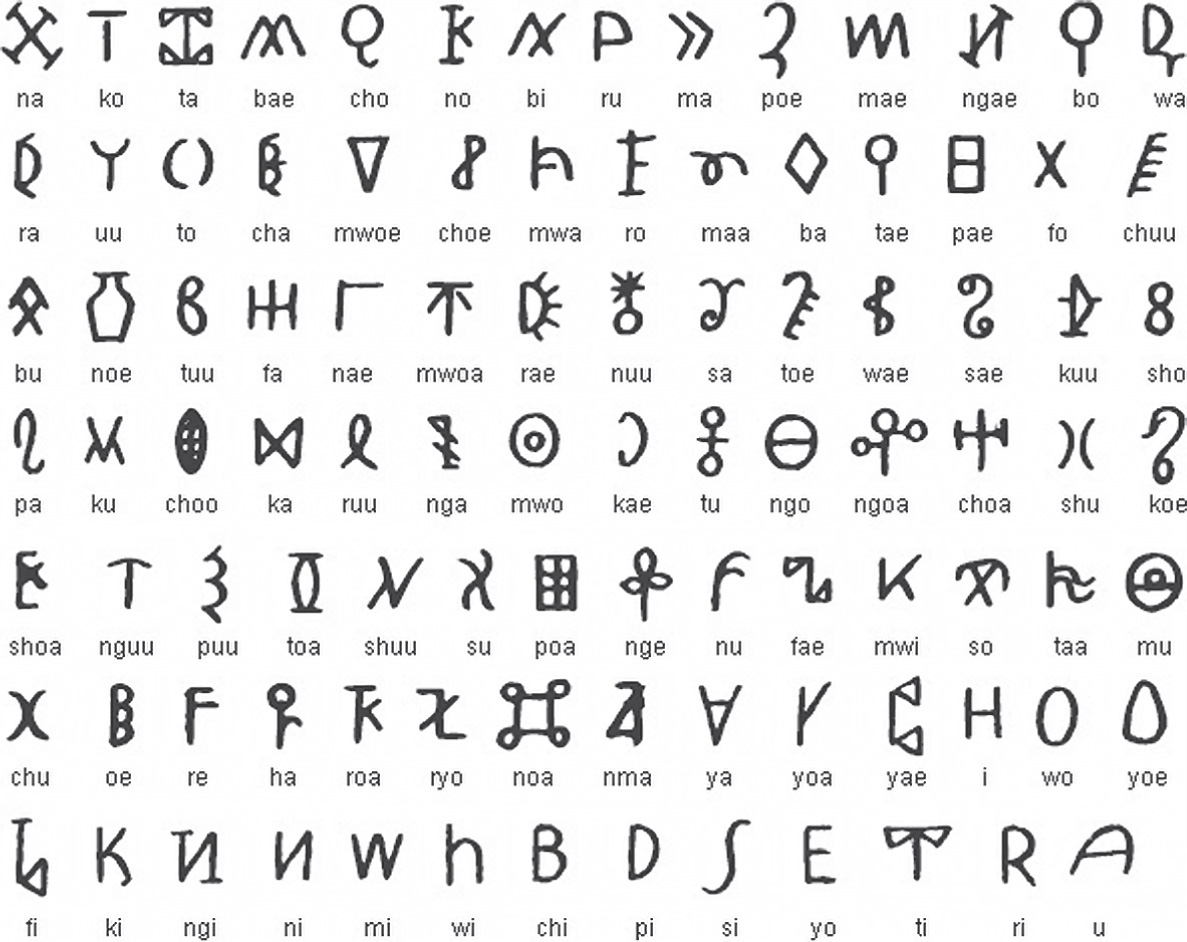
13. The syllabary of the Caroline Islands (Woleai)
INVENTION, INTENTION
What is an invention, exactly? “The creation of something that didn’t exist before,” you’re probably thinking. And you’re right. Put in those terms, invention is tied to the awareness of an absence, which it then fills by creating something from nothing. You detect a problem and then find a way to solve it. As was the case with the first tools, especially Neolithic tools: whether to chip or break or cut something, they formed sharp and hard (flint) instruments fit for the task. Think about the (similar) problem of bringing food to our mouths: by ingeniously adding a handle to a spoon, we refined (with a better grip) an activity we’d already partly sorted out (scooping). Same with the fork, for skewering and for twirling our spaghetti. You might say your hands are more efficient, but not when it comes to piercing solids and ladling liquids. We need the tool to solve the problem.
If to invent, therefore, is to find a remedy, then the bureaucrats were right: writing was invented to fulfill the need of managing land and people. I can’t remember who it was who said that the pen is mightier than the sword.* But if that were really the case, then we’d have to consider the invention of writing to be intentional, a planned and systematic effort. No accident along the way, no intuitive flash: a deliberate act. And a conscious act, at that, done with cognitive awareness.
Which means that we have a problem. Or at least I do, since the title of this book is The Greatest Invention, and here I am about to double down on my claim that writing was sparked by a flash of insight and is not, at least at its origins, an invention. And I’d go even further. For me, invention equals intention, but when it comes to understanding writing, thinking in terms of necessity and clear objectives is of little use. The idea of necessity (that is, the urgency of finding a solution to a problem) is not always at the root of invention. In fact, the opposite is often true—we discover a thing first, only to later find that it has a practical application, perhaps far different than what we’d initially imagined. Do you recall the rebus, and the way the homophony lightbulb went off in our heads? That is an example of discovery. Invention comes later, as an effect of discovery. And it is piecemeal, gradual, magnificently layered. It needs to be broken in—it needs time, and energy, before it becomes intention.
The moment has arrived to take a tour of the true inventions in writing’s history—those built from the ground up, completely original, influenced by no other culture that may have developed something similar. We’ll explore inventions in Egypt, China, Mesopotamia, and Mesoamerica, and how they adhered to a model only up to a certain point—that is, as long as that model allowed for adaptability, flexibility, and regard for the ever-changing conditions of life.
The greatest inventions in history—from the wheel to electricity, from computers to nuclear fission—are all born, without exception, from the spark of discovery. In that millisecond of creative and vital intuition—voilà—entire revolutions take place. Refining these revolutionary discoveries, making them whole, is what invention truly is: the complete process, the full circle. This requires dedication, time, intuition, foresight, and planning.
So let’s zoom in now on the gears and cogs of this ingenious, human, and imperfect mechanism. Let’s have a look at this great invention.
THE FOREST
One hundred years ago, the economist Frank Knight formalized a distinction between uncertainty and risk. Uncertainty, he said, is the absence of knowledge, and is therefore impossible to calculate. Risk, on the other hand, is measurable, since it can be calculated using a probability distribution of potential results or outcomes. With uncertainty there’s little you can do—ontologically speaking, you cannot be certain about uncertainty. Yet, by definition, both uncertainty and risk are ways of projecting the future.
Engaged, as we are, with the invention of writing, our realm is the realm of the past. And when you’re dealing with the past, every method of verification has its holes. We’re always at risk of getting it wrong. Which is why we’ve been wrestling for so many years—and still are, in part—with one of the most important questions: How many times has writing been invented? How can we determine this with any degree of probability, if not certainty?
Up until about forty years ago, we were convinced that writing had been invented only once in all of human history. So widespread was this conviction that it was baptized with a pompous name, resounding in its staunch creationism: monogenesis. One invention, end of story, no other explanations accepted. Nothing is ever invented twice—as you know, man can’t reinvent the wheel, and therefore, in conclusion, etc., etc.
If you take a leap back into your own past, I’m sure this authoritarian version of events will sound familiar—a vague, Proustian memory will come wafting over you, from your days in elementary or middle school, something about Mesopotamia and how cuneiform was the first and only time writing was invented, the source from which all other scripts descend. As we know, however, the neurons in our hippocampus toy with our memories and compromise their clarity. So it may be that you’ve completely forgotten what your beloved teacher said just after that: “However, we have still yet to determine the exact number of times that this invention has occurred.” (I, too, like the hippocampus, am prone to tweaking your memories, since your teacher probably never said anything of the sort.)
Over the last forty years, since the time I was born, things have shifted substantially, and the view that writing was invented only once is no longer so categorical. The inscriptions from Mesoamerica, which we’ve been deciphering gradually from the 1970s on, are clear evidence of a true invention, free of outside influence—even if it was only through gritted teeth that the “monogenesists” accepted the theory that Mayan glyphs constitute a veritable writing system. How could these Native American symbols, so heterogeneous, so fantastical, ever be compared with the thin and perfect wedges of Mesopotamia, the true cradle of civilization?
In science as in life, if you find at least two clear-cut cases, you should probably start looking for others. Egypt’s earliest writings are not only close to being contemporary with Mesopotamia’s (the beginning of the fourth millennium BCE), they may have even come first, from what we can tell. For which reason it’s likely that Egypt, too, created its writing system from scratch, autonomously, with no external interference, perhaps even before cuneiform. And China—if somewhat later, toward the end of the second millennium BCE—invented a completely new system, utterly different from the Egyptian and Mesopotamian scripts.
Four inventions, now all but proven. Though could there be others, still? We have no definitive answer, but it’s likely that there are. And we’ve already mentioned them. Easter Island may have created Rongorongo on its own, uninfluenced by European colonizers. And the Indus Valley developed the highly repetitive and formulaic Harappa “script.” Though there’s still much disagreement around this latter case, since its status as a full-fledged writing system is up for debate.
To answer the question “How many times?” one must keep the larger picture in mind, without losing sight of the various local contexts and details. Inventing a script involves certain necessary steps, which, as we’ll see, come with their own structural restrictions and present a number of commonalities, whether the invention is created ex nihilo or not. Inventions, in other words, travel along separate but parallel tracks, following similar paths to formation. These paths resemble one another at the foundational and structural level, which does nothing to subtract from the splendor of their differences. It’s therefore not only possible that writing has been invented many times throughout human history, it’s also highly probable.
Taking a global view means accounting for both aspects: similarities and differences. Those of us who study writing systems (though perhaps not only us) must move beyond a local, isolated, restricted view of things, steering well clear of our current obsession with specialization. We must move beyond the Aegean, Egypt, Mesopotamia, and China, and embrace the entire expanse of the world. Without borders. It’s well past time we stop acting like people who’ve seen thousands of trees but have never truly seen the forest.