

Postcard, ‘La Couture’.
CHAPTER I
3 June 1918. Paris. A forty-eight-year-old woman sweeps into a police station in the busy 15th arrondissement on the Left Bank of the Seine. She is dressed in the flamboyant style of the belle époque: all feathers and fur trims; performative hat and corsetry. She requests urgent assistance, and petitions for a divorce. The reason? Her husband, she insists, has been replaced by a series of doubles. Numerous ‘lookalikes’ have substituted themselves for other members of her family, her wider social circle, even for herself. There’s one who’s taken up residence in her apartment. In addition, she informs the desk officer, abducted children are being held captive in the cellar of her house and she can hear them calling out.
A couturière before she married, she will outline to her doctor, with an insider’s eye for detail, what she likes to wear on a daily basis. In his 1923 landmark paper about her, her doctor lists: ‘a black and lavender suit, a black “Amazonian” hat’ (which seems to be the love child of a bowler and large fedora, a sort of female cowboy hat) ‘with a veil and another hat in lavender’.1 She doesn’t say what kind the second is − perhaps she alternated between two different sizes for different occasions or seasons − but whatever the particular accessories that summer’s day in 1918 her tailoring would probably have been theatrical, a signature of the era, creating an S-shape silhouette, making a shelf of bust and behind.
There is nothing unusual in a fashion-conscious member of the bourgeoisie flaunting her adherence to the most up-to-date mode, except when you consider that, by 1918, the belle époque is well and truly over. It’s been over for years. The war that brought it to an abrupt end is still staggering to its own conclusion not far from where this peculiar scene is playing out. She is a walking anachronism. She continues detailing her day-to-day styling as evidence of her true identity, with forensic specificity, right down to the buttons and species of fur; features she will request that her doctor carefully notes down, so that no one mistakes her for her substitutes or misses any telltale alterations made by the impersonators. The real her, she points out for additional identification purposes, is usually accompanied by a little blonde girl ‘in an embroidered linen dress, with her hair in a French plait, a white Brandenburg coat with ivory buttons and lined with duchesse satin, a straw cloche hat with a fancy white feather, yellow knee-length boots. In winter: dressed in a fluffy coat, a velvet cloche hat with white or beaver fur.’2 The doctor will later share these details in his paper all about her. We can only imagine how this exotic creature with her stories of substitutions and kidnappings played to an overworked, nicotine-stained police commissariat in the middle of a city subdued by a seemingly endless war.
‘Madame M’, as she will be called when the doctor presents her case to the world, has intimate technological knowledge of the tailoring she describes. As a younger woman she earned her living piecing together fashionable garments for her clients. From the moment we meet her buttonholing a policeman it’s clear she is a figure living in her own private reality. She begins to map out the sinister topography of this reality to an audience for the first time. Her colourful and frivolous appearance is a good way beyond nostalgic. She is a ghost of the relatively recent but already misty past. The belle époque commenced at the end of the Franco-Prussian War in 1871 and finished at the outbreak of the Great War. It was a moniker given retrospectively, meaning, essentially, ‘the good old days’. The woman at the police station is wearing the motto proudly. She operates in her own youth: the Paris of haute couture, when clothes could afford to be costume.
Back at the police desk, the officer faces her. Our ‘Madame M’ has described the plot in headline terms, but she has much more she needs to get across to the authorities. So what does she want? Her allegations are ludicrous, paranoid. By the way she is speaking, agitated, desperate, this is not a game. The stakes could not be higher. Children are trapped and in danger. Identities and fortunes have been stolen. Is anyone listening? Will she get what she demands?
This feels like the opening scenario of an Edgar Allan Poe short story. Her allegations set up a dark and fog-shrouded mystery. Delusions, though, have always been a murky brew of real life and imaginative fantasy. Delusions are by their nature useful to fiction because they so naturally and economically dramatise the unconscious desires of a protagonist; they make the hairs on the back of your neck rise. You recognise something in what they are communicating about the trials and tactics of being alive, but you are not quite sure what. They are uncanny, just beyond your comprehension but deeply suggestive. So it is with the idea of the substitute double. The eponymous William Wilson in Edgar Allan Poe’s short story of 1839 is a man plagued from his school days to adulthood by a rivalrous double. Poe portrays a man attempting to get away from the undesired aspect of himself by manifesting another self altogether, a splitting of the self. So often the fictional representations predate the clinical descriptions: Poe’s story trumps Freud’s concept of the repressed, unconscious alter ego and its drives by at least half a century.
In Dostoyevsky’s 1846 novel The Double, the protagonist is a low-ranking office worker with poor social skills persecuted by a double who resembles him in almost every single detail except that the double possesses the very social skills that the protagonist lacks. He is tormented by this ‘doppelgänger’ to a denouement which sees more and more replicas present themselves, and is eventually carted off to an asylum.
The doppelgänger, literally ‘double-walker’, was portrayed historically as a ghostly phenomenon, and, more often than not, a portent of bad luck. The concepts of alter egos and double spirits have appeared in the folklore, myths, religious ideas and traditions of many cultures throughout history. In the mid-nineteenth century English speakers began to overlay this German word doppelgänger onto the concept of ghostly ‘wraiths’. The English novelist Catherine Crowe’s 1848 work The Night Side of Nature popularised the term. Crowe’s book investigates a series of phenomena lying outside of scientific understanding, and she devotes an entire chapter to breathless accounts of double sightings from the eighteenth and nineteenth centuries. Most of her accounts are taken from cases shared with her by German physicians, each of which feature people who have been witness to doubles, either of themselves or of loved ones. Some can open doors and gates, some are seen by more than one person. They usually appear just before the death of the person who has been duplicated. In Norse mythology a ‘vardoger’ is a double who is witnessed performing a person’s actions in advance. The doppelgänger is a version of the ‘Ankou’: a personification of death in Breton, Cornish and Norman folklore. Capgras’s paper on ‘Madame M’ will be given the title of ‘L’Illusion des “sosies”’. ‘Sosies’, or ‘doubles’, is a French word derived from Plautus’s play Amphitryon in which the god Mercury assumes the appearance of Sosie, the servant of Amphitryon, connecting once again the clinical language of delusions all the way back to the myths of classical literature.
The psychoanalyst Otto Rank, a member of Freud’s circle, introduced the idea of the double to psychoanalysis in his 1914 essay ‘Der Doppelgänger’.3 Freud’s essay ‘The Uncanny’ followed in 1919 and suggested that fear of the doppelgänger was a symptom of an unconscious, repressed, fear of death. A double scares us because it forces us to recognise an anxiety we have repressed. It feels familiar.4
Rank made special reference to The Student of Prague, a German silent horror film of 1913. Set in 1820, the film is loosely based on Poe’s ‘William Wilson’. The image of a poor student is stolen from his mirror by a sorcerer who once promised to help him with his love match but instead becomes his double, and his love rival. The duel finale sees the student shoot this double, and, in so doing, kill himself. At the time of Rank’s essay, the cinema was still a very new technology for a general audience, and its silver screens offered a kind of double dream world in themselves, making them the appropriate place for audiences to watch a story about the crisis of the individual play out. A few years later we see the reflection of these screens in ‘Léa-Anna B’s eyes and her false belief – the first formally described case of ‘erotomania’– that a complete stranger was in love with her. The overblown true-love stories popular in 1920s cinema were a powerful two-way experience for a person looking up at them from a dark theatre, and encouraged dreaming and the projection of self onto others.
We don’t know precisely what the desk officer at the commissariat for the Necker district made of ‘Madame M’ and her startling claims. We do know, from the paper published about her case that she was promptly escorted to the Infirmerie Spéciale, a hulking edifice on the Île-de-France in central Paris housing a network of public offices connected to the Paris police. Here she underwent a psychological assessment, then was moved to the Sainte-Anne mental hospital for more interviews, and then, on 7 April 1919, transferred to Maison Blanche, another pioneering Parisian asylum of the age, one of a number established in the aftermath of the Revolution where modern psychiatric practice was first developed. It is apposite that our first case study takes Paris as its setting, as the story of delusions and the part they play in the history of modern psychiatry, is, in many ways, a French one.
‘Madame M’ was at the mercy of the system now, but what she found at Maison Blanche was not all bad. Here was someone who was not only willing, but keen, to listen to what she was trying to say. The doctor recalls clocking her as she walked in, describing ‘the pretty costumes of her younger days’ and ‘a touch of coquetry’, apparently intrigued by this creature from another age from the instant he first encountered her. The physician who set about taking down the details of this intriguing new case was a certain Joseph Capgras, and his name would be for ever associated with her disorder. Through her, he would become the eponymous father of a delusion ‘type’. ‘Madame M’s symptoms defined it. Capgras is almost the same age as the woman in front of him, just three years older, both of them in their late forties at the time of this meeting, and the fame and reputation of both parties will be inextricably linked. They are from the same generation, but you wouldn’t know it to look at them: Capgras wears his physician’s whites over a sombre three-piece suit, arms crossed as he listens, a neat moustache beneath a penetrating scowl of concentration. He gives his subject a pseudonym, abbreviating her name to ‘Madame M’, which renders her a poster girl for the new category of delusion, disconnecting her from her real-life family history even as it immortalises her. Capgras follows a standard physicians’ ethical code in not identifying a patient in the written case notes – he will only ever give us the first letter of her maiden name, ‘M’, and later drops in her married name, ‘C’. He would have known both her given names in full, of course, but she is no less mysterious to him. Anyway, she insists that she wants nothing whatsoever to do with either her so-called maiden name, or her married name for that matter, because they are no more than evidence of abductions and substitutions. The question of her true identity, denied and stolen by others, is the root of her crisis.
Capgras’s life trajectory has, like everyone’s, been diverted by the war. In spring 1919 he has only just resumed work as chief psychiatrist at Maison Blanche, the institution to which ‘Madame M’ has transferred. He is fresh from a lengthy period of mobilisation, which began in 1914 when he was assigned to help the evacuating casualties at the Battle of the Marne, one of the bloodiest of the war. This first meeting with ‘Madame M’ is taking place in the theatrical surroundings of Maison Blanche, an imposing classical-style building in the shape of Louis XIII’s chateau at Versailles. It is purpose-built as an asylum with three wings in a U shape around a courtyard. The asylum was evacuated during the war and turned over to a military hospital, and its hundreds of patients have also only just returned. We are just the other side of the conflict, but the impression of the war is everywhere.
Capgras will observe ‘Madame M’ for several years searching for clues as to the cause of her extraordinary beliefs. After countless audiences, collating any biographical scraps and domestic details which might make sense of her, he commits his thoughts to paper. He will share his appraisal of ‘Madame M’ in a lecture at a meeting of the Société Clinique de Médecine Mentale, published as ‘L’Illusion des “sosies”’, or ‘The Illusion of “Doubles”’. His peers are all interested in the newly revived subject area of delusions and love nothing more than a chance to argue out their different theories and interpretations in public. Capgras reveals the case of ‘Madame M’ to his audience with a dramatic flourish. ‘We present here’, he says, ‘a paranoid megalomaniac…interesting due to the existence of a delusion, or rather a strange interpretation: for about ten years she has been transforming everyone in her entourage, even those closest to her, such as her husband and daughter, into various and numerous doubles.’5 The principal delusion, the doctor says, is substitution. He also lays out a subplot for their interest: the ‘illegal confinement of a large number of people, particularly children, in the basement of her house, and throughout Paris…’ The theatricality doesn’t stop there. Unbeknown to the audience Capgras has brought ‘Madame M’ in person to the lecture theatre and she is waiting offstage.
Capgras declares this delusion an ‘exceptional case…rich…fantastic and yet systematized’. He has clearly enjoyed the challenge of deciphering ‘Madame M’s messages through the clues. Why has she committed herself to such an absurd and palpably false theory, a theory which flies in the face of the evidence? What has happened to her? What does she want? We might also ask why is Capgras so interested in this one particular woman that he devotes so much attention to her and her wild accusations? The audience wait expectantly for him to unroll his theories and interpretations. What facts has he managed to establish? The waypoints of her life, the ones he’s been able to elicit and thinks are pertinent, are these:
Mme M is now 53 years old with no family history of psychiatric disorder. She had typhoid at the age of 12, received a primary education until the age of 14, then learned and practised the trade of couturière. Married in 1898 at the age of 29, one year later she had a son who died (she believes he was substituted), then she had twin girls, one of whom died (abducted according to her), the other is in good health and now 20 years of age, and in 1906 twin boys were born, both of whom died at a young age (according to her one was abducted, the other poisoned). She lived comfortably, her husband owning a large dairy business. A restrained, sober person, the only thing she ever took to excess was coffee… In the ward Mme M is usually calm, polite, even kind when one is not talking to her about her delusion; she does not make any friends, remains completely idle, and refuses all work. She gets annoyed at the name M; sometimes she writes long letters, sometimes also she indulges in soliloquies accompanied by gesticulations which bear witness to her intellectual excitement. This is noticeable when the patient exhibits her delusion, which she does in a rather complex manner, talkatively, verbosely and with an extreme flow of ideas which require precise, close cross examination to stem her natural tendency of continually diverging from the point… Mme M, has never been aggressive, but has made two attempts to escape, and has escaped once.
After a no-nonsense opening, signalling a fairly ordinary background, the allegations are stark and disturbing. Infant abduction and poisoning. The picture is contradictory, even when painted in the brusque manner you would expect from a doctor’s working notes. She is not a couturière any more, she is a married woman, living comfortably as the wife of a successful business owner. Four of her children died in the early years of her marriage, her doctor says, although she flatly denies this. She changes quickly from calm and polite to displays of irritability, jealousy, grandiosity. She’s prone to physical agitation as she tries desperately to communicate her story, but she is also lazy, preferring a totally solitary existence. Cumulatively the characteristics begin to move, like pieces inside a kaleidoscope, and make an image of ‘Madame M’ difficult to see in the round. Capgras notes her respectable marital status and comfortable financial position along with the listlessness. His aside that her only vice was a taste for coffee sounds quaint now, but then comes a reference to her attempts at escaping the hospital. We remember that ‘Madame M’ is in an asylum. She has lost her autonomy. She’s a prisoner. She’s not the first of our subjects to try to escape. A hundred years before, Margaret Nicholson, the housemaid adamant she was George V’s rightful heir jumped over the wall of Bedlam in London. Nicholson was caught running to her brother’s pub for sanctuary. Like ‘Madame M’, she was returned to her cell.
Capgras continues presenting his case to the assembled crowd of peers, whose rapt attention he commands. He cues the big reveal. ‘Madame M’ herself is brought into the room. She is now wearing the plain asylum uniform and she is told to stand in front of the phalanx of doctors and retell her story, live, for their consideration. Psychiatrist Gaëtan Gatian de Clérambault is among their number, watching with interest. He is chief physician at the Prefecture of Police, with its psychiatric emergency room, the Infirmerie Spéciale where ‘Madame M’ was brought for assessment. He may well have been there when she was first brought in by the police officer, and could even have conducted the initial evaluation. She would certainly have turned heads at the Infirmerie. He’d remember her. Paris’s underclass wash up there day and night – it is a place where criminality, destitution and mental disturbance congregate: absinthe drinkers, prostitutes, homeless, poor, the delusional. It provides a clearing house for extraordinary stories of all sorts. De Clérambault is a former classmate of Capgras, just a year younger, and a rival in the psychiatric avant-garde. Only a year or so earlier, he was the first formally to describe (and attach his own name to) another ‘type’ of delusion: ‘De Clérambault syndrome’, or ‘erotomania’, holding up ‘Léa-Anna B’ and her belief in George V’s undying love as the example.
Born in Verdun-sur-Garonne in south-west France, Joseph Capgras completes his medical training in the hospitals in nearby Toulouse. He gravitates to psychiatry as a speciality under the influence of his uncle, an asylum doctor in the Paris area, and comes top in a series of highly competitive examinations which leads him to a post at Maison Blanche. He is an ambitious man, who has made his way from the provinces to Paris and at this point he is already well known for a 1909 work on psychosis and disorders of recognition, Les Folies raisonnantes, co-written with his mentor, Paul Sérieux. Sérieux also collaborated with German psychiatrist Emil Kraepelin, a giant of psychiatry, who first described ‘dementia praecox’ – the condition which became known as schizophrenia – as a disease of the brain. It was Kraepelin’s way of seeing things that cast delusions out to the margins. They became minor symptoms of his new disease and had remained in the wilderness for many decades, considered unworthy of research as discrete subjects.6
The lecture continues and de Clérambault jumps in to offer his tuppence worth. He suggests ‘Madame M’ might be hallucinating. ‘Madame M’ has been on stage listening attentively. She interrupts in turn, ‘entering vivaciously’ into the discussion. She’s sticking to her story and she repeats some points for those at the back. She is ‘not a woman’, she is a ‘young girl’ and lives depend upon someone taking action now.
Interwoven with her delusion of substitute doubles are what modern psychiatry would call ‘persecutory’ and ‘grandiose’ delusions – two more of the principal categories of delusion clinicians will establish later in the century. She points the finger at the many people who are out to get her, identifying coordinated plots between officials, doctors and administrators. Three or four years after their marriage, after the death of their twin boys in 1906, her husband noticed a ‘nervous’ state develop in his wife, followed by ‘jealousy’ and ‘delusions of grandeur’. Another strand in ‘Madame M’s story is the question of her own noble lineage. It is quite a family tree:
‘I am from a very important family,’ writes Madame M; ‘I am the granddaughter of Princess Eugenie; I was born to the Legion of Honour; my father was the Duke of Broglie and my mother Mlle de Rio-Branco, the daughter of the Duke of Luynes.’
Capgras teases out key facts from the genealogical tangle for his paper, sometimes quoting her, at other times speaking for her, summarising to move things along:
Her paternal grandmother is the queen of the Indies. De Rio-Branco is the name of the children of Henry IV from whom she descends; she is a relative of the Duke of Salandra. She adds, ‘M. Pierre-Paul M, who died at my house, certified that I was not his daughter, that he had acted criminally in hiding me from my parents and that I was 15 months old when the abduction was committed.’ Therefore she believed she had been substituted for the daughter of M. M. from the cradle.
Now Capgras glosses the money situation according to his patient:
She claimed her fortune to be immense, that all of Rio de Janeiro belongs to her grandmother who owns considerable mines in Buenos Aires. ‘I am certain,’ she says, that I have been left 200 million francs by my grandfather, Louis XVIII, who lived at the Tuileries… Since my childhood I have been pursued by a gang who knew about my wealth, since I was taken away from my parents and abandoned with a M.M.’ Thus substituted for the daughter of this man, she should not be called ‘M’ but Louise C., the name of her husband, or Mathilde de Rio-Branco, the name of her true family.
She is insistent. She was abducted and swapped as a fifteen-month-old baby and is now pursued by the thieves who know the truth. She renounces any ties to the family who took her in. ‘Pierre-Paul M.’ is the name of the man people call her father. He died at her house, she says, in a throwaway comment. These seedy and oddly specific domestic details jar with all the grandiose talk about Louis XVIII and Versailles and the fortune. It is while she is in full flow that her own first name slips out. She is called Louise. She’s not remotely interested in owning the name, of course, this is not the identity she is asserting, but now we know it, and it is a touching detail: informal and ordinary against the affectation and melodrama.
The melodrama starts up again: ‘My character has never been anything other than upright… I am an untarnished woman… My signature has value.’ ‘Madame M’ wants to stress that the real her, Mme de Rio-Branco, is ‘honest’ and ‘of sound mind’. ‘Just think of the trap in which I find myself; one must be gifted with an intelligence and an uprightness that will match up to each and every test, to hold one’s head up high to all the villainous leeches. So there is a story of a true French Woman who wanted to save three-quarters of the Universe,’ she says, not afraid of hyperbole. ‘I would have done great things with this fortune. I would have done some good for everyone.’ In her stagey patriotism we hear echoes of the ‘Napoleons’ who belted out their orders along the neighbouring corridors many decades back, and even the ‘Christs’ who turn up in Israel. Delusions of grandeur bestow terrible responsibilities and sacrifices as well as riches. She would save everyone with her bountiful generosity, if she could just have her true identity back. She expresses frustration at her own powerlessness, but even this is underpinned by her grandiosity. She is powerless because the whole world is rigged against her. It’s a nightmare and she’s at the centre, with everyone giving her downfall their full attention. The gang of ‘forgers’ and ‘swindlers’ who stole the money of her birthright have even tried to poison her food at the asylum by putting arsenic in her ‘spices, her food and drink’.
Her case brings together some of the most enduring themes of delusion. Capgras is careful, though, to foreground her main theme again: the disappearance of people close to her and their substitutions. The doubles have stolen her marriage certificate as part of an elaborate identity theft, so that she will be punished for the crimes of these substitutes. This identity theft has entailed surgery which wouldn’t be out of place in a gothic Hammer horror film:
To clarify her identity, and complete her justification, she points out the transformations of which she has been the object. ‘I was blonde, they made me chestnut, with eyes three times the size; they were rounded in front, now they are flat: they put drops in my meals to take away the features of my eyes, and the same with my hair; as for my chest, I no longer have one…and that’s why no one recognises me anymore…
Capgras is a man interested in motive: after the war he was appointed a forensic expert to French courts of law, and he examined numerous criminals, publishing ‘Crimes et Délires Passionnels’ in 1927.7 The question of legal responsibility was a particularly thorny one at the time and Capgras argued that the concept be replaced with notions of psychological ‘morbidity’ and ‘noxiousness’. He liked to solve complex cases, to decode psyches. In ‘Madame M’ he had much to unpick. And then her husband joins the story, stepping centre stage. The melodrama becomes more macabre:
Her husband M. C. also disappeared: a double took his place; she wanted to get divorced from this double; she drew up a petition and made a request for a separation to the courts. Her husband had been murdered and the ‘men’ who came to see her are doubles of her husband; she counted at least eighty.
She ups the ante again. Her husband wasn’t just swapped out and disappeared, he was murdered. He was killed before he was substituted. A stream of impersonators visit her. The circumstances are shady but her grounds for divorce are clear. She must be allowed to separate:
Moreover, she continues, if this person is my husband, he is more than unrecognisable, he is a completely transformed person. I can assure you that the imposter [sic] husband that they are trying to insinuate is my own husband, who has not existed for ten years, is not the person who is keeping me here.
She alters her allegations slightly: there is one individual taking the place of her husband but he is nothing like her husband. The cover-up is obvious and unconvincing but the authorities deny all the evidence. This so-called ‘husband’ is a stooge, claiming rights he doesn’t have, keeping her prisoner.
Capgras tells us about another particularly unnerving claim. She says that because of the abduction of her son, and his substitution with a double she was ‘thus at the burial of a child who was not mine’. The substitute ‘was poisoned at twenty-two months. She noticed this by looking at his nails.’ This specific detail of the appearance of the deceased child’s nails has the ring of grim experience, even though it’s set within the far-fetched scenario of a funeral for a child who’s been switched.
She returns again and again to her physical appearance and her clothes. Capgras reports her confused, and confusing, explanation for her altered features:
So that there is no longer any mistake about it, here are my personal details, for which there is urgent need because of the change which has taken place in me during the last twenty-five years […] I have been transformed in order to completely change my person. Being unrecognisable, apart from a few identifying marks, it would be possible for them to pass me off as an insane person. My particulars: I was blonde, brown-eyed with some black areas in the brown, scars near my right eye and various others, a scar on my right hand and a turquoise ring, which was confiscated from me, and I had two small freckles on my neck. […] This person, who is me and whose true particulars I am relating, is honest beyond doubt… No mistake can possibly be made, I am the only person with these distinguishing features. She cites also her surname, all her Christian names, her full date of birth, and the full address of the person that she replaced following her substitution. Her Paris address includes the arrondissement, the quartier, the street, the number, floor, and even the side on which the flat is situated. In short, she is concerned not to be taken as a double for herself and because she notices the signs of age, or rather the signs of persecution, which have changed her face.
This woman is a stickler for accuracy down to the finest details and she is keen to help organise the clues for her doctor and provide all the administrative help she can. She’s most keen to demonstrate the workings of the plot to steal her identity and replace her with a double. She overwrites the most ordinary personal details with evidence of this plot, even pointing out its influence and logic in the normal signs of ageing. Her persecutors have inflicted deliberate changes on her appearance in order to separate her from her true identity. They present her as mad so that she won’t be believed and have worked to undermine her public credibility. She also picks out the various scars on her face and hand as identifying features, but gives no explanation for them. Her past is shadowy, and marks like this whisper of something sinister.
Capgras ploughs on with his lecture. How will he attempt to frame her delusion? Will we agree?
‘Madame M’ is scrupulously careful to namecheck the cobbled boulevards and alleyways of the 15th and 14th arrondissements. She is up and down them on her daily errands. The 14th will become even more famous by the time Capgras’s landmark paper ‘L’Illusion des “sosies”’, or ‘The Illusion of “Doubles”’, is published. Capgras is fifty-three years old when it begins circulating and the années folles – France’s ‘Roaring Twenties’ – are just kicking off. The cafés and entertainment spots of Montmartre draw influential artistic figures to the area which ‘Madame M’ knows so well, some American expats – Hemingway, F. Scott Fitzgerald – as well as Picasso and Cocteau. By the time the wider world gets to know her name, ‘Madame M’ is no longer at liberty to walk these streets and enjoy the atmosphere.
All we know for sure about ‘Madame M’s feelings for the family she grew up in is that she wants nothing to do with her family name ‘M’. She even claims that her ‘fake’ father ‘Pierre-Paul M’ confessed to the crime of abducting her. She doesn’t disclose anything more. The belief that you’ve been swapped, and are actually, for example, a prince or princess, rather than a member of an ordinary family, is not an uncommon fantasy in children. The difference is that most grow out of it. With her elaborate plot ‘Madame M’ gives us a strange analogue to reality, but a few details stand out within it because they are so particular, hinting at real-life family secrets, estrangements or unresolved conflicts.
‘Madame M’s childhood is brushed off with the mention of a bout of typhoid, but we can work out that she was born in 1870, the year the Siege of Paris began. Her birth coincided with the defeat of the French by the Prussians exactly forty-eight years before she met Capgras. Her social circle in her early years would have included previous generations who had felt the aftershocks of the Siege and the Paris Commune. They surely told the children the story of how a working-class revolutionary movement briefly ruled the city, refusing to accept the authority of the French government after the surrender to the Prussians. They might have been more cautious talking about the widespread starvation that followed. But it was the new prosperity of the Third Republic that ‘Madame M’ came to Paris for, and by the time she was there making her living, in the years before the next war, France had expanded its empire and was reaping the economic rewards. Earnings were good for the burgeoning middle classes. Before her marriage, ‘Madame M’ would have witnessed the confidence of the era at close quarters. Even if she couldn’t afford the material trappings herself at the time, she would have seen the showiness of her age reflected in her clients, who flitted in and out of her place of work, looking for a dressmaker to realise a certain fantasy in cloth so they might signal publicly they were part of the glamour. The architectural landmarks of her daily stamping ground feature in her conspiracy and they are the shops and apartment blocks skirting Montparnasse, a stone’s throw from the lively cultural centre of the belle époque.
There was little by way of welfare assistance for the poor and France had a large economic underclass which never enjoyed the benefits of the belle époque at all. ‘Madame M’ began work in 1888, and spent ten years of her life making what were essentially costumes, behind the scenes, before she married ‘M. C.’ in 1888. Nevertheless, begging, destitution, prostitution and illnesses from poor sanitation would have been impossible to avoid on the streets of Paris in the years leading up to the Great War. As well as typhoid, tuberculosis was the great threat to public health by this time. The mannequins ‘Madame M’ dressed up in the fashions of Paris and Vienna were styled to appeal to the new money in the city, and would have given no hint of the parallel experience. Her formative years as a young adult were spent in a world of make-believe: the Exposition Universelle of 1889 was held the year after ‘Madame M’s marriage. With its showstopping Eiffel Tower spectacularly illuminated as an entrance, the world’s fair showed Paris off as the cultural centre of Europe, at the leading edge of technological and scientific innovation. Light entertainment sparkled in the cabarets; the saucy cancan whipping up enthusiastic crowds with high kicks. The rich could travel easily for the first time on the new network of railways to exotic resorts, and ladies’ fashion magazines included advertisements for glamorous destinations like Biarritz or the Italian Riviera, intended to catch the eye of the bourgeoise wife with suggestions of wanderlust. ‘Madame M’ could not have avoided material decadence, conspicuous consumption and aspiration any more than she could ignore the poverty and sickness. This was a divided society and anyone attempting to live and succeed within it had somehow to accommodate these contradictions.
One landmark plays a starring role in her alleged conspiracy. It lay below the street level of her neighbourhood: the Paris ‘catacombs’. The 14th arrondissement boasted an elaborate network of underground tunnels, two hundred miles of passageways filled with human remains. This was a counterpart world, only feet away, but inaccessible and mysterious. Over a century earlier, just before the Revolution, the city authorities had co-opted a number of abandoned quarries as a vast ossuary. Labourers were to transfer skeletons there from the overflowing cemeteries at the edge of Paris. ‘Catacombs’ was the name given to a series of underground tombs along the Appian Way in ancient Rome. Digging the tunnels in Paris centuries later created an artificial hill of rubble referred to by students fond of a good classical allusion as ‘Mount Parnassus’ after the mountain in central Greece celebrated by the Greek poets. They recited poems at its foot, and so Montparnasse got its name. ‘Madame M’s crisis played out alongside the First World War and its aftermath and the creation of the catacombs was well outside living memory. Even so, the network was a reminder of another time when the city was overwhelmed by its dead. It is, then, a poetic setting for her delusion, whose principal image system is that of doubles, of mirroring, of a daily life shadowed by enemy networks and impenetrable motives. Beneath rue Mathurin-Regnier, a street she knows, is another world, packed with the desperate, the abducted, and more substitutes:
…there are dungeons, an artesian well and vaults where about 28,000 people have been shut up since 1911, a group of individuals strip the people of everything they have and shut them up in the cellars: they were in correspondence with a tenant in her house. The ‘double’ of a Madame P. Beneath the Military School, l’Avenue Suffren, le boulevard Dupleix, rue Dutot, about twenty children are asking her to get them out. Under her own house she can hear the voices of children calling out: ‘Mother, I beg you, come and get us out.’ Beneath it’s a complete system of ‘amphitheatres’, of ‘underground passages’; the people have gone underground as if by means of a service or goods lift, by stages, by stages, and someone is doing away with them. Living people are being buried in catacombs. Near Pasteur thousands of individuals have been shut up and mummified. The cellars of Paris are full of children. During the war, because of the planes which were flying above the house, many people including children went down into the cellars and did not come back up; they found that they were trapped. Underground operating theatres were set up to disfigure people and it was said that they were people returning from the war. The shelters are not very safe, because of those who go down, very few come back up; she forbade people from going down. ‘The German fighter planes are firing blanks; there are no bombs, people are wrong to seek refuge in the cellars: many young girls are unable to get back out, as the opening is blocked up. The Métro is fatal for us, because the French and English armies have been put down there: the crisis of strength in the military arises particularly because of the disappearance of regiments underground, in the Métro… More people have disappeared like that’ – she writes – ‘than have been taken prisoner.’ The military uniforms loaded onto the trucks belong to soldiers undressed underground.
Her doctor gives us ‘Madame M’s sketch of what’s going on beneath her feet. Here are circles of an underground hell worthy of Dante’s Inferno. This subterranean nightmare is teeming with the horrors of the First World War. The underground spaces of the 14th arrondissement are a prison for disappeared children and soldiers. The soldiers shout reports of torture up to her: ‘Madam we have been underground for three years and they have been dragging us around like carts and chasing us with whips.’ She believes that the war itself has been drafted as a cover for an ever wider-reaching covert operation. There are no bombs. If houses are demolished, it’s just to confuse people. Germans are firing blanks. It’s part of a scheme to get people into the underground prisons where they can be operated on, and from which few emerge. Doctors and nurses at Sainte-Anne and Maison Blanche are all in on it. They all have doubles, and they also disappear ‘underground by means of a service or goods lift’ to a ‘system of amphitheatres’. Even her husband, the substitute version, descends under the hospital at one point on a visit to see her.
The image of military uniforms being loaded onto trucks stands out. Another very particular and mundane detail that has the quality of something she’d really witnessed; routine activity by the side of the road that stopped her in her tracks and haunted her afterwards. She mentions these uniforms only to explain them away quickly as more evidence of the plot: the clothes belong to the naked soldiers who are trapped underground.
She reminds us that the catacombs were no longer the only tunnels under the city. The digging out of the Paris Métro had begun in 1898, with the first line inaugurated in 1900 during the Exposition Universelle. On 4 November 1920 a new line opened linking Montparnasse to Montmartre. This was an ongoing feat of civil engineering and technology that ‘Madame M’ will have passed on the streets of Paris over the years. It stopped and started just as the catacomb excavations had. The catacombs, at twenty metres beneath the pavement, were far deeper than the sewer or Métro system, but the different strata of tunnels become part of ‘Madame M’s parallel universe, and the conduits connect as part of her far-reaching conspiracy.
The image of the soldiers lost underground will have been a potent one to Joseph Capgras, after his experiences as a field officer at the Battle of Marne in September 1914, a key Allied victory and one of the turning points of the war on the Western Front. Skirmishing had reached the outskirts of Paris. The city was saved by the victory, and France’s position in the war preserved, but this had come at great human cost: with an estimated 500,000 wounded or killed in a single week, including 250,000 French, of which 80,000 died, and around 250,000 Germans, this was the highest number of daily losses of any battle on the Western Front. After their defeat, the Germans retreated, leaving more than 11,000 prisoners for the French, and it was some of their pitiful and traumatised number that Joseph Capgras assessed and treated at evacuation hospital No. 38, Section 5, not long before he met ‘Madame M’. In 1916 Capgras was assigned to the psychiatric centre at Orléans, and, with Paul Juquelier and Joseph Bonhomme, provided reports on ‘mental confusion’, which had been precipitated by the war, a condition which would be interpreted by others as ‘shell shock’. In July 1917 Capgras presented with his colleagues to the Société Clinique de Médecine Mentale with accounts of wounded soldiers’ ‘stupor’, ‘dreaminess’, ‘auditory and visual hallucinations’; ‘cinematic’ replays of battle, and the incurable catatonia of some, such as those who had experienced the battle at Verdun.8 In August 1917, Capgras was promoted to the rank of ‘médecin-major de 2e classe de l’A.T’ and in 1919 he was decommissioned and resumed practice at Maison Blanche. In 1937 he was made Chevalier de la Légion d’honneur in Dijon for his work.
It is not hard, then, to see why Capgras might be receptive to a woman whose tales of substitution and abduction offered further opportunity to explore links between trauma and mental disturbance.
Delusions often reflect the social preoccupations and anxieties of the age, and, given her delusion of doubles, it’s striking that ‘Madame M’s lifetime to date had seen the technical development of the media of optical duplication and projection. The first cinematic public entertainments like the ‘Phantasmagoria’ (hugely popular in France from the end of the eighteenth century right up until true moving pictures arrived at the turn of the nineteenth) used shadows, waxed mirrors and smoke to create spectral illusions which were macabre in nature, intended to inspire terror and dread. These quietly unsettled many people’s notions of individual integrity and uniqueness.9 Capgras uses the word ‘phantasmagoria’ to describe ‘Madame M’s ‘wild imaginings’. The technical possibilities of duplication in devices like the ‘magic lantern’ converged with wider spiritual and psychological anxieties. They dramatised the central question haunting ‘the double’: how can a person distinguish between what is truly an external presence and what is, in fact, an internal, psychological conflict projected outside of oneself? ‘Madame M’ had been brought up in a world captivated by the morbid, ‘out of body’ visions created by the magic lantern, which seemed to raise the dead from the shadows. By 1918, she would perhaps have visited a parlour or two to marvel at early true moving Kinetoscope cinema. It’s hard to miss the visual influence of the Phantasmagoria in the nightmarish, hallucinatory visions of the subterranean prison she describes. This was a world dealing with the losses of the war. A concurrent fashion for seances channelled a collective yearning for the dead and the hope that they were still alive and might return in some form or other.
France saw rapid urbanisation after ‘Madame M’ arrived in Paris, and she navigated a city that was undergoing a population explosion. The war brought death on an industrial scale to a generation of young men, made possible in part by technological developments such as the machine gun. There was a stark new cheapness to human life and labour, but the technological progress of industrialisation had also created the city’s prosperity. A person might lose their footing, sensing their place in the world, their power and value threatened, at the same time as noticing opportunities out there for the taking. They might choose to rebel against the demotion.
Capgras is fixed on the question of what laid the groundwork for ‘Madame M’s challenge to reality as most people generally accepted it. A hundred years on we are particularly curious about the woman behind the pseudonym, called Louise, a woman of whom we’ve had only fleeting glimpses. What was her everyday life like before she was institutionalised in Maison Blanche?
Capgras notes that ‘Madame M’ is most articulate when she’s writing. Apparently she tends to ramble off the point when extemporising, but her doctor is impressed by the coherence of her letters and he quotes extracts liberally. He tells us that she received ‘some education’ until the age of fourteen.
Girls’ education was limited in France, but primary education was compulsory from 1882 for both sexes in the country from the ages of six until thirteen, and included mandatory tuition in needlework for girls. Free, secular schools came in with the Jules Ferry Laws, named after the staunchly republican lawyer and Minister of Public Instruction in the 1880s, who wrested control of education away from the Catholic Church. ‘Madame M’ may have attended a Catholic school before that, paid for by her parents, but, regardless, she received good enough teaching, and was a sufficiently able student during her short school career to be the confident writer Capgras observes. The biographical details in the records include only a brief mention of her métier, stating that after she finished her education at fourteen, she went straight to work as a couturière.

Atélier Maison de Couture Storch, 28 rue Henrion de Pansey, Paris, 14th arrondissement (postcard).
The job title is ambiguous. Before her marriage and the war, ‘Madame M’ may have been a sole trader, like the number who advertised in the back of the fashion magazine La Couturière Parisienne, offering her services as a dressmaker or making corsets for a competitive price. These advertisements sat among others for sewing machines or furs – ‘Beaver or Canadian skunk, Madame?’ (in Paris, exotic feathers and furs were featured in fashion as never before). Still others promised beauty enhancement or new feats of vertiginous millinery – and even fortune tellers who also seem to have been in high demand, suggesting that anxieties about the future simmered on in the minds of a population who were enjoying only a brief window of play before the next major conflict. In an edition of La Couturière Parisienne from before the war, next to dress and embroidery promotions, a ‘Madame Renault’ offers women lessons in hypnotism and ‘magnetism’, a treatment that was continuing the legacy of the German doctor Franz Mesmer’s theories of innate invisible forces as physical cure, passed down all the way from the eighteenth century. Mesmer’s theories were still beckoning come hither to the general public: they had captivated the British diplomat James Tilly Matthews when he was in Paris more than a century before. Matthews gave these forces form, and malevolent function, in his magnetic mind-influencing machine the ‘Air Loom’ which was at the centre of his delusion that traitorous revolutionary conspirators were trying to overthrow the government.
A hundred years later, a couturière advertising in a ladies’ magazine next to the likes of ‘Madame Renault’ and her lessons in magnetism generally offered tailor-made services, with a mannequin for modelling the clothes on, cutting from a pattern, sewing and assembling, adjusting hems and adding embellishments and accessories according to trends: feathers, embroidery, buttons and gloves. Work like this would have been increasingly time-pressured, as the couture industry moved to fast-paced seasonal cycles.
Large numbers of very young women migrated to Paris from the provinces to make a living, employing the manual skills they had acquired at school, and the nineteenth century saw a fivefold increase in the population of Paris, which reached well over three million by 1896.10 Having learned her trade, a dressmaker might join a large atelier or couture house, even working her way up to occupy a managerial role within one of these fiercely hierarchical organisations, heading a section, or taking up a particular speciality.
She might, of course, join a very low-paid collective of two thousand or so seamstresses, or petites mains (literally ‘little hands’), backroom girls who painstakingly brought haute couture creations to life in larger ateliers. ‘Madame M’ mentions burying a child in Bagneux, to the south of Paris, so perhaps had links there. Capgras mentions in passing that she went ‘to the Auvergne to find her children’ so it’s also possible she had family roots in that particular part of rural south-central France, whose primary industries were farming, cheesemaking and glassworking. Any migrant to the city from a rural, provincial life would be faced with the brazen pretension of Paris. It is not hard to imagine mental conflicts emerging, ‘cognitive dissonance’, between where a woman like her felt she should have come from, and where she actually came from; what she could pretend to be, and what she was.
The American social psychologist Leon Festinger presented the first fully formed ideas about how internal conflicts might motivate people in his Theory of Cognitive Dissonance in 1957. It’s a work very much of the twentieth century but it’s useful as a way of understanding delusions from the more distant past. Festinger’s theory came from his observations while he was imbedded in a cult and living at close quarters with its members who were expecting the imminent end of the world. They had left jobs and homes, but when the prophecy failed to come true, rather than desert the cult in despair they set about recruiting additional members with renewed energy. Festinger concluded that they needed support for their beliefs more than ever, in order to lessen the pain of the blatant failure. According to Festinger’s theory, a person who is holding onto contradictory beliefs, ideas or values experiences significant psychological stress when forced to challenge one of them by the outside world. Internal inconsistency is very uncomfortable, and people will do almost anything in their power to make things consistent in order to function well. To Festinger, this driver is even more powerful than emotion, habit or financial reward. The difficulty of sitting with contradictory positions, when each seems true, is resolved most directly by blindly believing something.
‘Madame M’ took a step up with her marriage in 1888 in terms of the greater financial security that came with it. A ‘dairy business’ probably means a retail operation rather than a farm, and husband-and-wife business enterprises were also very common. This ‘murdered’ husband whom Capgras abbreviates to ‘M. C.’ is a shadowy figure but we may imagine him crossing paths with his wife-to-be at the sales end of his dairy business. The boulevards of the 14th or 15th arrondissements were strung with boutiques, and stores offering daily provisions, like laiteries, as well as trades servicing a booming economy, places where atelier workers would be able to associate with wealthier merchants and clients. Did ‘M. C.’ meet his future wife while sourcing clothes for himself or a female family member? She was far more protected as a married woman with a solid business funding the household, a rung or two up the ladder, but did she miss the sovereignty of life as a dressmaker, or the energy and comradeship of her work in a collective of petites mains?
And then, in the early years of her marriage, she lost four of her children. The death of children in infancy was, sadly, all too common at the end of the nineteenth century, but for ‘Madame M’ these years included a series of personal catastrophes.
Then comes the war, and the devastation converges with her private loss. Capgras reports the husband’s testimony – she was mentally unbalanced for many years before this war started, he says. It was over the four years of the war, though, that the delusion really came to fruition. There was a crisis point in 1914 after which she began to complain about thousands of substituted versions of her own daughter plaguing her, as well as other dreadful apparitions of children with ‘stitch marks’ on their faces from operations to remove their thoughts.
One day obsessed by this notion of the abduction of children, following the death of four of her own, Mme de Rio-Branco no longer recognises her daughter; someone has abducted this child and replaced her with another child who bears a resemblance to her; the next day another little girl similar to the one before appears; two days later there is another substitution of a double. From 1914 to 1918 she writes, more than two thousand doubles of her daughter have passed before her eyes; every day, indeed a number of times a day, a little girl appears.
Et qui n’est chaque fois ni tout a fait la même, ni tout a fait une autre.
This fragment of poetry translates as: ‘And each time she is neither entirely the same, nor entirely different.’ It is not entirely clear whether Capgras is quoting his patient here or providing his own gloss on her delusion, but ‘Madame M’ has apparently illustrated one of her many expository letters to Capgras with an extract from a Paul Verlaine poem of 1866, ‘Mon rêve familier’. The poem would have been an old one, even then, but it communicates perfectly ‘Madame M’s strange sense of finding her ‘daughters’ both familiar and alien. The fact that you can’t tell if it’s Capgras or ‘Madame M’ talking is an expression of how close the two lives have become. The quotation is from a section of Verlaine’s poems grouped under the subtitle ‘Mélancholia’ from his collection Poèmes saturniens. Verlaine was a member of the Parnassian movement. Like Montparnasse, this group of Parisian poets took its name from the home of the Muses, Mount Parnassus. The Parnassians published only a few volumes, bringing back classical subjects and rejecting fashionable sentimentality in favour of formal discipline and a cool, emotional detachment. If ‘Madame M’ read Paul Verlaine, as it seems she did, then she knew about melancholy, and she knew this poem well enough to quote it by heart. She was sixteen when it was first published, and already working in Paris.
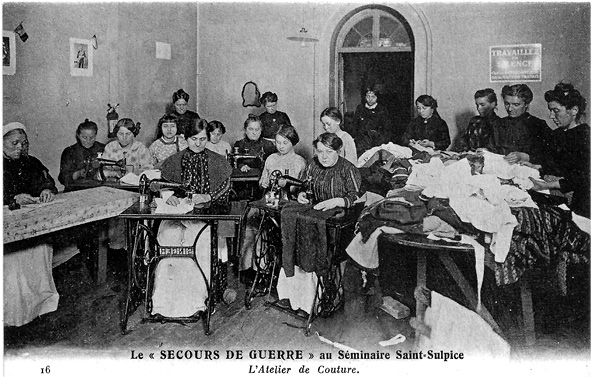
Le Secours De Guerre au Seminaire Saint Sulpice, ‘L’Atélier de Couture’ (postcard).
What was real life like for ‘Madame M’ during the earlier stages of the war? She would probably have been drafted into the war effort, just as other seamstresses and couturières were. Women took new positions in the workforce, in munitions factories and postal services or public transport. Anyone in Paris would have been aware that the front lines were moving ever closer to the city and would have endured shelling by the Germans, as well as rationing, food shortages and the newest silent enemy, an epidemic of Spanish flu spreading with terrifying speed across Paris in the spring of 1918. This invisible scourge took hold as ‘Madame M’s crisis peaked.
Her delusion came fully to life during the last year of the war. It is plausible that she did witness soldiers’ uniforms being loaded or unloaded in Paris at this time. Since the boots of dead soldiers were never reused, it is most likely that the lorry she saw was being loaded with uniforms to be sent out to the front, rather than those of the fallen being sent back after battle. There were plenty of other reminders of conflict and loss in the public spaces local to her that year. Nearby Montparnasse Cemetery was dense with graves: of the victims of the Franco-Prussian War, and the Siege of Paris and the Commune, adults and children. At the end of rue Froidevaux are the public gardens and the entrance to the catacombs.
It’s in these dark spaces underneath Paris that ‘Madame M’ finds an organising image. It all falls into place. The children haven’t died: they have been stolen and hidden in cellars. The soldiers who were supposedly lost in the war aren’t dead either. They’re trapped in the tunnels beneath the city. The uniforms on the lorries by the side of the road belong to these soldiers. She can now see a coherent alternative world with its own strange logic, one that can contain and explain confusing personal circumstances or untethered grief. The plot extends into the marital home: any dissatisfaction or alienation is explained by the fact that her identity has been stolen and her husband is not her husband: they have both been replaced by substitutes.
Something else is going on, out of sight, in 1918. With uncanny synchronicity given ‘Madame M’s belief in doubles and substitutions, another extraordinary feat of engineering is underway, just north of Paris. The works digging out the Métro she can’t avoid, but this operation is bigger and crazier than anything she could have imagined. ‘Madame M’ would have known nothing about it – almost no one did. It was a closely guarded military operation. Maps discovered by Le Figaro in the city archives show a ‘Second Paris’ was under construction, complete with a replica Champs-Élysées and Gare Montparnasse. The plan was devised by the Air Defence Group in the era before radar to fool German bombers, and save the real city with a decoy: a life-size fake. The Illustrated London News of 6 November 1920 picked up the extraordinary story after the war and printed sketches of the original maps from October 1918: ‘Objectif A’ and ‘Objectif B’.11

Plans for a ‘fake Paris’ designed to confuse enemy raiders during the war – reprinted in the Illustrated London News, 1920.
The civic doppelgänger was to be sited in the Forest of Saint-Germain-en-Laye, in the little village of Maisons-Laffitte, on a section of the Seine which curved in a similar way to the one which ran through Paris and might fool a pilot from the air. Plans were executed by the electrical engineer Ferdinand Jacopozzi, the man responsible for the wonder of the Eiffel Tower, to illuminate ‘Paris’ with electric lights, lending a lifelike glow to the double, with lanterns flashing red and white on cue to pass for train lines and working points. The Armistice was signed before the plan could be finished or trialled, but life-size landmarks were mocked up in wood and canvas, including a model Gare de l’Est and a dummy suburb of Saint-Denis was completed, situated to the north-east at Villepinte. The small section that was built was quickly dismantled and forgotten. ‘Madame M’ didn’t have any idea that this giant substitute was being put together just a few miles away from where she lived. What would she have made of the top-secret maps laying out the landmarks’ doubles had she known of their existence? How might she have incorporated the project into her delusion? Could it have wrong-footed her and somehow snapped her out of it? The fake Paris project feels as incredible as one of her conspiracies. The decoy city requires us to believe secret operatives are going to the most extraordinary lengths to fool others. In that sense it would fit right into her scheme.
So how did Joseph Capgras interpret ‘Madame M’s false beliefs, and what explanations did he offer?
Capgras understood that there is no better way to understand delusions than to listen to the people experiencing them.
The 1923 ‘Madame M’ case study was the legacy of over a hundred years of fine medical description. This literature first came out of France after the Revolution when physicians began more active listening and meticulous note-taking. The approach reflected a more receptive attitude and began to build a literature around the new discipline of psychiatry in its modern sense. Cases of delusion were a particularly intriguing element of this literature and the first part of the nineteenth century was a golden age of investigation into them. It was a new subject and open for debate, and leading physicians like Philippe Pinel and then his protégé Jean-Étienne-Dominique Esquirol generated lots of new thinking. Most radically, that they might be understandable from a psychological point of view; the product of trauma, rather than just a ‘melancholic’ imbalance of humours or demonic possession. A century passed before Capgras described ‘Madame M’. Interest had waned in the meantime, but his notes pick up on these older insights about mental disturbances and repeat them for a new generation. If people were to be treated, not merely incarcerated, then a more humane approach was required, and that would demand careful listening and the recording of individual stories and symptoms, however subjective they might be.
In their 1923 paper, Capgras and his co-author Jean Reboul-Lachaux present the ‘Delusion of Doubles’ as a psychiatric disorder associated with women, as with other symptoms of ‘hysteria’. They identify an ‘imaginative hypertension’ and ‘psychic excitement’ in their subject that leads to ‘fantastic’ storytelling, with a ‘hallucinatory’ dimension to how they interpret the world. The doctors have seen this kind of recognition disorder before, though. What interests them about ‘Madame M’ and makes them believe that they are describing something new and important – the reason for the great fanfare around the case study – is the particular way in which ‘Madame M’s recognition malfunctions: she fails to recognise only the people close to her.
Mme de Rio-Branco hardly ever notices doubles of passers-by that she comes across, and it is rare that she discovers suggestive resemblances amongst strangers; more often than not it is one and the same person who changes successively into the first double, the second, the third, etc., at intervals of a few hours, a few days, or a few weeks… In order to explain the triggering of the phenomenon… In any recognition, there exists, more or less, a struggle between two emotional elements of sensory, or memory images: the feeling of both familiarity and strangeness… The feeling of strangeness develops in her, therefore […] and it jostles with the feeling of familiarity that is inherent in all recognition. […] With her, the delusion of doubles is not really therefore a sensory delusion, but rather the conclusion of an emotional judgement.12
Her failure to recognise people is based in her emotional state. Capgras suggests that her ‘emotional judgement’ rationalises a jumbled-up sense of familiarity and strangeness by not recognising a person as themselves. He also points out ‘Madame M’s natural predisposition to paranoia, as well as an obsessive attention to detail. The spark – she suddenly conceives of an abduction plot – is thrown on top of this and ignites a delusion which spreads into other aspects of her life.
A year after the publication of the first paper on the ‘Delusion of Doubles’ Capgras adapted his interpretation and described a second case of the delusion more closely in line with the terms of psychoanalysis, as pioneered by Freud, whose ideas were in their ascendancy.13 By 1929 a delusion featuring substitutes was more often than not viewed through a Freudian lens – that is, as a defence against internal conflicts. This view paves the way for Leon Festinger’s idea of ‘cognitive dissonance’ and how hard we will try to make our clashing thoughts harmonise. According to Freud, delusional patients develop ambivalent feelings towards certain people close to them, and resolve the accompanying uncomfortable, even unbearable, feelings of guilt about this by ‘splitting’ them into two: the ‘true’ individual, and the doppelgänger, or double, onto whom they heap all the negative freight. It is easier to live with a ‘double’, or the idea that your loved one has been substituted, than admit to feeling a ‘strangeness’ towards a member of your own family, or, even worse, to the possibility that you cannot truly know the people closest to you, or they you. Capgras and Reboul-Lachaux suggested that the doppelgänger was a product of the logique des émotions. If a loved one no longer inspires the same feelings one has come to expect, then it cannot be that person, and must instead be someone who looks exactly like that person.14 Freudian readings of doubles delusions also blamed unconscious Oedipal feelings – unacceptable sexual desires – for the splitting into two.
After Capgras’s lecture in which he showed off his ‘Madame M’ and her ‘unique’ disorder, one of the audience came forward with a further example of the delusion. Then others from the wider psychiatric community began to rifle through old notes and speak up. The delusion turned out not to have been as rare as had first been assumed, nor was it the preserve of ‘hysterical’ women. In 1866 the German psychiatrist Karl Ludwig Kahlbaum had described a patient who reported imposters that were the spitting image of friends and family.15 The delusion had been in their midst for years; they just hadn’t thought to look for it.
The delusion was first referred to as ‘Capgras syndrome’ by psychiatrists Dupuoy and Montassut in their 1924 paper (the fourth formally reported case), but it wasn’t until 1936 that a man was formally diagnosed under that umbrella. The man believed his parents were substituted doubles. There were other cases sitting quietly on the shelves, waiting to be found. In 1908, well before Capgras put pen to paper on the subject, American author and mental health reformer Clifford Beers described a psychosis he suffered from in which he believed his brother and parents were doppelgängers. Beers had even devised a ‘ruse’ to trick himself out of the belief, writing a letter to his brother whose identity would be authenticated should he be in possession of the letter when the brothers met. With proof confirmed, Beers claims to have successfully challenged the beliefs underpinning his delusion.
Capgras syndrome is still considered rare, but what cases there are in the literature do show a range of reaction to the substitute doubles.16 One subject whose husband had been ‘replaced’ would pour tea for the doppelgänger, plus an extra cup for her husband, in case he returned.17 One woman had such a rapport with her daughter’s doppelgänger that she let the situation be and rubbed along perfectly happily with her. An air of menace and danger is never far away, though, because the question remains when a substitute double arrives: what has happened to the ‘real’ person? The perceived substitute is in danger, the target for all the accusations, even in an extreme case blamed for murder or abduction. The possibility of reprisal lurks around the corner.
Today, Capgras syndrome is one of the delusions most directly associated with neurological disease. Capgras himself understood that organic brain disease could exist alongside the psychological dimension when a delusion develops. He investigated delusion of doubles in old age and how it related to the degenerative processes of ageing in the brain. But it was not until the 1980s that diagnostic technology homed in more closely on the brain lesions which so often co-existed with delusions but were not originally thought to be related. Capgras syndrome is seen in dementia with Lewy bodies, and in Parkinson’s disease. After the publication of Capgras’s paper in 1923 old case notes came to public attention which mentioned syphilis, and there is no doubt that neurological damage has always been in the mix as a cause. It’s possible typhoid fever was a contributory factor, as it may have been for Charles VI of France and his glass delusion. Organic disease doesn’t seem to explain ‘Madame M’, but, of course, she was never scanned for signs of it. Capgras did look, as far as the technology of the day would allow, and writes that ‘the physical and neurological examination doesn’t reveal anything other than a slight bilateral patellar hyper-reflectivity’ – abnormal knee reflexes. Regardless, we have to acknowledge that ‘Madame M’s symptoms remain to some extent ambiguous.
Capgras transferred from Maison Blanche to the Sainte-Anne asylum, where he spent the rest of his career, his work stalled by the beginning of the next world war. Sainte-Anne had been a progressive institution long before his arrival. While Capgras was preparing his landmark paper for publication back in 1922, it opened the first voluntary mental health service, meaning that patients could turn up for treatment without being detained under the old law. The hospital was a good fit for him, with his instinct to challenge dogma wherever he found it. He was remembered as being well liked by his patients: ‘I have spoken to many who still remember his kindness and devotion,’ writes Jacques Postel, the chief psychiatrist at Sainte-Anne during the 1980s.18 Capgras was also remembered as being unusually open to the ideas of his younger colleagues, even if they did not share his views.
Joseph Capgras died in 1950 aged seventy-seven. He was cared for in his final years by his nephews, Xavier and Paul Abely. Abely, also a psychiatrist, had dedicated himself, under his uncle’s influence, to theories around the ‘mirror sign’ and schizophrenia. This was Abely’s observation that people with schizophrenia spent more prolonged periods looking in the mirror than the general population. According to Abely, this extended mirror-gazing demonstrated disordered self-recognition and feelings of alienation. We can already see an afterlife here for Capgras’s work into familiarity and strangeness, ‘self’ and ‘other’ in a ‘Delusion of Doubles’. When Abely mentioned his uncle, ‘it was in terms of his knowledge, clinical ability, and his total rejection of the grandiose clinical systems in which so many well-meaning clinical psychiatrists have become bogged down with a perverse delight that finds its equivalent only in the acedia of the Divine Comedy’.
Every clinician comes across a case early in their career that colours their research and thinking from then on. ‘Madame M’ was always there in the background, a life in parallel with his, a woman who had lived through the same war, but, unlike her doctor, no obituaries were written about her. She remained a source of fascination for Capgras. He returned to her story again and again over many years, thinking in new ways about it.
Whatever predispositions or diseases might have co-existed, the psychological dimension to ‘Madame M’s delusion is as compelling now as it was to Capgras.
‘My signature has value,’ she says. She wants her story to be recorded, she wants paperwork. We can hear a loud assertion of identity, of significance, of uniqueness.
Did ‘Madame M’ get what she wanted? The divorce she petitioned for, for example? Her belief her husband had been murdered and replaced suggests a certain ambivalence towards him at the very least. Divorce for French women had only fairly recently been re-established, in 1884 under the Third Republic. Divorce had first been introduced after the Revolution but continued to be seen as revolutionary and anti-Catholic and its social effects were feared by the aristocracy who didn’t want a return to all that, and certainly not to women being allowed to petition on equal grounds to men, as they had briefly been able to. Divorce was restricted under Napoleon and banned altogether under the monarchy and only returned after the Franco-Prussian War after decades of legal fighting. At any rate, as a patient in an asylum she would not have the autonomy to set a divorce in motion. We certainly register in her voice a clear warning that things are not all right, and she did attract the attention of Joseph Capgras, for a time, a man who wanted to listen and was sensitive to trauma. To that extent the delusion was successful. ‘Madame M’ is clear that the authorities must act, to restore justice and order. This was a sentiment no doubt shared by many at the end of the war. Women had been enthusiastically mobilised in France, but demobilisation had been fast and without ceremony. War did not lead to the enlargement of their civic or civil rights. Unlike their European neighbours in Britain, Germany, Austria and Holland, French women did not obtain the right to vote. The civil code granting wider rights to women would not be reformed until 1938, and then only in a limited way. The rationale for this was partially economic, partly to restore the domestic structures for the returning soldiers who wanted to find their women ‘as they had left them, where they had left them’.19 Did she ever consider the conspiracy foiled? What became of her surviving child after Capgras stopped chronicling her story? Did her husband, if he remained legally her husband, ever visit her again? Did Capgras? The records show only that she was moved to the incurable section of the asylum. They don’t reveal if she ever left Maison Blanche.
Like fake Paris, ‘Madame M’s delusion is an extraordinary feat of imagination. The bespoke reality she makes for herself works hard for her, containing a messy life in one giant narrative. It organises her enemy – they are identity-stealers who must be stopped. It gives her a job – fighting a specific crime. Her world is well ordered and moral and it won’t entertain any creeping nihilism or anarchy. Reality becomes, if not more bearable, at least more avoidable – she is fully occupied with the mental heavy lifting of keeping the delusion going. The pace and scope of the doubling is dizzying, and the world teems with impersonators, both of the people she says are dead (but who we know to be alive) like her husband, and also of the people she acknowledges to be alive, like the surviving daughter, who she sees as a series of fakes. Then there are the impersonators of ‘Madame M’ herself. Her story has some of the overblown magic of a magic lantern show which obscures the formative incidents and influences of her life behind the scenes. Despite a few suggestive clues, the background remains sketchy.
The flipside of the doubles, though, are the abductions and disappearings. She flags up these absences, of children and soldiers, and in doing that articulates something quietly poignant. In her alternative reality, these missing people are still alive. She campaigns frantically for their rescue but it’s easier to believe that loved ones have been hidden, even that a substitute has been buried in place of a child, than live with the random cruelty of their deaths.