
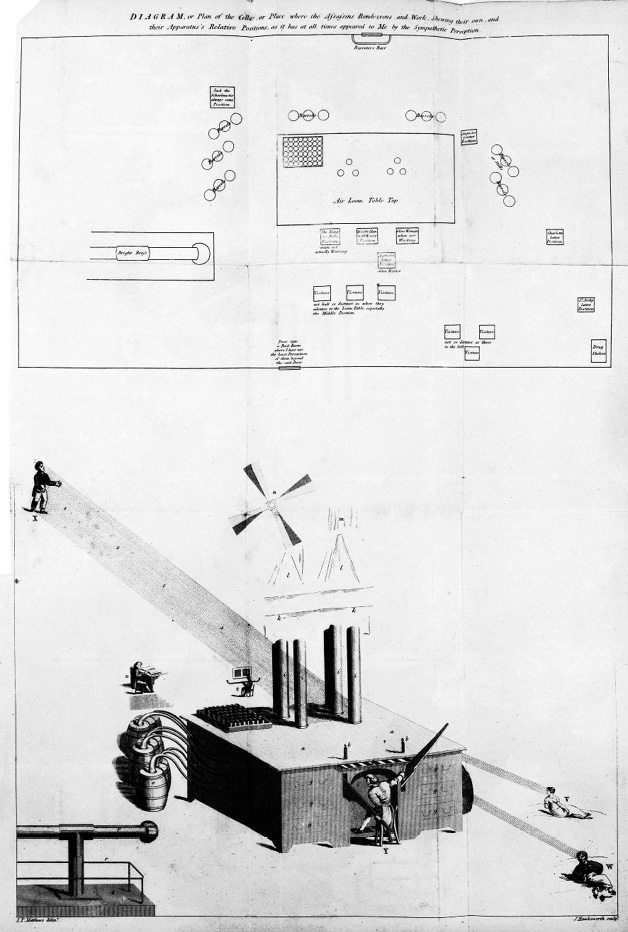
Detail from an illustration by James Tilly Matthews for Illustrations of Madness by John Haslam (1810).
CHAPTER II
We move back in time by some 130 years. The date is 6 September 1793, and we’re travelling north, from the Left Bank and Montparnasse, across the Seine, to Montmartre in the 9th arrondissement. The Hôtel de Biéville sits on the rue de la Grange-Batelière: an imposing neoclassical building, its vast shuttered windows topped with stone swags framing the monogram ‘DB’ for the Duc de Biéville who commissioned it. Until recently it was occupied by a captain in the king’s personal guard, but now the French National Guard has jurisdiction. At the top of the sweeping staircase is a room guarded by gendarmes; inside sits a young man who looks to be in his twenties, head hanging down and clasped in both hands. Before all this, he was a London tea-broker. The Terror commenced by decree the previous day, enforcing the harshest measures against those suspected of being enemies of the Revolution, and the Committee of Public Safety has named this individual, who calls himself James Tilly Matthews, a spy. Rooms above and below are occupied by many others now incarcerated, with countless more in jails across the city, none of them with any prospect of trial. Civil war has spread from the Vendée and hostile armies surround France. The different faces of the Revolution, the more moderate Girondists, and the Jacobins, are turning on each other. The revolutionary government is in no mood to give special favours, least of all to a man who says he is a volunteer envoy from the British government. Matthews has had his passport confiscated, and he doesn’t speak a word of French. He waits, planning his next move. ‘It is not easy to find out the truth about this person,’ writes the author of an occasional column called ‘Revolutionary Mondays’ in the newspaper La Justice which, a century later, looks back at the cause célèbre of Matthews and his appearance in Paris, ‘the antecedents, the true conditions of this half-masked, mysterious negotiator. We only know of him what he wants us to learn…he says that he is not English, but Welsh, and that since Caesar, the inhabitants of Wales are known for their love of liberty.’
Matthews’s attempt to explain himself is quoted extensively in the same newspaper:
I may also add that my mother is from a French family of the name Tilly, who were obliged to leave France after the revocation of the Edict of Nantes. I was baptised under this name. I appear in the baptismal registers under the name of James Tilly, and, like the coat of arms in use in my country, I have always had French arms on my badge/insignia. I don’t usually use the name Tilly as in my country, to use three names would be ostentatious. And so, I am happy with that of my father, except when it is some act of property, when I never omit to insert them all. The constituent Assembly has reintegrated into their rights as citizens all the descendants of French refugees. I too resolved to leave England, because I didn’t like the government’s principles. It is in consequence of this resolution that I started to take a strong interest in French affairs.1
He adds that he does not detest the English, but their government.
This young man is falling over himself to say the right thing about his true allegiance and save his own skin. He is twenty-seven years old and in big trouble. What sort of figure does he cut? Is he still sporting the standard attire of a diplomat: silky knee-breeches, lace cuffs, ruffles, frills and a frock coat, or has this ‘gadfly’, as the ‘Revolutionary Mondays’ columnist calls him, found plainer workers’ clothes in a nod to the more militant supporters of the Revolution who have seized a brief moment of power during the Terror? Matthews’s primary contacts in Paris have been the more moderate statesmen of the Revolution, men like Georges Danton and Charles-François Lebrun. If he’s dressed like his associates, as a gentleman, then, like ‘Madame M’ at the police station, he’s visibly a man out of time, styled according to the diplomatic codes of an age which have gone out of date overnight. Danton and Lebrun have also just been named as suspects.
As a self-styled negotiator Matthews has been trying to keep the peace between warring factions who do not want it kept. He’s persisted for several years with these intractable negotiations, demands ratcheting up on all sides, concessions denied, but trust has completely broken down. Now the French are questioning his motives, as the English soon will, and his neck is, almost literally in the age of the guillotine, on the line. His life depends on choosing the right side but power can flip from one to the other in the course of a day, an hour even. French contacts suspect him of being a double agent. His deft tightrope-walking is suspicious. His ability to adapt himself according to his audience has been a lifesaver, but now looks like evidence of guilt. He must decide.
Matthews is then held in Paris, in a series of prisons until the early part of 1796. He’s in chains, in solitary confinement and in fear of random violence and his life. By then, the revolutionary government have concluded that this so-called ‘emissary’ is indeed a double agent, and he is rather miraculously spared the guillotine and thrown out of France on the grounds that he is a lunatic. This may well be an administrative error in all the chaos. It’s just possible that someone bothered to assess Matthews’s mental capacity and took a humane view of what should be done with him, but if he was very obviously unbalanced or raving it was a rare display. He’s sent packing back to England. There are no carriages for him now. He apparently walked shoeless from Paris to Calais, scavenging what he could. Over the following year he will convince himself of a sinister political conspiracy at work right under everyone’s noses.
Occasionally a case emerges from the archives that allows us to see what such a delusion might have meant on an existential level for the person experiencing it. James Tilly Matthews is one such case. He is considered the first fully documented case of what became known as ‘paranoid schizophrenia’. Matthews’s delusion features an extraordinary mind-altering machine and a shady gang of operatives – proto-Dickensian crooks with pox-scarred hags as accomplices. This gang is sending out invisible magnetic waves from their newfangled device into the heads of the Westminster elite. The covert operation is part of a far-reaching conspiracy between French Jacobin revolutionaries and the British government. Corrupt parties both sides of the Channel are in league working to upend the political power structures in London as in Paris and install revolutionaries in Westminster.
Matthews left London as a tea-broker-turned-diplomat, with friends in high places, but when he arrives back in town he is penniless, a common felon who has been unceremoniously deported. He finds his wife and child living in abject poverty. His wife has always been unidentified, a faceless presence in his story, and we don’t know what happened to her while her husband was detained in France, but it’s safe to say the revenue stream from the wholesale tea trade dried up. They’re in basic lodgings in the south-east of the city now and must come to terms with a new situation. This is a stark reduction in circumstances, a humiliation that’s often included in accounts of a time when a delusion began to form.
Britain is a confused political scene. Wild conspiracy theories have begun to germinate here about the French situation. Conservative commentators whisper that the chaos of the Revolution might have been by the design of the ‘Illuminati’. This is a society of intellectuals hoping to advance their Enlightenment principles and the talk is that they have infiltrated the Freemasons network, and the French elite. Now they’re posing as Jacobins and they have overthrown the monarchy and the church in the service of their own agenda.
Confined to his basic lodgings, Matthews is entertaining notions of an alternative plot, one even more sinister and wide-ranging than anything the Illuminati are suspected of. It has crossed the Channel and infiltrated Britain. He begins to organise his intelligence. Members of the government are doing secret deals to allow Jacobin revolutionaries to overthrow the British government. He will reach out to the loyal politicians whose ear he once had. Will they hear him out? He informs the relevant officials but his allegations are ignored. On 12 September, he writes a long letter to Lord Liverpool, the minister for war, briefing him on the treason and the need for urgent action. This letter also receives no response. As an intermediary and peace broker he knows all the secrets. There are bribes paid in jewels going to and fro. What are the authorities going to do about it? He even delivers evidence to Mr Pitt himself, but the prime minister rebuffs him. He is rejected. Again and again, snubbed by the establishment he was once on good terms with. He sends one final letter. He is again ignored.
Matthews gathers some papers together and sets off for Westminster.
The next event dates the dramatic first public appearance of Matthews’s delusion. Friday 4 November 1796, still not long after his return from France, Matthews sits in the front row of the public gallery in the House of Commons, visibly agitated. He waits for the right moment to strike.
There is a lull as the filing clerk inserts a clause into a bill. The man stands up and raises his right hand, in which he brandishes a piece of paper. He calls down to the chamber: ‘Traitor!… Treason! Treason! I come to disclose Treason to the House.’ The London Gazette for that week splashes with the headline ‘Disturbance in the Gallery’ and reports Matthews’s words as: ‘I wish to surrender myself to the Sargant at Arms and be examined at your Bar.’
The gallery is duly cleared and the man is frogmarched to an antechamber, where he gives his name and address as James Tilly Matthews of 6 Camberwell Grove. He then fills in a few more of the blanks in his story. The papers say he’s Welsh. The London Gazette for the first week of November 1796 says something else, quoting him that his father is Welsh, but that he is from Staffordshire.2 No one else picks this up this qualifying detail, apart from, logically enough, the Staffordshire Advertiser.
Matthews then buttonholes everyone in the room. It’s about the treason and his thankless attempts to expose it. The demonstration in the House of Commons was a last resort. He can prove everything to the House if he is permitted the time. He is determined ‘to let the country know the fact, or perish in the attempt’, reports the London Gazette. He is also being followed everywhere by spies, even a man who ‘personated him’ (another substitute double on the streets). His life is in danger. People have been employed to kill him. The House, unsurprisingly, does not do his bidding. They decide instead that he is ‘deranged in his intellect’. The London Gazette says he shows ‘disappointment and regret’ at being ordered to leave Parliament.
There’s more. At some point before the scene in the House of Commons, Matthews has become convinced of an extraordinary machine at work at the centre of the plot. This is a piece of kit called the ‘Air Loom’, which can control minds, weaving ‘airs’, or gases, into a ‘warp of magnetic fluid’ which is then directed at its victim. Revolutionaries with their fingers on the buttons and levers are manipulating the thoughts of serving British politicians.
Near every public office an air-loom is concealed, and if the police were sufficiently vigilant, they might detect a set of retches at work near the Houses of Parliament, Admiralty, Treasury, &c, and there is a gang established near St Luke’s Hospital…all the persons holding high stations in the government are held impregnated. An expert of the gang, who is magnetically prepared, contrives to place himself near the person of a minister of state, also impregnated, and is thus enabled to force any particular thought into his mind and obtain his reflections on the thought so forced. – Thus, for instance, when a Secretary of War is at church, in the theatre, or sitting in his office and thinking on indifferent subjects; the expert magnetist would suddenly throw into his mind the subject of exchange of prisoners. The secretary would, perhaps, wonder how he became possessed of such a subject, as it was by no means connected with his thoughts; he would, however, turn the topic in his mind and conclude that such particular principle ought to form the basis of the negociation. The expert magnetist, having, by watching and sucking, obtained his opinion, would immediately inform the French Minister of the sentiments of the English Secretary, and by such means become enabled to baffle him in the exchange.3
The gang are influencing at the highest level. Even the prime minister William Pitt is no match for the magnetic forces and has become a ‘mere puppet’ to the villains who plan to assassinate him. Matthews has survived on his wits. This is dangerous work. He may look like a double agent, but he’s actually a whistle-blower keeping tabs on the plans for ‘the republicanising of Great Britain and Ireland’, and ‘disorganising the British navy’. Our daring hero falls over himself to declare his allegiance, but this time to the British, downplaying any affinity with the French. Cells of the Air Loom are concealed in numerous basements and cellars across London, even in the grounds of the hospital itself. We think of ‘Madame M’ and the Paris of more than a century later with its basements full of stolen children.
Bow Street Magistrates hear the case and Matthews’s family plead with the authorities that he is sane. Matthews is a tricky proposition. Here is a delusional conspiracy theorist but some of the most implausible elements to the story he told police are demonstrably true. He was a tea-broker but newspaper reports confirm that he had been in Paris during the most tumultuous years of the Revolution and at a pivotal moment in world history. Brokering peace instead of tea is quite a career change.
He appears before Lord Kenyon at Lincoln’s Inn Fields, but after petitions from his parish authorities in south-east London, who have had enough of dealing with this troublesome ‘pauper’ on their patch, he is committed.
On 28 January 1797, the year after he was sent packing from France, Matthews enters the Bethlehem psychiatric hospital, better known as Bethlem, or ‘Bedlam’. At the time, the hospital was still situated at Moorfields, just beyond the northern wall of the City of London. Records show that he is moved to the incurable section of the hospital the following year, on 21 January 1798.

‘James Tilly Matthews put on the incurables’, 21 January 1798, Bethlem Hospital Incurable Patient Admission Registers.
Matthews had been declared a ‘lunatic’ by the French authorities, but was never admitted into the French psychiatric system that was pioneering a more psychological, humane approach to mental illness. He was brought instead to the most celebrated British asylum of the day. It was a different picture in Bedlam. The hospital Matthews arrived at was, on the exterior at least, a showy, purpose-built affair. Designed by the famed polymath Robert Hooke, its grand scale advertised a great benevolence towards the predicament of lunatics. Stone pillars at the entrance cautioned as well as impressed visitors with the figures of ‘Melancholy’ and ‘Raving Madness’ carved in Portland stone at the top. The hospital had been built, however, on the ‘town ditch’ − essentially a rubbish tip − so its foundations were unsound. By the time Matthews got there, the place was falling down; the enlarged cells and well-lit galleries of Hooke’s design now damp and dilapidated, with uneven floors and a leaking roof. The patients there were still manacled, still enduring regular cold-bath treatments, bleeding and all sorts of other violent restraints and violations. The post of physician there had historically been awarded on a charitable and honorary basis, and a salary was a relatively new thing for a man like John Haslam, the doctor-at-large and apothecary at the hospital. Most physicians were in and out, making their money ‘mad doctoring’ in private practice, but as an apothecary Haslam was on site daily. This may go some way to explaining his rise at the institution.
The term ‘Bedlam’ was, even then, synonymous with chaos. The asylum featured in the final scene of Hogarth’s series of paintings ‘The Rake’s Progress’ in which protagonist Tom lies almost naked on the floor, his loyal wife Sarah weeping beside him, as an asylum tourist and her maid look on. Visitors were still coming in large numbers on high days and holidays to gawp at the spectacle, and spot its most famous residents despite the squalor of the place; perhaps even because of it. Years of war with revolutionary France had drained the public coffers and made refurbishment of institutions like this a low priority.
On 18 March 1797 a woman interrupts the morning meeting of the Bethlem Subcommittee. ‘I am the wife to Mr. Matthews and demand to know by what authority my husband is detained.’ Matthews’s admission papers are shown to her but she won’t be fobbed off. Eventually she receives an order that she is longer allowed to visit her husband. She makes his behaviour worse. She’s kept a nameless, indistinct figure, on the other side of the walls, but she will haunt the hospital authorities.
Who knows exactly when the two men first set eyes on each other but it’s John Haslam we have to thank for Matthews’s promotion from a bizarre diplomatic anecdote in a French newspaper to a landmark case study of delusion. Haslam is in charge of Matthews’s treatment at Bedlam and he compiles a book about the case: Illustrations of Madness. Haslam’s treatment of the story is highly original. His turns a ‘first person’ account of a delusion into a page-turning caper. He is puppet master to his patient but at pains to say that Matthews was keen to get the story out there and shared his story willingly, collaborating with Haslam by drawing the diagrams and character sketches himself. This is the first time an entire book has been devoted to the delusional imagination of one individual case. Haslam subtitles his book ‘Exhibiting a Singular Case of Insanity, and a no less remarkable difference in Medical Opinion: Developing the Nature of Assailment, and the Manner of Working Events; with a Description of the Tortures Experienced by Bomb-Bursting, Lobster-Cracking and Lengthening the Brain’.
John Haslam lives at close quarters with Matthews for more than fifteen years before he presents the delusion to the public for the first time. Our intermediary keeps careful record of Matthews’s ‘insanity’ over the many years of his confinement and he takes us on an up-close, street-level tour of Matthews world. The resulting guide to one man’s delusion is in the eighteenth-century version of Glorious Technicolor, with tracking shots along dirty, crowded streets. The atmosphere is seedy and oppressive. The dramatis personae are rounded up for us:
Mr M. insists that in some apartment near London Wall there is a gang of villains profoundly skilled in pneumatic chemistry… The assailing gang consists of seven members, four of whom are men, and three women. Of these persons four are commonly resident, and two have never stirred abroad since he has been the subject of their persecution; of their general habits little is known. Occasionally they appear in the streets, and by ordinary persons would be taken to be pickpockets or private distillers. They leave home to correspond with others of their profession; hire themselves out as spies, and discover the secrets of government to the enemy, or confederate to work events of most atrocious nature. At home they lie together in promiscuous intercourse and filthy community.4
Haslam promises special access to this filthy community through the eyes of his swashbuckling investigator on the ground. Matthews’s words are faithfully transcribed, Haslam insists, and he is ‘contented and grateful’ to have the plot brought to public attention. Matthews holds a lantern up to a villains’ gallery, illuminating the characters from his imagination. Bill ‘exerts the most unrelenting and murderous villainy’, and ‘has never been known to smile’; his second-in-command, ‘Jack the Schoolmaster’ is ‘about 60 years of age. It is not well ascertained if he wears a wig, but he generally appears in the act of shoving his wig back with his forefinger, and frequently says: “So you shall, when you can ketch [catch] us at it.”’ The leader, ‘Bill the King’, is ruthless and ‘surpassed the rest in skill, and in the dexterity with which he worked the machine. He is about 64 or 5 years of age, and in person resembles the late Dr De Velangin [an eccentric doctor interested in diet and nutrition who worked for a time at Bedlam] but his features are coarser; perhaps, he is a nearer likeness to the late Sir William Pulteney [the fabulously wealthy and Pitt-supporting parliamentarian] to whom he is made a duplicate.’ Brief flashes of recognisable London society personalities make the scene disorientating, both familiar and unfamiliar, like faces in a hall of mirrors. The crude copies walking the streets of Matthews’s London call forward to the frauds who lurk around in ‘Madame M’s Paris more than a century later with their obvious post-operative scars. ‘Sir Archy’ wears a ‘drag coat’ with breeches that button between the legs. ‘Some of the men assert that Sir Archy is a woman dressed in men’s apparel…a low-minded blackguard, always cracking obscene jokes and throwing out gibes and sarcasms. In his speech there is an affectation of a provincial accent.’ He uses a magnet to manipulate ‘brain sayings’. The operator of the machine is a sinister, disfigured lady known only as the ‘Glove Woman’: she always wears cotton mittens as she has ‘the itch’. She is ‘pockfretten’ – scarred by pox – with ‘downy hair’ on her upper lip and chin, she wears a ‘common fawn-coloured Norwich gown’, a plain woven ‘camblet shawl’ and a ‘chip hat covered with black silk… The rest of the gang…are constantly bantering and plucking at her like a number of rooks at a strange jack door [jackdaw]: she has never been known to speak.’ Augusta is superficially charming ‘ordinarily dressed as a country tradesman’s wife, in black, without powder’, but ‘exceedingly spiteful and malignant’ when crossed. She roams London’s West End as an undercover agent with other gangs, her specific objective with the magnets is to influence women. Charlotte has ‘the appearance of a French woman, being a kind of ruddy brunette’. They keep her ‘nearly naked and poorly fed. Mr Matthews is led to suppose that she is chained; for she has sometimes stated herself to be equally a prisoner with himself. She always speaks French, but her language and brain-sayings are conveyed in an English idiom.’ You can’t miss the confusion of French and English identity in the character of Charlotte; she embodies the confusion of Matthews’s influences and anxieties about allegiance to one side or another. Perhaps she also reflects his own disjointed memories of his time spent chained up during the Terror.
There was already a high-profile patient under Haslam’s care at Bedlam when Matthews came through the doors: a docile and enigmatic woman, fond of Shakespeare and gingerbread, called Margaret Nicholson. The pair would go on to spend many years as neighbours. She was a mother figure to the other patients just as he later become a father figure. Nicholson was sixteen years his senior, and had already been at Bedlam for a decade when he turned up carrying his fully realised world and its cast of characters. She had been admitted after attempting to stab King George III with a blunt dessert knife and was something of a celebrity spot for the sightseers to the hospital who would beg an audience with her. It’s conceivable that Matthews was given special permission to cross into the women’s section of the hospital and meet her. They would hear about each other, and they had, after all, a lot in common. Both exhibited delusions of grandeur. According to Haslam, Matthews had occasionally been known to lose his usual composure and throw his weight around, like the ‘Napoleons’ who arrived a few years later at a number of French asylums, as if he were ‘Emperor of the whole world, issuing proclamations to his disobedient subjects and hurling from their thrones the usurpers of his dominions’. This line could have come straight out of Nicholson’s mouth as she demands her usurper King George III acknowledge her claim to the throne. Matthews’s delusion of persecution puts him firmly at the centre of the universe and assumes that all eyes are fixed on him. As with ‘Madame M’, he is powerless, but this is predicated on the world caring enough to disenfranchise him. Matthews’s life after his diplomatic mission runs parallel with Napoleon Bonaparte’s rise, but with the two men going in opposite directions. ‘We told you that you were Buonaparte’s talisman’, the gang gloat, ‘and that we would work him up to as high a pitch of grandeur as we would fix you below the common level of human nature.’ Haslam describes Matthews with an arched eyebrow as ‘our own resident Un-Napoleon’.
Haslam has good reason to resent Matthews. The doctor saw sanity and insanity, like day and night, as two states that could not, by definition, co-exist. Matthews’s presentation makes it very difficult to be so black and white about the question of whether or not he’s ‘out of his mind’. He is such an accomplished draughtsman that when a competition was launched for a design for a new Bedlam on its new site on St George’s Fields in Lambeth, south London (the building which is now the Imperial War Museum) he submitted designs. He didn’t win, but his efforts so impressed the governors that he was paid £30. Over the years of his incarceration he was apparently a mild-mannered character. His doctor said he could even be an ‘automaton’ waiting for others to take charge of him (rather like ‘Madame M’s listlessness). At other moments he is described as scholarly, peacemaking and well liked by fellow inmates. He was allowed to garden some land among the tumbledown, dated exterior walls which he ‘brought to a high state of cultivation’. One of his unrealised schemes in Paris had been to solve the food shortages with a network of city gardens and he made plans for a kitchen garden at Bedlam. His family stood by him for the duration of his time at Bedlam, and continued to lobby for his release, although they were barred from visiting him. Banning visitors to Bedlam was very unusual and, as Mike Jay suggests in The Influencing Machine, only strengthened his belief that he was a political prisoner and an enemy of the state.
Matthews is a real threat to Haslam’s authority, but their relationship remains ambiguous. It is Haslam who gives Matthews the pens and other materials to enable him to draw his private world (just like wardens at the beginning of the twentieth century will give our milliner ‘Léa-Anna B’ Shakespeare plays to read while she waits for word from King George V) and he fosters Matthews’s evident talent as a draughtsman. He seems, on one level at least, to be captivated by his patient’s imaginative creation – the Air Loom and the realm in which it operates – even as he sneers at the reality of this world in his commentary. The relationship between this doctor and patient also dramatises a very old question, the same one opposing religious authorities used to ask: namely, who gets to decide what is delusional, and what is not?
Matthews’s exceptional technical skill gives his diagrams a lifelike precision. He gets down to the nitty gritty of how all these unseen forces are worked and exploited by this fantastical cast of agents. And we loop around again to the perennial and knotty question of what a delusion might mean.
The air from the device is a putrid cocktail of ‘stinking human breath, mortification and of the plague’, ‘seminal fluid’ and arsenic among its component parts. The machine begins a quasi-mechanical process whereby this air assails a person, causing them to act and feel in a desired way through planted thoughts, or the more torturous ‘lobster-cracking’ to which Haslam refers in the subtitle of the book, when the pressure from the magnetic atmosphere stops a person’s circulation, as if they’re caught in the teeth of tongs. Forces are also channelled through ordinary domestic appliances: ‘apoplexy-working with the nutmeg grater’, for example, or, most subversively of all, a cylindrical mirror held up to the target so that all ‘thoughts are made to assume a grotesque interpretation; and the person assailed is surprised that his fixed and solemn opinions should take a form which compels him to distrust their identity, forcing him to laugh at the most important subjects. It can cause good sense to appear as insanity, and convert truth into a libel; distort the wisest institutions of civilized society into the practices of barbarians, and strain the bible into a jest book.’ In other words, this system can turn the world upside down in a moment and make a laughing stock out of anything and anyone.
The gang work as a team. One member sucks out existing sentiments, another forces in new ones. There is bawdy comedy when bodily functions are enlisted: magnetic fluid, for example, is extracted through the anus ‘bubble by bubble’ to dastardly ends. Magnetism as a vehicle for psychic communication is perhaps the most extraordinary and fearsome trick. An ‘inferior member of the gang (generally a novice) is…furnished with a bottle containing the magnetic fluid which issues from a valve on pressure. If the object to be assailed be sitting in a coffeehouse, the magnetic practitioner hovers about him, perhaps enters into conversation, and during such discourse, by opening the valve, sets at liberty the volatile magnetic fluid which is respired by the person intended to be assailed. So great is the attraction between the human body and this fluid, that the party becomes certainly impregnated.’ The communication and control happen ‘without producing the ordinary vibrations of the air’, lodging in the cavity of the ear while the bystander is none the wiser. The gang even work at night, forcing their grotesque images into the intellect in a way which is both ‘wonderful and distressing’. This can happen to you when you’re asleep or drinking your coffee. You might get an apprentice on work experience. It’s no laughing matter, though. It was this gang who persuaded the authorities to cook up false allegations that Matthews was mad in order to invalidate his claims. They got him committed. The further a person goes from the pneumatic machine the weaker its hold on him, but you have to get a thousand feet away before it loses its controlling power. The ‘interposition of walls causes but a trifling difference’. The conspiracy can penetrate the hospital and reach him. They can still reach him and will eventually kill him. He can’t escape, even inside fortress Bedlam, just as ‘Madame M’ will be trapped in Maison Blanche with doctor doubles who are involved in a plot to poison her.
To Matthews, this is no caper. This is a crime of high treason, and it’s live. The situation is perilous.
Today, Matthew’s ideas would be seen as ‘paranoid’; a category of delusion which might include ideas of ‘reference’ (the belief that harmless or coincidental events relate directly to you, when they don’t) and persecution (believing others are observing you and may be trying to harm you). The word ‘paranoia’ was coined by Hippocrates to describe the delirious ramblings people experience when they have a very high temperature. He used two Greek words – ‘para’ meaning beside and ‘nous’ meaning mind – to create a word meaning literally ‘out of one’s mind’. The term was picked up and eventually came to refer to a disorder of mind that did not involve delirium. The World Health Organization’s classification system for psychiatric phenomena, built on work at the Maudsley Hospital in the 1960s, established the principal delusion types: grandiosity, reference, jealousy, pregnancy, catastrophe, religion, guilt and others. Over the last century paranoid delusions have become the most common of all.
With the medicalisation of mental health conditions at the end of the nineteenth century came the diagnosis of ‘dementia praecox’, which would soon be known as schizophrenia, whose schema swallowed up delusions as one of many symptoms. Matthews was retrospectively labelled with this diagnosis and within its framework the Air Loom delusion was ‘un-understandable’ in terms of psychology or life experience.
It’s true that Matthews as he appears in Illustrations of Madness is a larger than life character, a showman demonstrating his visions whose human features are obscured behind smoke and mirrors. Can we catch a glimpse of the man? Where did the path that took him to Bedlam start?
Matthews became clearly unstable after years working as a negotiator in revolutionary France. But what made him decide to go to Paris to attempt such an impossible diplomatic task in the first place? Can we even be sure what name he went by? By his own admission he was in the habit of using different configurations of his surnames at different times depending on which country he was in and how much of a show-off he wanted to be. Most biographies of Matthews give his birth date as 1770 and state that he was originally from Wales, and little is generally known of his early life. Welsh origins have been assumed thanks to his statement to Bow Street Magistrates where he says the name Matthews is from his Welsh father. A detail in the administrative documents from the day of his arrest in London rewards another look. He stipulates that he was baptised James Tilly, under his French Huguenot mother’s name, not under Matthews. This leaves more variables for a researcher trying to find traces of him in the records, especially given the fact that small changes or discrepancies in spelling were common in registers at this time.
A throwaway remark by Matthews, supposedly from his own mouth while making his statement, provides a lead and helps focus the search. It’s been sitting there all along, overlooked in the London Gazette’s report of Matthews’s antics at the House of Commons. His father, he says, was from Wales, but he is himself in fact a ‘native of Staffordshire’. Any trumpeting of national identity by Matthews should be taken with a big pinch of salt. We know that he would say anything to stay on side. But naming the country of Staffordshire as the place where he grew up has an authentic ring, since there’s no obvious reason to lie about it either way. It’s the Staffordshire Advertiser of 12 November 1796 (quoting the London Gazette) that brings us the breaking news of the drama in the House of Commons – did the paper believe this to be a local man?
Modern search engines mean it’s now possible to cross-reference variant spellings on a name with a possible new location in the online records.
There is a baptism record for a ‘James Tilley Matthews’ (Tilley with an ‘e’) for 8 March 1766 in St Peter’s Church, Kinver (or Kinfare), Staffordshire, England. The entry goes on to call him ‘son of Edward Matthews Jane his wife’.
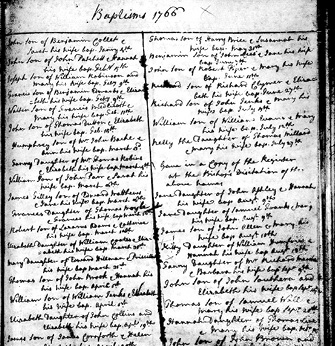
Parish baptisms, 1766, Kinver Staffordshire: ‘James Tilley son of Edward Matthews & Jane his wife, bap. March 5th.’
According to another Parish register, this time in London, a ‘James Tilley Matthews’ (again, Tilley with an ‘e’), aged twenty-one, married Elizabeth Sarah Gibbs, also aged twenty-one years, on 20 April 1787 in the bride’s parish of St George’s, Bloomsbury, Camden.

The marriage record of James Tilley Matthews and Elizabeth Sarah Gibbs, St George’s, Bloomsbury, 20 April 1787.
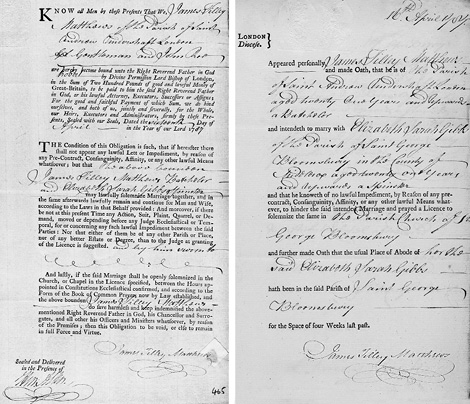
Marriage bond and allegation, James Tilley Matthews of the Parish of St Andrew Undershaft and Elizabeth Sarah Gibbs of the Parish of St George’s, Bloomsbury, 16 April 1787.
Four days earlier, on 16 April, there is as marriage bond recorded – a sworn statement that you are free to marry on pain of a substantial fine, in this case of £200 – in which a ‘James Tilley Matthews’, ‘a bachelor’, is described as being ‘of the parish of St Andrew Undershaft’.
Can we connect the two men? We have a very few clues as to what our Matthews was up to before his adventures in France began but he’s clear about his occupation pre-spying. He was a ‘tea-broker’ and he gives his address as 84 Leadenhall Street, in the City of London.
This James Tilley Matthews’s parish when he married is St Andrew Undershaft, the church which sits just off Leadenhall Street on St Mary Axe in the city of London (it’s still there, a rare example of a building that survived both the Great Fire and the Blitz). It is less than a three-minute walk from St Andrew Undershaft to 84 Leadenhall Street, where our Matthews says he worked as a tea broker, before his diversion into French/English diplomacy. St Andrew Undershaft is, in fact, the closest church to 84 Leadenhall. The James Tilley Matthews who was born in Kinver in 1766 would be the right age in April 1787, just turned twenty-one, for the two records to match. If it’s our man, his long-time unidentified wife now has a name, Elizabeth Sarah, and family in Bloomsbury. After so many years as a nameless presence to the side of her husband’s story, she starts to take on some definition. The area surrounding the impressive Hawksmoor church where they married was developing fast into a well-to-do area, a world away from the slums of St Giles down the road, with elegant garden squares and its centrepiece, the British Museum.
If our James Tilly Matthews was born in south-west Staffordshire in 1766, then the Industrial Revolution was all around him as he was growing up. By the late eighteenth century five ‘slitting mills’ were working in the county which includes Kinver, more than anywhere else in Britain at the time. The mills would slit iron bars into rods to be made into nails in the surrounding Black Country. Staffordshire was at the forefront of the charge for innovation in industrial processes, in pottery, iron, coal and glass. The scale of the mechanisation would have meant a multi-sensory assault on any local, particularly on a child, the sights and sounds both awesome and troubling as the process accelerated to an unrecognisable future society.
He may well have come to London to serve an apprenticeship, as young men from almost all tiers of society did at this time, looking to qualify in a line of work which offered good prospects. If a father had contacts in the tea business – this was usually how positions were secured – indenture fees were often paid for a son’s apprenticeship. Tea was a booming business with a bright future in the 1780s and 1790s, the drink now exceptionally popular with the middle classes, and drew many young people into the City of London.
East India House was the focal point of Leadenhall Street in the eighteenth century as the headquarters of the East India Company, which held the monopoly for the import of tea from India and China. Tea auctions were hosted here, placing London at the centre of the international tea trade at the time Matthews was brokering the stuff. These auctions of imported tea were held quarterly and the commodity traded ‘by the candle’, meaning that a candle was lit with each new lot and, when an inch had burned away, the hammer would fall, keeping proceedings moving at pace.
Armed with the good prospects of a career in tea, Matthews marries Elizabeth Sarah just a month after turning twenty-one, also the age at which an apprentice was allowed to make his living in the City of London.
Five years pass before he first travels to France. Presumably he was working during this time for, or through, whichever importers or dealers in tea had premises at 84 Leadenhall (the company name, like the building itself, is now lost). Becoming a Freeman of a livery company like the Drapers, who often took tea dealers and brokers into their company, could give a man a more secure footing. Regardless, there was every chance that, in the early 1790s, he was doing rather well. Elizabeth and James started a family.
Matthews’s earlier education is harder to make sense of. The penmanship he later demonstrated at Bedlam was admired even by the doctor who loathed him for most things – he also drew frontispieces for some of Haslam’s special volumes, and the fonts and designs that he set were apparently indistinguishable in quality from those of a publishing house. He may have learned calligraphy while in Bedlam. We know his persecutor-turned-mentor was in the habit of providing him with whatever equipment he needed.
At some point, going about his daily business in London, Matthews came into the orbit of David Williams, a Welsh clergyman and prominent religious and educational reformer. This contact would change the direction of his life. If we take him at his word, that Matthews’s father was indeed Welsh like Williams, perhaps there was a connection between the two senior figures. We know the younger Matthews became acquainted with David Williams because it was he who led the trip to Paris in late 1792 that Matthews joined when he made his very first venture to France. The expedition also included Joseph Priestley, the renowned experimental scientist who is best known for his work on the chemistry of gases. Williams was the magnetic centre of a high-profile discussion group which drew in scientists and other public figures of the day. He was a one-time associate of Benjamin Franklin and regularly hosted events in a chapel in Margaret Street in central London. These sessions tackled head-on the pressing issues of the day such as governance, and constitutional issues facing prospective new republics.
How did Matthews find himself among this heavyweight intellectual company? An obvious entrée opportunity were the public lectures run by Williams. There’s no evidence of an extensive schooling in Staffordshire, or of family money, and Matthews has many of the hallmarks of an autodidact with natural ability, acquiring a high level of skill in a variety of disciplines. When he is interviewed after his arrest in London, he claims to have left England initially because he ‘didn’t like the government’s principles’. An ambitious young man with his sights set on becoming a person of influence – and doing well enough in business to pay for it – could take private tuition for the purposes of self-improvement. Williams was known to adopt private pupils of ‘defective’ education who wished to take part in public life.
Williams’s circle is a natural draw for Matthews. The members are all renowned and idealistic republicans keen to roll up their sleeves and get to work actioning the project in France. Having fallen in with the group, Matthews receives an offer that would turn the most level of heads: an invitation to Paris – to the very centre of the political action in Europe. They are proposing to help to draft a French constitution. It’s a grand undertaking. Matthews steps up and joins the deputation, assured of the opportunity and adventure of a lifetime. On the boat to France, Williams and Priestley and the others had a lot to talk about and agree upon. Did Priestley mention anything on the way over about exciting discoveries in the field of pneumatic chemistry – about gases even? Did anything of the political and scientific zeal of these men rub off on their young companion? If the James Tilley Matthews from Kinver is our man, that makes him twenty-seven when he joins this trip to Paris, a crucial few years older than some biographies have him. All the evidence points to a curious and tenacious man who couldn’t wait to dive into the wider world and its affairs. He is a natural conduit for the wide-eyed conviction of the age, but he soon acquires a preternatural level of confidence. He makes several trips to France, flitting between British parliamentarians and their French counterparts, even troubling Prime Minister William Pitt himself. Looked at through a modern lens, we might see early signs of the delusions of grandeur that can characterise schizophrenia. He gives himself a job – as an agent of peace between nations.
The central argument of Haslam’s book about the case pivoted around the question of whether or not James Tilly Matthews was evidentially sane or insane. The story has been passed down the generations as a crazed Boy’s Own adventure of the Georgian era. Haslam’s agenda gets in the way of a clear view of Matthews. Can we see behind the artifice to what was going on around him in the real world; what was influencing him, by the way, as he went about his business on the streets of Paris and London before his arrest?
First, we might ask where the Air Loom, an extraordinary feat of imaginative engineering, sprang from? Where did the idea set seed?
Illustrations of Madness mentions a formative encounter. While he was locked up for spying in Paris, killing time with another young buck who had found himself on the wrong side of the regime, it seems the conversation came round to new scientific thinking. This was way beyond anything he would have heard from Joseph Priestley. It was second-hand gossip about the cutting edge of physics and chemistry and how minds might be able to talk to each other through connections that weren’t visible to the naked eye. It was all new to Matthews, but he was open to it:
The first hint Mr M received of the possibility of such sympathetic communication was in France, before the period of his confinement. He there, in one of the prisons, became acquainted with a Mr. Chavanay, whose father had been cook to Lord Lonsdale. One day, when they were sitting together, Mr. Chavanay said, ‘Mr Matthews, are you acquainted with the art of talking with your brains?’ Mr. M. replied in the negative. Mr C. said, ‘It is effected by means of the magnet.’
And just like that, apparently, Matthews was introduced to the reality of invisible forces and their power to change minds. A chat around the subject would have led inevitably to an honourable mention of a certain Viennese Dr Mesmer, who in recent years had been expounding a new ‘hypnotic’ theory to the bourgeoisie of Paris who were in thrall to the idea. ‘Mesmerism’ was a new conception of natural forces organised around the idea of an invisible substance that passed through the air, an ‘animal magnetism’, that was present inside people’s bodies and which a doctor could manipulate to various ends.
Demonstrations of mesmerism were banned during the Revolution, but when Matthews made his first few visits to Paris during the early 1790s, although Mesmer himself had already quit the city, these demonstrations were still commonplace, and members of the public could elect to be in the audience, or even participate. Matthews was too late to see the first stage for these demos, in a set of rooms at the luxurious Hôtel Bullion, on the rue Coq-Héron in the 1st arrondissement, where Mesmer set up in his practice shortly after arriving in Paris in January 1778. Mesmer had been derided and discredited in Vienna, but in Paris he found himself with up to twenty patients a day and, with his sessions overrun on a one-to-one basis, he had to up his game. A New England society magazine describes the atmosphere of Mesmer’s rooms with breathless wonder. This was an immersive experience:
In all Paris there were no apartments so charmingly furnished as Monsieur Mesmer’s. Richly-stained glass shed a dim, religious light on his spacious saloons which were almost covered with mirrors; orange blossoms scented all the air of his corridors; incense of the most expensive kind burned in antique vases on his chimney pieces; Aeolian harps sighed melodious music from distant chambers…5
Mesmer had devised a piece of apparatus called the ‘baquet’ which allowed him to treat more people at a time in a version of group therapy. This baquet was a large wooden tub containing sixteen bottles in a radial pattern. Each of these bottles was filled with iron filings, powdered sulphur and crushed glass. Iron rods projected from the vessel with powerful magnets at their base, and participants would hold hands, allowing the animal magnetism to flow between them, hoping to experience its healing effects.
An English doctor who observed Mesmer at work describes in more detail how the baquet was used in the group therapy:
In the middle of the room is placed a vessel of about a foot and a half high… It is so large that twenty people can easily sit round it: near the edge of the lid which covers it there are holes pierced corresponding to the number of persons who are to surround it; into these holes are introduced iron rods, bent at right angles outwards, and of different heights, so as to answer to the part of the body to which they are to be applied. Besides these rods, there is a rope which communicates between the baquet and one of the patients, and from him is carried to another, and so on the whole round. The most sensible effects are produced on the approach of Mesmer, who is said to convey the fluid by certain motions of his hands or eyes, without touching the person. I have talked with several who have witnessed these effects, who have convulsions occasioned and removed by a movement of the hand…6
Apparently, Mesmer would often conclude his treatments by playing some music on a glass armonica, and the overall effect would be hypnotic. The cultivated, fragrant and spooky atmosphere of these gatherings feels more like a seance than a medical procedure. Mesmer’s salons, like the Phantasmagoria, are operating well before the spiritualist movement entered the stage. Spiritualism and the seance of the popular imagination didn’t materialise until 1848, in a bedroom in a clapboard house in upstate New York where the Fox sisters, eleven-year-old Margaretta and fourteen-year-old Catherine, lived. The sisters claimed to be communicating with the dead via ‘raps’ on wood and crowds began to assemble around a table in the Fox home, hoping to hear these ‘raps’ which the sisters passed off as messages from the deceased. With their fame spreading, Leah, a third Fox sister and in her thirties, decided to take the family on tour, first of the US and then overseas, to appear before spellbound audiences. Thus a homespun cottage industry became an international movement. Mesmer’s salons pre-dated the Fox sisters’ roadshow by many decades but his ideas drifted across the Atlantic and his influence was felt in this craze for the occult that emerged in the 1840s. His method now seems prescient of many of the religious practices associated with spiritualism.
In Paris in the late eighteenth century the public were already showing an appetite for evidence of unseen powers. Mesmer’s audience could choose from a variety of theatrical demonstrations around town, whether that be the healing powers of medical electricity, or the thrill dread of the Phantasmagoria and the magic lantern which presented ghostly apparitions, doppelgängers and the resurrection of the dead.
Marie Antoinette was a devoted follower, but an enquiry led by scientists declared Mesmer a charlatan and he fled the city in 1785. To others, however, he remained a genius. By the time Matthews arrived in Paris Mesmer was long gone, but the waves he generated were still moving around the city. Over the course of their conversation in the cell, Mr Chavanay might well have mentioned Mesmer’s protégé, Antoine Hyacinthe de Chastenet, and, more significantly, Chastenet’s brother, the Marquis de Puységur, who continued to draw followers while Mesmer was in exile in Switzerland. The institute run by Puységur in Strasbourg was disbanded by order of the revolutionary government and Puységur paid his dues with a few years in prison, but mesmerism and magnetism continued to exert influence for more than a hundred years. Its appeal reached all the way to the ladies’ magazines of the 1920s where practitioners advertised to women like ‘Madame M’ and her clients. Although Matthews did not meet the man himself, Mesmer exerted a magnetic pull on his psyche, as he did on so many. Looking at the last remaining example of a Mesmer baquet, preserved in the Musée d’Histoire de la Médecine et de la Pharmacie in Lyons (acquired in 1846 by a Bavarian furrier who stumbled across it in a house clearance) it is hard to miss the references in the Air Loom and the similarities are suggestive that Matthews had seen one, or at least had one described for him in great detail.
Mesmer’s centrepiece was a prototype for the Air Loom. The Heath Robinson contraption is re-versioned in Matthews’s imagination. On the face of it both objects are crude, almost naive examples of industrial engineering, but both also cast forward to a world where the most powerful networks are functioning out of sight in the ether. Both objects are inventions straight out of a ‘Steampunk’ science fiction fantasy, but arrive nearly two hundred years before the genre was conceived. Steampunk presents an alternative Victorian Times, hissing and clanking with a combination of retro and futuristic steam-powered machinery. The Air Loom is Georgian, but plays by the same rules: the device boasts fantastical powers, but it quotes real-world, analogue technology. In Illustrations of Madness, the gang ‘proudly boast of their contempt for the science of the present era’. Matthews’s Air Loom agents laugh at redundant old-world technologies. The machine he conjures up is cutting edge but designed to bring about harm. It animates an unease about the rate of scientific discovery; how each new insight into natural laws could be used, who would be in the know and who left behind, how it could disrupt day-to-day life, where it all might lead.

A surviving example of Mesmer’s ‘baquet’ at the Musée d’Histoire de la Médecine et de la Pharmacie, Lyon, France.
This was at a time when a great number of invisible forces were being discovered and utilised everywhere – the force of gravity, for example; electricity, even magnetism itself – and scientists were beginning to identify and play with them. The realm of the supernatural was now enlightened science. In his writing about the future, Arthur C. Clarke included three ‘laws’. The third law proclaimed: ‘Any sufficiently advanced technology is indistinguishable from magic.’7 The line between vanguard science and charlatanism was becoming more difficult to draw with confidence – pneumatic chemistry was a controversial field. A certain amount of magical thinking was required in order to comprehend each technological advance anyway. These newly identified energies were replacing the other ‘invisible forces’ in which countless generations had believed – forces like those which had accounted for madness: God’s revenge on sinners, for example, or the powers of the devil and demonic possession. Once you believed in mesmerism it wasn’t such a great stretch for someone like Matthews to translate elusive but powerful forces of nature into a set of notions which explained why he was so mentally unbalanced. Currents of magnetic fluid flowing between people are a neat explanation for any Romantic or existential anxieties about who is in charge now. The currents move through any wall or person in Matthews’s delusion. ‘Léa-Anna B’ will come up with something similar in the 1920s as part of her delusion of erotomania. The force she identifies is an almost ectoplasmic cloud she calls ‘La Morve’ which mingles among people and influences her actions.
When Matthews visited Paris in the early 1790s, a massive civic project was underway beneath the streets. This was the grisly process of moving bones from the overwhelmed cemeteries to the derelict quarries just beyond the city. By day, Matthews went about his business in the city meeting politicians, building his diplomatic reputation, and by night labourers stocked the catacombs with the remains of Paris’s dead. The ancient stone mines in the 14th arrondissement had caved in back in 1774, swallowing up three hundred metres of rue Denfert Rochereau, in the area that would become the Montparnasse of ‘Madame M’. A lack of space for the dead, on top of poor city sanitation, incubated disease and an intolerable stench. Louis XVI conceived an idea for solving this crisis and the process of disinterring bones from their graves began in 1787, away from the eyes of Parisians who were deeply unhappy at breaking into the final resting places of their dearly departed. These covert night-time operations continued to haunt the city, making their way to into ‘Madame M’s delusion more than a hundred years later, when the network was disturbed by excavations of tunnels for the Métro. Perhaps Matthews knew about the project. Perhaps he caught sight of the nocturnal activity and witnessed men shovelling load after load from their carts, and was affected by it, like ‘Madame M’ when she saw the packing up of First World War uniforms by the side of the road. The catacombs landed a leading role in ‘Madame M’s delusion as a prison for disappeared soldiers from the First World War and containers of numerous ‘lost’ children. Whatever the route, the catacombs had also found their way into the image system for the Air Loom, the interconnecting channels corresponding to Matthews’s idea of a concealed network of spies. The process of moving the dead was paused during the Revolution, as were Mesmer’s demonstrations, but on an early sojourn in Paris Matthews could have stumbled across the spectacle in the dark. Looking back at events from his cell in Bedlam a scene like that becomes a bad omen.
So how does his doctor John Haslam interpret Matthews’s allegations? Haslam has known his patient for over a decade by the time he sits down to write a book about him in 1810. He does not dwell on the reasons for the delusion itself, psychological or otherwise. His primary concern is with the question of whether Matthews should be considered legally sane or insane. There is a solid reason for this. Matthews has just been declared of sound mind by a judge after years of legal argument instigated by his family. After he was committed, the family continued to protest on his behalf. They brought a writ of habeas corpus in 1809, and, after long interviews with Matthews, a panel of doctors and lawyers could find ‘no evidence of derangement’. With Illustrations of Madness, Haslam is attempting more than just the retelling of a page-turning conspiracy story. The work represents a defence of his professional life, and of the overarching clinical approach taken to mental disturbance at Bedlam during his tenure. Haslam prefaces the book with an account of the recent court case which has put his judgement in the spotlight along with Matthew’s mental state. Haslam is diplomatic, praising the qualifications of the eminent panel, even though they contradicted his own panel of witnesses. He is also clearly determined that the book should be proof, in Matthews’s own words, that he is completely out of his mind. He has been mad all along, Haslam insists. He does what he promised Matthews and publishes the exposé of cloak-and-dagger corruption but it’s with the hint of a sneer on his lips. Between the lines, he signals that staff at Bedlam were correct in their diagnosis and should be exonerated from any charges of malpractice. Bitterness leaks out between every line and there are a few clear accusations: Matthews’s claim that external forces are controlling him is a ploy that would not stand up as a defence in a court of law. It constitutes a failure to take responsibility for his actions and to go along with it would set a dangerous precedent. ‘There are already too many maniacs allowed to enjoy a dangerous liberty,’ he argues pompously, ‘and the Governors of Bethlem Hospital, confiding in the skill and integrity of their medical officers, were not disposed to liberate a mischievous lunatic to disturb the good order and peace of society.’
In Illustrations of Madness Haslam’s reputation-saving agenda gets in the way of his patient, standing between Matthews and anyone wanting to hear him out. Nevertheless, the relationship between Haslam and Matthews is long and more finely balanced than it first appears. The duel reflects a time when the traditional power dynamic between doctor and patient was unstable. The question of who was mad, who was not and who had the power to decide had always been a hot topic, but it was now the subject of particularly feverish debate. Even the mental capacity of King George III was in question. The issue of how the mentally unbalanced should be treated was also nowhere near decided.
An awareness of delusion as psychiatric illness in its own right began in earnest in France at the beginning of the nineteenth century in the years after the Revolution. Before 1800 or thereabouts, to be delusional was to be inhabited by demons, and the treatment was not medical. It came courtesy of the clergy with the rituals of exorcism. The seventeenth-century philosopher Thomas Hobbes encapsulates the prevailing opinion as essentially binary: ‘The opinions of the worlds, both in Ancient and later ages, concerning the cause of madness have been two. Some, deriving from the Passions; some from Daemons, or Spirits, either good or bad, which they thought might enter into man.’8
After the Revolution, secular thinking around delusions as a medical disorder began to crystallise. Paris was a natural epicentre for this disruptive new approach. The Revolution had led to the abolition of arbitrary imprisonment – standard practice under the previous regime – and this demanded new ideas on how to treat the mentally ill. They could no longer be locked up on the strength of a cursory letter committing them, and the key thrown away. Something had to be ‘done’ with them. A cluster of major asylums sprung up at Bicêtre, Charenton and Salpêtrière, which was reserved for women, Maison Blanche and, after 1867, Sainte-Anne. The patients were carefully studied for the first time with a view to recording the symptoms and searching for therapeutic solutions.
The general shake-up of the Revolution freed doctors to work on understanding delusions in a new way: as a psychiatric illness. The pioneers were physicians such as Philippe Pinel, often referred to as the first modern psychiatrist, and his student Jean-Étienne-Dominique Esquirol. They laid down the basic language of psychopathology during these turbulent years.
As a passportless James Tilly Matthews sat in his cell at the Hôtel de Biéville at the height of the Terror, desperately plotting his next move, Pinel was getting his feet under the desk at Bicêtre asylum. Most medical histories include the 1876 painting by Robert Fleury of Pinel heroically cutting the chains of the mad at La Salpêtrière. Although his reputation as the single-handed liberator has been taken down a peg or two in recent decades, Pinel’s leadership in those early days of psychiatry did see innovation in terms of new treatments for the mind. Psychoanalysis did not yet exist, and nor did penicillin, which would have helped many people with delusions as they were symptoms of syphilis which was prevalent in the population at the time, or porphyria, the liver disorder that may have afflicted George III. Nevertheless, this desire to listen to people experiencing delusions marked an important change. Doctors were struggling to understand and patients struggling to be understood.
After Pinel, Jean-Étienne Esquirol continued the work, putting together a long list of delusional disorders, formally categorising them, for the first time, to create a working taxonomy, a map for treatment. ‘Delusion of grandeur’, ‘delusion of doubles’, ‘delusion of persecution’, ‘erotomania’, ‘somantic’ delusions involving transformations of the body, to name just a few of the most notorious. French physicians coined one iconic title after another. ‘The patients’, Esquirol notes in a textbook introducing the idea of ‘monomania’ – a mode of obsessional thinking related to delusions – ‘seize upon a false principle, which they pursue without deviating from logical reasonings, and from which they deduce legitimate consequences, which modify their affections, and the acts of their will. Aside from this partial delirium, they think, reason and act like other men.’9
The legacy of this careful attention is the remarkable body of case studies left to us in the archives of the major asylums in Paris.10 Pinel referred to them as ‘anecdotes’ and ‘sketches’ but he knew, as did Esquirol, that these intimate accounts were a treasure trove of primary sources. There were plenty of gaps in the notes, but each case formed a part of an ambitious project. This was the advent of modern medicine, when physicians wrote things up so they could compare notes and improve treatments. An array of medical journals were established around this time to the same end. The spike in reports of delusions at the turn of that century is explained in part by the spike in medical descriptions of all kinds.
In London, by contrast, Bedlam was a worn-out institution in terminal decline, although there was more enlightened thinking emerging elsewhere in Britain. One establishment even threatened to overtake French reform in scope, and in terms of the freedoms that patients were allowed. The Quaker family the Tukes had made money, neatly enough in the tea business, and put their minds and resources to reform in psychiatric hospitals. The patriarch William Tuke, his son Henry and grandson Samuel, established the Retreat asylum in York, an institution that borrowed the phrase ‘moral treatment’ from Pinel’s ‘traitement moral’ in France. The Retreat adopted a kinder, more thoughtful approach to the custody and care of the mentally ill after the example set in Paris, incorporating into the design extensive open gardens in which the patients could wander and ‘lose themselves’. Gardens would become prize features of more and more institutions over the coming decades, such as the one at Vanves, a carefully contrived pastoral idyll outside Paris that ‘Madame X’ looked out across while explaining to her doctor that she was already dead. Samuel Tuke wrote up a popular account of the York Retreat, sending the vision out into the wider world, and when Bedlam was eventually rebuilt in Lambeth, the superintendent visited the Retreat for inspiration and admired its atmosphere.
Matthews remained in Bedlam for almost the rest of his life, tending his own little patch of soil there, but the family as a whole never lost faith in him over the decades he remined in the institution. There was a nephew by marriage who kept up the pressure along with Elizabeth Sarah. The tireless years of litigation came at great expense, especially against the likes of Haslam who had a strong incentive to fight them at every stage in order to save his reputation.
Jamaican parish records show Elizabeth Sarah emigrated there with their child at some point, after years petitioning for her husband’s release. She may simply have wanted to escape the reputational damage of being married to an inmate at Bedlam. More likely she was desperate to relieve the financial pressure on her. There were servant positions to be had in the busy colonial estates. Having maintained contact for so long it’s a painful fact she was never allowed back inside to see him. The last image we have of her is a long way from Camberwell and even further from the fine church in Bloomsbury where she married James.
The family managed to bring one more case to court to argue that Matthews was sane and should be allowed to leave Bedlam. Tenacity was clearly a family trait, and it finally paid off. Matthews was declared sane and released on 27 June 1813. He moved into a private establishment in Bethnal Green into the care of a Mr Fox. Fox apparently agreed that he was in his right mind and he was much freer to come and go as he pleased. He was even allowed to carry on helping with the gardening as he had done at Bedlam.
After a decades’ long duel with Haslam, Matthews delivered a devastating parting shot. His testimony about abuses at Bedlam to a Select Committee for a report on ‘Madhouses’ convinced the panel, and helped to see Haslam dismissed after its publication in 1816. His words contributed to reform at the institution.
And what of Matthew’s delusional beliefs? Did they lose any of their grip following the recognition and validation given to him by the court case and its verdict? Or did he conclude they believed his allegations, might even foil the plot thanks to him? Matthews died in Mr Fox’s house less than two years after he arrived, on 10 January 1815, aged forty-eight. The clerks at Bedlam cared enough about their former inmate to record the event in the log.
The hall of fame of paranoid delusion has collected many other remarkable characters since James Tilly Matthews. Another landmark case was that of Daniel Paul Schreber, a judge in fin de siècle Germany. His case was immortalised by Freud in 1911 who gave a commentary on Schreber’s 1903 Memoirs of My Nervous Illness. The action focused on Schreber’s doctor, Professor Paul Flechsig. Schreber came to believe that his psychiatrist was controlling his thoughts and actions, using a ‘nerve language’, a complex communication system which linked souls to God. Others were able to make contact with his nerves through ‘divine rays’. He also believed that Flechsig was trying to transform him into a woman. Schreber had intended his memoir to interrogate the question of legal ethics around keeping someone inside an asylum against their will. Freud glossed the delusion differently: Schreber’s repressed impulses and ambivalent feelings about his brother and father were leading him to project motives onto his doctor, Flechsig, even onto God.
There are numerous, quieter cases of paranoid delusion to be found in the archives. Ellen Hamilton, for example, a forty-one-year-old woman from St John’s Wood, London, who was admitted to Bedlam on 10 January 1892, nearly eighty years after Matthews was released into the private care of Mr Fox. In her admission case notes, Hamilton is greatly distressed in her belief that people are ‘telephoning into her ears’ and that ‘people had extorted money from her by means of the telephone, that her house had been blown up… Susan Glynn, sister of above…told me that her sister sometimes walked about all night, that she accused people of stealing her property, that she heard voices through imaginary telephones making unpleasant accusations.’11
Paranoia and conspiracy are the defining delusions of the last hundred years. Nanotechnology, social media and reality television have replaced pneumatic chemistry and mesmerism as conductors of threat at this point in the twenty-first century.
After 1945, discoveries of spying apparatus regularly made the news and in the US during the Cold War countless people became convinced the security services were downloading their thoughts through micro-transmitters: they were reading minds. ‘The Great Seal Bug’, a piece of spy kit otherwise known as ‘The Thing’, was the most infamous. A device for covert listening, it was discovered in 1952 and eventually made public in May 1960 when the story was splashed across the international press. This was a carved wooden wall plaque, a copy of Great Seal of the United States, given as a gift from the Soviet Union to the US ambassador in Moscow, W. Averell Harriman, on 4 August 1945. The bug was secreted inside and it remained on the wall in the Moscow study for seven years. Eventually, a British radio operative intercepted a conversation and realised the Soviets were beaming radio waves at US diplomatic buildings. The device functioned in a completely novel way. It was active only when a strong electromagnetic signal of the correct frequency was sent to it from outside to wake it up. It had no power supply so had a potentially unlimited life, and it was very small and easy to hide. Get Smart, a popular television show in the US in the mid-1960s, featured a counter-intelligence office, Maxwell Smart. Smart used a ‘shoe phone’, a cutting-edge invention with a secret receiver in the heel and a transmitter in the sole that looks a lot like an early mobile. The press shot of Smart holding the shoe to his ear, furrow-browed, eyebrow raised, is a comic pose from light entertainment, but it also signals a growing unease around who might be listening, and how.
The most powerful forces are still the unseen ones, wanting our money or our vote, anonymous behind the screen, disrupting our ability to authenticate facts and identities. With the development of nanotechnology, the idea of a chip in your tooth downloading your thoughts is not as implausible as it was three hundred years ago, or even five years ago. It’s increasingly tricky to separate out the false beliefs from the advanced tech. Wireless devices in our home listen to us, collect data about us and adjust their algorithms accordingly. The machines really are listening.
A delusion of conspiracy organises the enemy, gives a shape to ambiguity, a face to anonymous players and fears. It gives a person a job to do: a bad guy to fight, and, by its own logic, casts the person experiencing it as the good guy, legitimising any subsequent actions.12 Any evidence that a belief isn’t true is further proof of conspiracy. The belief won’t answer to reason because it’s working very successfully on its own terms, and there are compelling reasons for a person to keep it up. In his 1974 paper, Harvard psychologist Brendan Maher said, ‘the delusional belief is not being held in the face of evidence normally sufficient to destroy it, but is being held because of evidence powerful enough to support it’. Many delusions represent a certain simplification of the world: a world which is easier to navigate, somewhere a person can feel safe, where they play an important role. Conspiracy theories often represent a dangerous oversimplification. It’s not an easy sell to coax a person back from a gloriously neat world into a more nuanced and confusing one.
There are many gaps in the records into which we lose aspects of Matthews the man. We can see him more clearly in relation to others. The way his delusion functions, at its simplest level, connects him to people who have also struggled to contain incompatible demands, shocks and falls and forged an alternative reality to live in. He maps the world for himself, describing the landmarks and the personnel. He has agency, and his role is of critical importance.
At the centre of Matthews’s delusion is something more original: a strange and intimidating machine. The Air Loom lives up to its name, looming down at us as a premonition of the mechanised world of the nineteenth century, and the technology of the twentieth, which will see people, even God, demoted. Matthews performs like a medium at a seance, his visions anticipating the darker and deeper conspiracy theories that will proliferate over the following centuries. A more personal story comes through, too: here is a self-made idealist who experiences humiliation, rejection, feelings of powerlessness. His is a psyche under extreme stress, pulled in too many directions; a peacemaker who cannot make peace, who finds himself unwelcome everywhere he turns. He brings an artist’s imagination to the problem and the Air Loom is the artwork.