
17
Book I. General Preface
Apollonius to Eudemus, greeting.
If you are in good health and circumstances are in other respects as you wish, it is well; I too am tolerably well. When I was with you in Pergamum, I observed that you were eager to become acquainted with my work in conics; therefore I send you the first book which I have corrected, and the remaining books I will forward when I have finished them to my satisfaction. I daresay you have not forgotten my telling you that I undertook the investigation of this subject at the request of Naucrates the geometer at the time when he came to Alexandria and stayed with me, and that, after working it out in eight books, I communicated thein to him at once, somewhat too hurriedly, without a thorough revision (as he was on the point of sailing), but putting down all that occurred to me, with the intention of returning to them later. Wherefore I now take the opportunity of publishing each portion from time to time, as it is gradually corrected. But, since it has chanced that some other persons also who have been with me have got the first and second books before they were corrected, do not be surprised if you find them in a different shape.
Now of the eight books the first four form an elementary introduction; the first contains the modes of producing the three sections and the opposite branches [of the hyperbola] and their fundamental properties worked out more fully and generally than in the writings of other authors; the second treats of the properties of the diameters and axes of the sections as well as the asymptotes and other things of general importance and necessary for determining limits of possibility, and what I mean by diameters and axes you will learn from this book. The third book contains many remarkable theorems useful for the synthesis of solid loci and determinations of limits; the most and prettiest of these theorems are new, and, when I had discovered them, I observed that Euclid had not worked out the synthesis of the locus with respect to three and four lines, but only a chance portion of it and that not successfully: for it was not possible that the synthesis could have been completed without my additional discoveries. The fourth book shows in how many ways the sections of cones meet one another and the circumference of a circle; it contains other matters in addition, none of which has been discussed by earlier writers, concerning the number of points in which a section of a cone or the circumference of a circle meets (the opposite branches of a hyperbola).
The rest (of the books) are more by way of surplusage: one of them deals somewhat fully with minima and maxima, one with equal and similar sections of cones, one with theorems involving determination of limits, and the last with determinate conic problems.
When all the books are published it will of course be open to those who read them to judge them as they individually please. Farewell.
...
The Cone
If a straight line indefinite in length, and passing always through a fixed point, be made to move round the circumference of a circle which is not in the same plane with the point, so as to pass successively through every point of that circumference, the moving straight line will trace out the surface of a double cone, or two similar cones lying in opposite directions and meeting in the fixed point, which is the apex of each cone.
The circle about which the straight line moves is called the base of the cone lying between the said circle and the fixed point, and the axis is defined as the straight line drawn from the fixed point or the apex to the centre of the circle forming the base.
The cone so described is a scalene or oblique cone except in the particular case where the axis is perpendicular to the base. In this latter case the cone is a right cone.
If a cone be cut by a plane passing through the apex, the resulting section is a triangle, two sides being straight lines lying on the surface of the cone and the third side being the straight line which is the intersection of the cutting plane and the plane of the base.
Let there be a cone whose apex is A and whose base is the circle BC, and let O be the centre of the circle, so that AO is the axis of the cone. Suppose now that the cone is cut by any plane parallel to the plane of the base BC, as DE, and let the axis AO meet the plane DE in o. Let p be any point on the intersection of the plane DE and the surface of the cone. Join Ap and produce it to meet the circumference of the circle BC in P. Join OP, op.
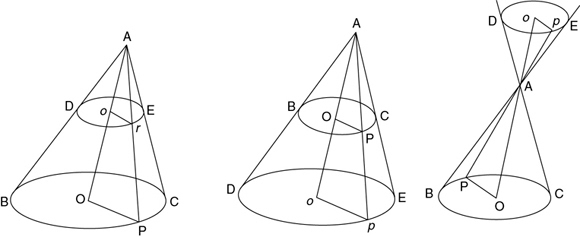
Then, since the plane passing through the straight lines AO, AP cuts the two parallel planes BC, DE in the straight lines OP, op respectively, OP, op are parallel.
:. Op: OP = Ao: AO.
And, BPC being a circle, OP remains constant for all positions of p on the curve DpE, and the ratio Ao: AO is also constant.
Therefore op is constant for all points on the section of the surface by the plane DE. In other words, that section is a circle.
Hence all sections of the cone which are parallel to the circular base are circles. [I. 4.]
...
Proposition 1
[I. 11.]
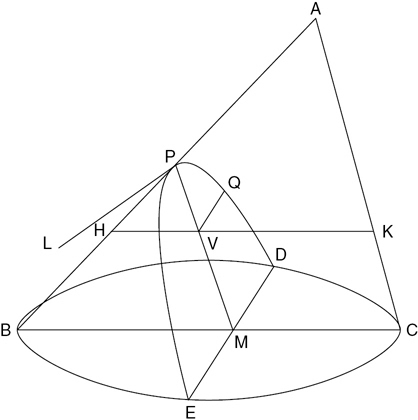
First let the diameter PM of the section be parallel to one of the sides of the axial triangle as AC, and let QV be any ordinate to the diameter PM. Then, if any straight line PL (supposed to be drawn perpendicular to PM in the plane of the section) be taken of such a length that PL: PA = BC2: BA. AC, it is to be proved that
QV2 = PL. PV.
Let HK be drawn through V parallel to BC. Then, since QV is also parallel to DE, it follows that the plane through H, Q, K is parallel to the base of the cone and therefore produces a circular section whose diameter is HK. Also QV is at right angles to HK.
:. HV. VK = QV2.
Now, by similar triangles and by parallels,
HV: PV = BC: AC
and VK: PA = BC: BA.
:. HV. YK: PV. PA = BC2: BA. AC.
Hence QV2: PV. PA = PL:PA
= PL. PV: PV: PA.
:. QV2 = PL. PY.
It follows that the square on any ordinate to the fixed diameter PM is equal to a rectangle applied to the fixed straight line PL drawn at right angles to PM with altitude equal to the corresponding abscissa PV. Hence the section is called a Parabola.
The fixed straight line PL is called the latus rectum or the parameter of the ordinates.
This parameter, corresponding to the diameter PM, will for the future be denoted by the symbol p.
Thus QV2 = p. PV,
or QV2 ∝ PV.
...
Proposition 3
[I. 13.]
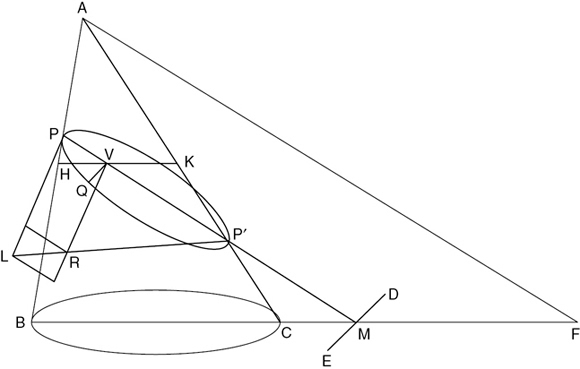
If PM meets AC in P’ and BC in M, draw AF parallel to PM meeting BC produced in F, and draw PL at right angles to PM in the plane of the section and of such a length that PL: PP’= BF. FC: AF2. Join P’L and draw VR parallel to PL meeting P’L in R. It will be proved that QV2 =PV. VR.
Proposition 4
[I. 14.]
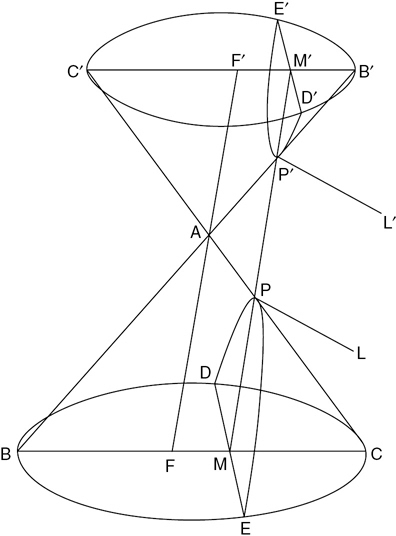
If a plane cuts both parts of a double cone and does not pass through the apex, the sections of the two parts of the cone will both be hyperbolas which will have the same diameter and equal latera recta corresponding thereto. And such sections are called Opposite Branches.
Translated by T. L. Heath
Reading and Discussion Questions
1.Apollonius assumes that we know quite a number of proofs and definitions already. Where do these come from?
2.How does Apollonius define a cone? What sorts of curves could you make by slicing through a cone with a plane?
3.Does Apollonius strike you as someone who is interested in practical applications? Can you think of any applications that his mathematics might have in later physics or astronomy?