
18
Lucius thereupon laughed and said: “Do not, my good fellow, bring an action against me for impiety after the manner of Cleanthes, who held that the Greeks ought to indict Aristarchus of Samos on a charge of impiety because he set in motion the hearth of the universe; for he tried to savethe phenomena by supposing the heaven to remain at rest, and the earth to revolve in an inclined circle, while rotating at the same time about its own axis.”
Plutarch, On the Face in the Moon
Distances of the Sun and the Moon
Hypotheses
1.The moon receives its light from the sun.
2.The earth has the relation of a point and centre to the sphere in which the moon moves.
3.When the moon appears to us halved, the great circle dividing the dark and the bright portions of the moon is in the direction of our eye.
4.When the moon appears to us halved, its distance from the sun is less than a quadrant by one-thirtieth of a quadrant.
5.The breadth of the earth’s shadow is that of two moons.
6.The moon subtends one-fifteenth part of a sign of the zodiac.
It may now be proved that the distance of the sun from the earth is greater than eighteen times, but less than twenty times, the distance of the moon—this follows from the hypothesis about the halved moon; that the diameter of the sun has the aforesaid ratio to the diameter of the moon; and that the diameter of the sun has to the diameter of the earth a ratio which is greater than 19:3 but less than 43:6—this follows from the ratio discovered about the distances, the hypothesis about the shadow, and the hypothesis that the moon subtends one-fifteenth part of a sign of the zodiac.
...
Proposition 7
The distance of the sun from the earth is greater than eighteen times, but less than twenty times, the distance of the moon from the earth.
For let A be the centre of the sun, B that of the earth; let AB be joined and produced; let Γ be the centre of the moon when halved; let a plane be drawn through AB and Γ, and let the section made by it in the sphere on which the centre of the sun moves be the great circle ΑΔΕ, let ΑΓ, ΓΒ be joined, and let ΒΓ be produced to Δ.
Then, because the point Γ is the centre of the moon when halved, the angle ΑΓΒ will be right. From B let BE be drawn at right angles to BA. Then the arc ΕΔ will be one-thirtieth of the arc ΕΔΑ; for, by hypothesis, when the moon appears to us halved, its distance from the sun is less than a quadrant by one-thirtieth of a quadrant [Hypothesis 4]. Therefore the angle ΕΒΓ is also one-thirtieth of a right angle. Let the parallelogram AE be completed, and let BZ be joined. Then the angle ZBE will be one-half of a right angle. Let the angle ZBE be bisected by the straight line BH; then the angle HBE is one-fourth part of a right angle. But the angle ΔΒΕ is one-thirtieth part of a right angle; therefore angle HBE : angle ΔΒΕ=15 : 2; for, of those parts of which a right angle contains 60, the angle HBE contains 15 and the angle ΔΒΕ contains 2.
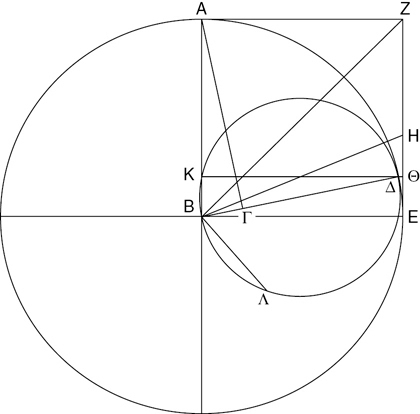
Now since ΗΕ : ΕΘ>angle HBE : angle ΔΒΕ, therefore ΗΕ : ΕΘ>15 : 2.
And since BE=EZ, and the angle at E is right, therefore:
|
ZB2=2BE2. |
|
|
But |
ZB2 : BE2 = ZH2 : HE2. |
|
Therefore |
ZH2=2HE2. |
|
Now |
49<2.25, |
|
so that |
ZH2 : HE2>49 : 25. |
|
Therefore |
ZH : HE>7 : 5. |
|
Therefore, componendo, |
ZE : EH>12 : 5, |
|
that is, |
ZE : EH>36 : 15. |
But it was also proved that
|
HE : EΘ>15 : 2. |
|
|
Therefore, ex aequali, |
ZE : EΘ>36 : 2, |
|
that is, |
ZE : EΘ>18 : 1. |
Therefore ZE is greater than eighteen times ΕΘ. And ZE is equal to BE. Therefore BE is also greater than eighteen times ΕΘ. Therefore BH is much greater than eighteen times ΘΕ.
|
But |
ΒΘ : ΘΕ = ΑΒ : ΒΓ, |
by similarity of triangles. Therefore AB is also greater than eighteen times ΒΓ. And AB is the distance of the sun from the earth, while ΓΒ is the distance of the moon from the earth; therefore the distance of the sun from the earth is greater than eighteen times the distance of the moon from the earth.
I say now that it is less than twenty times. For through Δ let ΔΚ be drawn parallel to EB, and about the triangle ΔΚΒ let the circle ΔΚΒ be drawn; its diameter will be ΔΒ, by reason of the angle at K being right. Let ΒΛ, the side of a hexagon, be fitted into the circle. Then, since the angle ΔΒΕ is one-thirtieth of a right angle, therefore the angle ΒΔΚ is also one-thirtieth of a right angle. Therefore the arc BK is one-sixtieth of the whole circle. But ΒΛ is one-sixth part of the whole circle.
|
Therefore |
arc ΒΛ=10. arc BK. |
And the arc ΒΛ has to the arc ΒΚ a ratio greater than that which the straight line ΒΛ has to the straight line BK.
|
Therefore |
ΒΛ<10. BK. |
|
And |
ΒΔ=2 ΒΛ. |
|
Therefore |
ΒΔ<20. BK. |
|
But |
ΒΔ : ΒΚ = ΑΒ : ΒΓ. |
|
Therefore |
AB 20. < ΒΓ. |
And AB is the distance of the sun from the earth, while ΒΓ is the distance of the moon from the earth; therefore the distance of the sun from the earth is less than twenty times the distance of the moon from the earth. And it was proved to be greater than eighteen times.
Translated by T. L. Heath
Reading and Discussion Questions
1.What physical evidence is Aristarchus appealing to in order to calculate the relative distances of the earth, moon, and sun?
2.Aristarchus is remembered for having proposed a heliocentric hypothesis (that the earth revolves around the sun). Given the arguments of Aristotle encountered in previous readings what reasons might ancient natural philosophers have had for rejecting this idea?