
35
On That Which We Have Hitherto Accomplished in Astronomy with God’s Help, and on That Which with His Gracious Aid Has Yet to Be Completed in the Future
In the year of Our Lord 1563, that is 35 years ago, on the occasion of the great conjunction of the upper planets which took place at the end of Cancer and the beginning of Leo, when I had reached the age of sixteen years, I was occupied with studies of classical literature in Leipzig, where I lived with my governor, supported by my beloved paternal uncle ... By and by I got accustomed to distinguishing the constellations of the sky, and in the course of a month I learnt to know them all, in so far as they were located in that part of the sky which was visible there. For this purpose I made use of a small celestial globe, not greater than a fist, which I used to take with me in the evening without mentioning it to anybody. I learnt this by myself, without any guidance; in fact I never had the benefit of a teacher in Mathematics (Astronomy), otherwise I might have made quicker and better progress in these subjects. Soon my attention was drawn towards the motions of the planets ... .
Later on, in the year 1564, I secretly had a wooden astronomical radius made according to the direction of Gemma Frisius. This instrument was provided with an accurate division utilizing transversal points by Bartholomæus Scultetus, who at the time lived in Leipzig, and with whom I was on intimate terms on account of our mutual interests. Scultetus had been taught the principle of transversal points by his teacher Homelius. When I had got this radius, I eagerly set about making stellar observations whenever I enjoyed the benefit of a clear sky, and often I stayed awake the whole night through, while my governor slept and knew nothing about it; for I observed the stars through a skylight and entered the observations specially in a small book, which is still in my possession. Soon afterwards I noticed that angular distances, which by the radius had been found to be equal, and which with the help of a mathematical calculation of proportions had been converted into numbers, did not in every respect agree with each other. After I had found the cause of the error, I invented a table by which I could correct the defects of this radius ... . But in 1569 and the following year, when I lived in Augsburg, I very often observed the stars, not only with the very large quadrant, which I had made in the garden of the mayor outside the city (about which I have spoken above), but also with another instrument, a wooden sextant that I invented there, and I entered my observations in a special book. I also did this industriously later on, after I had again returned to my fatherland, using another similar, though somewhat larger instrument, particularly when the strange new star, that flared up in 1572, made me give up my chemical investigations which occupied me very much after I had started them in Augsburg and which I continued until that time, and turn towards the study of the celestial phenomena. Having observed it industriously I described it, first in a small book, later conscientiously and thoroughly in a whole volume. In the course of time I had other and yet other astronomical instruments made, some of which I took with me when I travelled again all through Germany and part of Italy. Even on the journey I continued to observe the stars whenever possible.
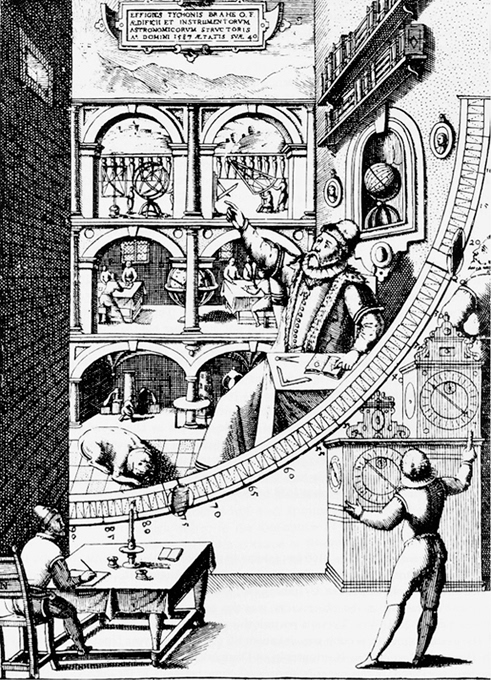
When at length I had returned to the fatherland about the time of my 28th year ... the noble and mighty Frederick II, King of Denmark and Norway, of illustrious memory, sent one of his young noblemen to me at Knudstrup with a Royal letter bidding me to go to see him immediately wherever he might be dwelling on Sealand. When I had presented myself without delay this excellent King, who cannot be sufficiently praised, of his own accord and according to his most gracious will offered me that island in the far-famed Danish Sound that our countrymen call Hven ... . He asked me to erect buildings on this island, and to construct instruments for astronomical investigations as well as for chemical studies, and he graciously promised me that he would abundantly defray the expenses. After I had for some time contemplated the matter and asked some wise men for their advice, I gave up my previous plan and willingly agreed to the King’s wish, particularly when I saw that on this island, which is situated all by itself between Scania and Sealand, I could be rid of the disturbances of visitors, and that I could in this way obtain, in my own fatherland to which above other countries I owe so very much, the quiet and the convenient conditions that I had been looking for elsewhere. So, in the year 1576, I began building the castle Uraniborg, suitable for the study of Astronomy, and in the course of time I constructed buildings as well as astronomical instruments of various kinds, fitted for making accurate observations. The most important of these are delineated and explained in this book. Meanwhile I also energetically started observing, and for this work I made use of the assistance of several students who distinguished themselves by talents and a keen vision. I had such students in my house all the time, one class after another, and I taught them this and other sciences. Thus by the grace of God it came about that there was hardly any day or night with clear weather that we did not get a great many, and very accurate, astronomical observations of the fixed stars as well as of all the planets, and also of the comets that appeared during that time, seven of which were carefully observed in the sky from that place. In this way observations were industriously made during 21 years.
These I first collected in some big volumes, but later on I divided them up and distributed them among single books, one for each year, and had fair copies made. The arrangement I followed was such that the fixed stars, in so far as they had been observed during the year in question, had their own place, while the planets all had theirs, first the sun and moon, and next the other five planets in order up to Mercury; for I observed this planet also, although it is very seldom visible. In fact we observed it carefully almost every year, in the morning as well as in the evening ... . Being now in possession of the selected and careful observations of 21 years, made in the sky with different ingeniously constructed instruments that I have shown in the preceding pages (not to speak of the observations of the previous 14 years), I hold them as a very rare and costly treasure. Perhaps I shall at some time publish all of them, if God in his grace will permit me to add still more ... .
First of all we determined the course of the sun by very careful observations during several years. We not only investigated with great care its entrance into the equinoctial points, but we also considered the positions lying in between these and the solstitial points, particularly in the northern semicircle of the ecliptic since the sun there is not affected by refraction at noon. Observations were made in both cases and repeatedly confirmed, and from these I calculated mathematically both the apogee and the eccentricity corresponding to these times. With regard to the apogee as well as the eccentricity an obvious error has crept into both the Alphonsine tables and Copernicus’ work, so that the apogee of the sun is almost three degrees ahead of Copernicus’ value. The eccentricity amounts to about 2% when the radius of the eccentric orbit is put equal to 60, while the value of Copernicus is too small by almost a quarter ... . This work on the sun was of necessity the first thing that had to be done, since it is on the sun that the motions of the celestial bodies depend, and since it moves in the ecliptic, to which the other motions are referred ... .
With regard to the moon we used no less diligence in order to explain its intricate path, which in so many ways is complicated and not so simple and easy to make out as the ancients and Copernicus thought. For it presents another inequality with regard to the longitude, which these astronomers did not notice; nor have they determined the ratios of its revolution with sufficient accuracy. Moreover the limits of its maximum latitude differ from the value determined by Ptolemy, who with regard to this point was too confidently followed by all subsequent astronomers ... .
After the orbits of both celestial bodies [the sun and the moon] have thus been determined in such a way that they agree with the celestial phenomena, it follows that it will be possible to determine with absolute correctness their eclipses, their relative positions, and their motions and places, the need for which has been long felt. What we have said so far about the course of the sun and the moon, and the question of agreement with celestial phenomena, is clearly presented together with other subjects, in the first chapter of our Astronomiae instauratae Progymnasmata ... .
Further, as far as time and circumstances permitted, we very carefully determined the positions of all fixed stars visible to the naked eye, even those that are denoted as stars of the sixth magnitude, the longitude as well as the latitude. The accuracy was one minute of arc, in some cases even half a minute of arc. In this way we determined the positions of one thousand stars. The ancients were only able to count 22 more in spite of the fact that they lived at a lower geographical latitude where they ought to be able to see as many more as would correspond to the 200 stars that are always hidden from us here. Instead of these we determined a number of others which are very small, and which they did not include on this account. This immense task occupied us for almost 20 years, as we wished to investigate the whole problem carefully with different instruments ... .
The fact that the latitudes of the fixed stars are also undergoing changes as a consequence of the change in the obliquity of the ecliptic, was first discovered by me. In the chapter mentioned above I have proved it by various examples. Thus we can maintain with ample certainty, and this is confirmed by actual experience, that the positions of the fixed stars have been determined by us with perfect and infallible accuracy. We have even determined a great many of them several times, and with different instruments, too, each leading to the same result ... .
The only thing which is yet wanting with regard to the stars is to indicate their general motion through all the centuries during which the world has existed. It would not be so difficult to do this carefully, had the observations of the ancients in this field not been accepted, as they actually were. Yet I am convinced that I shall, by suitable corrections, be able to satisfy astronomers in this respect also, as far as that is possible.
One might have wished that the other stars which were catalogued by the ancients, but which are invisible in our latitudes, could have been added to the first thousand that I determined. Further, there are all the others, which were invisible even to the ancients who lived in the regions of Egypt, namely those that are located around the south Pole of the sky. For from the narratives of people who have sailed across the equator we know that there, too, the most beautiful stars are shining. With regard to the first proposition, it would be necessary to go to Egypt or some other similar place in Africa, and there industriously to note all the stars visible from that part of the world. But in order to attain the second goal it would be necessary to sail to South America, or to some other country beyond the equator, whence all the stars around the southern pole are visible, and observe them from there. So, if some mighty noblemen would care to fulfil our own and others’ wishes in both these respects, they would do a very good deed that would be ever gloriously remembered. Up to now no one has even tried to do a thing like this in the right way, let alone carried it out, as far as is known. I would be willing to provide the necessary instruments and tools if somebody could organize the work and get the right people for such a deserving enterprise.
With regard finally to the investigations of the intricate course of the five other planets, and attempts at explaining them, I have done all I could. For in this whole field we have assembled, first of all, the apogees as well as the eccentricities, and further the angular motions and the ratios of their orbits and periods, so that they no longer contain all the numerous errors of previous investigations. We have shown that the very apogees of the planets are subject to yet another inequality that had not previously been noted. Further, we have made the discovery that the annual period, which Copernicus explained by a motion of the earth in a large circle, while the ancients explained it by epicycles, is subject to a variation. All this and other matters connected with it we have remedied by means of a special hypothesis [the Tychonic System] that we invented and worked out 14 years ago, basing it on the phenomena ... .
With regard to all five planets there remains only one thing to do, namely to construct new and correct tables expressing by numbers all that has been established by more than 25 years of careful celestial observations (without mentioning the observations of the previous 10 years), thereby demonstrating the inaccuracy of the usual tables. We began this work and laid its foundations. It will not be difficult to complete it with the help of a few computers, and the results will then serve as a basis for the calculation of ephemerides for the coming years, as many as desired. The same can be done for the sun and the moon, for which we already have tables. In this way it will be possible with the greatest ease to demonstrate to posterity that the course of the celestial bodies as determined by us agrees with the phenomena, and is correctly given in every respect ... .
While we thus with untiring industry through many years observed these eternal celestial bodies which are as old as the world itself, we studied with equal care all new celestial bodies in the ethereal regions that appeared during this time, above all the new and very admirable star that was first seen towards the end of the year 1572 and stayed for 16 months before it became completely invisible. On the subject of this star we wrote a small book describing its appearance, while it was still visible, as I have already indicated. When we resumed this work a few years later, we prepared a whole volume on this same star on account of the wonderful nature of the phenomenon ... . We also prepared a special book on the immense comet that appeared five years later. In this we discuss it fully, including in the discussion our own observations and determinations as well as the opinions of others ... . Yet I hope that I shall soon, with the help of the gracious God, complete the second part of the second volume also. In this volume I shall clearly demonstrate that all the comets observed by me moved in the ethereal regions of the world and never in the air below the moon as Aristotle and his followers have tried without reason to make us believe for so many centuries; and the demonstration will be clearest for some of the comets, while for others it will be according to the opportunity I had. The reason why I treat the comets in the second volume of the Progymnasmata before I set about the other five planets, which I intend to discuss in the third volume, are given in the same place in the preface ... the comets, the true ethereal nature of which I prove conclusively, show that the entire sky is transparent and clear, and cannot contain any solid and real spheres. For the comets as a rule follow orbits of a kind that no celestial sphere whatever would permit, and consequently it is a settled thing that there is nothing unreasonable in the hypothesis invented by us [the Tychonic System], since we have found that there is no such thing as penetration of spheres and limits of distance, as the solid spheres do not really exist.
In the field of Astrology, too, we carried out work that should not be looked down upon by those who study the influences of the stars. Our purpose was to rid this field of mistakes and superstition, and to obtain the best possible agreement with the experience on which it is based. For I think that it will hardly be possible to find in this field a perfectly accurate theory that can come up to mathematical and astronomical truth. Having in my youth been more interested in this foretelling part of Astronomy that deals with prophesying and builds on conjectures, I later on, feeling that the courses of the stars upon which it builds were insufficiently known, put it aside until I should have remedied this want. After I at length obtained more accurate knowledge of the orbits of the celestial bodies, I took Astrology up again from time to time, and I arrived at the conclusion that this science, although it is considered idle and meaningless not only by laymen but also by most scholars, among which are even several astronomers, is really more reliable than one would think; and this is true not only with regard to meteorological influences and predictions of the weather [natural astrology], but also concerning the predictions by nativities [judicial astrology], provided that the times are determined correctly, and that the courses of the stars and their entrances into definite sections of the sky are utilized in accordance with the actual sky, and that their directions of motion and revolutions are correctly worked ... .
I also made with much care alchemical investigations, or chemical experiments. This subject too, I shall occasionally mention here, as the substances treated are somewhat analogous to the celestial bodies and their influences, for which reason I usually call this science terrestrial Astronomy. I have been occupied by this subject as much as by the celestial studies from my 23rd year, trying to gain knowledge and to prepare it, and up to now I have with much labour and at great expense made a great many findings with regard to the metals and minerals as well as the precious stones and plants, and other similar substances. I shall be willing to discuss these questions frankly with princes and noblemen, and other distinguished and learned people, who are interested in this subject and know something about it, and I shall occasionally give them information,as long as I feel sure, of their good intentions and that they will keep it secret. For it serves no useful purpose, and is unreasonable, to make such things generally known. For although many people pretend to understand them, it is not given to everybody to treat these mysteries properly according to the demands of nature, and in an honest and beneficial way.
Translated by H. Ræder, E. Strömgren, and B. Strömgren
Reading and Discussion Questions
1.What improvements in observational method does Brahe make?
2.What observations does Brahe make that no one has made before?
3.What are Brahe’s most important criticisms of Copernicus, and how does his own alternative model of the cosmos deal with these problems?