
36
Part I
1. On the Principal Parts of the World
What do you judge to be the lay-out of the principal parts of the world?
The Philosophy of Copernicus reckons up the principal parts of the world by dividing the figure of the world into regions. For in the sphere, which is the image of God the Creator and the Archetype of the world—as was proved in Book 1—there are three regions, symbols of the three persons of the Holy
Trinity—the centre, a symbol of the Father; the surface, of the Son; and the intermediate space, of the Holy Ghost. So, too, just as many principal parts of the world have been made—the different parts in the different regions of the sphere: the sun in the centre, the sphere of the fixed starson the surface, and lastly the planetary system in the region intermediate between the sun and the fixed stars.
...
Are there solid spheres [orbes] whereon the planets are carried? And are there empty spaces between the spheres?
Tycho Brahe disproved the solidity of the spheres by three reasons: the first from the movement of comets; the second from the fact that light is not refracted; the third from the ratio of the spheres.
For if spheres were solid, the comets would not be seen to cross from one sphere into another, for they would be prevented by the solidity; but they cross from one sphere into another, as Brahe shows.
From light thus: since the spheres are eccentric, and since the Earth and its surface—where the eye is—are not situated at the center of each sphere; therefore if. the spheres were solid, that is to say far more dense than that limpid ether, then the rays of the stars would be refracted before they reached our air, as optics teaches; and so the planet would appear irregularly and in places far different from those which could be predicted by the astronomer.
The third reason comes from the principles of Brahe himself; for they bear witness, as do the Copernican, that Mars is sometimes nearer the Earth than the sun is. But Brahe could not believe this interchange to be possible if the spheres were solid, since the sphere of Mars would have to intersect the sphere of the sun.
...
3. On the Order of the Movable Spheres
How are the planets divided among themselves?
Into the primary and the secondary. The primary planets are those whose bodies are borne around the sun, as will be shown below; the secondary planets are those whose own circles are arranged not around the sun but around one of the primary planets and who also share in the movement of the primary planet around the sun. Saturn is believed to have two such secondary planets and to draw them around with itself: they come into sight now and then with the help of a telescope. Jupiter has four such planets around itself: D, E, F, H. The Earth (B) has one (C) called the moon. It is not yet clear in the case of Mars, Venus, and Mercury whether they too have such a companion or satellite.

Then how many planets are to be considered in the doctrine on schemata?
No more than seven: the six so-called primary planets: (1) Saturn, (2) Jupiter, (3) Mars, (4) the Earth—the sun to eyesight, (5) Venus, (6) Mercury, and (7) only one of the secondary planets, the moon, because it alone revolves around our home, the Earth; the other secondary planets do not concern us who inhabit the Earth, and we cannot behold them without excellent telescopes.
...
What measure does Copernicus use in measuring the intervals of the single planets?
We must use a measure so proportioned that the other spheres can be compared, a measure very closely related to us and thus somehow known to us: such is the amplitude of the sphere whereon the centre of the Earth and the little sphere of the moon revolve—or its semidiameter, the distance of the Earth from the sun. This distance, like a measuring rod, is suitable for the business. For the Earth is our home; and from it we measure the distances of the heavens; and it occupies the middle position among the planets and for many reasons—on which below—it obtains the proportionality of a beginning among them. But the sun, by the evidence and judgment of our sight, is the principal planet. But by the vote of reason cast above, the sun is the heart of the region of moving planets proposed for measurement. And so our measuring rod has two very signal termini, the Earth and the sun.
How great therefore are the intervals between the single spheres?
The Copernican demonstrations show that the distance of Saturn is a little less than ten times the Earth’s from the sun; that of Jupiter, five times; that of Mars, one and one-half times; that of Venus, three-quarters; and that of Mercury, approximately one-third.
And so the diameter of the sphere of Saturn is less than twice the length of its neighbour Jupiter’s; the diameter of Jupiter is three times that of the lower planet Mars; the diameter of Mars is one and one-half times that of the terrestrial sphere placed around the sun; the diameter of the Earth’s sphere is more than one and one-third that of Venus; and that of Venus is approximately five-thirds or eight-fifths that of Mercury. However, it should be noted that the ratios of the distances are different in other parts of the orbits, especially in the case of Mars and Mercury.
What is the cause of the planetary intervals upon which the times of the periods follow?
The archetypal cause of the intervals is the same as that of the number of the primary planets, being six.
I implore you, you do not hope to be able to give the reasons for the number of the planets, do you?
This worry has been resolved, with the help of God, not badly. Geometrical reasons are co-eternal with God—and in them there is first the difference between the curved and the straight line. Above (in Book 1) it was said that the curved somehow bears a likeness to God; the straight line represents creatures. And first in the adornment of the world, the farthest region of the fixed stars has been made spherical, in that geometrical likeness of God because as a corporeal God—worshipped by the gentiles under the name of Jupiter—it had to contain all the remaining things in itself. Accordingly rectilinear magnitudes pertained to the inmost contents of the farthest sphere; and the first and most beautiful magnitudes to the primary contents. But among rectilinear magnitudes the first, the most perfect, the most beautiful, and most simple are those which are called the five regular solids. More than 2,000 years ago Pythagoreans said that these five were the figures of the world, as they believed that the four elements and the heavens—the fifth essence—were conformed to the archetype for these five figures.
But the truer reason for these figures including one another mutually is in order that these five figures may conform to the intervals of the spheres. Therefore, if there are five spherical intervals, it is necessary that there be six spheres: just as with four linear intervals, there must necessarily be five digits.
What are these five regular figures?
The cube, tetrahedron, dodecahedron, icosahedron, and octahedron.
How are these figures divided, and into what classes?
The cube, tetrahedron, and dodecahedron are primary; the octahedron and the icosahedron are secondary.
Why do you make the farmer primary and the latter secondary?
The three former figures have a prior origin, and the most simple angle (i.e., trilinear), and their own proper planes. The two latter have their origin in the primary figures, and a more composite angle made from many lines, and borrowed planes.
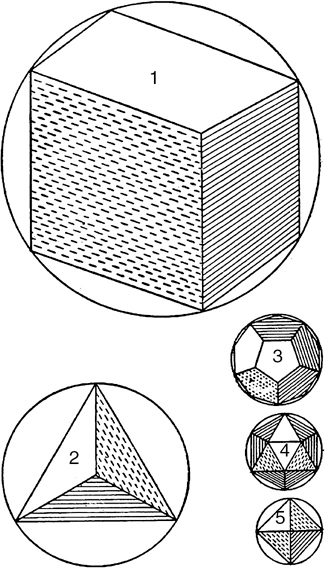
...
Show now what the place of the sphere of the Earth is among these figures.
The five bodies were distributed into two classes above: into those generated first, and those generated second. The former had a trilinear angle, and the latter a plurilinear. For as Adam was the first-born, and Eve was not his daughter but a part of him—and they are both called the first-made, but Cain and Abel and their sisters are their offspring; so the cube is in the first place, wherefrom have arisen, differently and more simply, the tetrahedronas it were a rib of the cube—and the dodecahedron, but in such a way that all three remain among the primary figures. The octahedron and the icosahedron, with their triangular planes, are as it were the offspring born of the cube and dodecahedron as fathers and from the tetrahedron as mother; and each of them bears a likeness to its parent.
So the three first figures of the same class had to enclose the circuit of the centre of the Earth and the two figures generated second, as the other class, should be enclosed by the sphere in which the Earth revolves, and so this sphere had to be made a boundary common to both orders, because the Earth, the home of the image of God, was going to be chief among the moving globes. For in this way the nature of being inscribed is kept in the second class and that of circumscribing in the first class. For it is more natural and more fitting that the octahedron should be inscribed in the cube, and the icosahedron in the dodecahedron, than the cube in the octahedron, and the dodecahedron in the icosahedron.
And so in this way the circuit of the centre of the Earth was placed in the middle between the planets; for three planets had to be placed outside, on account of the three primary figures; and two had to be placed inside its circuit on account of the two figures of the second class—to which the sun is added as a third in the inmost embrace of the centre of the mobile spheres. And so Saturn, Jupiter, and Mars were made the higher planets, and Venus, Mercury, and the sun, the lower. But the moon, which has a private movement around the Earth during the same common circuit of the Earth, is among the secondary planets, as was said above.
...
Part II
On the Movement of the Bodies of the World
1. How Many and of What Sort Are the Movements?
What was the opinion of Copernicus concerning the movement of bodies? For him, what was in motion and what was at rest?
There are two species of local movement: for either the whole thing turns, while remaining in its place, but with its parts succeeding one another. This movement can be called δινητις—lathe-movement, or cone-movement—from the resemblance; or rotation from a rotating pole. Or else the whole thing is borne from place to place circularly. The Greeks call this movement Φορα, the Latins circuitus, or circumlatio, or ambitus. But they call both movements generally revolution.
Accordingly Copernicus lays down that the sun is situated at the centre of the world and is motionless as a whole, viz., with respect to its centre and axis. Only a few years ago, however, we grasped by sense that the sun turns with respect to the parts of its body, i.e., around its centre and axis—as reasons had led me to assert for a long time—and with such great speed that one rotation is completed in the space of 25 or 26 days.
Now according as each of the primary bodies is nearer the sun, so it is borne around the sun in a shorter period, under the same common circle of the zodiac, and all in the same direction in which the parts of the solar body precede them—Mercury in the space of three months, Venus in seven and one-half months, the Earth with the lunar heaven in twelve months, Mars in twenty-two and one-half months or less than two years, Jupiter in twelve years, Saturn in thirty years. But for Copernicus the sphere of the fixed stars is utterly immobile.
The Earth meanwhile revolves around its own axis too, and the moon around the Earth—still in the same direction (if you look towards the outer parts of the world) as all the primary bodies.
Now for Copernicus all these movements are direct and continuous, and there are absolutely no stations or retrogradations in the truth of the matter.
...
How is the ratio of the periodic times, which you have assigned to the mobile bodies, related to the aforesaid ratio of the spheres wherein those bodies are borne?
The ratio of the times is not equal to the ratio of the spheres, but greater than it, and in the primary planets exactly the ratio of the 3/2th powers. That is to say, if you take the cube roots of the 30 years of Saturn and the 12 years of Jupiter and square them, the true ratio of the spheres of Saturn and Jupiter will exist in these squares. This is the case even if you compare spheres which are not next to one another. For example, Saturn takes 30 years; the Earth takes one year. The cube root of 30 is approximately 3.11. But the cube root of 1 is 1. The squares of these roots are 9.672 and 1. Therefore the sphere of Saturn is to the sphere of the Earth as 9,672 is to 1,000. And a more accurate number will be produced, if you take the times more accurately.
What is gathered from this?
Not all the planets are borne with the same speed, as Aristotle wished, otherwise their times would be as their spheres, and as their diameters; but, according as each planet is higher and farther away from the sun, so it traverses less space in one hour by its mean movement: Saturn—according to the magnitude of the solar sphere believed in by the ancients—traverses 240 German miles (in one hour), Jupiter 320 German miles, Mars 600, the centre of the Earth 740, Venus 800, and Mercury 1,200. And if this is to be according to the solar interval proved by me in the above, the number of miles must everywhere be tripled.
...
If there are no solid spheres, then there will seem to be all the more need of intelligences in order to regulate the movements of the heavens, although the intelligences are not gods. For they can be angels or some other rational creature, can they not?
There is no need of these intelligences, as will be proved; and it is not possible for the planetary globe to be carried around by an intelligence alone. For in the first place, mind is destitute of the animal power sufficient to cause movement, and it does not possess any motor force in its assent alone, and it cannot be heard or perceived by the irrational globe; and even if mind were perceived, the material globe would have no faculty of obeying or of moving itself. But before this, it has already been said that no animal force is sufficient for transporting the body from place to place, unless there are organs and some body which is at rest and on which the movement can take place. Therefore the question falls back to the above.
But on the contrary the natural powers which are implanted in the planetary bodies can enable the planet to be transported from place to place. But let it be posited as sufficient for movement that the intelligence should will movement into this or that region: then the discovery of the figure whereon the line of movement is ordered will be irrational. For we are convinced by the astronomical observations which have been taken correctly that the route of a planet is approximately circular and as a matter of fact eccentric—that is, the centre [of the circle] is not at the centre of the world or of some body; and furthermore that during the succession of ages the planet crosses from place to place. Now as many arguments can be drawn up against the discovery of such an orbit as there are parts of it already described.
For firstly, the orbit of the planet is not a perfect circle. But if mind caused the orbit, it would lay out the orbit in a perfect circle, which has beauty and perfection to the mind. On the contrary, the elliptic figure of the route of the planet and the laws of the movements whereby such a figure is caused smell of the nature of the balance or of material necessity rather than of the conception and determination of the mind, as will be shown below.
Finally, in order that we may grant that a different idea from that of a circle shines in the mind of the mover: it is asked by what means the mind can apply this or that [idea] to the regions of the world. Now the circle is described around some one fixed centre, but the ellipse, which is the figure of the planetary orbits, is described around two centres.
...
3. On the Revolution of the Solar Body Around Its Axis and Its Effect in the Movement of the Planets
By what reasons are you led to make the sun the moving cause or the source of movement for the planets?
1. Because it is apparent that in so far as any planet is more distant from the sun than the rest, it moves the more slowly—so that the ratio of the periodic times is the ratio of the 3/2th powers of the distances from the sun. Therefore we reason from this that the sun is the source of movement.
2. Below we shall hear the same thing come into use in the case of the single planets—so that the closer any one planet approaches the sun during any time, it is borne with an increase of velocity in exactly the ratio of the square.
3. Nor is the dignity or the fitness of the solar body opposed to this, because it is very beautiful and of a perfect roundness and is very great and is the source of light and heat, whence all life flows out into the vegetables: to such an extent that heat and light can be judged to be as it were certain instruments fitted to the sun for causing movement in the planets.
4. But in especial, all the estimates of probability are fulfilled by the sun’s rotation in its own space around its immobile axis, in the same direction in which all the planets proceed: and in a shorter period than Mercury, the nearest to the sun and fastest of all the planets. For as regards the fact that it is disclosed by the telescope in our time and can be seen every day that the solar body is covered with spots, which cross the disk of the sun or its lower hemisphere within 12 or 13 or 14 days, slowly at the beginning and at the end, but rapidly in the middle, which argues that they are stuck to the surface of the sun and turn with it; I proved in my Commentaries on Mars, Chapter 34, by reasons drawn from the very movement of the planets long before it was established by the sun-spots, that this movement necessarily; had to take place.
...
Then does the sun by the rotation of its body make the planets revolve? And how can this be since the sun is without hands with which it may lay hold of the planet, which is such a great distance away, and by rotating may make the planet revolve with itself?
Instead of hands there is the virtue of its body, which is emitted in straight lines throughout the whole amplitude of the world, and which—because it is a form of the body—rotates along with the solar body like a very rapid vortex; moving through the total amplitude of the circuit—whatever magnitude it reaches to—with equal speed; and the sun revolves m the narrowest space at the centre.
Could you make the thing clearer by some example?
Indeed there comes to our assistance the attraction between the loadstone and the iron pointer, which has been magnetized by the loadstone and which gets magnetic force by rubbing. Turn the loadstone in the neighbourhood of the pointer; the pointer will turn at the same time. Although the laying hold is of a different kind, nevertheless you see that not even here is there any bodily contact.
...
Finally by what arguments do you prove (4) that the centre of the sun, which is at the midpoint of the planetary spheres and bears their whole system—does not revolve in some annual movement, as Brahe wishes, but in accordance with Copernicus sticks immobile in one place, while the centre of the Earth revolves in an annual movement?
Even though the other necessarily follows from the demonstration of the one, nevertheless certain arguments pertain more closely to the sun and certain to the Earth; and certain others equally to both.
First on this side was the same argument whereby we just now claimed for the sun the midpoint of the spheres: namely, that the superfluous multitude of spheres and movements has been removed. For as it is much more probable that there should be some one system of spheres of the sun and that it should be common to the centre of the sun and to that node of the five spheres, according to Tycho Brahe than that we should believe according to Ptolemy that in any one of the five planets, over and above the spheres which have to do with their proper movements, there is present one whole system of spheres exactly like the sixth system of the sun; so also it is now much more probable that the centre of one Earth should revolve in an annual movement and the sun be at rest, according to Copernicus, than that, according to Brahe, this node of the five systems together with the spheres and planets themselves and the sun as a sixth should have the same annual movement besides the other movements which are proper to each. For even though Brahe removed from the true systems of the planets those five superfluous schemata of Ptolemy, which are like those of the sun, and reduced them to that common node of the systems, hid them, and melted them down into one; nevertheless he left in the world the very thing which was effected by those schemata: that any planet, over and above that movement which must really be granted to it, should be moved by the movement of the sun and should mix both into that one movement. And since there are no solid spheres, from this mixing there are caused in the expanse of the world very involved spirals. See the diagram of this involution in my Commentaries on Mars, folium 3.
Copernicus on the contrary by means of this one simple movement of the centre of the Earth stripped the five planets completely of this extrinsic movement of the sun, and made the centres of the six primary planets—that is, the Earth and the remaining five—each describe singly a simple and always similar orbit, or line very close to a circle, in the expanse of the world.
The second argument is from the movement in latitude. If epicycles revolve around an Earth at rest, either according to Ptolemy or according to Brahe; it will be necessary for those epicycles, especially those of the lower planets, in different ways to seek the sides as well as the head and feet, that is, to have a twofold libration. But with the Earth in motion, all the orbital circles have a constant inclination to the ecliptic. See Book v1, Part III where the latitudes of the lower planets supply us with a very clear argument for the movement of the Earth.
Thirdly, just as above, in the doctrine on the sphere, the diurnal revolution of the Earth being granted, the immense sphere of the fixed stars was freed from a diurnal movement of incalculable speed; so now, an annual movement being granted to this same Earth after the model of the other planets, we have ended that very slow movement of the fixed stars, which is called by Copernicus the precession of the equinoxes. See Book VII as regards these things. For it is much more believable to attribute them to the axis of the Earth, a very small body, than to such a great bulk.
Fourthly, the consideration of the ratios of the spheres wars on this side. For it is by no means probable that the centre of a great sphere should revolve in a small sphere. For the proper spheres of the three upper planets are much greater than the sphere of the sun—Saturn’s approximately ten times greater; Jupiter’s five times; Mars’ one and one half times. Therefore these five spheres are not carried around or dislocated from their position; but their centres remain approximately fixed, and, as a consequence, instead of this movement common to them and to the sun, the Earthrevolves.
The fifth argument, which is related to the preceding one, is the same as that whereby Brahe tried to disprove the solidity of the spheres. For if Brahe’s reasoning holds, as the orbit of Mars is one and one half times the orbit of the sun, so the body of Mars at fixed times returns to that point in the world’s expanse where the sun was at other times. And it is quite unbelievable that the regions which the primary planets pass through should be so jumbled together; since in Copernicus they are not only distinct, but are kept separate by very large intervals of emptiness.
I make the sixth argument similar to the fourth: from the magnitude of the movable bodies. For it is more believable that the body around which the smaller bodies revolve should be great. For just as Saturn, Jupiter, Mars, Venus, and Mercury are all smaller bodies than the solar body around which they revolve; so the moon is smaller than the Earth around which the moon revolves; so the four satellites of Jupiter are smaller than the body of Jupiter itself, around which they revolve. But if the sun moves, the sun which is the greatest, and the three higher planets which are all greater than the Earth, will revolve around the Earth which is smaller. Therefore it is more believable that the Earth, a small body, should revolve around the great body of the sun.
The seventh reason is drawn from the reasons for the intervals, which were unfolded above in the first part of this book. These reasons are disturbed and maimed, unless we grant to the Earth too its own sphere, which Copernicus gives to it between the spheres of Mars and of Venus. For even if the interval between Saturn and Jupiter could be deduced from the cube, that of Jupiter and Mars from the tetrahedron, and that of Venus and Mercury from the octahedron, even in Brahe’s ordering: yet there would still remain between Mars and Venus a single interval. But there remain two figures in the number of figures of the world. And the interval between Mars and Venus, which is in a greater ratio than double would not square with one of these figures, the dodecahedron or the icosahedron; nor could it be deduced from two figures, not even by the interposition of some sphere between them.
Eighthly, the same things are to be said concerning the harmony of the celestial movements, which are made up of the same numbers and proportions as our musical scale. And if you consider the excellence of the work or the pleasantness of contemplation, or finally the unavoidable force of the persuasion, this harmony can truly be called the soul and life of all astronomy. But this harmony is at last complete only if the Earth in its own place and rank among the planets strikes its own string and as it were sings its own note through a variation of a semitone: otherwise there would be no manifesting of its semitone, and that again is the soul of the song. As a matter of fact, if the semitone of the Earth is gone, there is destroyed from among the celestial movements the manifesting of the genera of song, i.e., the major and the minor modes, the most pleasant, most subtle, and most wonderful thing in this whole discussion. But concerning this in the Harmonies.
...
Part III
On the Real and True Irregularity of the Planets and Its Causes
...
2. On the Causes of Irregularity in Longitude
Then what causes do you bring forward as to why, although all the routes of the primary planets are arranged around the sun, nevertheless the angles—in which as if from the centre of the sun, the different parts of the route of one planet are viewed are not completed by the planet in proportional times?
Two causes concur, the one optical, the other physical, and each of almost equal effect. The first cause is that the route of the planet is not described around the sun at an equal distance everywhere; but one part of it is near the sun, and the opposite part is so much the farther away from the sun. But of equal things, the near are viewed at a greater angle, and the far away, at a smaller; and of those which are viewed at an equal angle, the near are smaller, and the far away are greater.
The other cause is that the planet is really slower at its greater distance from the sun, and faster at its lesser.
Therefore if the two causes are made into one, it is quite clear that of two arcs which are equal to sight, the greater time belongs to the arc which is greater in itself, and a much greater time on account of the real slowness of the planet in that farther arc.
But could not one cause suffice, so that, because generally the orbit of the planet draws as far away from the sun on one side as it draws near on the other, we might make such a great distance that all this apparent irregularity might be explained merely by this unequal distance of the parts of the orbit?
Observations do not allow us to make the inequality of the distances as great as the inequality of the time wherein the planet makes equal angles at the sun; but they bear witness that the inequality of the distances is sufficient to explain merely half of this irregularity: therefore the remainder comes from the real acceleration and slowing up of the planet.
...
What is the reason why the sun does not lay hold of the planet with equal strength from far away and from near-by?
The weakening of the form from the solar body is greater in a longer outflow than in a shorter; and although this weakening occurs in the ratio of the squares of the intervals, i.e., both in longitude and in latitude, nevertheless it works only in the simple ratio: the reasons have been stated above.
3. The Causes of the Irregularity in Altitude
But what pushes the planet out into more distant spaces and leads it back towards the sun?
The same which lays hold of the planet, the sun, namely, by means of the virtue of the form which has flowed out from its body throughout all the spaces of the world. For repulsion and attraction are as it were certain elements of this laying hold. For repulsion and attraction take place according to the lines of virtue going out from the centre of the sun; and since these lines revolve along with the sun, it is necessary for the planet too which is repelled and attracted to follow these lines in proportion to their strength in relation to the resistance of the planetary body. So the contrary movements of repulsion and attraction somehow compose this laying hold.
Do you attribute to the simple body of the sun and to its immaterial form the operations of attraction and repulsion which are contrary and so not simple?
The natural action or ενεργεια of moving the planetary body for the sake of assimilation or of bringing it back to its primal posture is one [in number]; but it seems to be diverse on account of the diversity of the object. For only in one region is the planetary body in concord with the solar body; in the other region it is discordant. But it belongs to the same simple work to embrace like things and to spit out unlike things. This opinion is strengthened by the case of magnets; for though they are not celestial bodies, nevertheless they do not have that biform virtue from the composition of elements but from a simple bodily form.
Therefore the planetary body itself will be composed of contrary parts?
No, indeed. For it follows only that the planetary globe has an inward configuration of straight lines or threads, like magnetic threads, which happen to be terminated in contrary regions; and in one of these regions, not on account of the body itself but on account of its posture in relation to the sun, there reigns friendship [familiaritas] with the sun; and in the other region, discord.
But isn’t it unbelievable that the celestial bodies should be certain huge magnets?
Then read the philosophy of magnetism of the Englishman William Gilbert; for in that book, although the author did not believe that the Earth moved among the stars, nevertheless he attributes a magnetic nature to it, by very many arguments, and he teaches that its magnetic threads or filaments extend in straight lines from south to north. Therefore it is by no means absurd or incredible that any one of the primary planets should be what one of the primary planets, namely the Earth, is.
Translated by Charles Glenn Wallis
Reading and Discussion Questions
1.What does Kepler seem to regard as his main goals and accomplishments? From this reading do you think that Kepler was expecting to be remembered primarily for what we call his “three laws of planetary motion” today?
2.What role do the five Platonic solids play in this reading? What importance does Kepler take magnetism to have?
3.What arguments does he provide for the view that the earth moves and that the sun stands still?
4.What are the three systems that he considers as models for the structure of the cosmos? Which system does he favor and why?