
37
THE SIDEREAL MESSENGER
UNFOLDING GREAT AND MARVELLOUS SIGHTS,
AND PROPOSING THEM TO THE ATTENTION OF EVERY ONE,
BUT ESPECIALLY PHILOSOPHERS AND ASTRONOMERS,
BEING SUCH AS HAVE BEEN OBSERVED BY
GALILEO GALILEI
A GENTLEMAN OF FLORENCE,
PROFESSOR OF MATHEMATICS IN THE UNIVERSITY OF PADUA,
WITH THE AID OF A
TELESCOPE
lately invented by him,
Respecting the Moon’s Surface, an innumerable number of Fixed Stars,
the Milky Way, and Nebulous Stars, but especially respecting
Four Planets which revolve round the Planet Jupiter at
different distances and in different periodic times, with
amazing velocity, and which, after remaining
unknown to every one up to this day, the
Author recently discovered, and
determined to name the
MEDICEAN STARS.
Venice 1610.
TO THE MOST SERENE
COSMO DE’ MEDICI, THE SECOND,
FOURTH GRAND-DUKE OF TUSCANY.
THERE is certainly something very noble and large-minded in the intention of those who have endeavoured to protect from envy the noble achievements of distinguished men, and to rescue their names, worthy of immortality, from oblivion and decay. This desire has given us the lineaments of famous men, sculptured in marble, or fashioned in bronze, as a memorial of them to future ages; to the same feeling we owe the erection of statues, both ordinary and equestrian; hence, as the poet says, has originated expenditure, mounting to the stars, upon columns and pyramids; with this desire, lastly, cities have been built, and distinguished by the names of those men, whom the gratitude of posterity thought worthy of being handed down to all ages. For the state of the human mind is such, that unless it be continually stirred by the counterparts of matters, obtruding themselves upon it from without, all recollection of the matters easily passes away from it.
But others, having regard for more stable and more lasting monuments, secured the eternity of the fame of great men by placing it under the protection, not of marble or bronze, but of the Muses’ guardianship and the imperishable monuments of literature. But why do I mention these things, as if human wit, content with these regions, did not dare to advance further; whereas, since she well understood that all human monuments do perish at last by violence, by weather, or by age, she took a wider view, and invented more imperishable signs, over which destroying Time and envious Age could claim no rights; so, betaking herself to the sky, she inscribed on the well-known orbs of the brightest stars—those everlasting orbs—the names of those who, for eminent and god-like deeds, were accounted worthy to enjoy an eternity in company with the stars. Wherefore the fame of Jupiter, Mars, Mercury, Hercules, and the rest of the heroes by whose names the stars are called, will not fade until the extinction of the splendour of the constellations themselves.
But this invention of human shrewdness, so particularly noble and admirable, has gone out of date ages ago, inasmuch as primeval heroes are in possession of those bright abodes, and keep them by a sort of right; into whose company the affection of Augustus in vain attempted to introduce Julius Cæsar; for when he wished that the name of the Julian constellation should be given to a star, which appeared in his time, one of those which the Greeks and the Latins alike name, from their hair-like tails, comets, it vanished in a short time and mocked his too eager hope. But we are able to read the heavens for your highness, most Serene Prince, far more truly and more happily, for scarcely have the immortal graces of your mind begun to shine on earth, when bright stars present themselves in the heavens, like tongues to tell and celebrate your most surpassing virtues to all time. Behold therefore, four stars reserved for your famous name, and those not belonging to the common and less conspicuous multitude of fixed stars, but in the bright ranks of the planets—four stars which, moving differently from each other, round the planet Jupiter, the most glorious of all the planets, as if they were his own children, accomplish the courses of their orbits with marvellous velocity, while all the while with one accord they complete all together mighty revolutions every ten years round the centre of the universe, that is, round the Sun.
But the Maker of the Stars himself seemed to direct me by clear reasons to assign these new planets to the famous name of your highness in preference to all others. For just as these stars, like children worthy of their sire, never leave the side of Jupiter by any appreciable distance, so who does not know that clemency, kindness of heart, gentleness of manners, splendour of royal blood, nobleness in public functions, wide extent of influence and power over others, all of which have fixed their common abode and seat in your highness,—who, I say, does not know that all these qualities, according to the providence of God, from whom all good things do come, emanate from the benign star of Jupiter? Jupiter, Jupiter, I maintain, at the instant of the birth of your highness having at length emerged from the turbid mists of the horizon, and being in possession of the middle quarter of the heavens, and illuminating the eastern angle, from his own royal house, from that exalted throne, looked out upon your most happy birth, and poured forth into a most pure atmosphere all the brightness of his majesty, in order that your tender body and your mind—though that was already adorned by God with still more splendid graces—might imbibe with your first breath the whole of that influence and power. But why should I use only plausible arguments when I can almost absolutely demonstrate my conclusion? It was the will of Almighty God that I should be judged by your most serene parents not unworthy to be employed in teaching your highness mathematics, which duty I discharged, during the four years just passed, at that time of the year when it is customary to take a relaxation from severer studies. Wherefore, since it evidently fell to my lot by God’s will, to serve your highness, and so to receive the rays of your surpassing clemency and beneficence in a position near your person, what wonder is it if you have so warmed my heart that it thinks about scarcely anything else day and night, but how I, who am indeed your subject not only by inclination, but also by my very birth and lineage, may be known to be most anxious for your glory, and most grateful to you? And so, inasmuch as under your patronage, most serene Cosmo, I have discovered these stars, which were unknown to all astronomers before me, I have, with very good right, determined to designate them with the most august name of your family. And as I was the first to investigate them, who can rightly blame me if I give them a name, and call them the Medicean Stars, hoping that as much consideration may accrue to these stars from this title, as other stars have brought to other heroes? For not to speak of your most serene ancestors, to whose everlasting glory the monuments of all history bear witness, your virtue alone, most mighty sire, can confer on those stars an immortal name; for who can doubt that you will not only maintain and preserve the expectations, high though they be, about yourself, which you have aroused by the very happy beginning of your government, but that you will also far surpass them, so that when you have conquered others like yourself, you may still vie with yourself, and become day by day greater than yourself and your greatness?
Accept, then, most clement Prince, this addition to the glory of your family, reserved by the stars for you; and may you enjoy for many years those good blessings, which are sent to you not so much from the stars as from God, the Maker and Governor of the stars.
Your Highness’s most devoted servant,
Galileo Galilei.
Padua, March 12, 1610.
THE ASTRONOMICAL MESSENGER
Containing and setting forth Observations lately made with the
aid of a newly invented Telescope respecting the Moon’s
Surface, the Milky Way, Nebulous Stars, an
innumerable multitude of Fixed Stars, and
also respecting Four Planets never before
seen, which have been named
THE COSMIAN STARS.
IN the present small treatise I set forth some matters of great interest for all observers of natural phenomena to look at and consider. They are of great interest, I think, first, from their intrinsic excellence; secondly, from their absolute novelty; and lastly, also on account of the instrument by the aid of which they have been presented to my apprehension.
The number of the Fixed Stars which observers have been able to see without artificial powers of sight up to this day can be counted. It is therefore decidedly a great feat to add to their number, and to set distinctly before the eyes other stars in myriads, which have never been seen before, and which surpass the old, previously known, stars in number more than ten times.
Again, it is a most beautiful and delightful sight to behold the body of the Moon, which is distant from us nearly sixty semi-diameters of the Earth, as near as if it was at a distance of only two of the same measures; so that the diameter of this same Moon appears about thirty times larger, its surface about nine hundred times, and its solid mass nearly 27,000 times larger than when it is viewed only with the naked eye; and consequently any one may know with the certainty that is due to the use of our senses, that the Moon certainly does not possess a smooth and polished surface, but one rough and uneven, and, just like the face of the Earth itself, is everywhere full of vast protuberances, deep chasms, and sinuosities.
Then to have got rid of disputes about the Galaxy or Milky Way, and to have made its nature clear to the very senses, not to say to the understanding, seems by no means a matter which ought to be considered of slight importance. In addition to this, to point out, as with one’s finger, the nature of those stars which every one of the astronomers up to this time has called nebulous, and to demonstrate that it is very different from what has hitherto been believed, will be pleasant, and very fine. But that which will excite the greatest astonishment by far, and which indeed especially moved me to call the attention of all astronomers and philosophers, is this, namely, that I have discovered four planets, neither known nor observed by any one of the astronomers before my time, which have their orbits round a certain bright star, one of those previously known, like Venus and Mercury round the Sun, and are sometimes in front of it, sometimes behind it, though they never depart from it beyond certain limits. All which facts were discovered and observed a few days ago by the help of a telescope devised by me, through God’s grace first enlightening my mind.
Perchance other discoveries still more excellent will be made from time to time by me or by other observers, with the assistance of a similar instrument, so I will first briefly record its shape and preparation, as well as the occasion of its being devised, and then I will give an account of the observations made by me.
About ten months ago a report reached my ears that a Dutchman had constructed a telescope, by the aid of which visible objects, although at a great distance from the eye of the observer, were seen distinctly as if near; and some proofs of its most wonderful performances were reported, which some gave credence to, but others contradicted. A few days after, I received confirmation of the report in a letter written from Paris by a noble Frenchman, Jaques Badovere, which finally determined me to give myself up first to inquire into the principle of the telescope, and then to consider the means by which I might compass the invention of a similar instrument, which a little while after I succeeded in doing, through deep study of the theory of Refraction; and I prepared a tube, at first of lead, in the ends of which I fitted two glass lenses, both plane on one side, but on the other side one spherically convex, and the other concave. Then bringing my eye to the concave lens I saw objects satisfactorily large and near, for they appeared one-third of the distance off and nine times larger than when they are seen with the natural eye alone. I shortly afterwards constructed another telescope with more nicety, which magnified objects more than sixty times. At length, by sparing neither labour nor expense, I succeeded in constructing for myself an instrument so superior that objects seen through it appear magnified nearly a thousand times, and more than thirty times nearer than if viewed by the natural powers of sight alone... .
Now let me review the observations made by me during the two months just past, again inviting the attention of all who are eager for true philosophy to the beginnings which led to the sight of most important phenomena.
The Moon: Ruggedness of its surface. Existence of lunar mountains and valleys. Let me speak first of the surface of the Moon, which is turned towards us. For the sake of being understood more easily, I distinguish two parts in it, which I call respectively the brighter and the darker. The brighter part seems to surround and pervade the whole hemisphere; but the darker part, like a sort of cloud, discolours the Moon’s surface and makes it appear covered with spots. Now these spots, as they are somewhat dark and of considerable size, are plain to every one, and every age has seen them, wherefore I shall call them great or ancient spots, to distinguish them from other spots, smaller in size, but so thickly scattered that they sprinkle the whole surface of the Moon, but especially the brighter portion of it. These spots have never been observed by any one before me; and from my observations of them, often repeated, I have been led to that opinion which I have expressed, namely, that I feel sure that the surface of the Moon is not perfectly smooth, free from inequalities and exactly spherical, as a large school of philosophers considers with regard to the Moon and the other heavenly bodies, but that, on the contrary, it is full of inequalities, uneven, full of hollows and protuberances, just like the surface of the Earth itself, which is varied everywhere by lofty mountains and deep valleys... .
And here I cannot refrain from mentioning what a remarkable spectacle I observed while the Moon was rapidly approaching her first quarter, a representation of which is given in the same illustration above. A protuberance of the shadow, of great size, indented the illuminated part in the neighbourhood of the lower cusp; and when I had observed this indentation longer, and had seen that it was dark throughout, at length, after about two hours, a bright peak began to arise a little below the middle of the depression; this by degrees increased, and presented a triangular shape, but was as yet quite detached and separated from the illuminated surface. Soon around it three other small points began to shine, until, when the Moon was just about to set, that triangular figure, having now extended and widened, began to be connected with the rest of the illuminated part, and, still girt with the three bright peaks already mentioned, suddenly burst into the indentation of shadow like a vast promontory of light... .

If one wishes to revive the old opinion of the Pythagoreans, that the Moon is another Earth, so to say, the brighter portion may very fitly represent the surface of the land, and the darker the expanse of water. Indeed, I have never doubted that if the sphere of the Earth were seen from a distance, when flooded with the Sun’s rays, that part of the surface which is land would present itself to view as brighter, and that which is water as darker in comparison. Moreover, the great spots in the Moon are seen to be more depressed than the brighter tracts; for in the Moon, both when crescent and when waning, on the boundary between the light and shadow, which projects in some places round the great spots, the adjacent regions are always brighter, as I have noticed in drawing my illustrations, and the edges of the spots referred to are not only more depressed than the brighter parts, but are more even, and are not broken by ridges or ruggednesses. But the brighter part stands out most near the spots, so that both before the first quarter and about the third quarter also, around a certain spot in the upper part of the figure, that is, occupying the northern region of the Moon, some vast prominences on the upper and lower sides of it rise to an enormous elevation, as the illustrations show. This same spot before the third quarter is seen to be walled round with boundaries of a deeper shade, which just like very lofty mountain summits appear darker on the side away from the Sun, and brighter on the side where they face the Sun; but in the case of the cavities the opposite happens, for the part of them away from the Sun appears brilliant, and that part which lies nearer to the Sun dark and in shadow. After a time, when the enlightened portion of the Moon’s surface has diminished in size, as soon as the whole or nearly so of the spot already mentioned is covered with shadow, the brighter ridges of the mountains mount high above the shade... .

Calculation to show that the height of some lunar mountains exceeds four Italian miles (22,000 British feet). I think that it has been sufficiently made clear, from the explanation of phenomena which have been given, that the brighter part of the Moon’s surface is dotted everywhere with protuberances and cavities; it only remains for me to speak about their size, and to show that the ruggednesses of the Earth’s surface are far smaller than those of the Moon’s; smaller, I mean, absolutely, so to say, and not only smaller in proportion to the size of the orbs on which they are. And this is plainly shown thus:—As I often observed in various positions of the Moon with reference to the Sun, that some summits within the portion of the Moon in shadow appeared illumined, although at some distance from the boundary of the light (the terminator), by comparing their distance with the complete diameter of the Moon, I learnt that it sometimes exceeded the one-twentieth (1/20th) part of the diameter. Suppose the distance to be exactly 1/20th part of the diameter, and let the diagram represent the Moon’s orb, of which C A F is a great circle, E its centre, and C Fa diameter, which consequently bears to the diameter of the Earth the ratio 2:7; and since the diameter of the Earth, according to the most exact observations, contains 7000 Italian miles, C F will be 2000, and C E 1000, and the 1/20th part of the whole, C F, 100 miles. Also let C F be a diameter of the great circle which divides the bright part of the Moon from the dark part (for, owing to the very great distance of the Sun from the Moon this circle does not differ sensibly from a great one), and let the distance of A from the point C be 1/20th part of that diameter; let the radius E A be drawn, and let it be produced to cut the tangent line G C D, which represents the ray that illumines the summit, in the point D. Then the arc C A or the straight line C D will be 100 of such units, as C E contains 1000. The sum of the squares of D C, C E is therefore 1,010,000, and the square of D E is equal to this; therefore the whole E D will be more than 1004; and A D will be more than 4 of such units, as C E contained 1000. Therefore the height of A D in the Moon, which represents a summit reaching up to the Sun’s ray, G C D, and separated from the extremity C by the distance C D, is more than 4 Italian miles; but in the Earth there are no mountains which reach to the perpendicular height even of one mile. We are therefore left to conclude that it is clear that the prominences of the Moon are loftier than those of the Earth... .
When the Moon, both before and after conjunction, is found not far from the Sun, not only does its orb show itself to our sight on the side where it is furnished with shining horns, but a slight and faint circumference is also seen to mark out the circle of the dark part, that part, namely, which is turned away from the Sun, and to separate it from the darker background of the sky. But if we examine the matter more closely, we shall see that not only is the extreme edge of the part in shadow shining with a faint brightness, but that the entire face of the Moon, that side, that is, which does not feel the Sun’s glare, is illuminated with a pale light of considerable brightness ... this tract of the Moon also, although deprived of sunlight, gleams with considerable light, and particularly so if the gloom of the night has already deepened through the absence of the Sun; for with a darker background the same light appears brighter ... .
This strange brightness has afforded no small perplexity to philosophical minds; and some have published one thing, some another, as the cause to be alleged for it ... Since, therefore, this kind of secondary brightness is not inherent and the Moon’s own, nor borrowed from any of the stars, nor from the Sun, and since there now remains in the whole universe no other body whatever except the Earth, what, pray, must we conclude? What must we assert? Shall we assert that the body of the Moon, or some other dark and sunless orb, receives light from the Earth? Why should it not be the Moon? And most certainly it is. The Earth, with fair and grateful exchange, pays back to the Moon an illumination like that which it receives from the Moon nearly the whole time during the darkest gloom of night.
Stars: Hitherto I have spoken of the observations which I have made concerning the Moon’s body; now I will briefly announce the phenomena which have been, as yet, seen by me with reference to the Fixed Stars. And first of all the following fact is worthy of consideration:—The stars, fixed as well as erratic, when seen with a telescope, by no means appear to be increased in magnitude in the same proportion as other objects, and the Moon herself, gain increase of size; but in the case of the stars such increase appears much less, so that you may consider that a telescope, which (for the sake of illustration) is powerful enough to magnify other objects a hundred times, will scarcely render the stars magnified four or five times. But the reason of this is as follows:—When stars are viewed with our natural eyesight they do not present themselves to us of their bare, real size, but beaming with a certain vividness, and fringed with sparkling rays, especially when the night is far advanced; and from this circumstance they appear much larger than they would if they were stripped of those adventitious fringes, for the angle which they subtend at the eye is determined not by the primary disc of the star, but by the brightness which so widely surrounds it. Perhaps you will understand this most clearly from the well-known circumstance that when stars rise just at sunset, in the beginning of twilight, they appear very small, although they may be stars of the first magnitude; and even the planet Venus itself, on any occasion when it may present itself to view in broad daylight, is so small to see that it scarcely seems to equal a star of the last magnitude. It is different in the case of other objects, and even of the Moon, which, whether viewed in the light of midday or in the depth of night, always appears of the same size. We conclude therefore that the stars are seen at midnight in uncurtailed glory, but their fringes are of such a nature that the daylight can cut them off, and not only daylight, but any slight cloud which may be interposed between a star and the eye of the observer. A dark veil or coloured glass has the same effect, for, upon placing them before the eye between it and the stars, all the blaze that surrounds them leaves them at once. A telescope also accomplishes the same result, for it removes from the stars their adventitious and accidental splendours before it enlarges their true discs (if indeed they are of that shape), and so they seem less magnified than other objects, for a star of the fifth or sixth magnitude seen through a telescope is shown as of the first magnitude only.
The difference between the appearance of the planets and the fixed stars seems also deserving of notice. The planets present their discs perfectly round, just as if described with a pair of compasses, and appear as so many little moons, completely illuminated and of a globular shape; but the fixed stars do not look to the naked eye bounded by a circular circumference, but rather like blazes of light, shooting out beams on all sides and very sparkling, and with a telescope they appear of the same shape as when they are viewed by simply looking at them, but so much larger that a star of the fifth or sixth magnitude seems to equal Sirius, the largest of all the fixed stars.
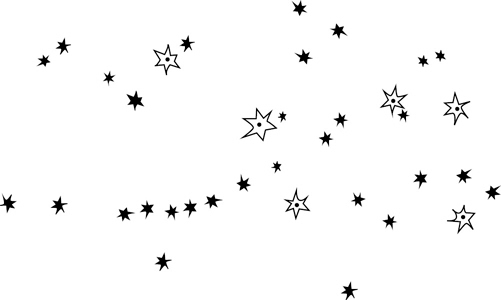
Orion’s Belt and Sword; 83 Stars
Pleiades; 36 Stars
Telescopic Stars: As my first example I had determined to depict the entire constellation of Orion, but I was overwhelmed by the vast quantity of stars and by want of time, and so I have deferred attempting this to another occasion, for there are adjacent to, or scattered among, the old stars more than five hundred new stars within the limits of one or two degrees. For this reason I have selected the three stars in Orion’s Belt and the six in his Sword, which have been long well-known groups, and I have added eighty other stars recently discovered in their vicinity, and I have preserved as exactly as possible the intervals between them. The well-known or old stars, for the sake of distinction, I have depicted of larger size, and I have outlined them with a double line; the others, invisible to the naked eye, I have marked smaller and with one line only. I have also preserved the differences of magnitude as much as I could... .
Nebulæ resolved into clusters of stars: And whereas that milky brightness, like the brightness of a white cloud, is not only to be seen in the Milky Way, but several spots of a similar colour shine faintly here and there in the heavens, if you turn the telescope upon any of them you will find a cluster of stars packed close together. Further—and you will be more surprised at this,—the stars which have been called by every one of the astronomers up to this day nebulous, are groups of small stars set thick together in a wonderful way, and although each one of them on account of its smallness, or its immense distance from us, escapes our sight, from the commingling of their rays there arises that brightness which has hitherto been believed to be the denser part of the heavens, able to reflect the rays of the stars or the Sun.
Discovery of Jupiter’s satellites, Jan. 7, 1610: I have now finished my brief account of the observations which I have thus far made with regard to the Moon, the Fixed Stars, and the Galaxy. There remains the matter, which seems to me to deserve to be considered the most important in this work, namely, that I should disclose and publish to the world the occasion of discovering and observing four PLANETS, never seen from the very beginning of the world up to our own times, their positions, and the observations made during the last two months about their movements and their changes of magnitude; and I summon all astronomers to apply themselves to examine and determine their periodic times, which it has not been permitted me to achieve up to this day, owing to the restriction of my time. I give them warning however again, so that they may not approach such an inquiry to no purpose, that they will want a very accurate telescope, and such as I have described in the beginning of this account.
On the 7th day of January in the present year, 1610, in the first hour of the following night, when I was viewing the constellations of the heavens through a telescope, the planet Jupiter presented itself to my view, and as I had prepared for myself a very excellent instrument, I noticed a circumstance which I had never been able to notice before, owing to want of power in my other telescope, namely, that three little stars, small but very bright, were near the planet; and although I believed them to belong to the number of the fixed stars, yet they made me somewhat wonder, because they seemed to be arranged exactly in a straight line, parallel to the ecliptic, and to be brighter than the rest of the stars, equal to them in magnitude. The position of them with reference to one another and to Jupiter was as follows:

On the east side there were two stars, and a single one towards the west. The star which was furthest towards the east, and the western star, appeared rather larger than the third.
I scarcely troubled at all about the distance between them and Jupiter, for, as I have already said, at first I believed them to be fixed stars; but when on January 8th, led by some fatality, I turned again to look at the same part of the heavens, I found a very different state of things, for there were three little stars all west of Jupiter, and nearer together than on the previous night, and they were separated from one another by equal intervals, as the accompanying illustration shows.
At this point, although I had not turned my thoughts at all upon the approximation of the stars to one another, yet my surprise began to be excited, how Jupiter could one day be found to the east of all the aforesaid fixed stars when the day before it had been west of two of them; and forthwith I became afraid lest the planet might have moved differently from the calculation of astronomers, and so had passed those stars by its own proper motion. I therefore waited for the next night with the most intense longing, but I was disappointed of my hope, for the sky was covered with clouds in every direction.
But on January 10th the stars appeared in the following position with regard to Jupiter; there were two only, and both on the east side of Jupiter, the third, as I thought, being hidden by the planet. They were situated just as before, exactly in the same straight line with Jupiter, and along the Zodiac.
When I had seen these phenomena, as I knew that corresponding changes of position could not by any means belong to Jupiter, and as, moreover, I perceived that the stars which I saw had been always the same, for there were no others either in front or behind, within a great distance, along the Zodiac,—at length, changing from doubt into surprise, I discovered that the interchange of position which I saw belonged not to Jupiter, but to the stars to which my attention had been drawn, and I thought therefore that they ought to be observed henceforward with more attention and precision.
Accordingly, on January 11th I saw an arrangement of the following kind, namely, only two stars to the east of Jupiter, the nearer of which was distant from Jupiter three times as far as from the star further to the east; and the star furthest to the east was nearly twice as large as the other one; whereas on the previous night they had appeared nearly of equal magnitude. I therefore concluded, and decided unhesitatingly, that there are three stars in the heavens moving about Jupiter, as Venus and Mercury round the Sun; which at length was established as clear as daylight by numerous other subsequent observations. These observations also established that there are not only three, but four, erratic sidereal bodies performing their revolutions round Jupiter, observations of whose changes of position made with more exactness on succeeding nights the following account will supply. I have measured also the intervals between them with the telescope in the manner already explained. Besides this, I have given the times of observation, especially when several were made in the same night, for the revolutions of these planets are so swift that an observer may generally get differences of position every hour.
Jan. 12.—At the first hour of the next night I saw these heavenly bodies arranged in this manner: The satellite furthest to the east was greater than the satellite furthest to the west; but both were very conspicuous and bright; the distance of each one from Jupiter was two minutes. A third satellite, certainly not in view before, began to appear at the third hour; it nearly touched Jupiter on the east side, and was exceedingly small. They were all arranged in the same straight line, along the ecliptic.
Jan. 13.—For the first time four satellites were in view in the following position with regard to Jupiter ... .1
These are my observations upon the four Medicean planets, recently discovered for the first time by me; and although it is not yet permitted me to deduce by calculation from these observations the orbits of these bodies, yet I may be allowed to make some statements, based upon them, well worthy of attention... . Besides, we have a notable and splendid argument to remove the scruples of those who can tolerate the revolution of the planets round the Sun in the Copernican system, yet are so disturbed by the motion of one Moon about the Earth, while both accomplish an orbit of a year’s length about the Sun, that they consider that this theory of the constitution of the universe must be upset as impossible; for now we have not one planet only revolving about another, while both traverse a vast orbit about the Sun, but our sense of sight presents to us four satellites circling about Jupiter, like the Moon about the Earth, while the whole system travels over a mighty orbit about the Sun in the space of twelve years.
Translated by Edward Stafford Carlos Rivingtons
Reading and Discussion Questions
1.What are some of the most important observations Galileo makes through his telescope? Do the telescopic observations provide any evidence for his heliocentric views?
2.What has Galileo discovered that he is calling the “Medician stars”? What reasons does he give for his choice of name, and what does this suggest about the relationship between astronomy and astrology in this period?
1There are two months of detailed observations like this, with accompanying images that follow – ed.