
Part VI
78
Prefatory Remarks
As we are about to discuss the motion, action, and use of the heart and arteries, it is imperative on us first to state what has been thought of these things by others in their writings, and what has been held by the vulgar and by tradition, in order that what is true may be confirmed, and what is false set right by dissection, multiplied experience, and accurate observation ... .
But I should like to be informed why, if the pulmonary vein were destined for the conveyance of air, it has the structure of a blood-vessel here. Nature had rather need of annular tubes, such as those of the bronchi in order that they might always remain open, and not be liable to collapse; and that they might continue entirely free from blood, lest the liquid should interfere with the passage of the air, as it so obviously does when the lungs labour from being either greatly oppressed or loaded in a less degree with phlegm, as they are when the breathing is performed with a sibilous or rattling noise.
Still less is that opinion to be tolerated which, as a two-fold material, one aerial, one sanguineous, is required for the composition of vital spirits, supposes the blood to ooze through the septum of the heart from the right to the left ventricle by certain hidden porosities, and the air to be attracted from the lungs through the great vessel, the pulmonary vein; and which, consequently, will have it, that there are numerous porosities in the septum of the heart adapted for the transmission of the blood. But by Hercules! no such pores can be demonstrated, nor in fact do any such exist. For the septum of the heart is of a denser and more compact structure than any portion of the body, except the bones and sinews. But even supposing that there were foramina or pores in this situation, how could one of the ventricles extract anything from the other—the left, e.g., obtain blood from the right, when we see that both ventricles contract and dilate simultaneously?
...
Chapter I: The Author’s Motives for Writing
When I first gave my mind to vivisections, as a means of discovering the motions and uses of the heart, and sought to discover these from actual inspection, and not from the writings of others, I found the task so truly arduous, so full of difficulties, that I was almost tempted to think, with Fracastorius, that the motion of the heart was only to be comprehended by God. For I could neither rightly perceive at first when the systole and when the diastole took place, nor when and where dilatation and contraction occurred, by reason of the rapidity of the motion, which in many animals is accomplished in the twinkling of an eye, coming and going like a flash of lightning; so that the systole presented itself to me now from this point, now from that; the diastole the same; and then everything was reversed, the motions occurring, as it seemed, variously and confusedly together. My mind was therefore greatly unsettled nor did I know what I should myself conclude, nor what believe from others ... .
At length, by using greater and daily diligence and investigation, making frequent inspection of many and various animals, and collating numerous observations, I thought that I had attained to the truth, that I should extricate myself and escape from this labyrinth, and that I had discovered what I so much desired, both the motion and the use of the heart and arteries. From that time I have not hesitated to expose my views upon these subjects, not only in private to my friends, but also in public, in my anatomical lectures, after the manner of the Academy of old.
...
Chapter II: On the Motions of the Heart, as Seen in the Dissection of Living Animals
In the first place, then, when the chest of a living animal is laid open and the capsule that immediately surrounds the heart is slit up or removed, the organ is seen now to move, now to be at rest; there is a time when it moves, and a time when it is motionless.
These things are more obvious in the colder animals, such as toads, frogs, serpents, small fishes, crabs, shrimps, snails, and shellfish. They also become more distinct in warm-blooded animals, such as the dog and hog, if they be attentively noted when the heart begins to flag, to move more slowly, and, as it were, to die: the movements then become slower and rarer, the pauses longer, by which it is made much more easy to perceive and unravel what the motions really are, and how they are performed. In the pause, as in death, the heart is soft, flaccid, exhausted, lying, as it were, at rest.
In the motion, and interval in which this is accomplished, three principal circumstances are to be noted:
1.That the heart is erected, and rises upwards to a point, so that at this time it strikes against the breast and the pulse is felt externally.
2.That it is everywhere contracted, but more especially towards the sides so that it looks narrower, relatively longer, more drawn together. The heart of an eel taken out of the body of the animal and placed upon the table or the hand, shows these particulars; but the same things are manifest in the hearts of all small fishes and of those colder animals where the organ is more conical or elongated.
3.The heart being grasped in the hand, is felt to become harder during its action. Now this hardness proceeds from tension, precisely as when the forearm is grasped, its tendons are perceived to become tense and resilient when the fingers are moved.
4.It may further be observed in fishes, and the colder blooded animals, such as frogs, serpents, etc., that the heart, when it moves, becomes of a paler color, when quiescent of a deeper blood-red color.
From these particulars it appears evident to me that the motion of the heart consists in a certain universal tension—both contraction in the line of its fibres, and constriction in every sense. It becomes erect, hard, and of diminished size during its action; the motion is plainly of the same nature as that of the muscles when they contract in the line of their sinews and fibres; for the muscles, when in action, acquire vigor and tenseness, and from soft become hard, prominent, and thickened: and in the same manner the heart.
We are therefore authorized to conclude that the heart, at the moment of its action, is at once constricted on all sides, rendered thicker in its parietes and smaller in its ventricles, and so made apt to project or expel its charge of blood. This, indeed, is made sufficiently manifest by the preceding fourth observation in which we have seen that the heart, by squeezing out the blood that it contains, becomes paler, and then when it sinks into repose and the ventricle is filled anew with blood, that the deeper crimson colour returns. But no one need remain in doubt of the fact, for if the ventricle be pierced the blood will be seen to be forcibly projected outwards upon each motion or pulsation when the heart is tense.
These things, therefore, happen together or at the same instant: the tension of the heart, the pulse of its apex, which is felt externally by its striking against the chest, the thickening of its parietes, and the forcible expulsion of the blood it contains by the constriction of its ventricles.
Hence the very opposite of the opinions commonly received appears to be true; inasmuch as it is generally believed that when the heart strikes the breast and the pulse is felt without, the heart is dilated in its ventricles and is filled with blood; but the contrary of this is the fact, and the heart, when it contracts (and the impulse of the apex is conveyed through the chest wall), is emptied. Whence the motion which is generally regarded as the diastole of the heart, is in truth its systole. And in like manner the intrinsic motion of the heart is not the diastole but the systole; neither is it in the diastole that the heart grows firm and tense, but in the systole, for then only, when tense, is it moved and made vigorous.
...
Neither is it true, as vulgarly believed, that the heart by any dilatation or motion of its own, has the power of drawing the blood into the ventricles; for when it acts and becomes tense, the blood is expelled; when it relaxes and sinks together it receives the blood in the manner and wise whichwill by-and-by be explained.
...
Chapter V. Of the Motion, Action and Office of the Heart
From these and other observations of a similar nature, I am persuaded it will be found that the motion of the heart is as follows:
First of all, the auricle contracts, and in the course of its contraction forces the blood (which it contains in ample quantity as the head of the veins, the store-house and cistern of the blood) into the ventricle, which, being filled, the heart raises itself straightway, makes all its fibres tense, contracts the ventricles, and performs a beat, by which beat it immediately sends the blood supplied to it by the auricle into the arteries. The right ventricle sends its charge into the lungs by the vessel which is called vena arteriosa, but which in structure and function, and all other respects, is an artery. The left ventricle sends its charge into the aorta, and through this by the arteries to the body at large.
These two motions, one of the ventricles, the other of the auricles, take place consecutively, but in such a manner that there is a kind of harmony or rhythm preserved between them, the two concurring in such wise that but one motion is apparent, especially in the warmer blooded animals, in which the movements in question are rapid. Nor is this for any other reason than it is in a piece of machinery, in which, though one wheel gives motion to another, yet all the wheels seem to move simultaneously; or in that mechanical contrivance which is adapted to firearms, where, the trigger being touched, down comes the flint, strikes against the steel, elicits a spark, which falling among the powder, ignites it, when the flame extends, enters the barrel, causes the explosion, propels the ball, and the mark is attained—all of which incidents, by reason of the celerity with which they happen, seem to take place in the twinkling of an eye ... .
The motion of the heart, then, is entirely of this description, and the one action of the heart is the transmission of the blood and its distribution, by means of the arteries, to the very extremities of the body; so that the pulse which we feel in the arteries is nothing more than the impulse of the blood derived from the heart.
Whether or not the heart, besides propelling the blood, giving it motion locally, and distributing it to the body, adds anything else to it—heat, spirit, perfection,—must be inquired into by-and-by, and decided upon other grounds. So much may suffice at this time, when it is shown that by the action of the heart the blood is transfused through the ventricles from the veins to the arteries, and distributed by them to all parts of the body.
... The grand cause of doubt and error in this subject appears to me to have been the intimate connexion between the heart and the lungs. When men saw both the pulmonary artery and the pulmonary veins losing themselves in the lungs, of course it became a puzzle to them to know how or by what means the right ventricle should distribute the blood to the body, or the left draw it from the venæ cavæ... .
Had anatomists only been as conversant with the dissection of the lower animals as they are with that of the human body, the matters that have hitherto kept them in a perplexity of doubt would, in my opinion, have met them freed from every kind of difficulty.
...
And first, in fishes, in which the heart consists of but a single ventricle, being devoid of lungs, the thing is sufficiently manifest. Here the sac, which is situated at the base of the heart, and is the part analogous to the auricle in man, plainly forces the blood into the heart, and the heart, in its turn, conspicuously transmits it by a pipe or artery, or vessel analogous to an artery; these are facts which are confirmed by simple ocular inspection, as well as by a division of the vessel, when the blood is seen to be projected by each pulsation of the heart.
The same thing is also not difficult of demonstration in those animals that have, as it were, no more than a single ventricle to the heart, such as toads, frogs, serpents, and lizards, which have lungs in a certain sense, as they have a voice. I have many observations by me on the admirable structure of the lungs of these animals, and matters appertaining, which, however, I cannot introduce in this place. Their anatomy plainly shows us that the blood is transferred in them from the veins to the arteries in the same manner as in higher animals, viz., by the action of the heart; the way, in fact, is patent, open, manifest; there is no difficulty, no room for doubt about it; for in them the matter stands precisely as it would in man were the septum of his heart perforated or removed, or one ventricle made out of two; and this being the case, I imagine that no one will doubt as to the way by which the blood may pass from the veins into the arteries.
...
Chapter VIII. Of the Quantity of Blood Passing Through the Heart from the Veins to the Arteries; and of the Circular Motion of the Blood
... Doctrine once sown strikes deep its root, and respect for antiquity influences all men. Still the die is cast, and my trust is in my love of truth and the candour of cultivated minds. And sooth to say, when I surveyed my mass of evidence, whether derived from vivisections, and my various reflections on them, or from the study of the ventricles of the heart and the vessels that enter into and issue from them, the symmetry and size of these conduits—for nature doing nothing in vain, would never have given them so large a relative size without a purpose—or from observing thearrangement and intimate structure of the valves in particular, and of the other parts of the heart in general, with many things besides, I frequently and seriously bethought me, and long revolved in my mind, what might be the quantity of blood which was transmitted, in how short a time its passage might be effected, and the like. But not finding it possible that this could be supplied by the juices of the ingested aliment without the veins on the one hand becoming drained, and the arteries on the other getting ruptured through the excessive charge of blood, unless the blood should somehow find its way from the arteries into the veins, and so return to the right side of the heart, I began to think whether there might not be a MOTION, AS IT WERE, IN A CIRCLE. Now, this I afterwards found to be true; and I finally saw that the blood, forced by the action of the left ventricle into the arteries, was distributed to the body at large, and its several parts, in the same manner as it is sent through the lungs, impelled by the right ventricle into the pulmonary artery, and that it then passed through the veins and along the vena cava, and so round to the left ventricle in the manner already indicated. This motion we may be allowed to call circular, in the same way as Aristotle says that the air and the rain emulate the circular motion of the superior bodies; for the moist earth, warmed by the sun, evaporates; the vapours drawn upwards are condensed, and descending in the form of rain, moisten the earth again. By this arrangement are generations of living things produced; and in like manner are tempests and meteors engendered by the circular motion, and by the approach and recession of the sun.
And similarly does it come to pass in the body, through the motion of the blood, that the various parts are nourished, cherished, quickened by the warmer, more perfect, vaporous, spirituous, and, as I may say, alimentive blood; which, on the other hand, owing to its contact with these parts, becomes cooled, coagulated, and so to speak effete. It then returns to its sovereign, the heart, as if to its source, or to the inmost home of the body, there to recover its state of excellence or perfection. Here it renews its fluidity, natural heat, and becomes powerful, fervid, a kind of treasury of life, and impregnated with spirits, it might be said with balsam. Thence it is again dispersed. All this depends on the motion and action of the heart.
The heart, consequently, is the beginning of life; the sun of the microcosm, even as the sun in his turn might well be designated the heart of the world; for it is the heart by whose virtue and pulse the blood is moved, perfected, and made nutrient, and is preserved from corruption and coagulation; it is the household divinity which, discharging its function, nourishes, cherishes, quickens the whole body, and is indeed the foundation of life, the source of all action. But of these things we shall speak more opportunely when we come to speculate upon the final cause of this motion of the heart.
As the blood-vessels, therefore, are the canals and agents that transport the blood, they are of two kinds, the cava and the aorta; and this not by reason of there being two sides of the body, as Aristotle has it, but because of the difference of office, not, as is commonly said, in consequence of any diversity of structure, for in many animals, as I have said, the vein does not differ from the artery in the thickness of its walls, but solely in virtue of their distinct functions and uses. A vein and an artery, both styled veins by the ancients, and that not without reason, as Galen has remarked, for the artery is the vessel which carries the blood from the heart to the body at large, the vein of the present day bringing it back from the general system to the heart; the former is the conduit from, the latter the channel to, the heart; the latter contains the cruder, effete blood, rendered unfit for nutrition; the former transmits the digested, perfect, peculiarly nutritive fluid.
Chapter IX. That There Is a Circulation of the Blood Is Confirmed from the First Proposition
...
Let us assume, either arbitrarily or from experiment, the quantity of blood which the left ventricle of the heart will contain when distended, to be, say, two ounces, three ounces, or one ounce and a half—in the dead body I have found it to hold upwards of two ounces. Let us assume further how much less the heart will hold in the contracted than in the dilated state; and how much blood it will project into the aorta upon each contraction; and all the world allows that with the systole something is always projected, a necessary consequence demonstrated in the third chapter, and obvious from the structure of the valves; and let us suppose as approaching the truth that the fourth, or fifth, or sixth, or even but the eighth part of its charge is thrown into the artery at each contraction; this would give either half an ounce, or three drachms, or one drachm of blood as propelled by the heart at each pulse into the aorta; which quantity, by reason of the valves at the root of the vessel, can by no means return into the ventricle. Now, in the course of half an hour, the heart will have made more than one thousand beats, in some as many as two, three, and even four thousand. Multiplying the number of drachms propelled by the number of pulses, we shall have either one thousand half ounces, or one thousand times three drachms, or a like proportional quantity of blood, according to the amount which we assume as propelled with each stroke of the heart, sent from this organ into the artery—a larger quantity in every case than is contained in the whole body! ...
Upon this supposition, therefore, assumed merely as a ground for reasoning, we see the whole mass of blood passing through the heart, from the veins to the arteries, and in like manner through the lungs.
...
This truth, indeed, presents itself obviously before us when we consider what happens in the dissection of living animals; the great artery need not be divided, but a very small branch only (as Galen even proves in regard to man), to have the whole of the blood in the body, as well that of the veins as of the arteries, drained away in the course of no long time—some half-hour or less. Butchers are well aware of the fact and can bear witness to it; for, cutting the throat of an ox and so dividing the vessels of the neck, in less than a quarter of an hour they have all the vessels bloodless—the whole mass of blood has escaped. The same thing also occasionally occurs with great rapidity in performing amputations and removing tumors in the human subject.
...
Chapter XIII. The Third Position Is Confirmed: And the Circulation of the Blood Is Demonstrated from It
The celebrated Hieronymus Fabricius of Aquapendente, a most skilful anatomist, and venerable old man, or, as the learned Riolan will have it, Jacobus Silvius, first gave representations of the valves in the veins, which consist of raised or loose portions of the inner membranes of these vessels, of extreme delicacy, and a sigmoid or semilunar shape. They are situated at different distances from one another, and diversely in different individuals; they are connate at the sides of the veins; they are directed upwards towards the trunks of the veins; the two—for there are for the most part two together—regard each other, mutually touch, and are so ready to come into contact by their edges, that if anything attempts to pass from the trunks into the branches of the veins, or from the greater vessels into the less, they completely prevent it; they are farther so arranged, that the horns of those that succeed are opposite the middle of the convexity of those that precede, and so on alternately.
The discoverer of these valves did not rightly understand their use, nor have succeeding anatomists added anything to our knowledge: for their office is by no means explained when we are told that it is to hinder the blood, by its weight, from all flowing into inferior parts; for the edges of the valves in the jugular veins hang downwards, and are so contrived that they prevent the blood from rising upwards; the valves, in a word, do not invariably look upwards, but always toward the trunks of the veins, invariably towards the seat of the heart. I, and indeed others, have sometimes found valves in the emulgent veins, and in those of the mesentery, the edges of which were directed towards the vena cava and vena portæ ... .
But the valves are solely made and instituted lest the blood should pass from the greater into the lesser veins, and either rupture them or cause them to become varicose; lest, instead of advancing from the extreme to the central parts of the body, the blood should rather proceed along the veins from the centre to the extremities; but the delicate valves, while they readily open in the right direction, entirely prevent all such contrary motion, being so situated and arranged, that if anything escapes, or is less perfectly obstructed by the cornua of the one above, the fluid passing, as it were, by the chinks between the cornua, it is immediately received on the convexity of the one beneath, which is placed transversely with reference to the former, and so is effectually hindered from getting any farther.
And this I have frequently experienced in my dissections of the veins: if I attempted to pass a probe from the trunk of the veins into one of the smaller branches, whatever care I took I found it impossible to introduce it far any way, by reason of the valves; whilst, on the contrary, it was most easy to push it along in the opposite direction, from without inwards, or from the branches towards the trunks and roots. In many places two valves are so placed and fitted, that when raised they come exactly together in the middle of the vein, and are there united by the contact of their margins; and so accurate is the adaptation, that neither by the eye nor by any other means of examination, can the slightest chink along the line of contact be perceived. But if the probe be now introduced from the extreme towards the more central parts, the valves, like the floodgates of a river, give way, and are most readily pushed aside. The effect of this arrangement plainly is to prevent all motion of the blood from the heart and vena cava, whether it be upwards towards the head, or downwards towards the feet, or to either side towards the arms, not a drop can pass; all motion of the blood, beginning in the larger and tending towards the smaller veins, is opposed and resisted by them; whilst the motion that proceeds from the lesser to end in the larger branches is favoured, or, at all events, a free and open passage is left for it.
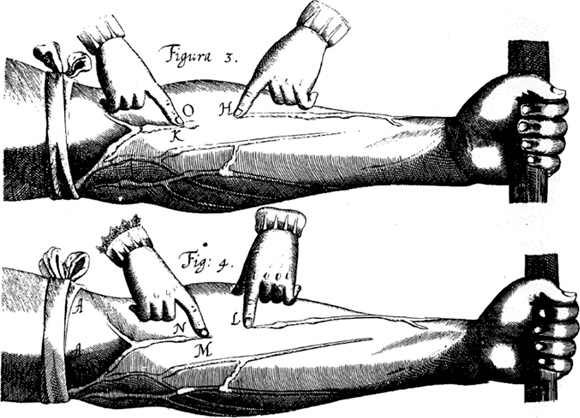
But that this truth may be made the more apparent, let an arm be tied up above the elbow as if for phlebotomy (A, A, fig. 1). At intervals in the course of the veins, especially in labouring people and those whose veins are large, certain knots or elevations (B, C, D, E, F) will be perceived, and this not only at the places where a branch is received (E, F), but also where none enters (C, D): these knots or risings are all formed by valves, which thus show themselves externally. And now if you press the blood from the space above one of the valves, from H to O, (fig. 2,) and keep the point of a finger upon the vein inferiorly, you will see no influx of blood from above; the portion of the vein between the point of the finger and the valve O will be obliterated; yet will the vessel continue sufficiently distended above the valve (O, G). The blood being thus pressed out and the vein emptied, if you now apply a finger of the other hand upon the distended part of the vein above the valve O, (fig. 3,) and press downwards, you will find that you cannot force the blood through or beyond the valve; but the greater effort you use, you will only see the portion of vein that is between the finger and the valve become more distended, that portion of the vein which is below the valve remaining all the while empty (H, O, fig. 3).
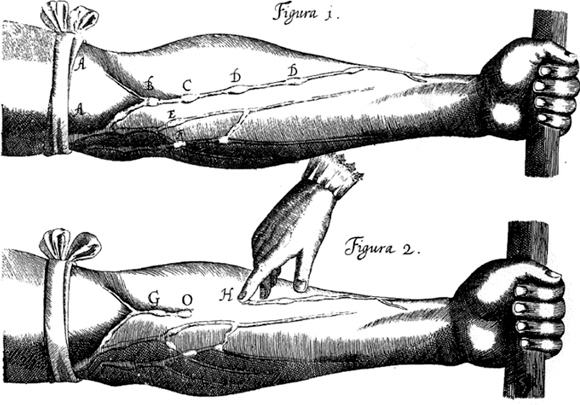
It would therefore appear that the function of the valves in the veins is the same as that of the three sigmoid valves which we find at the commencement of the aorta and pulmonary artery, viz., to prevent all reflux of the blood that is passing over them.
Farther, the arm being bound as before, and the veins looking full and distended, if you press at one part in the course of a vein with the point of a finger (L, fig. 4), and then with another finger streak the blood upwards beyond the next valve (N), you will perceive that this portion of the vein continues empty (L. N), and that the blood cannot retrograde, precisely as we have already seen the case to be in fig. 2; but the finger first applied (H, fig. 2, L, fig. 4), being removed, immediately the vein is filled from below, and the arm becomes as it appears at D C, fig. 1. That the blood in the veins therefore proceeds from inferior or more remote parts, and towards the heart, moving in these vessels in this and not in the contrary direction, appears most obviously. And although in some places the valves, by not acting with such perfect accuracy, or where there is but a single valve, do not seem totally to prevent the passage of the blood from the centre, still the greater number of them plainly do so; and then, where things appear contrived more negligently, this is compensated either by the more frequent occurrence or more perfect action of the succeeding valves, or in some other way: the veins in short, as they are the free and open conduits of the blood returning to the heart, so are they effectually prevented from serving as its channels of distribution from the heart.
But this other circumstance has to be noted: The arm being bound, and the veins made turgid, and the valves prominent, as before, apply the thumb or finger over a vein in the situation of one of the valves in such a way as to compress it, and prevent any blood from passing upwards from the hand; then, with a finger of the other hand, streak the blood in the vein upwards till it has passed the next valve above (N, fig. 4), the vessel now remains empty; but the finger at L being removed for an instant, the vein is immediately filled from below; apply the finger again, and having in the same manner streaked the blood upwards, again remove the finger below, and again the vessel becomes distended as before; and this repeat, say a thousand times, in a short space of time. And now compute the quantity of blood which you have thus pressed up beyond the valve, and then multiplying the assumed quantity by one thousand, you will find that so much blood has passed through a certain portion of the vessel; and I do now believe that you will find yourself convinced of the circulation of the blood, and of its rapid motion. But if in this experiment you say that a violence is done to nature, I do not doubt but that, if you proceed in the same way, only taking as great a length of vein as possible, and merely remark with what rapidity the blood flows upwards, and fills the vessel from below, you will come to the same conclusion.
Translated by Robert Willis
Reading and Discussion Questions
1.Harvey acknowledges that the analysis of the motions of the heart is a terribly difficult project. What makes the motion of the heart so hard to observe and analyze? What experimental subjects and methods does Harvey employ to make his investigations possible?
2.On what two grounds does Harvey argue that the blood must be circulating, and not constantly being both produced and consumed in the body? What is the importance of valves in the second argument?
3.Is Harvey a mechanist about biology, like Descartes, or does he evidence a more Aristotelian approach?