
79
These men will be comprised like ourselves of a soul and a body. First, it is necessary that I describe for you the body in itself, then afterward the soul in itself, and finally that I show you how these two natures would have to be joined and united in order to comprise some men who resemble us.
I make the supposition that the body is nothing else but a statue or earthen machine, that God has willed to form entire, in order to make it as similar to us as is possible. Thus he not only would have given it the external color and shape of our members, but also he put in the interior all the parts which are required to make it walk, eat, respire, and that it imitate, in the end, all of our functions which can be imagined to proceed from matter alone, and depend only on the disposition of the organs.
We see clocks, artificial fountains, mills, and other similar machines, which, being only made by men, nevertheless do not lack the force to move themselves in several diverse means. And it seems to me that I could not imagine as many kinds of movements in the latter as I suppose to be made by the hand of God, nor attribute to him only so much craftsmanship as we could think of.
Now I will not stop to describe to you the bones, nerves, muscles, veins, arteries, stomach, liver, spleen, heart and brain, nor all the other diverse parts of which this statue must be comprised. I assume these to be entirely similar to the parts of our body which bear the same name, and that could be shown to us by some learned anatomist, at least those large enough to be seen, if you do not already know them sufficiently from yourselves. Those which on account of their minuteness are invisible, I will be more easily and more clearly be able to make these known to you in speaking of the motions which depend on them. Thus there is only the need here to explicate these motions in order, [and] by the same means tell you that they are the same as those functions of ours they represent.
First off, the foodstuffs are digested in the stomach of this machine, by the force of specific fluids, which glide between their particles, separate them, agitate them, and heat them, just like ordinary water does to quicklime, or acid does to metals. Furthermore, as these liquids are brought very quickly to the heart by the arteries, as I will speak later on, they must be very hot. And even the foodstuffs are ordinarily such that they can be broken down and heated by their own power, just like new hay in a barn, if it is shut up before it is dry.
Know as well that the agitation that the little particles of these foodstuffs receive in being heated, conjoined to that of the stomach and bowels which contain them, and by the disposition of the small fibers which compose the intestines, cause them to descend little by little toward the orifice by which the most coarse of these must be exited, in the degree to which they are digested. However, the most subtle and active particles encounter here and there an infinity of small holes, by which they pass into the network of a great vein [renal portal vein] which carries them to the liver, and into other veins which carry them elsewhere. There is, in addition to this, nothing else which separates the smallest from the largest particles except these holes, just as when one shakes meal in a sack the purest part escapes, and only the smallness of the holes prevents the bran from following.
These most subtle particles of the foodstuffs, being unequal and still imperfectly mixed together, comprise a fluid [chyle] which would remain turbulent and whitish, except that a part of it is mixed immediately with the mass of the blood contained in the ramifications of the Portal vein, which receives this liquid from the intestines, and passes into the ramifications of the Vena Cava, which conducts it toward the heart, and into the liver, as if in a single vessel.
Likewise, it should be noted here that the pores of the liver are so disposed that when this fluid enters into it, it is refined, elaborated, given its color, and acquires the form of blood, just as the juice of black grapes, which is white, is converted into red wine when it is allowed to ferment on the vine.
Now the blood thereby contained in the veins has only one distinct passage by which it can leave them, namely that which conducts it into the concavity of the right heart [i.e., right ventricle]. And one knows that the flesh of the heart contains in its pores one of those lightless fires of which I have spoken above. This makes the heart so hot and fiery, that in proportion to the entrance of the blood into one of the two chambers or concavities which compose it, it is quickly expanded and dilated there, just as you could show by experience what would happen to the blood or milk of some animal if you pour it drop by drop into a very hot flask. And the fire which is in the heart of the machine I am describing serves only to dilate, heat and subtilize the blood in this way, which falls continually, drop by drop, by a passage from the vena cava, into the right cavity, from which it is exhaled into the lung. And from the pulmonary vein, which the anatomists have named the venous artery, it flows into the other cavity, from which it is distributed to all the body.
The flesh of the lung is so rarified and soft, and at all times so refreshed by respired air, that in proportion as the vapors of the blood leave the right cavity of the heart and enter the lung by the artery named by the anatomists the arterial vein [i.e., pulmonary vein], they are there thickened and converted into the blood once again. Then from there the blood falls drop by drop into the left cavity of the heart. If they were to enter without being thus thickened once again, the blood would not serve sufficiently to nourish the fire which is there.
Thus you see that respiration, which only functions in this machine to thicken these vapors, is no less necessary for the maintenance of this fire, than it is for the conservation of life in ourselves, at least in independent human beings, since in the fetus still in the womb cannot draw in fresh air by respiration, and there are two conduits which supply this defect. By one, the blood [in the fetus] from the vena cava passes into the venous artery [i.e. the pulmonary artery via the foramen ovale], and by the other, the vapors or rarefied blood from the arterial vein are exhaled and move into the Great Artery [aorta]. For the animals which have no lung, they have only a single cavity in the heart, or if they have several, they are all in a consecutive series to one another.
The pulse, or beating of the arteries, depends on eleven little membranes [i.e. mitral, tricuspid and semi-lunar valves], which like little doors, close and open the entrances of the four vessels which open upon the two cavities of the heart. At the moment one of these beats ends, and another is almost beginning, the little doors at the entrance of the two arteries are found to be precisely closed, and those at the openings of the two veins are open. Necessarily, two discharges of blood fall immediately from these two veins into each cavity of the heart. Then by their rarefication and expansion suddenly into a greater space than they previously occupied, press and close the little doors at the entrance of the two veins, by this means preventing further descent of blood into the heart, while pressing and opening those of the two arteries. Into these they enter quickly and with force, causing the inflation of the heart and all the arteries at the same moment. But immediately afterward, the rarified blood is condensed once again, or penetrates other parts of the body. Thus the heart and arteries are deflated, the little doors at the entrances of the two arteries are closed, and those at the opening of the two veins are reopened, admitting two other discharges of blood, which once again cause the inflation of the heart and arteries in the same way as the preceding.
Thus knowing the cause of the pulse, it is easy to understand that it isn’t so much the blood contained in the veins of this machine, and that freshly coming from the liver, which attaches itself to various parts, and repairs what their continual action, and the diverse activities of the other bodies which surround them detach from them, but that blood which is contained in its arteries, and already distilled in its heart. Because the blood which is in the veins always flows, little by little, from the extremities toward the heart. Furthermore, the arrangement of specific little doors or small valves, that anatomists have noticed in several places along our veins, must sufficiently persuade us that the same thing happens in ourselves. On the other hand, that which is in the arteries is pushed out of the heart with force, in separate little thrusts, toward the extremities of the arteries. Hence, it can be joined and united to all the members, and thereby maintain them, or even cause them to grow, if this [model] is to represent the body of a man arranged in this way.
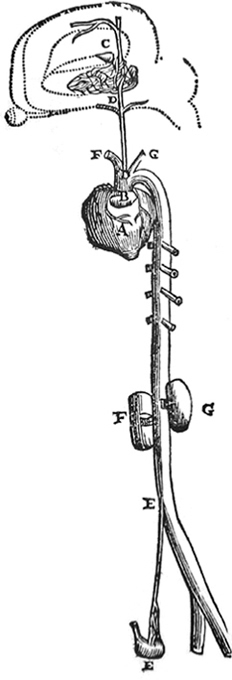
Descartes’ figure inserted into the 1664 edition showing relation of heart, brain, kidney and reproductive system.
At the moment that the arteries are inflated, the small particles of the blood that they contain here and there strike the roots of certain small filaments which then move from the extremities of the small branches of these arteries to comprise the bone, flesh, skin, nerves, brain, and all the remainder of the solid parts, according to the diverse means by which they are joined together or interlaced. Thus these particles have the power to push these filaments gradually ahead, and push them into their proper place. Then, at the moment that the arteries deflate, each of these particles stops at the point it is at, and by this means alone is joined and united to those parts it touches, according to what has just been said.
But what must primarily be observed is that all the most rapid, forceful and most subtle particles of the blood are transmitted into the cavity of the brain, inasmuch as the arteries which carry them there [carotids] are those which are most in a right line from the heart, and as you know, all bodies which are moved tend, as much as possible, to continue their motion in a right line.
Observe, for example [in the preceding figure] the heart “A,” and consider that when the blood leaves it with force by the opening “B,” all of its particles tend toward “C,” the cavities of the brain. But the vessel being restricted in size and unable to carry all of them, the most weakly impelled are deflected by the stronger, which by this means are alone moved there.
You should also note in passing that after those particles which enter the brain, there are none stronger or more active than those which go to the reproductive parts. For example, if those which have sufficient force to reach “D” cannot move further to “C,” because there is not enough room for them, they return preferably toward “E,” rather than toward “F” and “G” [i.e. the kidneys], because the route to “E” is more direct. In consequence of this, I could possibly have you see how one could form a new machine, entirely similar to the first, by the way in which the humor assembles at “E.” However, I cannot say more on this matter.
As for those particles of the blood which penetrate up to the brain, they function not only to nourish it and enter its substance, but more primarily to produce there a certain very wind, or rather a very lively and pure flame, that one terms the animal spirits. It is necessary to understand that the arteries which bring the blood from the heart, after being divided into an infinity of small branches and composing the fine tissues which are extended like tapestries at the base of the ventricles of the brain, are reassembled around a specific little gland, situated near the middle of the substance of the brain [the pineal gland], just at the entrance of its ventricles. At this place are a great number of small openings, by means of which the most subtle particles of the blood contained in the arteries can flow into this gland. But the arteries are so narrow that they allow no passage to the grosser particles.
It is also necessary to know that the arteries do not terminate at that point, but with several combined into one, they extend upward in a right line, then enter the great blood vessel which, like Euripos, bathes the entire superficial exterior of the brain [see “H” on diagram]. Furthermore, it is necessary to notice grossest particles of the blood can lose much of their motion in the windings of the fine tissues through which they pass. In the same proportion, they have the force to push the smaller particles among these, and thus transfer some of their motion to them. But the smaller particles cannot transfer their motion in the same way, inasmuch as their motion is increased by that transferred from the largest particles, and there are no other bodies around them to which they could as easily transfer it.
Whence it is easy to conceive that when the coarsest mount in a right line toward the superficial exterior of the brain, from whence they serve to nourish its substance, they cause the smallest and most agitated particles to be deflected, and all of them enter the [pineal] gland, which must be imagined as an overflowing spring, from which they flow simultaneously on all sides into the ventricles of the brain. Thus, without any further preparation or changes, except the separation of these from the coarser particles, but retaining the extreme velocity that has been given them by the heat of the heart, they cease to have the form of blood particles, and are called the animal spirits.
Now, to the degree that these animal spirits thus enter into the ventricles of the brain, they pass from there into the pores in the brain substance, and from these pores into the nerves. And according as they enter, or tend to enter, one or the other of these, they have the power to alter the shape of the muscles into which these nerves are inserted, and by this means make the members move, just as you may have seen in the grottos and fountains of our King, in which the simple force imparted to the water in leaving the fountain is sufficient for the motions of different machines, even making them play musical instruments, or speak words according to the diverse disposition of the tubes conducting the water.
In truth, one can make a strong comparison between the nerves of the machine I am describing to you and the tubes in these water-machines. Also, this holds for the other diverse machinery and springs which serve to move the water machine, and the muscles and tendons of the other, and also for the animal spirits and the driving water, with the heart as the fountain, and the ventricles of the brain the water main. Furthermore, respiration and other such natural and ordinary actions, which depend on the flow of the spirits, are like the movements of a clock or mill that the flow of water can render continuous. External objects, which by their presence alone, act upon the sense organs of this machine, and by this means force it to move in several different ways, are like intruders into one of these fountain grottoes, cause without thought the movements which are made in their presence. Because they cannot enter except by walking upon certain tiles, specially placed, so that, for example, if they approach the Bathing Diana, they will cause her to hide in the reeds. And if they attempt to pursue her, they will cause Neptune to move toward them, menacing them with his Trident. If they move to some other side, a marine monster will arise, who will spit water on their face, or something similar, all according to the skill of the investors who have made the statues.
Finally, when the rational soul is put in this machine, it will have its principal location in the brain, and will be there like a fountain director, who must be in the fountain-house from which emerge all the tubes of these machines into which the water is directed when one wishes to excite, inhibit or in some manner change their motions.
...
[In conclusion], I would like you to reflect, after the preceding, on how all the functions that I have attributed to this machine, such as the digestion of food, the beating of the heart and arteries, the nutrition and growth of the members, respiration, waking and sleep, reception of light, sound, smell, taste, heat and such qualities by the external sense organs, the impression of these sensory ideas on the organ of common sense and imagination [i.e. the pineal gland], and the retention or imprinting of these ideas in the memory, occur. Similarly, reflect on the internal motions of the appetites and passions, and finally on the external motions of all the members, which follow with reference both to the objects presented to the senses, and to the passions and impressions contained in the memory, which are imitated as closely as possible those of a true man. Thus, I say, when you reflect on how these functions follow completely naturally in this machine solely from the disposition of the organs, no more nor less than those of a clock or other automaton from its counterweights and wheels, then it is not necessary to conceive on this account any other vegetative soul, nor sensitive one, nor any other principle of motion and life, than its blood and animal spirits, agitated by the heat of the continually burning fire in the heart, and which is of the same nature as those fires found in inanimate bodies.
Translated by P. R. Sloan
Reading and Discussion Questions
1.To what kinds of machines does Descartes compare the body and various parts of the body? Can you think of examples of similar kinds of comparisons between the body and machines that you have encountered in contemporary science?
2.What role do “animal spirits” and the pineal gland play in Cartesian physiology?
3.Why does he think we can dispose of the concepts of vegetative and sensitive souls?