
80
The Preface
It is the great prerogative of Mankind above other Creatures, that we are not only able to behold the works of Nature, or barely to sustain our lives by them, but we have also the power of considering, comparing, altering, assisting, and improving them to various uses. And as this is the peculiar privilege of human Nature in general, so is it capable of being so far advanced by the helps of Art, and Experience, as to make some Men excel others in their Observations, and Deductions, almost as much as they do Beasts. By the addition of such artificial Instruments and methods, there may be, in some manner, a reparation made for the mischiefs, and imperfection, mankind has drawn upon itself, by negligence, and intemperance, and a willful and superstitious deserting the Prescripts and Rules of Nature, whereby every man, both from a derived corruption, innate and born with him, and from his breeding and converse with men, is very subject to slip into all sorts of errors.
The only way which now remains for us to recover some degree of those former perfections, seems to be, by rectifying the operations of the Sense, the Memory, and Reason, since upon the evidence, the strength, the integrity, and the right correspondence of all these, all the light, by which our actions are to be guided is to be renewed, and all our command over things it to be established.
It is therefore most worthy of our consideration, to recollect their several defects, that so we may the better understand how to supply them, and by what assistances we may enlarge their power, and secure them in performing their particular duties.
As for the actions of our Senses, we cannot but observe them to be in many particulars much outdone by those of other Creatures, and when at best, to be far short of the perfection they seem capable of: And these infirmities of the Senses arise from a double cause, either from the disproportion of the Object to the Organ, whereby an infinite number of things can never enter into them, or else from error in the Perception, that many things, which come within their reach, are not received in a right manner.
The like frailties are to be found in the Memory; we often let many things slip away from us, which deserve to be retained, and of those which we treasure up, a great part is either frivolous or false; and if good, and substantial, either in tract of time obliterated, or at best so overwhelmed and buried under more frothy notions, that when there is need of them, they are in vain sought for.
The two main foundations being so deceivable, it is no wonder, that all the succeeding works which we build upon them, of arguing, concluding, defining, judging, and all the other degrees of Reason, are liable to the same imperfection, being, at best, either vain, or uncertain: So that the errors of the understanding are answerable to the two other, being defective both in the quantity and goodness of its knowledge; for the limits, to which our thoughts are confined, are small in respect of the vast extent of Nature itself; some parts of it are too large to be comprehended, and some too little to be perceived. And from thence it must follow, that not having a full sensation of the Object, we must be very lame and imperfect in our conceptions about it, and in all the proportions which we build upon it; hence, we often take the shadow of things for the substance, small appearances for good similitudes, similitudes for definitions; and even many of those, which we think, to be the most solid definitions, are rather expressions of our own misguided apprehensions then of the true nature of the things themselves.
The effects of these imperfections are manifested in different ways, according to the temper and disposition of the several minds of men, some they incline to gross ignorance and stupidity, and others to a presumptuous imposing on other men’s Opinions, and a confident dogmatizing on matters, whereof there is no assurance to be given.
Thus all the uncertainty, and mistakes of humane actions, proceed either from the narrowness and wandering of our Senses, from the slipperiness or delusion of our Memory, from the confinement or rashness of our Understanding, so that ‘tis no wonder, that our power over natural causes and effects is so slowly improved, seeing we are not only to contend with the obscurity and difficulty of the things whereon we work and think, but even the forces of our own minds conspire to betray us.
These being the dangers in the process of humane Reason, the remedies of them all can only proceed from the real, the mechanical, the experimental Philosophy, which has this advantage over the Philosophy of discourse and disputation, that whereas that chiefly aims at the subtlety of its Deductions and Conclusions, without much regard to the first ground-work, which ought to be well laid on the Sense and Memory; so this intends the right ordering of them all, and the making them serviceable to each other.
The first thing to be undertaken in this weighty work, is a watchfulness over the failings and an enlargement of the dominion, of the Senses.
To which end it is requisite, first, that there should be a scrupulous choice, and a strict examination, of the reality, constancy, and certainty of the Particulars that we admit: This is the first rise whereon truth is to begin, and here the most severe, and most impartial diligence, must be employed; the storing up of all, without any regard to evidence or use, will only tend to darkness and confusion. We must not therefore esteem the riches of our Philosophical treasure by the number only, but chiefly by the weight; the most vulgar Instances are not to be neglected, but above all, the most instructive are to be entertained; the footsteps of Nature are to be traced, not only in her ordinary course, but when she seems to be put to her shifts, to make many doublings and turnings, and to use some kind of art in endeavoring to avoid our discovery.
The next care to be taken, in respect of the Senses, is a supplying of their infirmities with Instruments, and, as it were, the adding of artificial Organs to the natural; this in one of them has been of late years accomplished with prodigious benefit to all sorts of useful knowledge, by the invention of Optical Glasses. By the means of Telescopes, there is nothing so far distant but may be represented to our view; and by the help of Microscopes, there is nothing so small, as to escape our inquiry; hence there is a new visible World discovered to the understanding. By this means the Heavens are opened, and a vast number of new Stars, and new Motions, and new Productions appear in them, to which all the ancient Astronomers were utterly Strangers. By this the Earth itself, which lies so near us, under our feet, shews quite a new thing to us, and in every little particle of its matter; we now behold almost as great a variety of Creatures, as we were able before to reckon up in the whole Universe itself.
It seems not improbable, but that by these helps the subtlety of the composition of Bodies, the structure of their parts, the various texture of their matter, the instruments and manner of their inward motions, and all the other possible appearances of things, may come to be more fully discovered; all which the ancient Peripateticks were content to comprehend in two general and (unless further explained) useless words of Matter and Form. From whence there may arise many admirable advantages, towards the increase of the Operative, and the Mechanic Knowledge, to which this Age seems so much inclined, because we may perhaps be enabled to discern all the secret workings of Nature, almost in the same manner as we do those that are the productions of Art, and are managed by Wheels, and Engines, and Springs, that were devised by humane Wit.
In this kind I here present to the World my imperfect Endeavors; which though they shall prove no other way considerable, yet, I hope, they may be in some measure useful to the main Design of a reformation in Philosophy, if it be only by shewing, that there is not so much required towards it, any strength of Imagination, or exactness of Method, or depth of Contemplation (though the addition of these, where they can be had, must needs produce a much more perfect composure) as a sincere Hand, and a faithful Eye, to examine, and to record, the things themselves as they appear.
And I beg my Reader, to let me take the boldness to assure him, that in this present condition of knowledge, a man so qualified, as I have endeavored to be, only with resolution, and integrity, and plain intentions of employing his Senses aright, may venture to compare the reality and the usefulness of his services, towards the true Philosophy, with those of other men, that are of much stronger, and more acute speculations, that shall not make use of the same method by the Senses.
The truth is, the Science of Nature has been already too long made only a work of the Brain and the Fancy: It is now high time that it should return to the plainness and soundness of Observations on material and obvious things. It is said of great Empires, that the best way to preserve them from decay, is to bring them back to the first Principles, and Arts, on which they did begin. The same is undoubtedly true in Philosophy, that by wandering far away into invisible Notions, has almost quite destroyed itself, and it can never be recovered, or continued, but by returning into the same sensible paths, in which it did at first proceed.
If therefore the Reader expects from me any infallible Deductions, or certainty of Axioms, I am to say for myself, that those stronger Works of Wit and Imagination are above my weak Abilities; or if they had not been so, I would not have made use of them in this present Subject before me: Whenever he finds that I have ventured at any small Conjectures, at the causes of the things that I have observed, I beseech him to look, upon them only as doubtful Problems, and uncertain guesses, and not as unquestionable Conclusions, or matters of unconfutable Science; I have produced nothing here, with intent to bind his understanding to an implicit consent; I am so far from that, that I desire him, not absolutely to rely upon these Observations of my eyes, if he finds them contradicted by the future Ocular Experiments of other and impartial Discoverers.
As for my part, I have obtained my end, if these my small Labours shall be thought fit to take up some place in the large stock, of natural Observations, which so many hands are busy in providing. If I have contributed the meanest foundations whereon others may raise nobler Superstructures, I am abundantly satisfied; and all my ambition is, that I may serve to the great Philosophers of this Age, as the makers and the grinders of my Glasses did to me; that I may prepare and furnish them with some Materials, which they may afterwards order and manage withbetter skill, and to far greater advantage ... .
...
If once this method were followed with diligence and attention, there is nothing that lies within the power of human Wit (or which is far more effectual) of human Industry, which we might not compass; we might not only hope for Inventions to equalize those of Copernicus, Galileo, Gilbert, Harvy, and of others, whose Names are almost lost, that were the Inventors of Gun-powder, the Seamans Compass, Printing, Etching, Graving, Microscopes, &c. but multitudes that may far exceed them: for even those discoveries seem to have been the products of some such method, though but imperfect; What may not be therefore expected from it if thoroughly prosecuted? Talking and contention of Arguments would soon be turned into labours; all the fine dreams of Opinions, and universal metaphysical natures, which the luxury of subtle Brains has devised, would quickly vanish, and give place to solid Histories, Experiments and Works. And as at first, mankind fell by tasting of the forbidden Tree of Knowledge, so we, their Posterity, may be in part restored by the same way, not only by beholding and contemplating, but by tasting too those fruits of Natural knowledge, that were never yet forbidden.
From hence the World may be assisted with variety of Inventions, new matter for Sciences may be collected, the old improved, and their rust rubbed away; and as it is by the benefit of Senses that we receive all our Skill in the works of Nature, so they also may be wonderfully benefited by it, and may be guided to an easier and more exact performance of their Offices; ‘tis not unlikely, but that we may find out wherein our Senses are deficient, and as easily find ways of repairing them....
Micrographia, or Some Physiological Descriptions of Minute Bodies, Made by Magnifying Glasses; with Observations and Inquiries Thereupon
Observ. I. Of the Point of a Sharp Small Needle.
As in Geometry, the most natural way of beginning is from a Mathematical point; so is the same method in Observations and Natural history the most genuine, simple, and instructive. We must first endeavor to make letters, and draw single strokes true, before we venture to write whole Sentences, or to draw large Pictures. And in Physical Enquiries, we must endeavor to follow Nature in the more plain and easy ways she treads in the most simple and uncompounded bodies, to trace her steps, and be acquainted with her manner of walking there, before we venture ourselves into the multitude of meanders she has in bodies of a more complicated nature; lest, being unable to distinguish and judge of our way, we quickly lose both Nature our Guide, and our selves too, and are left to wander in the labyrinth of groundless opinions; wanting both judgment, that light, and experience, that clew, which should direct our proceedings.
We will begin these our Inquiries therefore with the Observations of Bodies of the most simple nature first, and so gradually proceed to those of a more compounded one. In prosecution of which method, we shall begin with a Physical point; of which kind the Point of a Needle is commonly reckoned for one; and is indeed, for the most part, made so sharp, that the naked eye cannot distinguish any parts of it: It very easily pierces, and makes its way through all kind of bodies softer then itself: But if viewed with a very good Microscope, we may find that the top of a Needle (though as to the sense very sharp) appears abroad, blunt, and very irregular end; not resembling a Cone, as is imagined, but only a piece of a tapering body, with a great part of the top removed, or deficient. The Points of Pins are yet more blunt, and the Points of the most curious Mathematical Instruments do very seldom arrive at so great a sharpness; how much therefore can be built upon demonstrations made only by the productions of the Ruler and Compasses, he will be better able to consider that shall but view those points and lines with a Microscope.
Now though this point be commonly accounted the sharpest (whence when we would express the sharpness of a point the most superlatively, we say, As sharp as a Needle) yet the Microscope can afford us hundreds of Instances of Points many thousand times sharper: such as those of the hairs, and bristles, and claws of multitudes of Insects; the thorns, or crooks, or hairs of leaves, and other small vegetables; nay, the ends of the stiriæ or small parallelipipeds of Amianthus, and alumen plumosum; of many of which, though the Points are so sharp as not to be visible, though viewed with a Microscope (which magnifies the Object, in bulk, above a million of times) yet I doubt not, but were we able practically to make Microscopes according to the theory of them, we might find hills, and dales, and pores, and a sufficient breadth, or expansion, to give all those parts elbow-room, even in the blunt top of the very Point of any of these so very sharp bodies. For certainly the quantity or extension of anybody may be Divisible in infinitum, though perhaps not the matter.
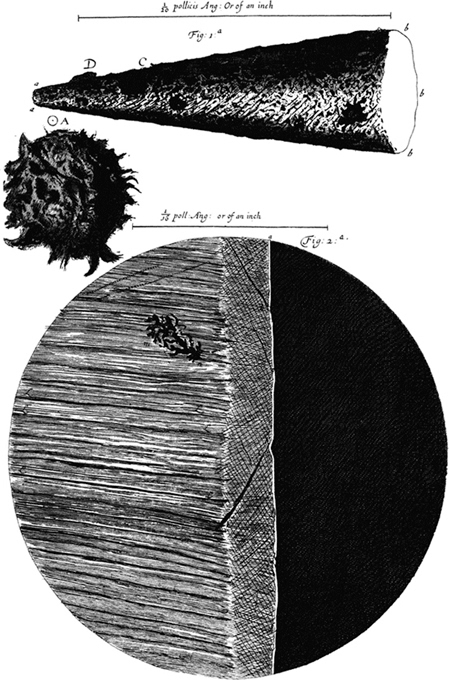
But to proceed: The Image we have here exhibited in the first Figure, was the top of a small and very sharp Needle, whose point aa nevertheless appeared through the Microscope above a quarter of an inch broad, not round nor flat, but irregular and uneven; so that it seemed to have been big enough to have afforded a hundred armed Mites room enough to be ranged by each other without endangering the breaking one another’s necks, by being thrust off on either side. The surface of which, though appearing to the naked eye very smooth, could not nevertheless hide a multitude of holes and scratches and ruggednesses from being discovered by the Microscope to invest it, several of which inequalities (as A, B, C, seemed holes made by some small specks of Rust; and D some adventitious body, that stuck very close to it) were casual. All the rest that roughen the surface, were only so many marks of the rudeness and bungling of Art. So unaccurate is it, in all its productions, even in those which seem most neat, that if examined with an organ more acute then that by which they were made, the more we see of their shape, the less appearance will there be of their beauty: whereas in the works of Nature, the deepest Discoveries shew us the greatest Excellencies. An evident Argument, that he that was the Author of all these things, was no other than Omnipotent; being able to include as great a variety of parts and contrivances in the yet smallest Discernable Point, as in those vaster bodies (which comparatively are called also Points) such as the Earth, Sun, or Planets. Nor need it seem strange that the Earth itself may be by Analogy called a Physical Point: For as its body, though now so near us as to fill our eyes and fancies with a sense of the vastness of it, may by a little Distance, and some convenient Diminishing Glasses, be made vanish into a scarce visible Speck, or Point (as I have often tried on the Moon, and (when not too bright) on the Sun it self.) So, could a Mechanical contrivance successfully answer our Theory, we might see the least spot as big as the Earth itself; and Discover, as Descartes also conjectures (Diop. ch. 10. § 9.), as great a variety of bodies in the Moon, or Planets, as in the Earth.
Observ. XVIII. Of the Schematisme or Texture of Cork, and of the Cells and Pores of Some Other such Frothy Bodies.
I took a good clear piece of Cork, and with a Pen-knife sharpened as keen as a Razor, I cut a piece of it off, and thereby left the surface of it exceeding smooth, then examining it very diligently with a Microscope, me thought I could perceive it to appear a little porous; but I could not so plainly distinguish them, as to be sure that they were pores, much less what Figure they were of: But judging from the lightness and yielding quality of the Cork, that certainly the texture could not be so curious, but that possibly, if I could use some further diligence, I might find it to be discernable with a Microscope, I with the same sharp Penknife, cut off from the former smooth surface an exceeding thin piece of it, and placing it on a black object Plate, because it was itself a white body, and casting the light on it with a deep plano-convex Glass, I could exceeding plainly perceive it to be all perforated and porous, much like a Honey-comb, but that the pores of it were not regular; yet it was not unlike a Honey-comb in these particulars.
First, in that it had a very little solid substance, in comparison of the empty cavity that was contained between, as does more manifestly.
Fig. 1. appear by the Figure A and B of the XI. Scheme, for the Interstitia, or walls (as I may so call them) or partitions of those pores were near as thin in proportion to their pores, as those thin films of Wax in a Honey-comb (which enclose and constitute the sexangular celts) are to theirs.
Next, in that these pores, or cells, were not very deep, but consisted of a great many little Boxes, separated out of one continued long pore, by certain Diaphragms, as is visible by the Figure B, which represents a sight of those pores split the long-ways.
I no sooner discerned these (which were indeed the first microscopical pores I ever saw, and perhaps, that were ever seen, for I had not met with any Writer or Person, that had made any mention of them before this) but me thought I had with the discovery of them, presently hinted to me the true and intelligible reason of all the Phænomena of Cork ... .
First, if I enquired why it was so exceeding light a body? my Microscope could presently inform me that here was the same reason evident that there is found for the lightness of froth, an empty Honey-comb, Wool, a Spunge, a Pumice-stone, or the like; namely, a very small quantity of a solid body, extended into exceeding large dimensions.
Next, it seemed nothing more difficult to give an intelligible reason, why Cork is a body so very unapt to suck and drink in Water, and consequently preserves itself, floating on the top of Water, though left on it never so long: and why it is able to stop and hold air in a Bottle, though it be there very much condensed and consequently presses very strongly to get a passage out, without suffering the least bubble to pass through its substance. For, as to the first, since our Microscope informs us that the substance of Cork is altogether filled with Air, and that that Air is perfectly enclosed in little Boxes or Cells distinct from one another. It seems very plain, why neither the Water, nor any other Air can easily insinuate itself into them, since there is already within them an intus existens, and consequently, why the pieces of Cork become so good floats for Nets, and stopples for Viols, or other close Vessels.
And thirdly, if we enquire why Cork has such a springiness and swelling nature when compressed? and how it comes to suffer so great a compression, or seeming penetration of dimensions, so as to be made a substance as heavy again and more, bulk for bulk, as it was before compression, and yet suffered to return, is found to extend itself again into the same space? Our Microscope will easily inform us, that the whole mass consists of an infinite company of small Boxes or Bladders of Air, which is a substance of a springy nature, and that will suffer a considerable condensation (as I have several times found by divers trials, by which I have most evidently condensed it into less than a twentieth part of its usual dimensions near the Earth, and that with no other strength than that of my hands without any kind of forcing Engine, such as Racks, Leavers, Wheels, Pullies, or the like, but this only by and by) and besides, it seems very probable that those very films or sides of the pores, have in them a springing quality, as almost all other kind of Vegetable substances have, so as to help to restore themselves to their former position.
And could we so easily and certainly discover the Schematisme and Texture even of these films, and of several other bodies, as we can these of Cork; there seems no probable reason to the contrary, but that we might as readily render the true reason of all their Phænomena; as namely, what were the cause of the springingess, and toughness of some, both as to their flexibility and restitution. What, of the friability or brittleness of some others, and the like; but till such time as our Microscope, or some other means, enable us to discover the true Schematism and Texture of all kinds of bodies, we must grope, as it were, in the dark, and only guess at the true reasons of things by similitudes and comparisons.
But, to return to our Observation. I told several lines of these pores, and found that there were usually about threescore of these small Cells placed end-ways in the eighteenth part of an Inch in length, whence I concluded there must be near eleven hundred of them, or somewhat more than a thousand in the length of an Inch, and therefore in a square Inch above a Million, or 1166400, and in a Cubic Inch, above twelve hundred Millions, or 1259712000, a thing almost incredible, did not our Microscope assure us of it by ocular demonstration; nay, did it not discover to us the pores of a body, which were they diaphragmed, like those of Cork, would afford us in one Cubic Inch, more than ten times as many little Cells, as is evident in several charred Vegetables; so prodigiously curious are the works of Nature, that even these conspicuous pores of bodies, which seem to be the channels or pipes through which the Succus nutritius, or natural juices of Vegetables are conveyed, and seem to correspond to the veins, arteries and other Vessels in sensible creatures, that these pores I say, which seem to be the Vessels of nutrition to the vastest body in the World, are yet so exceeding small, that the Atoms which Epicurus fancied would go near to prove too big to enter them, much more to constitute a fluid body in them. And how infinitely smaller then must be the Vessels of a Mite, or the pores of one of those little Vegetables I have discovered to grow on the back-side of a Rose-leaf, and shall anon more fully describe, whose bulk is many millions of times less than the bulk of the small shrub it grows on; and even that shrub, many millions of times less in bulk then several trees (that have heretofore grown in England, and are this day flourishing in other hotter Climates, as we are very credibly informed) if at least the pores of this small Vegetable should keep any such proportion to the body of it, as we have found these pores of other Vegetables to do to their bulk. But of these pores I have said more elsewhere.
...
Nor is this kind of Texture peculiar to Cork only; for upon examination with my Microscope, I have found that the pith of an Elder, or almost any other Tree, the inner pulp or pith of the Cany hollow stalks of several other Vegetables: as of Fennel, Carrots, Daucus, Burdocks, Teasels, Fearn, some kinds of Reeds, &c. have much such a kind of Schematisme, as I have lately shewn that of Cork, save only that here the pores are ranged the long-ways, or the same ways with the length of the Cane, whereas in Cork they are transverse.
Observ. LIII. Of a Flea.
The strength and beauty of this small creature, had it no other relation at all to man, would deserve a description.
For its strength, the Microscope is able to make no greater discoveries of it then the naked eye, but only the curious contrivance of its legs and joints, for the exerting that strength, is very plainly manifested, such as no other creature, I have yet observed, has anything like it; for the joints of it are so adapted, that he can, as ‘twere, fold them short one within another, and suddenly stretch, or spring them out to their whole length, that is, of the fore-legs, the part A, of the 34. Scheme, lies within B, and B within C, parallel to, or side by side each other; but the parts of the two next, lie quite contrary, that is, D without E, and E without F, but parallel also; but the parts of the hinder legs, G, H and I, bend one within another, like the parts of a double jointed Ruler, or like the foot, leg and thigh of a man; these six legs he clitches up altogether, and when he leaps, springs them all out, and thereby exerts his whole strength at once.
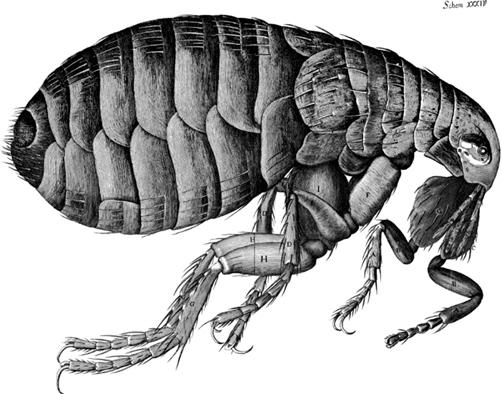
But, as for the beauty of it, the Microscope manifests it to be all over adorned with a curiously polished suit of sable Armour, neatly jointed, and beset with multitudes of sharp pins, shaped almost like Porcupine’s Quills, or bright conical Steel-bodkins; the head is on either side beautified with a quick and round black eye K, behind each of which also appears a small cavity, L, in which he seems to move to and fro a certain thin film beset with many small transparent hairs, which probably may be his ears; in the forepart of his head, between the two fore-legs, he has two small long jointed feelers, or rather smellers, MM, which have four joints, and are hairy, like those of several other creatures; between these, it has a small proboscis, or probe, NNO, that seems to consist of a tube NN, and a tongue or sucker O, which I have perceived him to slip in and out. Besides these, it has also two chaps or biters PP, which are somewhat like those of an Ant, but I could not perceive them toothed; these were shaped very like the blades of a pair of round-topped scissors, and were opened and shut just after the same manner; with these Instruments does this little busy Creature bite and pierce the skin, and suck out the blood of an Animal, leaving the skin inflamed with a small round red spot. These parts are very difficult to be discovered, because, for the most part, they lye covered between the fore-legs. There are many other particulars, which, being more obvious, and affording no great matter of information, I shall pass by, and refer the Reader to the Figure.
Observ. LIV. Of a Louse.
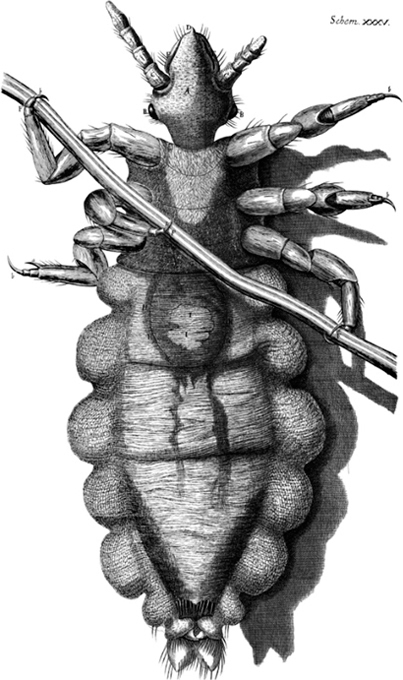
This is a Creature so officious, that ‘twill be known to everyone at one time or other, so busy, and so impudent, that it will be intruding itself in every ones company, and so proud and aspiring withal, that it fears not to trample on the best, and affects nothing so much as a Crown; feeds and lives very high, and that makes it so saucy, as to pull any one by the ears that comes in its way, and will never be quiet till it has drawn blood: it is troubled at nothing so much as at a man that scratches his head, as knowing that man is plotting and contriving some mischief against it, and that makes it oftentime sculk into some meaner and lower place, and run behind a man’s back, though it go very much against the hair; which ill conditions of it having made it better known then trusted, would exempt me from making any further description of it, did not my faithful Mercury, my Microscope, bring me other information of it. For this has discovered to me, by means of a very bright light cast on it, that it is a Creature of a very odd shape; it has a head shaped like that expressed in 35. Scheme marked with A, which seems almost Conical, but is a little flatted on the upper and under sides, at the biggest part of which, on either side behind the head (as it were, being the place where other Creatures ears stand) are placed its two black shining goggle eyes BB, looking backwards, and fenced round with several small cilia, or hairs that encompass it, so that it seems this Creature has no very good foresight: It does not seem to have any eye-lids, and therefore perhaps its eyes were so placed, that it might the better cleanse them with its fore-legs; and perhaps this may be the reason, why they so much avoid and run from the light behind them, for being made to live in the shady and dark recesses of the hair, and thence probably their eye having a great aperture, the open and clear light, especially that of the Sun, must needs very much offend them; to secure these eyes from receiving any injury from the hairs through which it passes, it has two horns that grow before it, in the place where one would have thought the eyes should be; each of these CC hath four joints, which are fringed, as ‘twere, with small bristles, from which to the tip of its snout D, the head seems very round and tapering, ending in a very sharp nose D, which seems to have a small hole, and to be the passage through which he sucks the blood. Now whereas if it be placed on its back, with its belly upwards, as it is in the 35. Scheme, it seems in several Positions to have a resemblance of chaps, or jaws, as is represented in the Figure by EE, yet in other postures those dark strokes disappear; and having kept several of them in a box for two or three days, so that for all that time they had nothing to feed on, I found, upon letting one creep on my hand, that it immediately fell to sucking, and did neither seem to thrust its nose very deep into the skin, nor to open any kind of mouth, but I could plainly perceive a small current of blood, which came directly from its snout, and past into its belly; and about A there seemed a contrivance, somewhat resembling a Pump, pair of Bellows, or Heart, for by a very swift systole and diastole the blood seemed drawn from the nose, and forced into the body. It did not seem at all, though I viewed it a good while as it was sucking, to thrust more of its nose into the skin then the very snout D, nor did it cause the least discernable pain, and yet the blood seemed to run through its head very quick and freely, so that it seems there is no part of the skin but the blood is dispersed into, nay, even into the cuticula; for had it thrust its whole nose in from D to CC, it would not have amounted to the supposed thickness of that tegument, the length of the nose being not more than a three hundredth part of an inch. It has six legs, covered with a very transparent shell, and jointed exactly like a Crab’s, or Lobster’s; each leg is divided into six parts by these joints, and those have here and there several small hairs; and at the end of each leg it has two claws, very properly adapted for its peculiar use, being thereby enabled to walk very securely both on the skin and hair; and indeed this contrivance of the feet is very curious, and could not be made more commodiously and compendiously, for performing both these requisite motions, of walking and climbing up the hair of a man’s head, then it is: for, by having the lesser claw (a) set so much short of the bigger (b) when it walks on the skin the shorter touches not, and then the feet are the same with those of a Mite, and several other small Insects, but by means of the small joints of the longer claw it can bend it round, and so with both claws take hold of a hair, in the manner represented in the Figure, the long transparent Cylinder FFF, being a Man’s hair held by it.
The Thorax seemed cased with another kind of substance then the belly, namely, with a thin transparent horny substance, which upon the fasting of the Creature did not grow flaccid; through this I could plainly see the blood, sucked from my hand, to be variously distributed, and moved to and fro; and about G there seemed a pretty big white substance, which seemed to be moved within its thorax; besides, there appeared very many small milk-white vessels, which crossed over the breast between the legs, out of which, on either side, were many small branchings, these seemed to be the veins and arteries, for that which is analogous to blood in all Insects is milk-white.
The belly is covered with a transparent substance likewise, but more resembling a skin then a shell, for ‘tis grained all over the belly just like the skin in the palms of a man’s hand, and when the belly is empty, grows very flaccid and wrinkled; at the upper end of this is placed the stomach HH, and perhaps also the white spot II may be the liver or pancreas, which, by the peristaltick motion of the guts, is a little moved to and fro, not with a systole and diastole, but rather with a thronging or jostling motion. Viewing one of these Creatures, after it had fasted two days, all the hinder part was lank and flaccid, and the white spot II hardly moved, most of the white branchings disappeared, and most also of the redness or sucked blood in the guts, the peristaltick motion of which was scarce discernable; but upon the suffering it to suck, it presently filled the skin of the belly, and of the six scalloped embossments on either side, as full as it could be stuffed, the stomach and guts were as full as they could hold; the peristaltick motion of the gut grew quick, and the jostling motion of II accordingly; multitudes of milk-white vessels seemed quickly filled, and turgid, which were perhaps the veins and arteries and the Creature was so greedy, that though it could not contain more, yet it continued sucking as fast as ever, and as fast emptying itself behind: the digestion of this Creature must needs be very quick, for though I perceived the blood thicker and blacker when sucked, yet, when in the guts, it was of a very lovely ruby colour, and that part of it, which was digested into the veins, seemed white; whence it appears, that a further digestion of blood may make it milk, at least of a resembling colour: What is else observable in the figure of this Creature, may be seen by the 35.
Reading and Discussion Questions
1.What is Hooke’s opinion of data gathered from our senses? What is the importance of observation? What are its pitfalls? Do we have any way of overcoming the limitations of our senses?
2.Why does Hooke begin his observations with an account of examining a needle? What does he conclude from this examination about the products of human artifice? How does this compare to the discoveries about the productions of nature he observes in the flea and the louse?
3.What does Hooke discover in his examination of cork?