
94
Introduction
When on board H.M.S. ‘Beagle,’ as naturalist, I was much struck with certain facts in the distribution of the inhabitants of South America, and in the geological relations of the present to the past inhabitants of that continent. These facts seemed to me to throw some light on the origin of species—that mystery of mysteries, as it has been called by one of our greatest philosophers. On my return home, it occurred to me, in 1837, that something might perhaps be made out on this question by patiently accumulating and reflecting on all sorts of facts which could possibly have any bearing on it. After five years’ work I allowed myself to speculate on the subject, and drew up some short notes; these I enlarged in 1844 into a sketch of the conclusions, which then seemed to me probable: from that period to the present day I have steadily pursued the same object. I hope that I may be excused for entering on these personal details, as I give them to show that I have not been hasty in coming to a decision.
My work is now nearly finished; but as it will take me two or three more years to complete it, and as my health is far from strong, I have been urged to publish this Abstract. I have more especially been induced to do this, as Mr. Wallace, who is now studying the natural history of the Malay archipelago, has arrived at almost exactly the same general conclusions that I have on the origin of species. Last year he sent to me a memoir on this subject, with a request that I would forward it to Sir Charles Lyell, who sent it to the Linnean Society, and it is published in the third volume of the Journal of that Society. Sir C. Lyell and Dr. Hooker, who both knew of my work—the latter having read my sketch of 1844—honoured me by thinking it advisable to publish, with Mr. Wallace’s excellent memoir, some brief extracts from my manuscripts.
This Abstract, which I now publish, must necessarily be imperfect. I cannot here give references and authorities for my several statements; and I must trust to the reader reposing some confidence in my accuracy. No doubt errors will have crept in, though I hope I have always been cautious in trusting to good authorities alone. I can here give only the general conclusions at which I have arrived, with a few facts in illustration, but which, I hope, in most cases will suffice. No one can feel more sensible than I do of the necessity of hereafter publishing in detail all the facts, with references, on which my conclusions have been grounded; and I hope in a future work to do this. For I am well aware that scarcely a single point is discussed in this volume on which facts cannot be adduced, often apparently leading to conclusions directly opposite to those at which I have arrived. A fair result can be obtained only by fully stating and balancing the facts and arguments on both sides of each question; and this cannot possibly be here done.
I much regret that want of space prevents my having the satisfaction of acknowledging the generous assistance which I have received from very many naturalists, some of them personally unknown to me. I cannot, however, let this opportunity pass without expressing my deep obligations to Dr. Hooker, who for the last fifteen years has aided me in every possible way by his large stores of knowledge and his excellent judgment.
In considering the Origin of Species, it is quite conceivable that a naturalist, reflecting on the mutual affinities of organic beings, on their embryological relations, their geographical distribution, geological succession, and other such facts, might come to the conclusion that each species had not been independently created, but had descended, like varieties, from other species. Nevertheless, such a conclusion, even if well founded, would be unsatisfactory, until it could be shown how the innumerable species inhabiting this world have been modified, so as to acquire that perfection of structure and coadaptation which most justly excites our admiration. Naturalists continually refer to external conditions, such as climate, food, etc., as the only possible cause of variation. In one very limited sense, as we shall hereafter see, this may be true; but it is preposterous to attribute to mere external conditions, the structure, for instance, of the woodpecker, with its feet, tail, beak, and tongue, so admirably adapted to catch insects under the bark of trees. In the case of the mistletoe, which draws its nourishment from certain trees, which has seeds that must be transported by certain birds, and which has flowers with separate sexes absolutely requiring the agency of certain insects to bring pollen from one flower to the other, it is equally preposterous to account for the structure of this parasite, with its relations to several distinct organic beings, by the effects of external conditions, or of habit, or of the volition of the plant itself.
The author of the ‘Vestiges of Creation’ would, I presume, say that, after a certain unknown number of generations, some bird had given birth to a woodpecker, and some plant to the mistletoe, and that these had been produced perfect as we now see them; but this assumption seems to me to be no explanation, for it leaves the case of the coadaptations of organic beings to each other and to their physical conditions of life, untouched and unexplained.
It is, therefore, of the highest importance to gain a clear insight into the means of modification and coadaptation. At the commencement of my observations it seemed to me probable that a careful study of domesticated animals and of cultivated plants would offer the best chance of making out this obscure problem. Nor have I been disappointed; in this and in all other perplexing cases I have invariably found that our knowledge, imperfect though it be, of variation under domestication, afforded the best and safest clue. I may venture to express my conviction of the high value of such studies, although they have been very commonly neglected by naturalists.
From these considerations, I shall devote the first chapter of this Abstract to Variation under Domestication. We shall thus see that a large amount of hereditary modification is at least possible, and, what is equally or more important, we shall see how great is the power of man in accumulating by his Selection successive slight variations. I will then pass on to the variability of species in a state of nature; but I shall, unfortunately, be compelled to treat this subject far too briefly, as it can be treated properly only by giving long catalogues of facts. We shall, however, be enabled to discuss what circumstances are most favourable to variation. In the next chapter the Struggle for Existence amongst all organic beings throughout the world, which inevitably follows from their high geometrical powers of increase, will be treated of. This is the doctrine of Malthus, applied to the whole animal and vegetable kingdoms. As many more individuals of each species are born than can possibly survive; and as, consequently, there is a frequently recurring struggle for existence, it follows that any being, if it vary however slightly in any manner profitable to itself, under the complex and sometimes varying conditions of life, will have a better chance of surviving, and thus be NATURALLY SELECTED. From the strong principle of inheritance, any selected variety will tend to propagate its new and modified form.
This fundamental subject of Natural Selection will be treated at some length in the fourth chapter; and we shall then see how Natural Selection almost inevitably causes much Extinction of the less improved forms of life and induces what I have called Divergence of Character. In the next chapter I shall discuss the complex and little known laws of variation and of correlation of growth. In the four succeeding chapters, the most apparent and gravest difficulties on the theory will be given: namely, first, the difficulties of transitions, or in understanding how a simple being or a simple organ can be changed and perfected into a highly developed being or elaborately constructed organ; secondly the subject of Instinct, or the mental powers of animals, thirdly, Hybridism, or the infertility of species and the fertility of varieties when intercrossed; and fourthly, the imperfection of the Geological Record. In the next chapter I shall consider the geological succession of organic beings throughout time; in the eleventh and twelfth, their geographical distribution throughout space; in the thirteenth, their classification or mutual affinities, both when mature and in an embryonic condition. In the last chapter I shall give a brief recapitulation of the whole work, and a few concluding remarks.
No one ought to feel surprise at much remaining as yet unexplained in regard to the origin of species and varieties, if he makes due allowance for our profound ignorance in regard to the mutual relations of all the beings which live around us. Who can explain why one species ranges widely and is very numerous, and why another allied species has a narrow range and is rare? Yet these relations are of the highest importance, for they determine the present welfare, and, as I believe, the future success and modification of every inhabitant of this world. Still less do we know of the mutual relations of the innumerable inhabitants of the world during the many past geological epochs in its history. Although much remains obscure, and will long remain obscure, I can entertain no doubt, after the most deliberate study and dispassionate judgment of which I am capable, that the view which most naturalists entertain, and which I formerly entertained—namely, that each species has been independently created—is erroneous. I am fully convinced that species are not immutable; but that those belonging to what are called the same genera are lineal descendants of some other and generally extinct species, in the same manner as the acknowledged varieties of any one species are the descendants of that species. Furthermore, I am convinced that Natural Selection has been the main but not exclusive means of modification.
1. Variation under Domestication
Causes of Variability. Effects of Habit. Correlation of Growth. Inheritance. Character of Domestic Varieties. Difficulty of distinguishing between Varieties and Species. Origin of Domestic Varieties from one or more Species. Domestic Pigeons, their Differences and Origin. Principle of Selection anciently followed, its Effects. Methodical and Unconscious Selection. Unknown Origin of our Domestic Productions. Circumstances favourable to Man’s power of Selection.
When we look to the individuals of the same variety or sub-variety of our older cultivated plants and animals, one of the first points which strikes us, is, that they generally differ much more from each other, than do the individuals of any one species or variety in a state of nature. When we reflect on the vast diversity of the plants and animals which have been cultivated, and which have varied during all ages under the most different climates and treatment, I think we are driven to conclude that this greater variability is simply due to our domestic productions having been raised under conditions of life not so uniform as, and somewhat different from, those to which the parent-species have been exposed under nature. There is, also, I think, some probability in the view propounded by Andrew Knight, that this variability may be partly connected with excess of food. It seems pretty clear that organic beings must be exposed during several generations to the new conditions of life to cause any appreciable amount of variation; and that when the organisation has once begun to vary, it generally continues to vary for many generations. No case is on record of a variable being ceasing to be variable under cultivation. Our oldest cultivated plants, such as wheat, still often yield new varieties: our oldest domesticated animals are still capable of rapid improvement or modification.
It has been disputed at what period of life the causes of variability, whatever they may be, generally act; whether during the early or late period of development of the embryo, or at the instant of conception. Geoffroy St. Hilaire’s experiments show that unnatural treatment of the embryo causes monstrosities; and monstrosities cannot be separated by any clear line of distinction from mere variations. But I am strongly inclined to suspect that the most frequent cause of variability may be attributed to the male and female reproductive elements having been affected prior to the act of conception ... .
Sterility has been said to be the bane of horticulture; but on this view we owe variability to the same cause which produces sterility; and variability is the source of all the choicest productions of the garden. I may add, that as some organisms will breed most freely under the most unnatural conditions (for instance, the rabbit and ferret kept in hutches), showing that their reproductive system has not been thus affected; so will some animals and plants withstand domestication or cultivation, and vary very slightly—perhaps hardly more than in a state of nature.
A long list could easily be given of “sporting plants”; by this term gardeners mean a single bud or offset, which suddenly assumes a new and sometimes very different character from that of the rest of the plant. Such buds can be propagated by grafting, etc., and sometimes by seed. These “sports” are extremely rare under nature, but far from rare under cultivation; and in this case we see that the treatment of the parent has affected a bud or offset, and not the ovules or pollen. But it is the opinion of most physiologists that there is no essential difference between a bud and an ovule in their earliest stages of formation; so that, in fact, “sports” support my view, that variability may be largely attributed to the ovules or pollen, or to both, having been affected by the treatment of the parent prior to the act of conception. These cases anyhow show that variation is not necessarily connected, as some authors have supposed, with the act of generation.
Seedlings from the same fruit, and the young of the same litter, sometimes differ considerably from each other, though both the young and the parents, as Muller has remarked, have apparently been exposed to exactly the same conditions of life; and this shows how unimportant the direct effects of the conditions of life are in comparison with the laws of reproduction, and of growth, and of inheritance; for had the action of the conditions been direct, if any of the young had varied, all would probably have varied in the same manner ... . Nevertheless some slight amount of change may, I think, be attributed to the direct action of the conditions of life—as, in some cases, increased size from amount of food, colour from particular kinds of food and from light, and perhaps the thickness of fur from climate.
Habit also has a decided influence, as in the period of flowering with plants when transported from one climate to another. In animals it has a more marked effect; for instance, I find in the domestic duck that the bones of the wing weigh less and the bones of the leg more, in proportion to the whole skeleton, than do the same bones in the wild-duck; and I presume that this change may be safely attributed to the domestic duck flying much less, and walking more, than its wild parent. The great and inherited development of the udders in cows and goats in countries where they are habitually milked, in comparison with the state of these organs in other countries, is another instance of the effect of use. Not a single domestic animal can be named which has not in some country drooping ears; and the view suggested by some authors, that the drooping is due to the disuse of the muscles of the ear, from the animals not being much alarmed by danger, seems probable.
There are many laws regulating variation, some few of which can be dimly seen, and will be hereafter briefly mentioned. I will here only allude to what may be called correlation of growth. Any change in the embryo or larva will almost certainly entail changes in the mature animal. In monstrosities, the correlations between quite distinct parts are very curious; and many instances are given in Isidore Geoffroy St. Hilaire’s great work on this subject. Breeders believe that long limbs are almost always accompanied by an elongated head. Some instances of correlation are quite whimsical; thus cats with blue eyes are invariably deaf; colour and constitutional peculiarities go together, of which many remarkable cases could be given amongst animals and plants. From the facts collected by Heusinger, it appears that white sheep and pigs are differently affected from coloured individuals by certain vegetable poisons. Hairless dogs have imperfect teeth; long-haired and coarse-haired animals are apt to have, as is asserted, long or many horns; pigeons with feathered feet have skin between their outer toes; pigeons with short beaks have small feet, and those with long beaks large feet. Hence, if man goes on selecting, and thus augmenting, any peculiarity, he will almost certainly unconsciously modify other parts of the structure, owing to the mysterious laws of the correlation of growth.
The result of the various, quite unknown, or dimly seen laws of variation is infinitely complex and diversified ... .
Any variation which is not inherited is unimportant for us. But the number and diversity of inheritable deviations of structure, both those of slight and those of considerable physiological importance, is endless. Dr. Prosper Lucas’s treatise, in two large volumes, is the fullest and the best on this subject. No breeder doubts how strong is the tendency to inheritance: like produces like is his fundamental belief: doubts have been thrown on this principle by theoretical writers alone. When a deviation appears not unfrequently, and we see it in the father and child, we cannot tell whether it may not be due to the same original cause acting on both; but when amongst individuals, apparently exposed to the same conditions, any very rare deviation, due to some extraordinary combination of circumstances, appears in the parent—say, once amongst several million individuals—and it reappears in the child, the mere doctrine of chances almost compels us to attribute its reappearance to inheritance. Everyone must have heard of cases of albinism, prickly skin, hairy bodies, etc., appearing in several members of the same family. If strange and rare deviations of structure are truly inherited, less strange and commoner deviations may be freely admitted to be inheritable. Perhaps the correct way of viewing the whole subject, would be, to look at the inheritance of every character whatever as the rule, and non-inheritance as the anomaly.
The laws governing inheritance are quite unknown; no one can say why the same peculiarity in different individuals of the same species, and in individuals of different species, is sometimes inherited and sometimes not so; why the child often reverts in certain characters to its grandfather or grandmother or other much more remote ancestor; why a peculiarity is often transmitted from one sex to both sexes or to one sex alone, more commonly but not exclusively to the like sex. It is a fact of some little importance to us, that peculiarities appearing in the males of our domestic breeds are often transmitted either exclusively, or in a much greater degree, to males alone. A much more important rule, which I think may be trusted, is that, at whatever period of life a peculiarity first appears, it tends to appear in the offspring at a corresponding age, though sometimes earlier. In many cases this could not be otherwise: thus the inherited peculiarities in the horns of cattle could appear only in the offspring when nearly mature; peculiarities in the silkworm are known to appear at the corresponding caterpillar or cocoon stage. But hereditary diseases and some other facts make me believe that the rule has a wider extension, and that when there is no apparent reason why a peculiarity should appear at any particular age, yet that it does tend to appear in the offspring at the same period at which it first appeared in the parent. I believe this rule to be of the highest importance in explaining the laws of embryology. These remarks are of course confined to the first APPEARANCE of the peculiarity, and not to its primary cause, which may have acted on the ovules or male element; in nearly the same manner as in the crossed offspring from a short-horned cow by a long-horned bull, the greater length of horn, though appearing late in life, is clearly due to the male element.
Having alluded to the subject of reversion, I may here refer to a statement often made by naturalists—namely, that our domestic varieties, when run wild, gradually but certainly revert in character to their aboriginal stocks. Hence it has been argued that no deductions can be drawn from domestic races to species in a state of nature. I have in vain endeavoured to discover on what decisive facts the above statement has so often and so boldly been made. There would be great difficulty in proving its truth: we may safely conclude that very many of the most strongly-marked domestic varieties could not possibly live in a wild state. In many cases we do not know what the aboriginal stock was, and so could not tell whether or not nearly perfect reversion had ensued. It would be quite necessary, in order to prevent the effects of intercrossing, that only a single variety should be turned loose in its new home. Nevertheless, as our varieties certainly do occasionally revert in some of their characters to ancestral forms, it seems to me not improbable, that if we could succeed in naturalising, or were to cultivate, during many generations, the several races, for instance, of the cabbage, in very poor soil (in which case, however, some effect would have to be attributed to the direct action of the poor soil), that they would to a large extent, or even wholly, revert to the wild aboriginal stock. Whether or not the experiment would succeed, is not of great importance for our line of argument; for by the experiment itself the conditions of life are changed. If it could be shown that our domestic varieties manifested a strong tendency to reversion,—that is, to lose their acquired characters, whilst kept under unchanged conditions, and whilst kept in a considerable body, so that free intercrossing might check, by blending together, any slight deviations of structure, in such case, I grant that we could deduce nothing from domestic varieties in regard to species. But there is not a shadow of evidence in favour of this view: to assert that we could not breed our cart and race-horses, long and short-horned cattle, and poultry of various breeds, and esculent vegetables, for an almost infinite number of generations, would be opposed to all experience. I may add, that when under nature the conditions of life do change, variations and reversions of character probably do occur; but natural selection, as will hereafter be explained, will determine how far the new characters thus arising shall be preserved.
...
When we attempt to estimate the amount of structural difference between the domestic races of the same species, we are soon involved in doubt, from not knowing whether they have descended from one or several parent-species. This point, if it could be cleared up, would be interesting; if, for instance, it could be shown that the greyhound, bloodhound, terrier, spaniel, and bull-dog, which we all know propagate their kind so truly, were the offspring of any single species, then such facts would have great weight in making us doubt about the immutability of the many very closely allied and natural species—for instance, of the many foxes—inhabiting different quarters of the world. I do not believe, as we shall presently see, that all our dogs have descended from any one wild species; but, in the case of some other domestic races, there is presumptive, or even strong, evidence in favour of this view.
...
Even in the case of the domestic dogs of the whole world, which I fully admit have probably descended from several wild species, I cannot doubt that there has been an immense amount of inherited variation. Who can believe that animals closely resembling the Italian greyhound, the bloodhound, the bull-dog, or Blenheim spaniel, etc.—so unlike all wild Canidae—ever existed freely in a state of nature? It has often been loosely said that all our races of dogs have been produced by the crossing of a few aboriginal species; but by crossing we can get only forms in some degree intermediate between their parents; and if we account for our several domestic races by this process, we must admit the former existence of the most extreme forms, as the Italian greyhound, bloodhound, bull-dog, etc., in the wild state. Moreover, the possibility of making distinct races by crossing has been greatly exaggerated. There can be no doubt that a race may be modified by occasional crosses, if aided by the careful selection of those individual mongrels, which present any desired character; but that a race could be obtained nearly intermediate between two extremely different races or species, I can hardly believe. Sir J. Sebright expressly experimentised for this object, and failed. The offspring from the first cross between two pure breeds is tolerably and sometimes (as I have found with pigeons) extremely uniform, and everything seems simple enough; but when these mongrels are crossed one with another for several generations, hardly two of them will be alike, and then the extreme difficulty, or rather utter hopelessness, of the task becomes apparent. Certainly, a breed intermediate between TWO VERY DISTINCT breeds could not be got without extreme care and long-continued selection; nor can I find a single case on record of a permanent race having been thus formed.
On the Breeds of the Domestic Pigeon
Believing that it is always best to study some special group, I have, after deliberation, taken up domestic pigeons. I have kept every breed which I could purchase or obtain, and have been most kindly favoured with skins from several quarters of the world, more especially by the Honourable W. Elliot from India, and by the Honourable C. Murray from Persia.
...
Great as the differences are between the breeds of pigeons, I am fully convinced that the common opinion of naturalists is correct, namely, that all have descended from the rock-pigeon (Columba livia), including under this term several geographical races or sub-species, which differ from each other in the most trifling respects.
...
From these several reasons, namely, the improbability of man having formerly got seven or eight supposed species of pigeons to breed freely under domestication; these supposed species being quite unknown in a wild state, and their becoming nowhere feral; these species having very abnormal characters in certain respects, as compared with all other Columbidae, though so like in most other respects to the rock-pigeon; the blue colour and various marks occasionally appearing in all the breeds, both when kept pure and when crossed; the mongrel offspring being perfectly fertile;—from these several reasons, taken together, I can feel no doubt that all our domestic breeds have descended from the Columba livia with its geographical sub-species.
...
I have discussed the probable origin of domestic pigeons at some, yet quite insufficient, length; because when I first kept pigeons and watched the several kinds, knowing well how true they bred, I felt fully as much difficulty in believing that they could ever have descended from a common parent, as any naturalist could in coming to a similar conclusion in regard to the many species of finches, or other large groups of birds, in nature. One circumstance has struck me much; namely, that all the breeders of the various domestic animals and the cultivators of plants, with whom I have ever conversed, or whose treatises I have read, are firmly convinced that the several breeds to which each has attended, are descended from so many aboriginally distinct species. Ask, as I have asked, a celebrated raiser of Hereford cattle, whether his cattle might not have descended from long horns, and he will laugh you to scorn. I have never met a pigeon, or poultry, or duck, or rabbit fancier, who was not fully convinced that each main breed was descended from a distinct species. Van Mons, in his treatise on pears and apples, shows how utterly he disbelieves that the several sorts, for instance a Ribston-pippin or Codlin-apple, could ever have proceeded from the seeds of the same tree. Innumerable other examples could be given. The explanation, I think, is simple: from long-continued study they are strongly impressed with the differences between the several races; and though they well know that each race varies slightly, for they win their prizes by selecting such slight differences, yet they ignore all general arguments, and refuse to sum up in their minds slight differences accumulated during many successive generations. May not those naturalists who, knowing far less of the laws of inheritance than does the breeder, and knowing no more than he does of the intermediate links in the long lines of descent, yet admit that many of our domestic races have descended from the same parents—may they not learn a lesson of caution, when they deride the idea of species in a state of nature being lineal descendants of other species?
Selection
Let us now briefly consider the steps by which domestic races have been produced, either from one or from several allied species. Some little effect may, perhaps, be attributed to the direct action of the external conditions of life, and some little to habit; but he would be a bold man who would account by such agencies for the differences of a dray and race horse, a greyhound and bloodhound, a carrier and tumbler pigeon. One of the most remarkable features in our domesticated races is that we see in them adaptation, not indeed to the animal’s or plant’s own good, but to man’s use or fancy. Some variations useful to him have probably arisen suddenly, or by one step; many botanists, for instance, believe that the fuller’s teazle, with its hooks, which cannot be rivalled by any mechanical contrivance, is only a variety of the wild Dipsacus; and this amount of change may have suddenly arisen in a seedling. So it has probably been with the turnspit dog; and this is known to have been the case with the ancon sheep. But when we compare the dray-horse and race-horse, the dromedary and camel, the various breeds of sheep fitted either for cultivated land or mountain pasture, with the wool of one breed good for one purpose, and that of another breed for another purpose; when we compare the many breeds of dogs, each good for man in very different ways; when we compare the game-cock, so pertinacious in battle, with other breeds so little quarrelsome, with “everlasting layers” which never desire to sit, and with the bantam so small and elegant; when we compare the host of agricultural, culinary, orchard, and flower-garden races of plants, most useful to man at different seasons and for different purposes, or so beautiful in his eyes, we must, I think, look further than to mere variability. We cannot suppose that all the breeds were suddenly produced as perfect and as useful as we now see them; indeed, in several cases, we know that this has not been their history. The key is man’s power of accumulative selection: nature gives successive variations; man adds them up in certain directions useful to him. In this sense he may be said to make for himself useful breeds.
...
At the present time, eminent breeders try by methodical selection, with a distinct object in view, to make a new strain or sub-breed, superior to anything existing in the country. But, for our purpose, a kind of Selection, which may be called Unconscious, and which results from every one trying to possess and breed from the best individual animals, is more important. Thus, a man who intends keeping pointers naturally tries to get as good dogs as he can, and afterwards breeds from his own best dogs, but he has no wish or expectation of permanently altering the breed. Nevertheless I cannot doubt that this process, continued during centuries, would improve and modify any breed, in the same way as Bakewell, Collins, etc., by this very same process, only carried on more methodically, did greatly modify, even during their own lifetimes, the forms and qualities of their cattle. Slow and insensible changes of this kind could never be recognised unless actual measurements or careful drawings of the breeds in question had been made long ago, which might serve for comparison. In some cases, however, unchanged or but little changed individuals of the same breed may be found in less civilised districts, where the breed has been less improved. There is reason to believe that King Charles’s spaniel has been unconsciously modified to a large extent since the time of that monarch. Some highly competent authorities are convinced that the setter is directly derived from the spaniel, and has probably been slowly altered from it. It is known that the English pointer has been greatly changed within the last century, and in this case the change has, it is believed, been chiefly effected by crosses with the fox-hound; but what concerns us is, that the change has been effected unconsciously and gradually, and yet so effectually, that, though the old Spanish pointer certainly came from Spain, Mr. Borrow has not seen, as I am informed by him, any native dog in Spain like our pointer.
By a similar process of selection, and by careful training, the whole body of English racehorses have come to surpass in fleetness and size the parent Arab stock, so that the latter, by the regulations for the Goodwood Races, are favoured in the weights they carry. Lord Spencer and others have shown how the cattle of England have increased in weight and in early maturity, compared with the stock formerly kept in this country. By comparing the accounts given in old pigeon treatises of carriers and tumblers with these breeds as now existing in Britain, India, and Persia, we can, I think, clearly trace the stages through which they have insensibly passed, and come to differ so greatly from the rock-pigeon.
...
In regard to the domestic animals kept by uncivilised man, it should not be overlooked that they almost always have to struggle for their own food, at least during certain seasons. And in two countries very differently circumstanced, individuals of the same species, having slightly different constitutions or structure, would often succeed better in the one country than in the other, and thus by a process of “natural selection,” as will hereafter be more fully explained, two sub-breeds might be formed. This, perhaps, partly explains what has been remarked by some authors, namely, that the varieties kept by savages have more of the character of species than the varieties kept in civilised countries.
On the view here given of the all-important part which selection by man has played, it becomes at once obvious, how it is that our domestic races show adaptation in their structure or in their habits to man’s wants or fancies. We can, I think, further understand the frequently abnormal character of our domestic races, and likewise their differences being so great in external characters and relatively so slight in internal parts or organs. Man can hardly select, or only with much difficulty, any deviation of structure excepting such as is externally visible; and indeed he rarely cares for what is internal. He can never act by selection, excepting on variations which are first given to him in some slight degree by nature. No man would ever try to make a fantail, till he saw a pigeon with a tail developed in some slight degree in an unusual manner, or a pouter till he saw a pigeon with a crop of somewhat unusual size; and the more abnormal or unusual any character was when it first appeared, the more likely it would be to catch his attention. But to use such an expression as trying to make a fantail, is, I have no doubt, in most cases, utterly incorrect. The man who first selected a pigeon with a slightly larger tail, never dreamed what the descendants of that pigeon would become through long-continued, partly unconscious and partly methodical selection. Perhaps the parent bird of all fantails had only fourteen tail-feathers somewhat expanded, like the present Java fantail, or like individuals of other and distinct breeds, in which as many as seventeen tail-feathers have been counted. Perhaps the first pouter-pigeon did not inflate its crop much more than the turbit now does the upper part of its oesophagus,—a habit which is disregarded by all fanciers, as it is not one of the points of the breed.
Nor let it be thought that some great deviation of structure would be necessary to catch the fancier’s eye: he perceives extremely small differences, and it is in human nature to value any novelty, however slight, in one’s own possession.
...
I must now say a few words on the circumstances, favourable, or the reverse, to man’s power of selection. A high degree of variability is obviously favourable, as freely giving the materials for selection to work on; not that mere individual differences are not amply sufficient, with extreme care, to allow of the accumulation of a large amount of modification in almost any desired direction. But as variations manifestly useful or pleasing to man appear only occasionally, the chance of their appearance will be much increased by a large number of individuals being kept; and hence this comes to be of the highest importance to success.
...
To sum up on the origin of our Domestic Races of animals and plants. I believe that the conditions of life, from their action on the reproductive system, are so far of the highest importance as causing variability. I do not believe that variability is an inherent and necessary contingency, under all circumstances, with all organic beings, as some authors have thought. The effects of variability are modified by various degrees of inheritance and of reversion. Variability is governed by many unknown laws, more especially by that of correlation of growth. Something may be attributed to the direct action of the conditions of life. Something must be attributed to use and disuse. The final result is thus rendered infinitely complex. In some cases, I do not doubt that the intercrossing of species, aboriginally distinct, has played an important part in the origin of our domestic productions. When in any country several domestic breeds have once been established, their occasional intercrossing, with the aid of selection, has, no doubt, largely aided in the formation of new sub-breeds; but the importance of the crossing of varieties has, I believe, been greatly exaggerated, both in regard to animals and to those plants which are propagated by seed. In plants which are temporarily propagated by cuttings, buds, etc., the importance of the crossing both of distinct species and of varieties is immense; for the cultivator here quite disregards the extreme variability both of hybrids and mongrels, and the frequent sterility of hybrids; but the cases of plants not propagated by seed are of little importance to us, for their endurance is only temporary. Over all these causes of Change I am convinced that the accumulative action of Selection, whether applied methodically and more quickly, or unconsciously and more slowly, but more efficiently, is by far the predominant Power.
2. Variation under Nature
Variability. Individual differences. Doubtful species. Wide ranging, much diffused, and common species vary most. Species of the larger genera in any country vary more than the species of the smaller genera. Many of the species of the larger genera resemble varieties in being very closely, but unequally, related to each other, and in having restricted ranges.
Before applying the principles arrived at in the last chapter to organic beings in a state of nature, we must briefly discuss whether these latter are subject to any variation. To treat this subject at all properly, a long catalogue of dry facts should be given; but these I shall reserve for my future work. Nor shall I here discuss the various definitions which have been given of the term species. No one definition has as yet satisfied all naturalists; yet every naturalist knows vaguely what he means when he speaks of a species. Generally the term includes the unknown element of a distinct act of creation. The term “variety” is almost equally difficult to define; but here community of descent is almost universally implied, though it can rarely be proved. We have also what are called monstrosities; but they graduate into varieties. By a monstrosity I presume is meant some considerable deviation of structure in one part, either injurious to or not useful to the species, and not generally propagated. Some authors use the term “variation” in a technical sense, as implying a modification directly due to the physical conditions of life; and “variations” in this sense are supposed not to be inherited: but who can say that the dwarfed condition of shells in the brackish waters of the Baltic, or dwarfed plants on Alpine summits, or the thicker fur of an animal from far northwards, would not in some cases be inherited for at least some few generations? and in this case I presume that the form would be called a variety.
Again, we have many slight differences which may be called individual differences, such as are known frequently to appear in the offspring from the same parents, or which may be presumed to have thus arisen, from being frequently observed in the individuals of the same species inhabiting the same confined locality. No one supposes that all the individuals of the same species are cast in the very same mould. These individual differences are highly important for us, as they afford materials for natural selection to accumulate, in the same manner as man can accumulatein any given direction individual differences in his domesticated productions ... .
There is one point connected with individual differences, which seems to me extremely perplexing: I refer to those genera which have sometimes been called “protean” or “polymorphic,” in which the species present an inordinate amount of variation; and hardly two naturalists can agree which forms to rank as species and which as varieties. We may instance Rubus, Rosa, and Hieracium amongst plants, several genera of insects, and several genera of Brachiopod shells. In most polymorphic genera some of the species have fixed and definite characters. Genera which are polymorphic in one country seem to be, with some few exceptions, polymorphic in other countries, and likewise, judging from Brachiopod shells, at former periods of time. These facts seem to be very perplexing, for they seem to show that this kind of variability is independent of the conditions of life. I am inclined to suspect that we see in these polymorphic genera variations in points of structure which are of no service or disservice to the species, and which consequently have not been seized on and rendered definite by natural selection, as hereafter will be explained.
Those forms which possess in some considerable degree the character of species, but which are so closely similar to some other forms, or are so closely linked to them by intermediate gradations, that naturalists do not like to rank them as distinct species, are in several respects the most important for us. We have every reason to believe that many of these doubtful and closely-allied forms have permanently retained their characters in their own country for a long time; for as long, as far as we know, as have good and true species. Practically, when a naturalist can unite two forms together by others having intermediate characters, he treats the one as a variety of the other, ranking the most common, but sometimes the one first described, as the species, and the other as the variety. But cases of great difficulty, which I will not here enumerate, sometimes occur in deciding whether or not to rank one form as a variety of another, even when they are closely connected by intermediate links; nor will the commonly-assumed hybrid nature of the intermediate links always remove the difficulty. In very many cases, however, one form is ranked as a variety of another, not because the intermediate links have actually been found, but because analogy leads the observer to suppose either that they do now somewhere exist, or may formerly have existed; and here a wide door for the entry of doubt and conjecture is opened.
Hence, in determining whether a form should be ranked as a species or a variety, the opinion of naturalists having sound judgment and wide experience seems the only guide to follow. We must, however, in many cases, decide by a majority of naturalists, for few well-marked and well-known varieties can be named which have not been ranked as species by at least some competent judges.
That varieties of this doubtful nature are far from uncommon cannot be disputed. Compare the several floras of Great Britain, of France or of the United States, drawn up by different botanists, and see what a surprising number of forms have been ranked by one botanist as good species, and by another as mere varieties. Mr. H. C. Watson, to whom I lie under deep obligation for assistance of all kinds, has marked for me 182 British plants, which are generally considered as varieties, but which have all been ranked by botanists as species; and in making this list he has omitted many trifling varieties, but which nevertheless have been ranked by some botanists as species, and he has entirely omitted several highly polymorphic genera. Under genera, including the most polymorphic forms, Mr. Babington gives 251 species, whereas Mr. Bentham gives only 112,—a difference of 139 doubtful forms! Amongst animals which unite for each birth, and which are highly locomotive, doubtful forms, ranked by one zoologist as a species and by another as a variety, can rarely be found within the same country, but are common in separated areas. How many of those birds and insects in North America and Europe, which differ very slightly from each other, have been ranked by one eminent naturalist as undoubted species, and by another as varieties, or, as they are often called, as geographical races! Many years ago, when comparing, and seeing others compare, the birds from the separate islands of the Galapagos Archipelago, both one with another, and with those from the American mainland, I was much struck how entirely vague and arbitrary is the distinction between species and varieties.
...
When a young naturalist commences the study of a group of organisms quite unknown to him, he is at first much perplexed to determine what differences to consider as specific, and what as varieties; for he knows nothing of the amount and kind of variation to which the group is subject; and this shows, at least, how very generally there is some variation. But if he confine his attention to one class within one country, he will soon make up his mind how to rank most of the doubtful forms. His general tendency will be to make many species, for he will become impressed, just like the pigeon or poultry-fancier before alluded to, with the amount of difference in the forms which he is continually studying; and he has little general knowledge of analogical variation in other groups and in other countries, by which to correct his first impressions. As he extends the range of his observations, he will meet with more cases of difficulty; for he will encounter a greater number of closely-allied forms. But if his observations be widely extended, he will in the end generally be enabled to make up his own mind which to call varieties and which species; but he will succeed in this at the expense of admitting much variation,—and the truth of this admission will often be disputed by other naturalists. When, moreover, he comes to study allied forms brought from countries not now continuous, in which case he can hardly hope to find the intermediate links between his doubtful forms, he will have to trust almost entirely to analogy, and his difficulties will rise to a climax.
Certainly no clear line of demarcation has as yet been drawn between species and sub-species—that is, the forms which in the opinion of some naturalists come very near to, but do not quite arrive at the rank of species; or, again, between sub-species and well-marked varieties, or between lesser varieties and individual differences. These differences blend into each other in an insensible series; and a series impresses the mind with the idea of an actual passage.
...
The passage from one stage of difference to another and higher stage may be, in some cases, due merely to the long-continued action of different physical conditions in two different regions; but I have not much faith in this view; and I attribute the passage of a variety, from a state in which it differs very slightly from its parent to one in which it differs more, to the action of natural selection in accumulating (as will hereafter be more fully explained) differences of structure in certain definite directions. Hence I believe a well-marked variety may be justly called an incipient species; but whether this belief be justifiable must be judged of by the general weight of the several facts and views given throughout this work.
...
From looking at species as only strongly-marked and well-defined varieties, I was led to anticipate that the species of the larger genera in each country would oftener present varieties, than the species of the smaller genera; for wherever many closely related species (i.e. species of the same genus) have been formed, many varieties or incipient species ought, as a general rule, to be now forming. Where many large trees grow, we expect to find saplings. Where many species of a genus have been formed through variation, circumstances have been favourable for variation; and hence we might expect that the circumstances would generally be still favourable to variation. On the other hand, if we look at each species as a special act of creation, there is no apparent reason why more varieties should occur in a group having many species, than in one having few.
...
Finally, then, varieties have the same general characters as species, for they cannot be distinguished from species,—except, firstly, by the discovery of intermediate linking forms, and the occurrence of such links cannot affect the actual characters of the forms which they connect; and except, secondly, by a certain amount of difference, for two forms, if differing very little, are generally ranked as varieties, notwithstanding that intermediate linking forms have not been discovered; but the amount of difference considered necessary to give to two forms the rank of species is quite indefinite. In genera having more than the average number of species in any country, the species of these genera have more than the average number of varieties. In large genera the species are apt to be closely, but unequally, allied together, forming little clusters round certain species. Species very closely allied to other species apparently have restricted ranges. In all these several respects the species of large genera present a strong analogy with varieties. And we can clearly understand these analogies, if species have once existed as varieties, and have thus originated: whereas, these analogies are utterly inexplicable if each species has been independently created.
We have, also, seen that it is the most flourishing and dominant species of the larger genera which on an average vary most; and varieties, as we shall hereafter see, tend to become converted into new and distinct species. The larger genera thus tend to become larger; and throughout nature the forms of life which are now dominant tend to become still more dominant by leaving many modified and dominant descendants. But by steps hereafter to be explained, the larger genera also tend to break up into smaller genera. And thus, the forms of life throughout the universe become divided into groups subordinate to groups.
3. Struggle for Existence
Bears on natural selection. The term used in a wide sense. Geometrical powers of increase. Rapid increase of naturalised animals and plants. Nature of the checks to increase. Competition universal. Effects of climate. Protection from the number of individuals. Complex relations of all animals and plants throughout nature. Struggle for life most severe between individuals and varieties of the same species; often severe between species of the same genus. The relation of organism to organism the most important of all relations.
Before entering on the subject of this chapter, I must make a few preliminary remarks, to show how the struggle for existence bears on Natural Selection. It has been seen in the last chapter that amongst organic beings in a state of nature there is some individual variability; indeed I am not aware that this has ever been disputed. It is immaterial for us whether a multitude of doubtful forms be called species or sub-species or varieties; what rank, for instance, the two or three hundred doubtful forms of British plants are entitled to hold, if the existence of any well-marked varieties be admitted. But the mere existence of individual variability and of some few well-marked varieties, though necessary as the foundation for the work, helps us but little in understanding how species arise in nature. How have all those exquisite adaptations of one part of the organisation to another part, and to the conditions of life, and of one distinct organic being to another being, been perfected? We see these beautiful co-adaptations most plainly in the woodpecker and mistletoe; and only a little less plainly in the humblest parasite which clings to the hairs of a quadruped or feathers of a bird; in the structure of the beetle which dives through the water; in the plumed seed which is wafted by the gentlest breeze; in short, we see beautiful adaptations everywhere and in every part of the organic world.
Again, it may be asked, how is it that varieties, which I have called incipient species, become ultimately converted into good and distinct species, which in most cases obviously differ from each other far more than do the varieties of the same species? How do those groups of species, which constitute what are called distinct genera, and which differ from each other more than do the species of the same genus, arise? All these results, as we shall more fully see in the next chapter, follow inevitably from the struggle for life. Owing to this struggle for life, any variation, however slight and from whatever cause proceeding, if it be in any degree profitable to an individual of any species, in its infinitely complex relations to other organic beings and to external nature, will tend to the preservation of that individual, and will generally be inherited by its offspring. The offspring, also, will thus have a better chance of surviving, for, of the many individuals of any species which are periodically born, but a small number can survive. I have called this principle, by which each slight variation, if useful, is preserved, by the term of Natural Selection, in order to mark its relation to man’s power of selection. We have seen that man by selection can certainly produce great results, and can adapt organic beings to his own uses, through the accumulation of slight but useful variations, given to him by the hand of Nature. But Natural Selection, as we shall hereafter see, is a power incessantly ready for action, and is as immeasurably superior to man’s feeble efforts, as the works of Nature are to those of Art.
We will now discuss in a little more detail the struggle for existence. In my future work this subject shall be treated, as it well deserves, at much greater length. The elder De Candolle and Lyell have largely and philosophically shown that all organic beings are exposed to severe competition. In regard to plants, no one has treated this subject with more spirit and ability than W. Herbert, Dean of Manchester, evidently the result of his great horticultural knowledge. Nothing is easier than to admit in words the truth of the universal struggle for life, or more difficult—at least I have found it so—than constantly to bear this conclusion in mind. Yet unless it be thoroughly engrained in the mind, I am convinced that the whole economy of nature, with every fact on distribution, rarity, abundance, extinction, and variation, will be dimly seen or quitemisunderstood. We behold the face of nature bright with gladness, we often see superabundance of food; we do not see, or we forget, that the birds which are idly singing round us mostly live on insects or seeds, and are thus constantly destroying life; or we forget how largely these songsters, or their eggs, or their nestlings, are destroyed by birds and beasts of prey; we do not always bear in mind, that though food may be now superabundant, it is not so at all seasons of each recurring year.
I should premise that I use the term Struggle for Existence in a large and metaphorical sense, including dependence of one being on another, and including (which is more important) not only the life of the individual, but success in leaving progeny. Two canine animals in a time of dearth, may be truly said to struggle with each other which shall get food and live. But a plant on the edge of a desert is said to struggle for life against the drought, though more properly it should be said to be dependent on the moisture. A plant which annually produces a thousand seeds, of which on an average only one comes to maturity, may be more truly said to struggle with the plants of the same and other kinds which already clothe the ground. The mistletoe is dependent on the apple and a few other trees, but can only in a far-fetched sense be said to struggle with these trees, for if too many of these parasites grow on the same tree, it will languish and die. But several seedling mistletoes, growing close together on the same branch, may more truly be said to struggle with each other. As the mistletoe is disseminated by birds, its existence depends on birds; and it may metaphorically be said to struggle with other fruit-bearing plants, in order to tempt birds to devour and thus disseminate its seeds rather than those of other plants. In these several senses, which pass into each other, I use for convenience sake the general term of struggle for existence.
A struggle for existence inevitably follows from the high rate at which all organic beings tend to increase. Every being, which during its natural lifetime produces several eggs or seeds, must suffer destruction during some period of its life, and during some season or occasional year, otherwise, on the principle of geometrical increase, its numbers would quickly become so inordinately great that no country could support the product. Hence, as more individuals are produced than can possibly survive, there must in every case be a struggle for existence, either one individual with another of the same species, or with the individuals of distinct species, or with the physical conditions of life. It is the doctrine of Malthus applied with manifold force to the whole animal and vegetable kingdoms; for in this case there can be no artificial increase of food, and no prudential restraint from marriage. Although some species may be now increasing, more or less rapidly, in numbers, all cannot do so, for the world would not hold them.
There is no exception to the rule that every organic being naturally increases at so high a rate, that if not destroyed, the earth would soon be covered by the progeny of a single pair. Even slow-breeding man has doubled in twenty-five years, and at this rate, in a few thousand years, there would literally not be standing room for his progeny. Linnaeus has calculated that if an annual plant produced only two seeds—and there is no plant so unproductive as this—and their seedlings next year produced two, and so on, then in twenty years there would be a million plants. The elephant is reckoned to be the slowest breeder of all known animals, and I have taken some pains to estimate its probable minimum rate of natural increase: it will be under the mark to assume that it breeds when thirty years old, and goes on breeding till ninety years old, bringing forth three pair of young in this interval; if this be so, at the end of the fifth century there would be alive fifteen million elephants, descended from the first pair.
...
In a state of nature almost every plant produces seed, and amongst animals there are very few which do not annually pair. Hence we may confidently assert, that all plants and animals are tending to increase at a geometrical ratio, that all would most rapidly stock every station in which they could any how exist, and that the geometrical tendency to increase must be checked by destruction at some period of life ... .
In looking at Nature, it is most necessary to keep the foregoing considerations always in mind—never to forget that every single organic being around us may be said to be striving to the utmost to increase in numbers; that each lives by a struggle at some period of its life; that heavy destruction inevitably falls either on the young or old, during each generation or at recurrent intervals. Lighten any check, mitigate the destruction ever so little, and the number of the species will almost instantaneously increase to any amount. The face of Nature may be compared to a yielding surface, with ten thousand sharp wedges packed close together and driven inwards by incessant blows, sometimes one wedge being struck, and then another with greater force.
What checks the natural tendency of each species to increase in number is most obscure. Look at the most vigorous species; by as much as it swarms in numbers, by so much will its tendency to increase be still further increased. We know not exactly what the checks are in even one single instance. Nor will this surprise anyone who reflects how ignorant we are on this head, even in regard to mankind, so incomparably better known than any other animal. This subject has been ably treated by several authors, and I shall, in my future work, discuss some of the checks at considerable length, more especially in regard to the feral animals of South America. Here I will make only a few remarks, just to recall to the reader’s mind some of the chief points. Eggs or very young animals seem generally to suffer most, but this is not invariably the case. With plants there is a vast destruction of seeds, but, from some observations which I have made, I believe that it is the seedlings which suffer most from germinating in ground already thickly stocked with other plants. Seedlings, also, are destroyed in vast numbers by various enemies; for instance, on a piece of ground three feet long and two wide, dug and cleared, and where there could be no choking from other plants, I marked all the seedlings of our native weeds as they came up, and out of the 357 no less than 295 were destroyed, chiefly by slugs and insects. If turf which has long been mown, and the case would be the same with turf closely browsed by quadrupeds, be let to grow, the more vigorous plants gradually kill the less vigorous, though fully grown, plants: thus out of twenty species growing on a little plot of turf (three feet by four) nine species perished from the other species being allowed to grow up freely.
The amount of food for each species of course gives the extreme limit to which each can increase; but very frequently it is not the obtaining food, but the serving as prey to other animals, which determines the average numbers of a species. Thus, there seems to be little doubt that the stock of partridges, grouse, and hares on any large estate depends chiefly on the destruction of vermin. If not one head of game were shot during the next twenty years in England, and, at the same time, if no vermin were destroyed, there would, in all probability, be less game than at present, although hundreds of thousands of game animals are now annually killed. On the other hand, in some cases, as with the elephant and rhinoceros, none are destroyed by beasts of prey: even the tiger in India most rarely dares to attack a young elephant protected by its dam.
Climate plays an important part in determining the average numbers of a species, and periodical seasons of extreme cold or drought, I believe to be the most effective of all checks. I estimated that the winter of 1854–55 destroyed four-fifths of the birds in my own grounds; and this is a tremendous destruction, when we remember that ten percent is an extraordinarily severe mortality from epidemics with man. The action of climate seems at first sight to be quite independent of the struggle for existence; but in so far as climate chiefly acts in reducing food, it brings on the most severe struggle between the individuals, whether of the same or of distinct species, which subsist on the same kind of food. Even when climate, for instance extreme cold, acts directly, it will be the least vigorous, or those which have got least food through the advancing winter, which will suffer most. When we travel from south to north, or from a damp region to a dry, we invariably see some species gradually getting rarer and rarer, and finally disappearing; and the change of climate being conspicuous, we are tempted to attribute the whole effect to its direct action. But this is a very false view: we forget that each species, even where it most abounds, is constantly suffering enormous destruction at some period of its life, from enemies or from competitors for the same place and food; and if these enemies or competitors be in the least degree favoured by any slight change of climate, they will increase in numbers, and, as each area is already fully stocked with inhabitants, the other species will decrease. When we travel southward and see a species decreasing in numbers, we may feel sure that the cause lies quite as much in other species being favoured, as in this one being hurt. So it is when we travel northward, but in a somewhat lesser degree, for the number of species of all kinds, and therefore of competitors, decreases northwards; hence in going northward, or in ascending a mountain, we far oftener meet with stunted forms, due to the DIRECTLY injurious action of climate, than we do in proceeding southwards or in descending a mountain. When we reach the Arctic regions, or snow-capped summits, or absolute deserts, the struggle for life is almost exclusively with the elements.
That climate acts in main part indirectly by favouring other species, we may clearly see in the prodigious number of plants in our gardens which can perfectly well endure our climate, but which never become naturalised, for they cannot compete with our native plants, nor resist destruction by our native animals.
When a species, owing to highly favourable circumstances, increases inordinately in numbers in a small tract, epidemics—at least, this seems generally to occur with our game animals—often ensue: and here we have a limiting check independent of the struggle for life. But even some of these so-called epidemics appear to be due to parasitic worms, which have from some cause, possibly in part through facility of diffusion amongst the crowded animals, been disproportionably favoured: and here comes in a sort of struggle between the parasite and its prey.
On the other hand, in many cases, a large stock of individuals of the same species, relatively to the numbers of its enemies, is absolutely necessary for its preservation. Thus we can easily raise plenty of corn and rape-seed, etc., in our fields, because the seeds are in great excess compared with the number of birds which feed on them; nor can the birds, though having a superabundance of food at this one season, increase in number proportionally to the supply of seed, as their numbers are checked during winter: but anyone who has tried, knows how troublesome it is to get seed from a few wheat or other such plants in a garden; I have in this case lost every single seed. This view of the necessity of a large stock of the same species for its preservation, explains, I believe, some singular facts in nature, such as that of very rare plants being sometimes extremely abundant in the few spots where they do occur; and that of some social plants being social, that is, abounding in individuals, even on the extreme confines of their range. For in such cases, we may believe, that a plant could exist only where the conditions of its life were so favourable that many could exist together, and thus save each other from utter destruction. I should add that the good effects of frequent intercrossing, and the ill effects of close interbreeding, probably come into play in some of these cases; but on this intricate subject I will not here enlarge.
...
I am tempted to give one more instance showing how plants and animals, most remote in the scale of nature, are bound together by a web of complex relations. I shall hereafter have occasion to show that the exotic Lobelia fulgens, in this part of England, is never visited by insects, andconsequently, from its peculiar structure, never can set a seed. Many of our orchidaceous plants absolutely require the visits of moths to remove their pollen-masses and thus to fertilise them. I have, also, reason to believe that humble-bees are indispensable to the fertilisation of the heartsease (Viola tricolor), for other bees do not visit this flower. From experiments which I have tried, I have found that the visits of bees, if not indispensable, are at least highly beneficial to the fertilisation of our clovers; but humble-bees alone visit the common red clover (Trifolium pratense), as other bees cannot reach the nectar. Hence I have very little doubt, that if the whole genus of humble-bees became extinct or very rare in England, the heartsease and red clover would become very rare, or wholly disappear. The number of humble-bees in any district depends in a great degree on the number of field-mice, which destroy their combs and nests; and Mr. H. Newman, who has long attended to the habits of humble-bees, believes that “more than two thirds of them are thus destroyed all over England.” Now the number of mice is largely dependent, as everyone knows, on the number of cats; and Mr. Newman says, “Near villages and small towns I have found the nests of humble-bees more numerous than elsewhere, which I attribute to the number of cats that destroy the mice.” Hence it is quite credible that the presence of a feline animal in large numbers in a district might determine, through the intervention first of mice and then of bees, the frequency of certain flowers in that district!
In the case of every species, many different checks, acting at different periods of life, and during different seasons or years, probably come into play; some one check or some few being generally the most potent, but all concurring in determining the average number or even the existence of the species. In some cases it can be shown that widely-different checks act on the same species in different districts. When we look at the plants and bushes clothing an entangled bank, we are tempted to attribute their proportional numbers and kinds to what we call chance. But how false a view is this! Everyone has heard that when an American forest is cut down, a very different vegetation springs up; but it has been observed that the trees now growing on the ancient Indian mounds, in the Southern United States, display the same beautiful diversity and proportion of kinds as in the surrounding virgin forests. What a struggle between the several kinds of trees must here have gone on during long centuries, each annually scattering its seeds by the thousand; what war between insect and insect—between insects, snails, and other animals with birds and beasts of prey—all striving to increase, and all feeding on each other or on the trees or their seeds and seedlings, or on the other plants which first clothed the ground and thus checked the growth of the trees! Throw up a handful of feathers, and all must fall to the ground according to definite laws; but how simple is this problem compared to the action and reaction of the innumerable plants and animals which have determined, in the course of centuries, the proportional numbers and kinds of trees now growing on the old Indian ruins!
The dependency of one organic being on another, as of a parasite on its prey, lies generally between beings remote in the scale of nature. This is often the case with those which may strictly be said to struggle with each other for existence, as in the case of locusts and grass-feeding quadrupeds. But the struggle almost invariably will be most severe between the individuals of the same species, for they frequent the same districts, require the same food, and are exposed to the same dangers.
...
As species of the same genus have usually, though by no means invariably, some similarity in habits and constitution, and always in structure, the struggle will generally be more severe between species of the same genus, when they come into competition with each other, than between species of distinct genera. We see this in the recent extension over parts of the United States of one species of swallow having caused the decrease of another species. The recent increase of the missel-thrush in parts of Scotland has caused the decrease of the song-thrush. How frequently we hear of one species of rat taking the place of another species under the most different climates! In Russia the small Asiatic cockroach has everywhere driven before it its great congener. One species of charlock will supplant another, and so in other cases. We can dimly see why the competition should be most severe between allied forms, which fill nearly the same place in the economy of nature; but probably in no one case could we precisely say why one species has been victorious over another in the great battle of life.
A corollary of the highest importance may be deduced from the foregoing remarks, namely, that the structure of every organic being is related, in the most essential yet often hidden manner, to that of all other organic beings, with which it comes into competition for food or residence, orfrom which it has to escape, or on which it preys. This is obvious in the structure of the teeth and talons of the tiger; and in that of the legs and claws of the parasite which clings to the hair on the tiger’s body. But in the beautifully plumed seed of the dandelion, and in the flattened and fringed legs of the water-beetle, the relation seems at first confined to the elements of air and water. Yet the advantage of plumed seeds no doubt stands in the closest relation to the land being already thickly clothed by other plants; so that the seeds may be widely distributed and fall on unoccupied ground. In the water-beetle, the structure of its legs, so well adapted for diving, allows it to compete with other aquatic insects, to hunt for its own prey, and to escape serving as prey to other animals.
...
It is good thus to try in our imagination to give any form some advantage over another. Probably in no single instance should we know what to do, so as to succeed. It will convince us of our ignorance on the mutual relations of all organic beings; a conviction as necessary, as it seems to be difficult to acquire. All that we can do, is to keep steadily in mind that each organic being is striving to increase at a geometrical ratio; that each at some period of its life, during some season of the year, during each generation or at intervals, has to struggle for life, and to suffer great destruction. When we reflect on this struggle, we may console ourselves with the full belief, that the war of nature is not incessant, that no fear is felt, that death is generally prompt, and that the vigorous, the healthy, and the happy survive and multiply.
4. Natural Selection
Natural Selection: its power compared with man’s selection, its power on characters of trifling importance, its power at all ages and on both sexes. Sexual Selection. On the generality of intercrosses between individuals of the same species. Circumstances favourable and unfavourable to Natural Selection, namely, intercrossing, isolation, number of individuals. Slow action. Extinction caused by Natural Selection. Divergence of Character, related to the diversity of inhabitants of any small area, and to naturalisation. Action of Natural Selection, through Divergence of Character and Extinction, on the descendants from a common parent. Explains the Grouping of all organic beings.
How will the struggle for existence, discussed too briefly in the last chapter, act in regard to variation? Can the principle of selection, which we have seen is so potent in the hands of man, apply in nature? I think we shall see that it can act most effectually. Let it be borne in mind in what an endless number of strange peculiarities our domestic productions, and, in a lesser degree, those under nature, vary; and how strong the hereditary tendency is. Under domestication, it may be truly said that the whole organisation becomes in some degree plastic. Let it be borne in mind how infinitely complex and close-fitting are the mutual relations of all organic beings to each other and to their physical conditions of life. Can it, then, be thought improbable, seeing that variations useful to man have undoubtedly occurred, that other variations useful in some way to each being in the great and complex battle of life, should sometimes occur in the course of thousands of generations? If such do occur, can we doubt (remembering that many more individuals are born than can possibly survive) that individuals having any advantage, however slight, over others, would have the best chance of surviving and of procreating their kind? On the other hand, we may feel sure that any variation in the least degree injurious would be rigidly destroyed. This preservation of favourable variations and the rejection of injurious variations, I call Natural Selection. Variations neither useful nor injurious would not be affected by natural selection, and would be left a fluctuating element, as perhaps we see in the species called polymorphic.
We shall best understand the probable course of natural selection by taking the case of a country undergoing some physical change, for instance, of climate. The proportional numbers of its inhabitants would almost immediately undergo a change, and some species might become extinct. We may conclude, from what we have seen of the intimate and complex manner in which the inhabitants of each country are bound together, that any change in the numerical proportions of some of the inhabitants, independently of the change of climate itself, would most seriously affect many of the others. If the country were open on its borders, new forms would certainly immigrate, and this also would seriously disturb the relations of some of the former inhabitants. Let it be remembered how powerful the influence of a single introduced tree or mammal has been shown to be. But in the case of an island, or of a country partly surrounded by barriers, into which new and better adapted forms could not freely enter, we should then have places in the economy of nature which would assuredly be better filled up, if some of the original inhabitants were in some manner modified; for, had the area been open to immigration, these same places would have been seized on by intruders. In such case, every slight modification, which in the course of ages chanced to arise, and which in any way favoured the individuals of any of the species, by better adapting them to their altered conditions, would tend to be preserved; and natural selection would thus have free scope for the work of improvement.
We have reason to believe, as stated in the first chapter, that a change in the conditions of life, by specially acting on the reproductive system, causes or increases variability; and in the foregoing case the conditions of life are supposed to have undergone a change, and this would manifestly be favourable to natural selection, by giving a better chance of profitable variations occurring; and unless profitable variations do occur, natural selection can do nothing. Not that, as I believe, any extreme amount of variability is necessary; as man can certainly produce great results by adding up in any given direction mere individual differences, so could Nature, but far more easily, from having incomparably longer time at her disposal. Nor do I believe that any great physical change, as of climate, or any unusual degree of isolation to check immigration, is actually necessary to produce new and unoccupied places for natural selection to fill up by modifying and improving some of the varying inhabitants. For as all the inhabitants of each country are struggling together with nicely balanced forces, extremely slight modifications in the structure or habits of one inhabitant would often give it an advantage over others; and still further modifications of the same kind would often still further increase the advantage. No country can be named in which all the native inhabitants are now so perfectly adapted to each other and to the physical conditions under which they live, that none of them could anyhow be improved; for in all countries, the natives have been so far conquered by naturalised productions, that they have allowed foreigners to take firm possession of the land. And as foreigners have thus everywhere beaten some of the natives, we may safely conclude that the natives might have been modified with advantage, so as to have better resisted such intruders.
As man can produce and certainly has produced a great result by his methodical and unconscious means of selection, what may not nature effect? Man can act only on external and visible characters: nature cares nothing for appearances, except in so far as they may be useful to any being. She can act on every internal organ, on every shade of constitutional difference, on the whole machinery of life. Man selects only for his own good; Nature only for that of the being which she tends. Every selected character is fully exercised by her; and the being is placed under well-suited conditions of life. Man keeps the natives of many climates in the same country; he seldom exercises each selected character in some peculiar and fitting manner; he feeds a long and a short beaked pigeon on the same food; he does not exercise a long-backed or long-legged quadruped in any peculiar manner; he exposes sheep with long and short wool to the same climate. He does not allow the most vigorous males to struggle for the females. He does not rigidly destroy all inferior animals, but protects during each varying season, as far as lies in his power, all his productions. He often begins his selection by some half-monstrous form; or at least by some modification prominent enough to catch his eye, or to be plainly useful to him. Under nature, the slightest difference of structure or constitution may well turn the nicely-balanced scale in the struggle for life, and so be preserved. How fleeting are the wishes and efforts of man! how short his time! and consequently how poor will his products be, compared with those accumulated by nature during whole geological periods. Can we wonder, then, that nature’s productions should be far “truer” in character than man’s productions; that they should be infinitely better adapted to the most complex conditions of life, and should plainly bear the stamp of far higher workmanship?
It may be said that natural selection is daily and hourly scrutinising, throughout the world, every variation, even the slightest; rejecting that which is bad, preserving and adding up all that is good; silently and insensibly working, whenever and wherever opportunity offers, at the improvement of each organic being in relation to its organic and inorganic conditions of life. We see nothing of these slow changes in progress, until the hand of time has marked the long lapse of ages, and then so imperfect is our view into long past geological ages, that we only see that the forms of life are now different from what they formerly were.
Although natural selection can act only through and for the good of each being, yet characters and structures, which we are apt to consider as of very trifling importance, may thus be acted on. When we see leaf-eating insects green, and bark-feeders mottled-grey; the alpine ptarmigan white in winter, the red-grouse the colour of heather, and the black-grouse that of peaty earth, we must believe that these tints are of service to these birds and insects in preserving them from danger.
...
Natural selection will modify the structure of the young in relation to the parent, and of the parent in relation to the young. In social animals it will adapt the structure of each individual for the benefit of the community; if each in consequence profits by the selected change. What natural selection cannot do, is to modify the structure of one species, without giving it any advantage, for the good of another species; and though statements to this effect may be found in works of natural history, I cannot find one case which will bear investigation. A structure used only once in an animal’s whole life, if of high importance to it, might be modified to any extent by natural selection; for instance, the great jaws possessed by certain insects, and used exclusively for opening the cocoon—or the hard tip to the beak of nestling birds, used for breaking the egg. It has been asserted, that of the best short-beaked tumbler-pigeons more perish in the egg than are able to get out of it; so that fanciers assist in the act of hatching. Now, if nature had to make the beak of a full-grown pigeon very short for the bird’s own advantage, the process of modification would be very slow, and there would be simultaneously the most rigorous selection of the young birds within the egg, which had the most powerful and hardest beaks, for all with weak beaks would inevitably perish: or, more delicate and more easily broken shells might be selected, the thickness of the shell being known to vary like every other structure.
Sexual Selection
Inasmuch as peculiarities often appear under domestication in one sex and become hereditarily attached to that sex, the same fact probably occurs under nature, and if so, natural selection will be able to modify one sex in its functional relations to the other sex, or in relation to wholly different habits of life in the two sexes, as is sometimes the case with insects. And this leads me to say a few words on what I call Sexual Selection. This depends, not on a struggle for existence, but on a struggle between the males for possession of the females; the result is not death to the unsuccessful competitor, but few or no offspring. Sexual selection is, therefore, less rigorous than natural selection. Generally, the most vigorous males, those which are best fitted for their places in nature, will leave most progeny. But in many cases, victory will depend not on general vigour, but on having special weapons, confined to the male sex. A hornless stag or spurless cock would have a poor chance of leaving offspring. Sexual selection by always allowing the victor to breed might surely give indomitable courage, length to the spur, and strength to the wing to strike in the spurred leg, as well as the brutal cock-fighter, who knows well that he can improve his breed by careful selection of the best cocks. How low in the scale of nature this law of battle descends, I know not; male alligators have been described as fighting, bellowing, and whirling round, like Indians in a war-dance, for the possession of the females; male salmons have been seen fighting all day long; male stag-beetles often bear wounds from the huge mandibles of other males. The war is, perhaps, severest between the males of polygamous animals, and these seem oftenest provided with special weapons. The males of carnivorous animals are already well armed; though to them and to others, special means of defence may be given through means of sexual selection, as the mane to the lion, the shoulder-pad to the boar, and the hooked jaw to the male salmon; for the shield may be as important for victory, as the sword or spear.
Amongst birds, the contest is often of a more peaceful character. All those who have attended to the subject, believe that there is the severest rivalry between the males of many species to attract by singing the females. The rock-thrush of Guiana, birds of Paradise, and some others, congregate; and successive males display their gorgeous plumage and perform strange antics before the females, which standing by as spectators, at last choose the most attractive partner. Those who have closely attended to birds in confinement well know that they often take individual preferences and dislikes: thus Sir R. Heron has described how one pied peacock was eminently attractive to all his hen birds. It may appear childish to attribute any effect to such apparently weak means: I cannot here enter on the details necessary to support this view; but if man can in a short time give elegant carriage and beauty to his bantams, according to his standard of beauty, I can see no good reason to doubt that female birds, by selecting, during thousands of generations, the most melodious or beautiful males, according to their standard of beauty, might produce a marked effect. I strongly suspect that some well-known laws with respect to the plumage of male and female birds, in comparison with the plumage of the young, can be explained on the view of plumage having been chiefly modified by sexual selection, acting when the birds have come to the breeding age or during the breeding season; the modifications thus produced being inherited at corresponding ages or seasons, either by the males alone, or by the males and females; but I have not space here to enter on this subject.
Thus it is, as I believe, that when the males and females of any animal have the same general habits of life, but differ in structure, colour, or ornament, such differences have been mainly caused by sexual selection; that is, individual males have had, in successive generations, some slight advantage over other males, in their weapons, means of defence, or charms; and have transmitted these advantages to their male offspring. Yet, I would not wish to attribute all such sexual differences to this agency: for we see peculiarities arising and becoming attached to the male sex in our domestic animals (as the wattle in male carriers, horn-like protuberances in the cocks of certain fowls, etc.), which we cannot believe to be either useful to the males in battle, or attractive to the females. We see analogous cases under nature, for instance, the tuft of hair on the breast of the turkey-cock, which can hardly be either useful or ornamental to this bird;—indeed, had the tuft appeared under domestication, it would have been called a monstrosity.
Illustrations of the Action of Natural Selection
In order to make it clear how, as I believe, natural selection acts, I must beg permission to give one or two imaginary illustrations. Let us take the case of a wolf, which preys on various animals, securing some by craft, some by strength, and some by fleetness; and let us suppose that the fleetest prey, a deer for instance, had from any change in the country increased in numbers, or that other prey had decreased in numbers, during that season of the year when the wolf is hardest pressed for food. I can under such circumstances see no reason to doubt that the swiftest and slimmest wolves would have the best chance of surviving, and so be preserved or selected,—provided always that they retained strength to master their prey at this or at some other period of the year, when they might be compelled to prey on other animals. I can see no more reason to doubt this, than that man can improve the fleetness of his greyhounds by careful and methodical selection, or by that unconscious selection which results from each man trying to keep the best dogs without any thought of modifying the breed.
Even without any change in the proportional numbers of the animals on which our wolf preyed, a cub might be born with an innate tendency to pursue certain kinds of prey. Nor can this be thought very improbable; for we often observe great differences in the natural tendencies of our domestic animals; one cat, for instance, taking to catch rats, another mice; one cat, according to Mr. St. John, bringing home winged game, another hares or rabbits, and another hunting on marshy ground and almost nightly catching woodcocks or snipes. The tendency to catch rats rather than mice is known to be inherited. Now, if any slight innate change of habit or of structure benefited an individual wolf, it would have the best chance of surviving and of leaving offspring. Some of its young would probably inherit the same habits or structure, and by the repetition of this process, a new variety might be formed which would either supplant or coexist with the parent-form of wolf. Or, again, the wolves inhabiting a mountainous district, and those frequenting the lowlands, would naturally be forced to hunt different prey; and from the continued preservation of the individuals best fitted for the two sites, two varieties might slowly be formed. These varieties would cross and blend where they met; but to this subject of intercrossing we shall soon have to return. I may add, that, according to Mr. Pierce, there are two varieties of the wolf inhabiting the Catskill Mountains in the United States, one with a light greyhound-like form, which pursues deer, and the other more bulky, with shorter legs, which more frequently attacks the shepherd’s flocks.
...
I am well aware that this doctrine of natural selection, exemplified in the above imaginary instances, is open to the same objections which were at first urged against Sir Charles Lyell’s noble views on “the modern changes of the earth, as illustrative of geology”; but we now very seldom hear the action, for instance, of the coast-waves, called a trifling and insignificant cause, when applied to the excavation of gigantic valleys or to the formation of the longest lines of inland cliffs. Natural selection can act only by the preservation and accumulation of infinitesimally small inherited modifications, each profitable to the preserved being; and as modern geology has almost banished such views as the excavation of a great valley by a single diluvial wave, so will natural selection, if it be a true principle, banish the belief of the continued creation of new organic beings, or of any great and sudden modification in their structure.
...
To sum up the circumstances favourable and unfavourable to natural selection, as far as the extreme intricacy of the subject permits. I conclude, looking to the future, that for terrestrial productions a large continental area, which will probably undergo many oscillations of level, and which consequently will exist for long periods in a broken condition, will be the most favourable for the production of many new forms of life, likely to endure long and to spread widely. For the area will first have existed as a continent, and the inhabitants, at this period numerous in individuals and kinds, will have been subjected to very severe competition. When converted by subsidence into large separate islands, there will still exist many individuals of the same species on each island: intercrossing on the confines of the range of each species will thus be checked: after physical changes of any kind, immigration will be prevented, so that new places in the polity of each island will have to be filled up by modifications of the old inhabitants; and time will be allowed for the varieties in each to become well modified and perfected. When, by renewed elevation, the islands shall be re-converted into a continental area, there will again be severe competition: the most favoured or improved varieties will be enabled to spread: there will be much extinction of the less improved forms, and the relative proportional numbers of the various inhabitants of the renewed continent will again be changed; and again there will be a fair field for natural selection to improve still further the inhabitants, and thus produce new species.
That natural selection will always act with extreme slowness, I fully admit. Its action depends on there being places in the polity of nature, which can be better occupied by some of the inhabitants of the country undergoing modification of some kind. The existence of such places will often depend on physical changes, which are generally very slow, and on the immigration of better adapted forms having been checked. But the action of natural selection will probably still oftener depend on some of the inhabitants becoming slowly modified; the mutual relations of many of the other inhabitants being thus disturbed. Nothing can be effected, unless favourable variations occur, and variation itself is apparently always a very slow process. The process will often be greatly retarded by free intercrossing. Many will exclaim that these several causes are amply sufficient wholly to stop the action of natural selection. I do not believe so. On the other hand, I do believe that natural selection will always act very slowly, often only at long intervals of time, and generally on only a very few of the inhabitants of the same region at the same time. I further believe, that this very slow, intermittent action of natural selection accords perfectly well with what geology tells us of the rate and manner at which the inhabitants of this world have changed.
Slow though the process of selection may be, if feeble man can do much by his powers of artificial selection, I can see no limit to the amount of change, to the beauty and infinite complexity of the coadaptations between all organic beings, one with another and with their physical conditions of life, which may be effected in the long course of time by nature’s power of selection.
Extinction
This subject will be more fully discussed in our chapter on Geology; but it must be here alluded to from being intimately connected with natural selection. Natural selection acts solely through the preservation of variations in some way advantageous, which consequently endure. But as from the high geometrical powers of increase of all organic beings, each area is already fully stocked with inhabitants, it follows that as each selected and favoured form increases in number, so will the less favoured forms decrease and become rare. Rarity, as geology tells us, is the precursor to extinction ... .
Furthermore, the species which are most numerous in individuals will have the best chance of producing within any given period favourable variations. We have evidence of this, in the facts given in the second chapter, showing that it is the common species which afford the greatest number of recorded varieties, or incipient species. Hence, rare species will be less quickly modified or improved within any given period, and they will consequently be beaten in the race for life by the modified descendants of the commoner species.
From these several considerations I think it inevitably follows, that as new species in the course of time are formed through natural selection, others will become rarer and rarer, and finally extinct. The forms which stand in closest competition with those undergoing modification and improvement, will naturally suffer most. And we have seen in the chapter on the Struggle for Existence that it is the most closely-allied forms,—varieties of the same species, and species of the same genus or of related genera,—which, from having nearly the same structure, constitution, andhabits, generally come into the severest competition with each other. Consequently, each new variety or species, during the progress of its formation, will generally press hardest on its nearest kindred, and tend to exterminate them ... .
Divergence of Character
The principle, which I have designated by this term, is of high importance on my theory, and explains, as I believe, several important facts. In the first place, varieties, even strongly-marked ones, though having somewhat of the character of species—as is shown by the hopeless doubts in many cases how to rank them—yet certainly differ from each other far less than do good and distinct species. Nevertheless, according to my view, varieties are species in the process of formation, or are, as I have called them, incipient species. How, then, does the lesser difference between varieties become augmented into the greater difference between species? That this does habitually happen, we must infer from most of the innumerable species throughout nature presenting well-marked differences; whereas varieties, the supposed prototypes and parents of future well-marked species, present slight and ill-defined differences. Mere chance, as we may call it, might cause one variety to differ in some character from its parents, and the offspring of this variety again to differ from its parent in the very same character and in a greater degree; but this alone would never account for so habitual and large an amount of difference as that between varieties of the same species and species of the same genus.
As has always been my practice, let us seek light on this head from our domestic productions. We shall here find something analogous. A fancier is struck by a pigeon having a slightly shorter beak; another fancier is struck by a pigeon having a rather longer beak; and on the acknowledged principle that “fanciers do not and will not admire a medium standard, but like extremes,” they both go on (as has actually occurred with tumbler-pigeons) choosing and breeding from birds with longer and longer beaks, or with shorter and shorter beaks. Again, we may suppose that at an early period one man preferred swifter horses; another stronger and more bulky horses. The early differences would be very slight; in the course of time, from the continued selection of swifter horses by some breeders, and of stronger ones by others, the differences would become greater, and would be noted as forming two sub-breeds; finally, after the lapse of centuries, the sub-breeds would become converted into two well-established and distinct breeds. As the differences slowly become greater, the inferior animals with intermediate characters, being neither very swift nor very strong, will have been neglected, and will have tended to disappear. Here, then, we see in man’s productions the action of what may be called the principle of divergence, causing differences, at first barely appreciable, steadily to increase, and the breeds to diverge in character both from each other and from their common parent.
But how, it may be asked, can any analogous principle apply in nature? I believe it can and does apply most efficiently, from the simple circumstance that the more diversified the descendants from any one species become in structure, constitution, and habits, by so much will they be better enabled to seize on many and widely diversified places in the polity of nature, and so be enabled to increase in numbers.
We can clearly see this in the case of animals with simple habits. Take the case of a carnivorous quadruped, of which the number that can be supported in any country has long ago arrived at its full average. If its natural powers of increase be allowed to act, it can succeed in increasing (the country not undergoing any change in its conditions) only by its varying descendants seizing on places at present occupied by other animals: some of them, for instance, being enabled to feed on new kinds of prey, either dead or alive; some inhabiting new stations, climbing trees, frequenting water, and some perhaps becoming less carnivorous. The more diversified in habits and structure the descendants of our carnivorous animal became, the more places they would be enabled to occupy. What applies to one animal will apply throughout all time to all animals—that is, if they vary—for otherwise natural selection can do nothing. So it will be with plants. It has been experimentally proved, that if a plot of ground be sown with one species of grass, and a similar plot be sown with several distinct genera of grasses, a greater number of plants and a greater weight of dry herbage can thus be raised. The same has been found to hold good when first one variety and then several mixed varieties of wheat have been sown on equal spaces of ground. Hence, if any one species of grass were to go on varying, and those varieties were continually selected which differed from each other in at all the same manner as distinct species and genera of grasses differ from each other, a greater number of individual plants of this species of grass, including its modified descendants, would succeed in living on the same piece of ground. And we well know that each species and each variety of grass is annually sowing almost countless seeds; and thus, as it may be said, is striving its utmost to increase its numbers. Consequently, I cannot doubt that in the course of many thousands of generations, the most distinct varieties of any one species of grass would always have the best chance of succeeding and of increasing in numbers, and thus of supplanting the less distinct varieties; and varieties, when rendered very distinct from each other, take the rank of species.
The truth of the principle, that the greatest amount of life can be supported by great diversification of structure, is seen under many natural circumstances ... .
After the foregoing discussion, which ought to have been much amplified, we may, I think, assume that the modified descendants of any one species will succeed by so much the better as they become more diversified in structure, and are thus enabled to encroach on places occupied by other beings. Now let us see how this principle of great benefit being derived from divergence of character, combined with the principles of natural selection and of extinction, will tend to act.
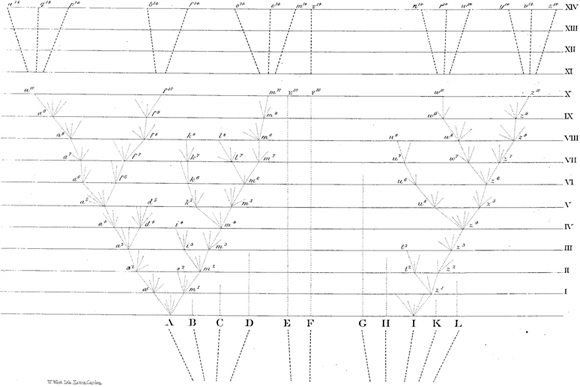
The accompanying diagram will aid us in understanding this rather perplexing subject. Let A to L represent the species of a genus large in its own country; these species are supposed to resemble each other in unequal degrees, as is so generally the case in nature, and as is represented in the diagram by the letters standing at unequal distances. I have said a large genus, because we have seen in the second chapter, that on an average more of the species of large genera vary than of small genera; and the varying species of the large genera present a greater number of varieties. We have, also, seen that the species, which are the commonest and the most widely-diffused, vary more than rare species with restricted ranges. Let (A) be a common, widely-diffused, and varying species, belonging to a genus large in its own country. The little fan of diverging dotted lines of unequal lengths proceeding from (A), may represent its varying offspring. The variations are supposed to be extremely slight, but of the most diversified nature; they are not supposed all to appear simultaneously, but often after long intervals of time; nor are they all supposed to endure for equal periods. Only those variations which are in some way profitable will be preserved or naturally selected. And here the importance of the principle of benefit being derived from divergence of character comes in; for this will generally lead to the most different or divergent variations (represented by the outer dotted lines) being preserved and accumulated by natural selection. When a dotted line reaches one of the horizontal lines, and is there marked by a small numbered letter, a sufficient amount of variation is supposed to have been accumulated to have formed a fairly well-marked variety, such as would be thought worthy of record in a systematic work.
The intervals between the horizontal lines in the diagram, may represent each a thousand generations; but it would have been better if each had represented ten thousand generations. After a thousand generations, species (A) is supposed to have produced two fairly well-marked varieties, namely a1 and m1. These two varieties will generally continue to be exposed to the same conditions which made their parents variable, and the tendency to variability is in itself hereditary, consequently they will tend to vary, and generally to vary in nearly the same manner as their parents varied. Moreover, these two varieties, being only slightly modified forms, will tend to inherit those advantages which made their common parent (A) more numerous than most of the other inhabitants of the same country; they will likewise partake of those more general advantages which made the genus to which the parent-species belonged, a large genus in its own country. And these circumstances we know to be favourable to the production of new varieties.
If, then, these two varieties be variable, the most divergent of their variations will generally be preserved during the next thousand generations. And after this interval, variety a1 is supposed in the diagram to have produced variety a2, which will, owing to the principle of divergence, differ more from (A) than did variety a1. Variety m1 is supposed to have produced two varieties, namely m2 and s2, differing from each other, and more considerably from their common parent (A). We may continue the process by similar steps for any length of time; some of the varieties, after each thousand generations, producing only a single variety, but in a more and more modified condition, some producing two or three varieties, and some failing to produce any. Thus the varieties or modified descendants, proceeding from the common parent (A), will generally go on increasing in number and diverging in character. In the diagram the process is represented up to the ten-thousandth generation, and under a condensed and simplified form up to the fourteen-thousandth generation.
But I must here remark that I do not suppose that the process ever goes on so regularly as is represented in the diagram, though in itself made somewhat irregular. I am far from thinking that the most divergent varieties will invariably prevail and multiply: a medium form may often long endure, and may or may not produce more than one modified descendant; for natural selection will always act according to the nature of the places which are either unoccupied or not perfectly occupied by other beings; and this will depend on infinitely complex relations. But as a general rule, the more diversified in structure the descendants from any one species can be rendered, the more places they will be enabled to seize on, and the more their modified progeny will be increased. In our diagram the line of succession is broken at regular intervals by small numbered letters marking the successive forms which have become sufficiently distinct to be recorded as varieties. But these breaks are imaginary, and might have been inserted anywhere, after intervals long enough to have allowed the accumulation of a considerable amount of divergent variation.
...
But during the process of modification, represented in the diagram, another of our principles, namely that of extinction, will have played an important part. As in each fully stocked country natural selection necessarily acts by the selected form having some advantage in the struggle for life over other forms, there will be a constant tendency in the improved descendants of any one species to supplant and exterminate in each stage of descent their predecessors and their original parent. For it should be remembered that the competition will generally be most severe between those forms which are most nearly related to each other in habits, constitution, and structure. Hence all the intermediate forms between the earlier and later states, that is between the less and more improved state of a species, as well as the original parent-species itself, will generally tend to becomeextinct. So it probably will be with many whole collateral lines of descent, which will be conquered by later and improved lines of descent. If, however, the modified offspring of a species get into some distinct country, or become quickly adapted to some quite new station, in which child and parent do not come into competition, both may continue to exist.
...
It is worthwhile to reflect for a moment on the character of the new species F14, which is supposed not to have diverged much in character, but to have retained the form of (F), either unaltered or altered only in a slight degree. In this case, its affinities to the other fourteen new species will be of a curious and circuitous nature. Having descended from a form which stood between the two parent-species (A) and (I), now supposed to be extinct and unknown, it will be in some degree intermediate in character between the two groups descended from these species. But as these two groups have gone on diverging in character from the type of their parents, the new species (F14) will not be directly intermediate between them, but rather between types of the two groups; and every naturalist will be able to bring some such case before his mind.
In the diagram, each horizontal line has hitherto been supposed to represent a thousand generations, but each may represent a million or hundred million generations, and likewise a section of the successive strata of the earth’s crust including extinct remains. We shall, when we come to our chapter on Geology, have to refer again to this subject, and I think we shall then see that the diagram throws light on the affinities of extinct beings, which, though generally belonging to the same orders, or families, or genera, with those now living, yet are often, in some degree, intermediate in character between existing groups; and we can understand this fact, for the extinct species lived at very ancient epochs when the branching lines of descent had diverged less.
I see no reason to limit the process of modification, as now explained, to the formation of genera alone. If, in our diagram, we suppose the amount of change represented by each successive group of diverging dotted lines to be very great, the forms marked a14 to p14, those marked b14 and f14, and those marked o14 to m14, will form three very distinct genera. We shall also have two very distinct genera descended from (I) and as these latter two genera, both from continued divergence of character and from inheritance from a different parent, will differ widely from the three genera descended from (A), the two little groups of genera will form two distinct families, or even orders, according to the amount of divergent modification supposed to be represented in the diagram. And the two new families, or orders, will have descended from two species of the original genus; and these two species are supposed to have descended from one species of a still more ancient and unknown genus.
We have seen that in each country it is the species of the larger genera which oftenest present varieties or incipient species. This, indeed, might have been expected; for as natural selection acts through one form having some advantage over other forms in the struggle for existence, it will chiefly act on those which already have some advantage; and the largeness of any group shows that its species have inherited from a common ancestor some advantage in common. Hence, the struggle for the production of new and modified descendants, will mainly lie between the larger groups, which are all trying to increase in number. One large group will slowly conquer another large group, reduce its numbers, and thus lessen its chance of further variation and improvement. Within the same large group, the later and more highly perfected sub-groups, from branching out and seizing on many new places in the polity of Nature, will constantly tend to supplant and destroy the earlier and less improved sub-groups. Small and broken groups and sub-groups will finally tend to disappear. Looking to the future, we can predict that the groups of organic beings which are now large and triumphant, and which are least broken up, that is, which as yet have suffered least extinction, will for a long period continue to increase. But which groups will ultimately prevail, no man can predict; for we well know that many groups, formerly most extensively developed, have now become extinct. Looking still more remotely to the future, we may predict that, owing to the continued and steady increase of the larger groups, a multitude of smaller groups will become utterly extinct, and leave no modified descendants; and consequently that of the species living at any one period, extremely few will transmit descendants to a remote futurity. I shall have to return to this subject in the chapter on Classification, but I may add that on this view of extremely few of the more ancient species having transmitted descendants, and on the view of all the descendants of the same species making a class, we can understand how it is that there exist but very few classes in each main division of the animal and vegetable kingdoms. Although extremely few of the most ancient species may now have living and modified descendants, yet at the most remote geological period, the earth may have been as well peopled with many species of many genera, families, orders, and classes, as at the present day.
Summary of Chapter
If during the long course of ages and under varying conditions of life, organic beings vary at all in the several parts of their organisation, and I think this cannot be disputed; if there be, owing to the high geometrical powers of increase of each species, at some age, season, or year, a severe struggle for life, and this certainly cannot be disputed; then, considering the infinite complexity of the relations of all organic beings to each other and to their conditions of existence, causing an infinite diversity in structure, constitution, and habits, to be advantageous to them, I think it would be a most extraordinary fact if no variation ever had occurred useful to each being’s own welfare, in the same way as so many variations have occurred useful to man. But if variations useful to any organic being do occur, assuredly individuals thus characterised will have the best chance of being preserved in the struggle for life; and from the strong principle of inheritance they will tend to produce offspring similarly characterised. This principle of preservation, I have called, for the sake of brevity, Natural Selection. Natural selection, on the principle of qualities being inherited at corresponding ages, can modify the egg, seed, or young, as easily as the adult. Amongst many animals, sexual selection will give its aid to ordinary selection, by assuring to the most vigorous and best adapted males the greatest number of offspring. Sexual selection will also give characters useful to the males alone, in their struggles with other males.
Whether natural selection has really thus acted in nature, in modifying and adapting the various forms of life to their several conditions and stations, must be judged of by the general tenour and balance of evidence given in the following chapters. But we already see how it entails extinction; and how largely extinction has acted in the world’s history, geology plainly declares. Natural selection, also, leads to divergence of character; for more living beings can be supported on the same area the more they diverge in structure, habits, and constitution, of which we see proof by looking at the inhabitants of any small spot or at naturalised productions. Therefore during the modification of the descendants of any one species, and during the incessant struggle of all species to increase in numbers, the more diversified these descendants become, the better will be their chance of succeeding in the battle of life. Thus the small differences distinguishing varieties of the same species, will steadily tend to increase till they come to equal the greater differences between species of the same genus, or even of distinct genera.
We have seen that it is the common, the widely-diffused, and widely-ranging species, belonging to the larger genera, which vary most; and these will tend to transmit to their modified offspring that superiority which now makes them dominant in their own countries. Natural selection, as has just been remarked, leads to divergence of character and to much extinction of the less improved and intermediate forms of life. On these principles, I believe, the nature of the affinities of all organic beings may be explained. It is a truly wonderful fact—the wonder of which we are apt to overlook from familiarity—that all animals and all plants throughout all time and space should be related to each other in group subordinate to group, in the manner which we everywhere behold—namely, varieties of the same species most closely related together, species of the same genus less closely and unequally related together, forming sections and sub-genera, species of distinct genera much less closely related, and genera related in different degrees, forming sub-families, families, orders, sub-classes, and classes. The several subordinate groups in any class cannot be ranked in a single file, but seem rather to be clustered round points, and these round other points, and so on in almost endless cycles. On the view that each species has been independently created, I can see no explanation of this great fact in the classification of all organic beings; but, to the best of my judgment, it is explained through inheritance and the complex action of natural selection, entailing extinction and divergence of character, as we have seen illustrated in the diagram.
The affinities of all the beings of the same class have sometimes been represented by a great tree. I believe this simile largely speaks the truth. The green and budding twigs may represent existing species; and those produced during each former year may represent the long succession of extinct species. At each period of growth all the growing twigs have tried to branch out on all sides, and to overtop and kill the surrounding twigs and branches, in the same manner as species and groups of species have tried to overmaster other species in the great battle for life. The limbs divided into great branches, and these into lesser and lesser branches, were themselves once, when the tree was small, budding twigs; and this connexion of the former and present buds by ramifying branches may well represent the classification of all extinct and living species in groups subordinate to groups. Of the many twigs which flourished when the tree was a mere bush, only two or three, now grown into great branches, yet survive and bear all the other branches; so with the species which lived during long-past geological periods, very few now have living and modified descendants. From the first growth of the tree, many a limb and branch has decayed and dropped off; and these lost branches of various sizes may represent those whole orders, families, and genera which have now no living representatives, and which are known to us only from having been found in a fossil state. As we here and there see a thin straggling branch springing from a fork low down in a tree, and which by some chance has been favoured and is still alive on its summit, so we occasionally see an animal like the Ornithorhynchus or Lepidosiren, which in some small degree connects by its affinities two large branches of life, and which has apparently been saved from fatal competition by having inhabited a protected station. As buds give rise by growth to fresh buds, and these, if vigorous, branch out and overtop on all sides many a feebler branch, so by generation I believe it has been with the great Tree of Life, which fills with its dead and broken branches the crust of the earth, and covers the surface with its ever branching and beautiful ramifications.
...
9. On the Imperfection of the Geological Record
On the absence of intermediate varieties at the present day. On the nature of extinct intermediate varieties; on their number. On the vast lapse of time, as inferred from the rate of deposition and of denudation. On the poorness of our palaeontological collections. On the intermittence of geological formations. On the absence of intermediate varieties in any one formation. On the sudden appearance of groups of species. On their sudden appearance in the lowest known fossiliferous strata.
In the sixth chapter I enumerated the chief objections which might be justly urged against the views maintained in this volume. Most of them have now been discussed. One, namely the distinctness of specific forms, and their not being blended together by innumerable transitional links, is a very obvious difficulty. I assigned reasons why such links do not commonly occur at the present day, under the circumstances apparently most favourable for their presence, namely on an extensive and continuous area with graduated physical conditions. I endeavoured to show, that the life of each species depends in a more important manner on the presence of other already defined organic forms, than on climate; and, therefore, that the really governing conditions of life do not graduate away quite insensibly like heat or moisture. I endeavoured, also, to show that intermediate varieties, from existing in lesser numbers than the forms which they connect, will generally be beaten out and exterminated during the course of further modification and improvement. The main cause, however, of innumerable intermediate links not now occurring everywhere throughout nature depends on the very process of natural selection, through which new varieties continually take the places of and exterminate their parent-forms. But just in proportion as this process of extermination has acted on an enormous scale, so must the number of intermediate varieties, which have formerly existed on the earth, be truly enormous. Why then is not every geological formation and every stratum full of such intermediate links? Geology assuredly does not reveal any such finely graduated organic chain; and this, perhaps, is the most obvious and gravest objection which can be urged against my theory. The explanation lies, as I believe, in the extreme imperfection of the geological record.
In the first place it should always be borne in mind what sort of intermediate forms must, on my theory, have formerly existed. I have found it difficult, when looking at any two species, to avoid picturing to myself, forms DIRECTLY intermediate between them. But this is a wholly false view; we should always look for forms intermediate between each species and a common but unknown progenitor; and the progenitor will generally have differed in some respects from all its modified descendants. To give a simple illustration: the fantail and pouter pigeons have both descended from the rock-pigeon; if we possessed all the intermediate varieties which have ever existed, we should have an extremely close series between both and the rock-pigeon; but we should have no varieties directly intermediate between the fantail and pouter; none, for instance, combining a tail somewhat expanded with a crop somewhat enlarged, the characteristic features of these two breeds. These two breeds, moreover, have become so much modified, that if we had no historical or indirect evidence regarding their origin, it would not have been possible to have determined from a mere comparison of their structure with that of the rock-pigeon, whether they had descended from this species or from some other allied species, such as C. oenas.
So with natural species, if we look to forms very distinct, for instance to the horse and tapir, we have no reason to suppose that links ever existed directly intermediate between them, but between each and an unknown common parent. The common parent will have had in its whole organisation much general resemblance to the tapir and to the horse; but in some points of structure may have differed considerably from both, even perhaps more than they differ from each other. Hence in all such cases, we should be unable to recognise the parent-form of any two or more species, even if we closely compared the structure of the parent with that of its modified descendants, unless at the same time we had a nearly perfect chain of the intermediate links.
It is just possible by my theory, that one of two living forms might have descended from the other; for instance, a horse from a tapir; and in this case DIRECT intermediate links will have existed between them. But such a case would imply that one form had remained for a very long period unaltered, whilst its descendants had undergone a vast amount of change; and the principle of competition between organism and organism, between child and parent, will render this a very rare event; for in all cases the new and improved forms of life will tend to supplant the old and unimproved forms.
By the theory of natural selection all living species have been connected with the parent-species of each genus, by differences not greater than we see between the varieties of the same species at the present day; and these parent-species, now generally extinct, have in their turn been similarly connected with more ancient species; and so on backwards, always converging to the common ancestor of each great class. So that the number of intermediate and transitional links, between all living and extinct species, must have been inconceivably great. But assuredly, if this theory be true, such have lived upon this earth.
On the Lapse of Time
Independently of our not finding fossil remains of such infinitely numerous connecting links, it may be objected, that time will not have sufficed for so great an amount of organic change, all changes having been effected very slowly through natural selection. It is hardly possible for me even to recall to the reader, who may not be a practical geologist, the facts leading the mind feebly to comprehend the lapse of time. He who can read Sir Charles Lyell’s grand work on the Principles of Geology, which the future historian will recognise as having produced a revolution in naturalscience, yet does not admit how incomprehensibly vast have been the past periods of time, may at once close this volume. Not that it suffices to study the Principles of Geology, or to read special treatises by different observers on separate formations, and to mark how each author attempts to give an inadequate idea of the duration of each formation or even each stratum. A man must for years examine for himself great piles of superimposed strata, and watch the sea at work grinding down old rocks and making fresh sediment, before he can hope to comprehend anything of the lapse of time, the monuments of which we see around us.
It is good to wander along lines of sea-coast, when formed of moderately hard rocks, and mark the process of degradation. The tides in most cases reach the cliffs only for a short time twice a day, and the waves eat into them only when they are charged with sand or pebbles; for there is reason to believe that pure water can effect little or nothing in wearing away rock. At last the base of the cliff is undermined, huge fragments fall down, and these remaining fixed, have to be worn away, atom by atom, until reduced in size they can be rolled about by the waves, and then are more quickly ground into pebbles, sand, or mud. But how often do we see along the bases of retreating cliffs rounded boulders, all thickly clothed by marine productions, showing how little they are abraded and how seldom they are rolled about! Moreover, if we follow for a few miles any line of rocky cliff, which is undergoing degradation, we find that it is only here and there, along a short length or round a promontory, that the cliffs are at the present time suffering. The appearance of the surface and the vegetation show that elsewhere years have elapsed since the waters washed their base.
...
I am tempted to give one other case, the well-known one of the denudation of the Weald. Though it must be admitted that the denudation of the Weald has been a mere trifle, in comparison with that which has removed masses of our palaeozoic strata, in parts ten thousand feet in thickness, as shown in Professor Ramsay’s masterly memoir on this subject. Yet it is an admirable lesson to stand on the North Downs and to look at the distant South Downs; for, remembering that at no great distance to the west the northern and southern escarpments meet and close, one can safely picture to oneself the great dome of rocks which must have covered up the Weald within so limited a period as since the latter part of the Chalk formation. The distance from the northern to the southern Downs is about 22 miles, and the thickness of the several formations is on an average about 1100 feet, as I am informed by Professor Ramsay. But if, as some geologists suppose, a range of older rocks underlies the Weald, on the flanks of which the overlying sedimentary deposits might have accumulated in thinner masses than elsewhere, the above estimate would be erroneous; but this source of doubt probably would not greatly affect the estimate as applied to the western extremity of the district. If, then, we knew the rate at which the sea commonly wears away a line of cliff of any given height, we could measure the time requisite to have denuded the Weald. This, of course, cannot be done; but we may, in order to form some crude notion on the subject, assume that the sea would eat into cliffs 500 feet in height at the rate of one inch in a century. This will at first appear much too small an allowance; but it is the same as if we were to assume a cliff one yard in height to be eaten back along a whole line of coast at the rate of one yard in nearly every twenty-two years. I doubt whether any rock, even as soft as chalk, would yield at this rate excepting on the most exposed coasts; though no doubt the degradation of a lofty cliff would be more rapid from the breakage of the fallen fragments. On the other hand, I do not believe that any line of coast, ten or twenty miles in length, ever suffers degradation at the same time along its whole indented length; and we must remember that almost all strata contain harder layers or nodules, which from long resisting attrition form a breakwater at the base. Hence, under ordinary circumstances, I conclude that for a cliff 500 feet in height, a denudation of one inch per century for the whole length would be an ample allowance. At this rate, on the above data, the denudation of the Weald must have required 306,662,400 years; or say three hundred million years.
The action of fresh water on the gently inclined Wealden district, when upraised, could hardly have been great, but it would somewhat reduce the above estimate. On the other hand, during oscillations of level, which we know this area has undergone, the surface may have existed for millions of years as land, and thus have escaped the action of the sea: when deeply submerged for perhaps equally long periods, it would, likewise, have escaped the action of the coast-waves. So that in all probability a far longer period than 300 million years has elapsed since the latter part of the Secondary period.
I have made these few remarks because it is highly important for us to gain some notion, however imperfect, of the lapse of years. During each of these years, over the whole world, the land and the water has been peopled by hosts of living forms. What an infinite number of generations, which the mind cannot grasp, must have succeeded each other in the long roll of years! Now turn to our richest geological museums, and what a paltry display we behold!
On the Poorness of Our Palaeontological Collections
That our palaeontological collections are very imperfect, is admitted by everyone. The remark of that admirable palaeontologist, the late Edward Forbes, should not be forgotten, namely, that numbers of our fossil species are known and named from single and often broken specimens, or from a few specimens collected on some one spot. Only a small portion of the surface of the earth has been geologically explored, and no part with sufficient care, as the important discoveries made every year in Europe prove. No organism wholly soft can be preserved. Shells and bones will decay and disappear when left on the bottom of the sea, where sediment is not accumulating ... . I suspect that but few of the very many animals which live on the beach between high and low watermark are preserved.
...
If then, there be some degree of truth in these remarks, we have no right to expect to find in our geological formations, an infinite number of those fine transitional forms, which on my theory assuredly have connected all the past and present species of the same group into one long and branching chain of life. We ought only to look for a few links, some more closely, some more distantly related to each other; and these links, let them be ever so close, if found in different stages of the same formation, would, by most palaeontologists, be ranked as distinct species. But I do not pretend that I should ever have suspected how poor a record of the mutations of life, the best preserved geological section presented, had not the difficulty of our not discovering innumerable transitional links between the species which appeared at the commencement and close of each formation, pressed so hardly on my theory.
On the Sudden Appearance of Whole Groups of Allied Species
The abrupt manner in which whole groups of species suddenly appear in certain formations, has been urged by several palaeontologists, for instance, by Agassiz, Pictet, and by none more forcibly than by Professor Sedgwick, as a fatal objection to the belief in the transmutation of species. If numerous species, belonging to the same genera or families, have really started into life all at once, the fact would be fatal to the theory of descent with slow modification through natural selection. For the development of a group of forms, all of which have descended from some one progenitor, must have been an extremely slow process; and the progenitors must have lived long ages before their modified descendants. But we continually over-rate the perfection of the geological record, and falsely infer, because certain genera or families have not been found beneath a certain stage, that they did not exist before that stage. We continually forget how large the world is, compared with the area over which our geological formations have been carefully examined; we forget that groups of species may elsewhere have long existed and have slowly multiplied before they invaded the ancient archipelagoes of Europe and of the United States. We do not make due allowance for the enormous intervals of time, which have probably elapsed between our consecutive formations,—longer perhaps in some cases than the time required for the accumulation of each formation. These intervals will have given time for the multiplication of species from some one or some few parent-forms; and in the succeeding formation such species will appear as if suddenly created.
...
On the Sudden Appearance of Groups of Allied Species in the Lowest Known Fossiliferous Strata
There is another and allied difficulty, which is much graver. I allude to the manner in which numbers of species of the same group, suddenly appear in the lowest known fossiliferous rocks. Most of the arguments which have convinced me that all the existing species of the same group have descended from one progenitor, apply with nearly equal force to the earliest known species. For instance, I cannot doubt that all the Silurian trilobites have descended from some one crustacean, which must have lived long before the Silurian age, and which probably differed greatly from any known animal. Some of the most ancient Silurian animals, as the Nautilus, Lingula, etc., do not differ much from living species; and it cannot on my theory be supposed, that these old species were the progenitors of all the species of the orders to which they belong, for they do not present characters in any degree intermediate between them. If, moreover, they had been the progenitors of these orders, they would almost certainly have been long ago supplanted and exterminated by their numerous and improved descendants.
Consequently, if my theory be true, it is indisputable that before the lowest Silurian stratum was deposited, long periods elapsed, as long as, or probably far longer than, the whole interval from the Silurian age to the present day; and that during these vast, yet quite unknown, periods of time, the world swarmed with living creatures.
To the question why we do not find records of these vast primordial periods, I can give no satisfactory answer.
...
For my part, following out Lyell’s metaphor, I look at the natural geological record, as a history of the world imperfectly kept, and written in a changing dialect; of this history we possess the last volume alone, relating only to two or three countries. Of this volume, only here and there a short chapter has been preserved; and of each page, only here and there a few lines. Each word of the slowly-changing language, in which the history is supposed to be written, being more or less different in the interrupted succession of chapters, may represent the apparently abruptly changed forms of life, entombed in our consecutive, but widely separated formations. On this view, the difficulties above discussed are greatly diminished, or even disappear.
13. Mutual Affinities of Organic Beings: Morphology: Embryology: Rudimentary Organs
CLASSIFICATION, groups subordinate to groups. Natural system. Rules and difficulties in classification, explained on the theory of descent with modification. Classification of varieties. Descent always used in classification. Analogical or adaptive characters. Affinities, general, complex and radiating. Extinction separates and defines groups. MORPHOLOGY, between members of the same class, between parts of the same individual. EMBRYOLOGY, laws of, explained by variations not supervening at an early age, and being inherited at a corresponding age. RUDIMENTARY ORGANS; their origin explained. Summary.
From the first dawn of life, all organic beings are found to resemble each other in descending degrees, so that they can be classed in groups under groups. This classification is evidently not arbitrary like the grouping of the stars in constellations. The existence of groups would have been of simple signification, if one group had been exclusively fitted to inhabit the land, and another the water; one to feed on flesh, another on vegetable matter, and so on; but the case is widely different in nature; for it is notorious how commonly members of even the same subgroup have different habits. In our second and fourth chapters, on Variation and on Natural Selection, I have attempted to show that it is the widely ranging, the much diffused and common, that is the dominant species belonging to the larger genera, which vary most. The varieties, or incipient species, thus produced ultimately become converted, as I believe, into new and distinct species; and these, on the principle of inheritance, tend to produce other new and dominant species. Consequently the groups which are now large, and which generally include many dominant species, tend to go on increasing indefinitely in size. I further attempted to show that from the varying descendants of each species trying to occupy as many and as different places as possible in the economy of nature, there is a constant tendency in their characters to diverge. This conclusion was supported by looking at the great diversity of the forms of life which, in any small area, come into the closest competition, and by looking to certain facts in naturalisation.
I attempted also to show that there is a constant tendency in the forms which are increasing in number and diverging in character, to supplant and exterminate the less divergent, the less improved, and preceding forms. I request the reader to turn to the diagram illustrating the action, as formerly explained, of these several principles; and he will see that the inevitable result is that the modified descendants proceeding from one progenitor become broken up into groups subordinate to groups. In the diagram each letter on the uppermost line may represent a genus includingseveral species; and all the genera on this line form together one class, for all have descended from one ancient but unseen parent, and, consequently, have inherited something in common. But the three genera on the left hand have, on this same principle, much in common, and form a sub-family, distinct from that including the next two genera on the right hand, which diverged from a common parent at the fifth stage of descent. These five genera have also much, though less, in common; and they form a family distinct from that including the three genera still further to the right hand, which diverged at a still earlier period. And all these genera, descended from (A), form an order distinct from the genera descended from (I). So that we here have many species descended from a single progenitor grouped into genera; and the genera are included in, or subordinate to, sub-families, families, and orders, all united into one class. Thus, the grand fact in natural history of the subordination of group under group, which, from its familiarity, does not always sufficiently strike us, is in my judgment fully explained.
Naturalists try to arrange the species, genera, and families in each class, on what is called the Natural System. But what is meant by this system? Some authors look at it merely as a scheme for arranging together those living objects which are most alike, and for separating those which are most unlike; or as an artificial means for enunciating, as briefly as possible, general propositions,—that is, by one sentence to give the characters common, for instance, to all mammals, by another those common to all carnivora, by another those common to the dog-genus, and then by adding a single sentence, a full description is given of each kind of dog. The ingenuity and utility of this system are indisputable. But many naturalists think that something more is meant by the Natural System; they believe that it reveals the plan of the Creator; but unless it be specified whetherorder in time or space, or what else is meant by the plan of the Creator, it seems to me that nothing is thus added to our knowledge. Such expressions as that famous one of Linnaeus, and which we often meet with in a more or less concealed form, that the characters do not make the genus, but that the genus gives the characters, seem to imply that something more is included in our classification, than mere resemblance. I believe that something more is included; and that propinquity of descent,—the only known cause of the similarity of organic beings,—is the bond, hidden as it is by various degrees of modification, which is partially revealed to us by our classifications.
Let us now consider the rules followed in classification, and the difficulties which are encountered on the view that classification either gives some unknown plan of creation, or is simply a scheme for enunciating general propositions and of placing together the forms most like each other. It might have been thought (and was in ancient times thought) that those parts of the structure which determined the habits of life, and the general place of each being in the economy of nature, would be of very high importance in classification. Nothing can be more false. No one regards the external similarity of a mouse to a shrew, of a dugong to a whale, of a whale to a fish, as of any importance.
...
All the foregoing rules and aids and difficulties in classification are explained, if I do not greatly deceive myself, on the view that the natural system is founded on descent with modification; that the characters which naturalists consider as showing true affinity between any two or more species, are those which have been inherited from a common parent, and, in so far, all true classification is genealogical; that community of descent is the hidden bond which naturalists have been unconsciously seeking, and not some unknown plan of creation, or the enunciation of general propositions, and the mere putting together and separating objects more or less alike.
...
Thus, on the view which I hold, the natural system is genealogical in its arrangement, like a pedigree; but the degrees of modification which the different groups have undergone, have to be expressed by ranking them under different so-called genera, sub-families, families, sections, orders, and classes.
...
We can understand, on these views, the very important distinction between real affinities and analogical or adaptive resemblances. Lamarck first called attention to this distinction, and he has been ably followed by Macleay and others. The resemblance, in the shape of the body and in the fin-like anterior limbs, between the dugong, which is a pachydermatous animal, and the whale, and between both these mammals and fishes, is analogical. Amongst insects there are innumerable instances: thus Linnaeus, misled by external appearances, actually classed an homopterous insect as a moth. We see something of the same kind even in our domestic varieties, as in the thickened stems of the common and Swedish turnip. The resemblance of the greyhound and racehorse is hardly more fanciful than the analogies which have been drawn by some authors between very distinct animals. On my view of characters being of real importance for classification, only in so far as they reveal descent, we can clearly understand why analogical or adaptive character, although of the utmost importance to the welfare of the being, are almost valueless to the systematist. For animals, belonging to two most distinct lines of descent, may readily become adapted to similar conditions, and thus assume a close external resemblance; but such resemblances will not reveal—will rather tend to conceal their blood-relationship to their proper lines of descent. We can also understand the apparent paradox, that the very same characters are analogical when one class or order is compared with another, but give true affinities when the members of the same class or order are compared one with another: thus the shape of the body and fin-like limbs are only analogical when whales are compared with fishes, being adaptations in both classes for swimming through the water; but the shape of the body and fin-like limbs serve as characters exhibiting true affinity between the several members of the whale family; for these cetaceans agree in so many characters, great and small, that we cannot doubt that they have inherited their general shape of body and structure of limbs from a common ancestor. So it is with fishes.
...
Morphology
We have seen that the members of the same class, independently of their habits of life, resemble each other in the general plan of their organisation. This resemblance is often expressed by the term “unity of type”; or by saying that the several parts and organs in the different species of the class are homologous. The whole subject is included under the general name of Morphology. This is the most interesting department of natural history, and may be said to be its very soul. What can be more curious than that the hand of a man, formed for grasping, that of a mole for digging, the leg of the horse, the paddle of the porpoise, and the wing of the bat, should all be constructed on the same pattern, and should include the same bones, in the same relative positions? Geoffroy St. Hilaire has insisted strongly on the high importance of relative connexion in homologous organs: the parts may change to almost any extent in form and size, and yet they always remain connected together in the same order. We never find, for instance, the bones of the arm and forearm, or of the thigh and leg, transposed. Hence the same names can be given to the homologous bones in widely different animals. We see the same great law in the construction of the mouths of insects: what can be more different than the immensely long spiral proboscis of a sphinx-moth, the curious folded one of a bee or bug, and the great jaws of a beetle?—yet all these organs, serving for such different purposes, are formed by infinitely numerous modifications of an upper lip, mandibles, and two pairs of maxillae. Analogous laws govern the construction of the mouths and limbs of crustaceans. So it is with the flowers of plants.
Nothing can be more hopeless than to attempt to explain this similarity of pattern in members of the same class, by utility or by the doctrine of final causes. The hopelessness of the attempt has been expressly admitted by Owen in his most interesting work on the ‘Nature of Limbs.’ On the ordinary view of the independent creation of each being, we can only say that so it is;—that it has so pleased the Creator to construct each animal and plant.
The explanation is manifest on the theory of the natural selection of successive slight modifications,—each modification being profitable in some way to the modified form, but often affecting by correlation of growth other parts of the organisation. In changes of this nature, there will be little or no tendency to modify the original pattern, or to transpose parts. The bones of a limb might be shortened and widened to any extent, and become gradually enveloped in thick membrane, so as to serve as a fin; or a webbed foot might have all its bones, or certain bones, lengthened to any extent, and the membrane connecting them increased to any extent, so as to serve as a wing: yet in all this great amount of modification there will be no tendency to alter the framework of bones or the relative connexion of the several parts. If we suppose that the ancient progenitor, the archetype as it may be called, of all mammals, had its limbs constructed on the existing general pattern, for whatever purpose they served, we can at once perceive the plain signification of the homologous construction of the limbs throughout the whole class.
...
How inexplicable are these facts on the ordinary view of creation! Why should the brain be enclosed in a box composed of such numerous and such extraordinarily shaped pieces of bone? As Owen has remarked, the benefit derived from the yielding of the separate pieces in the act of parturition of mammals, will by no means explain the same construction in the skulls of birds. Why should similar bones have been created in the formation of the wing and leg of a bat, used as they are for such totally different purposes? Why should one crustacean, which has an extremely complex mouth formed of many parts, consequently always have fewer legs; or conversely, those with many legs have simpler mouths? Why should the sepals, petals, stamens, and pistils in any individual flower, though fitted for such widely different purposes, be all constructed on the same pattern?
On the theory of natural selection, we can satisfactorily answer these questions. In the vertebrata, we see a series of internal vertebrae bearing certain processes and appendages; in the articulata, we see the body divided into a series of segments, bearing external appendages; and in flowering plants, we see a series of successive spiral whorls of leaves. An indefinite repetition of the same part or organ is the common characteristic (as Owen has observed) of all low or little-modified forms; therefore we may readily believe that the unknown progenitor of the vertebrata possessed many vertebrae; the unknown progenitor of the articulata, many segments; and the unknown progenitor of flowering plants, many spiral whorls of leaves. We have formerly seen that parts many times repeated are eminently liable to vary in number and structure; consequently it is quite probable that natural selection, during a long-continued course of modification, should have seized on a certain number of the primordially similar elements, many times repeated, and have adapted them to the most diverse purposes. And as the whole amount of modification will have been effected by slight successive steps, we need not wonder at discovering in such parts or organs, a certain degree of fundamental resemblance, retained by the strong principle of inheritance.
...
Embryology
It has already been casually remarked that certain organs in the individual, which when mature become widely different and serve for different purposes, are in the embryo exactly alike. The embryos, also, of distinct animals within the same class are often strikingly similar: a better proof ofthis cannot be given, than a circumstance mentioned by Agassiz, namely, that having forgotten to ticket the embryo of some vertebrate animal, he cannot now tell whether it be that of a mammal, bird, or reptile. The vermiform larvae of moths, flies, beetles, etc., resemble each other much more closely than do the mature insects; but in the case of larvae, the embryos are active, and have been adapted for special lines of life. A trace of the law of embryonic resemblance, sometimes lasts till a rather late age: thus birds of the same genus, and of closely allied genera, often resemble each other in their first and second plumage; as we see in the spotted feathers in the thrush group. In the cat tribe, most of the species are striped or spotted in lines; and stripes can be plainly distinguished in the whelp of the lion. We occasionally though rarely see something of this kind in plants: thus the embryonic leaves of the ulex or furze, and the first leaves of the phyllodineous acaceas, are pinnate or divided like the ordinary leaves of the leguminosae.
The points of structure, in which the embryos of widely different animals of the same class resemble each other, often have no direct relation to their conditions of existence. We cannot, for instance, suppose that in the embryos of the vertebrata the peculiar loop-like course of the arteries near the branchial slits are related to similar conditions,—in the young mammal which is nourished in the womb of its mother, in the egg of the bird which is hatched in a nest, and in the spawn of a frog under water. We have no more reason to believe in such a relation, than we have to believe that the same bones in the hand of a man, wing of a bat, and fin of a porpoise, are related to similar conditions of life. No one will suppose that the stripes on the whelp of a lion, or the spots on the young blackbird, are of any use to these animals, or are related to the conditions to which they are exposed.
...
But there is no obvious reason why, for instance, the wing of a bat, or the fin of a porpoise, should not have been sketched out with all the parts in proper proportion, as soon as any structure became visible in the embryo. And in some whole groups of animals and in certain members of other groups, the embryo does not at any period differ widely from the adult: thus Owen has remarked in regard to cuttle-fish, “there is no metamorphosis; the cephalopodic character is manifested long before the parts of the embryo are completed”; and again in spiders, “there is nothing worthy to be called a metamorphosis.” The larvae of insects, whether adapted to the most diverse and active habits, or quite inactive, being fed by their parents or placed in the midst of proper nutriment, yet nearly all pass through a similar worm-like stage of development; but in some few cases, as in that of Aphis, if we look to the admirable drawings by Professor Huxley of the development of this insect, we see no trace of the vermiform stage.
How, then, can we explain these several facts in embryology,—namely the very general, but not universal difference in structure between the embryo and the adult;—of parts in the same individual embryo, which ultimately become very unlike and serve for diverse purposes, being at this early period of growth alike;—of embryos of different species within the same class, generally, but not universally, resembling each other;—of the structure of the embryo not being closely related to its conditions of existence, except when the embryo becomes at any period of life active and has to provide for itself;—of the embryo apparently having sometimes a higher organisation than the mature animal, into which it is developed. I believe that all these facts can be explained, as follows, on the view of descent with modification.
...
The fore-limbs, for instance, which served as legs in the parent-species, may become, by a long course of modification, adapted in one descendant to act as hands, in another as paddles, in another as wings; and on the above two principles—namely of each successive modification supervening at a rather late age, and being inherited at a corresponding late age—the fore-limbs in the embryos of the several descendants of the parent-species will still resemble each other closely, for they will not have been modified. But in each individual new species, the embryonic fore-limbs will differ greatly from the fore-limbs in the mature animal; the limbs in the latter having undergone much modification at a rather late period of life, and having thus been converted into hands, or paddles, or wings. Whatever influence long-continued exercise or use on the one hand, and disuse on the other, may have in modifying an organ, such influence will mainly affect the mature animal, which has come to its full powers of activity and has to gain its own living; and the effects thus produced will be inherited at a corresponding mature age. Whereas the young will remain unmodified, or be modified in a lesser degree, by the effects of use and disuse.
...
As all the organic beings, extinct and recent, which have ever lived on this earth have to be classed together, and as all have been connected by the finest gradations, the best, or indeed, if our collections were nearly perfect, the only possible arrangement, would be genealogical. Descent being on my view the hidden bond of connexion which naturalists have been seeking under the term of the natural system. On this view we can understand how it is that, in the eyes of most naturalists, the structure of the embryo is even more important for classification than that of the adult. For the embryo is the animal in its less modified state; and in so far it reveals the structure of its progenitor.
...
Thus, as it seems to me, the leading facts in embryology, which are second in importance to none in natural history, are explained on the principle of slight modifications not appearing, in the many descendants from someone ancient progenitor, at a very early period in the life of each, though perhaps caused at the earliest, and being inherited at a corresponding not early period. Embryology rises greatly in interest, when we thus look at the embryo as a picture, more or less obscured, of the common parent-form of each great class of animals.
Rudimentary, Atrophied, or Aborted Organs
Organs or parts in this strange condition, bearing the stamp of inutility, are extremely common throughout nature. For instance, rudimentary mammae are very general in the males of mammals: I presume that the “bastard-wing” in birds may be safely considered as a digit in a rudimentarystate: in very many snakes one lobe of the lungs is rudimentary; in other snakes there are rudiments of the pelvis and hind limbs. Some of the cases of rudimentary organs are extremely curious; for instance, the presence of teeth in foetal whales, which when grown up have not a tooth in their heads; and the presence of teeth, which never cut through the gums, in the upper jaws of our unborn calves. It has even been stated on good authority that rudiments of teeth can be detected in the beaks of certain embryonic birds. Nothing can be plainer than that wings are formed for flight, yet in how many insects do we see wings so reduced in size as to be utterly incapable of flight, and not rarely lying under wing-cases, firmly soldered together!
...
On my view of descent with modification, the origin of rudimentary organs is simple. We have plenty of cases of rudimentary organs in our domestic productions,—as the stump of a tail in tailless breeds,—the vestige of an ear in earless breeds,—the reappearance of minute dangling horns in hornless breeds of cattle, more especially, according to Youatt, in young animals,—and the state of the whole flower in the cauliflower. We often see rudiments of various parts in monsters. But I doubt whether any of these cases throw light on the origin of rudimentary organs in a state of nature, further than by showing that rudiments can be produced; for I doubt whether species under nature ever undergo abrupt changes. I believe that disuse has been the main agency; that it has led in successive generations to the gradual reduction of various organs, until they have become rudimentary,—as in the case of the eyes of animals inhabiting dark caverns, and of the wings of birds inhabiting oceanic islands, which have seldom been forced to take flight, and have ultimately lost the power of flying. Again, an organ useful under certain conditions, might become injurious under others, as with the wings of beetles living on small and exposed islands; and in this case natural selection would continue slowly to reduce the organ, until it was rendered harmless and rudimentary.
...
Summary
In this chapter I have attempted to show, that the subordination of group to group in all organisms throughout all time; that the nature of the relationship, by which all living and extinct beings are united by complex, radiating, and circuitous lines of affinities into one grand system; the rules followed and the difficulties encountered by naturalists in their classifications; the value set upon characters, if constant and prevalent, whether of high vital importance, or of the most trifling importance, or, as in rudimentary organs, of no importance; the wide opposition in value between analogical or adaptive characters, and characters of true affinity; and other such rules;—all naturally follow on the view of the common parentage of those forms which are considered by naturalists as allied, together with their modification through natural selection, with its contingencies of extinction and divergence of character. In considering this view of classification, it should be borne in mind that the element of descent has been universally used in ranking together the sexes, ages, and acknowledged varieties of the same species, however different they may be in structure. If we extend the use of this element of descent,—the only certainly known cause of similarity in organic beings,—we shall understand what is meant by the natural system: it is genealogical in its attempted arrangement, with the grades of acquired difference marked by the terms varieties, species, genera, families, orders, and classes.
On this same view of descent with modification, all the great facts in Morphology become intelligible,—whether we look to the same pattern displayed in the homologous organs, to whatever purpose applied, of the different species of a class; or to the homologous parts constructed on the same pattern in each individual animal and plant.
On the principle of successive slight variations, not necessarily or generally supervening at a very early period of life, and being inherited at a corresponding period, we can understand the great leading facts in Embryology; namely, the resemblance in an individual embryo of the homologous parts, which when matured will become widely different from each other in structure and function; and the resemblance in different species of a class of the homologous parts or organs, though fitted in the adult members for purposes as different as possible. Larvae are active embryos, which have become specially modified in relation to their habits of life, through the principle of modifications being inherited at corresponding ages. On this same principle—and bearing in mind, that when organs are reduced in size, either from disuse or selection, it will generally be at that period of life when the being has to provide for its own wants, and bearing in mind how strong is the principle of inheritance—the occurrence of rudimentary organs and their final abortion, present to us no inexplicable difficulties; on the contrary, their presence might have been even anticipated. The importance of embryological characters and of rudimentary organs in classification is intelligible, on the view that an arrangement is only so far natural as it is genealogical.
Finally, the several classes of facts which have been considered in this chapter, seem to me to proclaim so plainly, that the innumerable species, genera, and families of organic beings, with which this world is peopled, have all descended, each within its own class or group, from common parents, and have all been modified in the course of descent, that I should without hesitation adopt this view, even if it were unsupported by other facts or arguments.
14. Recapitulation and Conclusion
Recapitulation of the difficulties on the theory of Natural Selection. Recapitulation of the general and special circumstances in its favour. Causes of the general belief in the immutability of species. How far the theory of natural selection may be extended. Effects of its adoption on the study of Natural history. Concluding remarks.
As this whole volume is one long argument, it may be convenient to the reader to have the leading facts and inferences briefly recapitulated.
That many and grave objections may be advanced against the theory of descent with modification through natural selection, I do not deny. I have endeavoured to give to them their full force. Nothing at first can appear more difficult to believe than that the more complex organs and instincts should have been perfected, not by means superior to, though analogous with, human reason, but by the accumulation of innumerable slight variations, each good for the individual possessor. Nevertheless, this difficulty, though appearing to our imagination insuperably great, cannot be considered real if we admit the following propositions, namely,—that gradations in the perfection of any organ or instinct, which we may consider, either do now exist or could have existed, each good of its kind,—that all organs and instincts are, in ever so slight a degree, variable,—and, lastly, that there is a struggle for existence leading to the preservation of each profitable deviation of structure or instinct. The truth of these propositions cannot, I think, be disputed.
It is, no doubt, extremely difficult even to conjecture by what gradations many structures have been perfected, more especially amongst broken and failing groups of organic beings; but we see so many strange gradations in nature, as is proclaimed by the canon, “Natura non facit saltum,” that we ought to be extremely cautious in saying that any organ or instinct, or any whole being, could not have arrived at its present state by many graduated steps. There are, it must be admitted, cases of special difficulty on the theory of natural selection; and one of the most curious of theseis the existence of two or three defined castes of workers or sterile females in the same community of ants; but I have attempted to show how this difficulty can be mastered.
With respect to the almost universal sterility of species when first crossed, which forms so remarkable a contrast with the almost universal fertility of varieties when crossed, I must refer the reader to the recapitulation of the facts given at the end of the eighth chapter, which seem to me conclusively to show that this sterility is no more a special endowment than is the incapacity of two trees to be grafted together, but that it is incidental on constitutional differences in the reproductive systems of the intercrossed species. We see the truth of this conclusion in the vast difference in the result, when the same two species are crossed reciprocally; that is, when one species is first used as the father and then as the mother.
The fertility of varieties when intercrossed and of their mongrel offspring cannot be considered as universal; nor is their very general fertility surprising when we remember that it is not likely that either their constitutions or their reproductive systems should have been profoundly modified. Moreover, most of the varieties which have been experimentised on have been produced under domestication; and as domestication apparently tends to eliminate sterility, we ought not to expect it also to produce sterility.
The sterility of hybrids is a very different case from that of first crosses, for their reproductive organs are more or less functionally impotent; whereas in first crosses the organs on both sides are in a perfect condition. As we continually see that organisms of all kinds are rendered in some degree sterile from their constitutions having been disturbed by slightly different and new conditions of life, we need not feel surprise at hybrids being in some degree sterile, for their constitutions can hardly fail to have been disturbed from being compounded of two distinct organisations. This parallelism is supported by another parallel, but directly opposite, class of facts; namely, that the vigour and fertility of all organic beings are increased by slight changes in their conditions of life, and that the offspring of slightly modified forms or varieties acquire from being crossed increased vigour and fertility. So that, on the one hand, considerable changes in the conditions of life and crosses between greatly modified forms, lessen fertility; and on the other hand, lesser changes in the conditions of life and crosses between less modified forms, increase fertility.
Turning to geographical distribution, the difficulties encountered on the theory of descent with modification are grave enough. All the individuals of the same species, and all the species of the same genus, or even higher group, must have descended from common parents; and therefore, in however distant and isolated parts of the world they are now found, they must in the course of successive generations have passed from some one part to the others ... .
As on the theory of natural selection an interminable number of intermediate forms must have existed, linking together all the species in each group by gradations as fine as our present varieties, it may be asked, Why do we not see these linking forms all around us? Why are not all organic beings blended together in an inextricable chaos? With respect to existing forms, we should remember that we have no right to expect (excepting in rare cases) to discover DIRECTLY connecting links between them, but only between each and some extinct and supplanted form. Even on a wide area, which has during a long period remained continuous, and of which the climate and other conditions of life change insensibly in going from a district occupied by one species into another district occupied by a closely allied species, we have no just right to expect often to find intermediate varieties in the intermediate zone. For we have reason to believe that only a few species are undergoing change at any one period; and all changes are slowly effected. I have also shown that the intermediate varieties which will at first probably exist in the intermediate zones, will be liable to be supplanted by the allied forms on either hand; and the latter, from existing in greater numbers, will generally be modified and improved at a quicker rate than the intermediate varieties, which exist in lesser numbers; so that the intermediate varieties will, in the long run, be supplanted and exterminated.
On this doctrine of the extermination of an infinitude of connecting links, between the living and extinct inhabitants of the world, and at each successive period between the extinct and still older species, why is not every geological formation charged with such links? Why does not every collection of fossil remains afford plain evidence of the gradation and mutation of the forms of life? We meet with no such evidence, and this is the most obvious and forcible of the many objections which may be urged against my theory. Why, again, do whole groups of allied species appear, though certainly they often falsely appear, to have come in suddenly on the several geological stages? Why do we not find great piles of strata beneath the Silurian system, stored with the remains of the progenitors of the Silurian groups of fossils? For certainly on my theory such strata must somewhere have been deposited at these ancient and utterly unknown epochs in the world’s history.
I can answer these questions and grave objections only on the supposition that the geological record is far more imperfect than most geologists believe. It cannot be objected that there has not been time sufficient for any amount of organic change; for the lapse of time has been so great as to be utterly inappreciable by the human intellect. The number of specimens in all our museums is absolutely as nothing compared with the countless generations of countless species which certainly have existed. We should not be able to recognise a species as the parent of any one or more species if we were to examine them ever so closely, unless we likewise possessed many of the intermediate links between their past or parent and present states; and these many links we could hardly ever expect to discover, owing to the imperfection of the geological record. Numerous existing doubtful forms could be named which are probably varieties; but who will pretend that in future ages so many fossil links will be discovered, that naturalists will be able to decide, on the common view, whether or not these doubtful forms are varieties? As long as most of the links between any two species are unknown, if any one link or intermediate variety be discovered, it will simply be classed as another and distinct species. Only a small portion of the world has been geologically explored. Only organic beings of certain classes can be preserved in a fossil condition, at least in any great number ... .
With respect to the absence of fossiliferous formations beneath the lowest Silurian strata, I can only recur to the hypothesis given in the ninth chapter. That the geological record is imperfect all will admit; but that it is imperfect to the degree which I require, few will be inclined to admit. If we look to long enough intervals of time, geology plainly declares that all species have changed; and they have changed in the manner which my theory requires, for they have changed slowly and in a graduated manner. We clearly see this in the fossil remains from consecutive formations invariably being much more closely related to each other, than are the fossils from formations distant from each other in time.
Such is the sum of the several chief objections and difficulties which may justly be urged against my theory; and I have now briefly recapitulated the answers and explanations which can be given to them. I have felt these difficulties far too heavily during many years to doubt their weight. But it deserves especial notice that the more important objections relate to questions on which we are confessedly ignorant; nor do we know how ignorant we are. We do not know all the possible transitional gradations between the simplest and the most perfect organs; it cannot be pretended that we know all the varied means of Distribution during the long lapse of years, or that we know how imperfect the Geological Record is. Grave as these several difficulties are, in my judgment they do not overthrow the theory of descent with modification.
Now let us turn to the other side of the argument. Under domestication we see much variability. This seems to be mainly due to the reproductive system being eminently susceptible to changes in the conditions of life; so that this system, when not rendered impotent, fails to reproduce offspring exactly like the parent-form. Variability is governed by many complex laws,—by correlation of growth, by use and disuse, and by the direct action of the physical conditions of life. There is much difficulty in ascertaining how much modification our domestic productions have undergone; but we may safely infer that the amount has been large, and that modifications can be inherited for long periods. As long as the conditions of life remain the same, we have reason to believe that a modification, which has already been inherited for many generations, may continue to be inherited for an almost infinite number of generations. On the other hand we have evidence that variability, when it has once come into play, does not wholly cease; for new varieties are still occasionally produced by our most anciently domesticated productions.
Man does not actually produce variability; he only unintentionally exposes organic beings to new conditions of life, and then nature acts on the organisation, and causes variability. But man can and does select the variations given to him by nature, and thus accumulate them in any desired manner. He thus adapts animals and plants for his own benefit or pleasure. He may do this methodically, or he may do it unconsciously by preserving the individuals most useful to him at the time, without any thought of altering the breed. It is certain that he can largely influence the character of a breed by selecting, in each successive generation, individual differences so slight as to be quite inappreciable by an uneducated eye. This process of selection has been the great agency in the production of the most distinct and useful domestic breeds. That many of the breeds produced by man have to a large extent the character of natural species, is shown by the inextricable doubts whether very many of them are varieties or aboriginal species.
There is no obvious reason why the principles which have acted so efficiently under domestication should not have acted under nature. In the preservation of favoured individuals and races, during the constantly-recurrent Struggle for Existence, we see the most powerful and ever-acting means of selection. The struggle for existence inevitably follows from the high geometrical ratio of increase which is common to all organic beings. This high rate of increase is proved by calculation, by the effects of a succession of peculiar seasons, and by the results of naturalisation, as explained in the third chapter. More individuals are born than can possibly survive. A grain in the balance will determine which individual shall live and which shall die,—which variety or species shall increase in number, and which shall decrease, or finally become extinct. As the individuals of the same species come in all respects into the closest competition with each other, the struggle will generally be most severe between them; it will be almost equally severe between the varieties of the same species, and next in severity between the species of the same genus. But the struggle will often be very severe between beings most remote in the scale of nature. The slightest advantage in one being, at any age or during any season, over those with which it comes into competition, or better adaptation in however slight a degree to the surrounding physical conditions, will turn the balance.
With animals having separated sexes there will in most cases be a struggle between the males for possession of the females. The most vigorous individuals, or those which have most successfully struggled with their conditions of life, will generally leave most progeny. But success will often depend on having special weapons or means of defence, or on the charms of the males; and the slightest advantage will lead to victory.
As geology plainly proclaims that each land has undergone great physical changes, we might have expected that organic beings would have varied under nature, in the same way as they generally have varied under the changed conditions of domestication. And if there be any variability under nature, it would be an unaccountable fact if natural selection had not come into play. It has often been asserted, but the assertion is quite incapable of proof, that the amount of variation under nature is a strictly limited quantity. Man, though acting on external characters alone and often capriciously, can produce within a short period a great result by adding up mere individual differences in his domestic productions; and every one admits that there are at least individual differences in species under nature. But, besides such differences, all naturalists have admitted the existence of varieties, which they think sufficiently distinct to be worthy of record in systematic works. No one can draw any clear distinction between individual differences and slight varieties; or between more plainly marked varieties and sub-species, and species. Let it be observed how naturalists differ in the rank which they assign to the many representative forms in Europe and North America.
If then we have under nature variability and a powerful agent always ready to act and select, why should we doubt that variations in any way useful to beings, under their excessively complex relations of life, would be preserved, accumulated, and inherited? Why, if man can by patience select variations most useful to himself, should nature fail in selecting variations useful, under changing conditions of life, to her living products? What limit can be put to this power, acting during long ages and rigidly scrutinising the whole constitution, structure, and habits of each creature,—favouring the good and rejecting the bad? I can see no limit to this power, in slowly and beautifully adapting each form to the most complex relations of life. The theory of natural selection, even if we looked no further than this, seems to me to be in itself probable. I have already recapitulated, as fairly as I could, the opposed difficulties and objections: now let us turn to the special facts and arguments in favour of the theory.
On the view that species are only strongly marked and permanent varieties, and that each species first existed as a variety, we can see why it is that no line of demarcation can be drawn between species, commonly supposed to have been produced by special acts of creation, and varieties which are acknowledged to have been produced by secondary laws. On this same view we can understand how it is that in each region where many species of a genus have been produced, and where they now flourish, these same species should present many varieties; for where the manufactory of species has been active, we might expect, as a general rule, to find it still in action; and this is the case if varieties be incipient species. Moreover, the species of the larger genera, which afford the greater number of varieties or incipient species, retain to a certain degree the character of varieties; for they differ from each other by a less amount of difference than do the species of smaller genera. The closely allied species also of the larger genera apparently have restricted ranges, and they are clustered in little groups round other species—in which respects they resemble varieties. These are strange relations on the view of each species having been independently created, but are intelligible if all species first existed as varieties.
As each species tends by its geometrical ratio of reproduction to increase inordinately in number; and as the modified descendants of each species will be enabled to increase by so much the more as they become more diversified in habits and structure, so as to be enabled to seize on many and widely different places in the economy of nature, there will be a constant tendency in natural selection to preserve the most divergent offspring of any one species. Hence during a long-continued course of modification, the slight differences, characteristic of varieties of the same species, tend to be augmented into the greater differences characteristic of species of the same genus. New and improved varieties will inevitably supplant and exterminate the older, less improved and intermediate varieties; and thus species are rendered to a large extent defined and distinct objects. Dominant species belonging to the larger groups tend to give birth to new and dominant forms; so that each large group tends to become still larger, and at the same time more divergent in character. But as all groups cannot thus succeed in increasing in size, for the world would not hold them, the more dominant groups beat the less dominant. This tendency in the large groups to go on increasing in size and diverging in character, together with the almost inevitable contingency of much extinction, explains the arrangement of all the forms of life, in groups subordinate to groups, all within a few great classes, which we now see everywhere around us, and which has prevailed throughout all time. This grand fact of the grouping of all organic beings seems to me utterly inexplicable on the theory of creation.
As natural selection acts solely by accumulating slight, successive, favourable variations, it can produce no great or sudden modification; it can act only by very short and slow steps. Hence the canon of “Natura non facit saltum,” which every fresh addition to our knowledge tends to make more strictly correct, is on this theory simply intelligible. We can plainly see why nature is prodigal in variety, though niggard in innovation. But why this should be a law of nature if each species has been independently created, no man can explain.
Many other facts are, as it seems to me, explicable on this theory. How strange it is that a bird, under the form of woodpecker, should have been created to prey on insects on the ground; that upland geese, which never or rarely swim, should have been created with webbed feet; that a thrush should have been created to dive and feed on sub-aquatic insects; and that a petrel should have been created with habits and structure fitting it for the life of an auk or grebe! and so on in endless other cases. But on the view of each species constantly trying to increase in number, with natural selection always ready to adapt the slowly varying descendants of each to any unoccupied or ill-occupied place in nature, these facts cease to be strange, or perhaps might even have been anticipated.
As natural selection acts by competition, it adapts the inhabitants of each country only in relation to the degree of perfection of their associates; so that we need feel no surprise at the inhabitants of any one country, although on the ordinary view supposed to have been specially created and adapted for that country, being beaten and supplanted by the naturalised productions from another land. Nor ought we to marvel if all the contrivances in nature be not, as far as we can judge, absolutely perfect; and if some of them be abhorrent to our ideas of fitness. We need not marvel at the sting of the bee causing the bee’s own death; at drones being produced in such vast numbers for one single act, and being then slaughtered by their sterile sisters; at the astonishing waste of pollen by our fir-trees; at the instinctive hatred of the queen bee for her own fertile daughters; at ichneumonidae feeding within the live bodies of caterpillars; and at other such cases. The wonder indeed is, on the theory of natural selection, that more cases of the want of absolute perfection have not been observed.
...
Looking to geographical distribution, if we admit that there has been during the long course of ages much migration from one part of the world to another, owing to former climatal and geographical changes and to the many occasional and unknown means of dispersal, then we can understand, on the theory of descent with modification, most of the great leading facts in Distribution.
...
The fact, as we have seen, that all past and present organic beings constitute one grand natural system, with group subordinate to group, and with extinct groups often falling in between recent groups, is intelligible on the theory of natural selection with its contingencies of extinction and divergence of character. On these same principles we see how it is, that the mutual affinities of the species and genera within each class are so complex and circuitous. We see why certain characters are far more serviceable than others for classification;—why adaptive characters, though of paramount importance to the being, are of hardly any importance in classification; why characters derived from rudimentary parts, though of no service to the being, are often of high classificatory value; and why embryological characters are the most valuable of all. The real affinities of all organic beings are due to inheritance or community of descent. The natural system is a genealogical arrangement, in which we have to discover the lines of descent by the most permanent characters, however slight their vital importance may be.
The framework of bones being the same in the hand of a man, wing of a bat, fin of the porpoise, and leg of the horse,—the same number of vertebrae forming the neck of the giraffe and of the elephant,—and innumerable other such facts, at once explain themselves on the theory of descent with slow and slight successive modifications. The similarity of pattern in the wing and leg of a bat, though used for such different purpose,—in the jaws and legs of a crab,—in the petals, stamens, and pistils of a flower, is likewise intelligible on the view of the gradual modification of parts or organs, which were alike in the early progenitor of each class. On the principle of successive variations not always supervening at an early age, and being inherited at a corresponding not early period of life, we can clearly see why the embryos of mammals, birds, reptiles, and fishes should be so closely alike, and should be so unlike the adult forms. We may cease marvelling at the embryo of an air-breathing mammal or bird having branchial slits and arteries running in loops, like those in a fish which has to breathe the air dissolved in water, by the aid of well-developed branchiae.
...
I have now recapitulated the chief facts and considerations which have thoroughly convinced me that species have changed, and are still slowly changing by the preservation and accumulation of successive slight favourable variations. Why, it may be asked, have all the most eminent living naturalists and geologists rejected this view of the mutability of species? It cannot be asserted that organic beings in a state of nature are subject to no variation; it cannot be proved that the amount of variation in the course of long ages is a limited quantity; no clear distinction has been, or can be, drawn between species and well-marked varieties. It cannot be maintained that species when intercrossed are invariably sterile, and varieties invariably fertile; or that sterility is a special endowment and sign of creation. The belief that species were immutable productions was almost unavoidable as long as the history of the world was thought to be of short duration; and now that we have acquired some idea of the lapse of time, we are too apt to assume, without proof, that the geological record is so perfect that it would have afforded us plain evidence of the mutation of species, if they had undergone mutation.
But the chief cause of our natural unwillingness to admit that one species has given birth to other and distinct species, is that we are always slow in admitting any great change of which we do not see the intermediate steps. The difficulty is the same as that felt by so many geologists, when Lyell first insisted that long lines of inland cliffs had been formed, and great valleys excavated, by the slow action of the coast-waves. The mind cannot possibly grasp the full meaning of the term of a hundred million years; it cannot add up and perceive the full effects of many slight variations, accumulated during an almost infinite number of generations.
Although I am fully convinced of the truth of the views given in this volume under the form of an abstract, I by no means expect to convince experienced naturalists whose minds are stocked with a multitude of facts all viewed, during a long course of years, from a point of view directly opposite to mine. It is so easy to hide our ignorance under such expressions as the “plan of creation,” “unity of design,” etc., and to think that we give an explanation when we only restate a fact. Anyone whose disposition leads him to attach more weight to unexplained difficulties than to the explanation of a certain number of facts will certainly reject my theory. A few naturalists, endowed with much flexibility of mind, and who have already begun to doubt on the immutability of species, may be influenced by this volume; but I look with confidence to the future, to young and rising naturalists, who will be able to view both sides of the question with impartiality. Whoever is led to believe that species are mutable will do good service by conscientiously expressing his conviction; for only thus can the load of prejudice by which this subject is overwhelmed be removed.
...
It may be asked how far I extend the doctrine of the modification of species. The question is difficult to answer, because the more distinct the forms are which we may consider, by so much the arguments fall away in force. But some arguments of the greatest weight extend very far. All the members of whole classes can be connected together by chains of affinities, and all can be classified on the same principle, in groups subordinate to groups. Fossil remains sometimes tend to fill up very wide intervals between existing orders. Organs in a rudimentary condition plainly show that an early progenitor had the organ in a fully developed state; and this in some instances necessarily implies an enormous amount of modification in the descendants. Throughout whole classes various structures are formed on the same pattern, and at an embryonic age the species closely resemble each other. Therefore I cannot doubt that the theory of descent with modification embraces all the members of the same class. I believe that animals have descended from at most only four or five progenitors, and plants from an equal or lesser number.
Analogy would lead me one step further, namely, to the belief that all animals and plants have descended from some one prototype. But analogy may be a deceitful guide. Nevertheless all living things have much in common, in their chemical composition, their germinal vesicles, their cellular structure, and their laws of growth and reproduction. We see this even in so trifling a circumstance as that the same poison often similarly affects plants and animals; or that the poison secreted by the gall-fly produces monstrous growths on the wild rose or oak-tree. Therefore I should infer from analogy that probably all the organic beings which have ever lived on this earth have descended from some one primordial form, into which life was first breathed.
When the views entertained in this volume on the origin of species, or when analogous views are generally admitted, we can dimly foresee that there will be a considerable revolution in natural history.
...
The other and more general departments of natural history will rise greatly in interest. The terms used by naturalists of affinity, relationship, community of type, paternity, morphology, adaptive characters, rudimentary and aborted organs, etc., will cease to be metaphorical, and will have a plain signification. When we no longer look at an organic being as a savage looks at a ship, as at something wholly beyond his comprehension; when we regard every production of nature as one which has had a history; when we contemplate every complex structure and instinct as the summing up of many contrivances, each useful to the possessor, nearly in the same way as when we look at any great mechanical invention as the summing up of the labour, the experience, the reason, and even the blunders of numerous workmen; when we thus view each organic being, how far more interesting, I speak from experience, will the study of natural history become!
A grand and almost untrodden field of inquiry will be opened, on the causes and laws of variation, on correlation of growth, on the effects of use and disuse, on the direct action of external conditions, and so forth. The study of domestic productions will rise immensely in value. A new variety raised by man will be a far more important and interesting subject for study than one more species added to the infinitude of already recorded species. Our classifications will come to be, as far as they can be so made, genealogies; and will then truly give what may be called the plan of creation. The rules for classifying will no doubt become simpler when we have a definite object in view.
...
During early periods of the earth’s history, when the forms of life were probably fewer and simpler, the rate of change was probably slower; and at the first dawn of life, when very few forms of the simplest structure existed, the rate of change may have been slow in an extreme degree. The whole history of the world, as at present known, although of a length quite incomprehensible by us, will hereafter be recognised as a mere fragment of time, compared with the ages which have elapsed since the first creature, the progenitor of innumerable extinct and living descendants, was created.
In the distant future I see open fields for far more important researches. Psychology will be based on a new foundation, that of the necessary acquirement of each mental power and capacity by gradation. Light will be thrown on the origin of man and his history.
Authors of the highest eminence seem to be fully satisfied with the view that each species has been independently created. To my mind it accords better with what we know of the laws impressed on matter by the Creator, that the production and extinction of the past and present inhabitants of the world should have been due to secondary causes, like those determining the birth and death of the individual. When I view all beings not as special creations, but as the lineal descendants of some few beings which lived long before the first bed of the Silurian system was deposited, they seem to me to become ennobled. Judging from the past, we may safely infer that not one living species will transmit its unaltered likeness to a distant futurity. And of the species now living very few will transmit progeny of any kind to a far distant futurity; for the manner in which all organic beings are grouped, shows that the greater number of species of each genus, and all the species of many genera, have left no descendants, but have become utterly extinct. We can so far take a prophetic glance into futurity as to foretell that it will be the common and widely-spreadspecies, belonging to the larger and dominant groups, which will ultimately prevail and procreate new and dominant species. As all the living forms of life are the lineal descendants of those which lived long before the Silurian epoch, we may feel certain that the ordinary succession by generation has never once been broken, and that no cataclysm has desolated the whole world. Hence we may look with some confidence to a secure future of equally inappreciable length. And as natural selection works solely by and for the good of each being, all corporeal and mental endowments will tend to progress towards perfection.
It is interesting to contemplate an entangled bank, clothed with many plants of many kinds, with birds singing on the bushes, with various insects flitting about, and with worms crawling through the damp earth, and to reflect that these elaborately constructed forms, so different from each other, and dependent on each other in so complex a manner, have all been produced by laws acting around us. These laws, taken in the largest sense, being Growth with Reproduction; Inheritance which is almost implied by reproduction; Variability from the indirect and direct action of the external conditions of life, and from use and disuse; a Ratio of Increase so high as to lead to a Struggle for Life, and as a consequence to Natural Selection, entailing Divergence of Character and the Extinction of less-improved forms. Thus, from the war of nature, from famine and death, the most exalted object which we are capable of conceiving, namely, the production of the higher animals, directly follows. There is grandeur in this view of life, with its several powers, having been originally breathed into a few forms or into one; and that, whilst this planet has gone cycling on according to the fixed law of gravity, from so simple a beginning endless forms most beautiful and most wonderful have been, and are being, evolved.
Reading and Discussion Questions
1.What influences on Darwin’s thinking in the Origin are evident from previous works that we have read? In particular, can you identify specific ways in which Darwin engages with ideas we encountered in Lamarck’s Zoological Philosophy, Cuvier’s Law of the Correlation of the Parts,Thomas Malthus’ An Essay on the Principle of Population, Paley’s Natural Theology, and Lyell’s Principles of Geology?
2.It will be important to Darwin’s theory both that there are slight individual differences among progeny and that some variation is heritable. How would you characterize the main points that Darwin makes about these ideas in Chapter 1 and what importance do they have? What does Darwin mean by artificial selection?
3.In what ways does Darwin work to erode the reader’s confidence that a clear distinction can be drawn between varieties and species in Chapter 2? What does Darwin take such difficulties in classification to suggest? How does the way that Darwin proposes to think about species differ from or compare to views we have encountered in other readings?
4.Chapter 3 of the Origin is entitled “Struggle for Existence.” What does Darwin mean by that and what role does it play in his theory? What sorts of factors might hold the tendency for populations to increase at high rates in check?
5.What does Darwin mean by “natural selection” and how does it relate to the struggle for existence?
6.Darwin articulates a theory of descent with modification by means of natural selection. Explain the central theory put forward Darwin’s Origin of Species (1859), focusing particularly on the first four chapters.
7.Toward the end of the Origin, in Chapter 14, Darwin describes the entire book as “one long argument” in support of his theory. How would you reconstruct that argument, the case that he makes for his theory?
8.In what sense could such a theory account for how diverse species arise? What does Darwin mean by divergence of character? Why does Darwin think that populations will tend to diversify?
9.Consider the diagram from the Origin of Species. Which of the following does Darwin intend to be inferred from the diagram? That species u8 goes extinct in time era VIII? That the more diversified descendants from any one species become, the more their modified progeny will tend to be increased? That species F10 goes extinct in time era X? That by time era II, the descendants of species A have successfully outcompeted the descendants of B & C?
10.In Chapter 9, Darwin considers the objection that: if there really has been a gradual transition between forms we should expect to see more intermediates. How does Darwin respond to imperfection of the geological record and what other objections does he anticipate and respond to? What criticisms does he think are most worthy of consideration? Can you think of other objections?
11.Darwin attempts to support his theory by arguing that it provides coherent explanations for a broad scope of diverse phenomena. Think of at least three distinct kinds of biological observations that Darwin thinks that his theory can explain. Discuss how Darwin uses such arguments, particularly in chapters 13 and 14 of the Origin.