
95
Introduction
The nature of the following work will be best understood by a brief account of how it came to be written. During many years I collected notes on the origin or descent of man, without any intention of publishing on the subject, but rather with the determination not to publish, as I thought that I should thus only add to the prejudices against my views. It seemed to me sufficient to indicate, in the first edition of my ‘Origin of Species,’ that by this work “light would be thrown on the origin of man and his history;” and this implies that man must be included with other organic beings in any general conclusion respecting his manner of appearance on this earth. Now the case wears a wholly different aspect. When a naturalist like Carl Vogt ventures to say in his address as President of the National Institution of Geneva (1869), “personne, en Europe au moins, n’ose plus soutenir la création indépendante et de toutes pièces, des espèces,” it is manifest that at least a large number of naturalists must admit that species are the modified descendants of other species; and this especially holds good with the younger and rising naturalists. The greater number accept the agency of natural selection; though some urge, whether with justice the future must decide, that I have greatly overrated its importance. Of the older and honoured chiefs in natural science, many unfortunately are still opposed to evolution in every form.
In consequence of the views now adopted by most naturalists, and which will ultimately, as in every other case, be followed by other men, I have been led to put together my notes, so as to see how far the general conclusions arrived at in my former works were applicable to man. This seemed all the more desirable as I had never deliberately applied these views to a species taken singly. When we confine our attention to any one form, we are deprived of the weighty arguments derived from the nature of the affinities which connect together whole groups of organisms—their geographical distribution in past and present times, and their geological succession. The homological structure, embryological development, and rudimentary organs of a species, whether it be man or any other animal, to which our attention may be directed, remain to be considered; but these great classes of facts afford, as it appears to me, ample and conclusive evidence in favour of the principle of gradual evolution. The strong support derived from the other arguments should, however, always be kept before the mind.
The sole object of this work is to consider, firstly, whether man, like every other species, is descended from some pre-existing form; secondly, the manner of his development; and thirdly, the value of the differences between the so-called races of man. As I shall confine myself to these points, it will not be necessary to describe in detail the differences between the several races—an enormous subject which has been fully discussed in many valuable works. The high antiquity of man has recently been demonstrated by the labours of a host of eminent men, beginning with M. Boucher de Perthes; and this is the indispensable basis for understanding his origin. I shall, therefore, take this conclusion for granted, and may refer my readers to the admirable treatises of Sir Charles Lyell, Sir John Lubbock, and others. Nor shall I have occasion to do more than to allude to the amount of difference between man and the anthropomorphous apes; for Prof. Huxley, in the opinion of most competent judges, has conclusively shewn that in every single visible character man differs less from the higher apes than these do from the lower members of the same order of Primates.
This work contains hardly any original facts in regard to man; but as the conclusions at which I arrived, after drawing up a rough draft, appeared to me interesting, I thought that they might interest others. It has often and confidently been asserted, that man’s origin can never be known: but ignorance more frequently begets confidence than does knowledge: it is those who know little, and not those who know much, who so positively assert that this or that problem will never be solved by science. The conclusion that man is the co-descendant with other species of some ancient,lower, and extinct form, is not in any degree new. Lamarck long ago came to this conclusion, which has lately been maintained by several eminent naturalists and philosophers; for instance by Wallace, Huxley, Lyell, Vogt, Lubbock, Büchner, Rolle, &c., and especially by Häckel. This last naturalist, besides his great work, ‘Generelle Morphologie’ (1866), has recently (1868, with a second edit. in 1870), published his ‘Natürliche Schöpfungsgeschichte,’ in which he fully discusses the genealogy of man. If this work had appeared before my essay had been written, I should probably never have completed it. Almost all the conclusions at which I have arrived I find confirmed by this naturalist, whose knowledge on many points is much fuller than mine. Wherever I have added any fact or view from Prof. Häckel’s writings, I give his authority in the text, other statements I leave as they originally stood in my manuscript, occasionally giving in the foot-notes references to his works, as a confirmation of the more doubtful or interesting points.
During many years it has seemed to me highly probable that sexual selection has played an important part in differentiating the races of man; but in my ‘Origin of Species’ (first edition, p. 199) I contented myself by merely alluding to this belief. When I came to apply this view to man, I found it indispensable to treat the whole subject in full detail. Consequently the second part of the present work, treating of sexual selection, has extended to an inordinate length, compared with the first part; but this could not be avoided.
I had intended adding to the present volumes an essay on the expression of the various emotions by man and the lower animals. My attention was called to this subject many years ago by Sir Charles Bell’s admirable work. This illustrious anatomist maintains that man is endowed with certain muscles solely for the sake of expressing his emotions. As this view is obviously opposed to the belief that man is descended from some other and lower form, it was necessary for me to consider it. I likewise wished to ascertain how far the emotions are expressed in the same manner by the different races of man. But owing to the length of the present work, I have thought it better to reserve my essay, which is partially completed, for separate publication.
Part I.—The Descent of Man
Chapter I. The Evidence of the Descent of Man from Some Lower Form
Nature of the evidence bearing on the origin of man—Homologous structures in man and the lower animals—Miscellaneous points of correspondence—Development—Rudimentary structures, muscles, sense-organs, hair, bones, reproductive organs, &c.—The bearing of these three great classes of facts on the origin of man.
He who wishes to decide whether man is the modified descendant of some pre-existing form, would probably first enquire whether man varies, however slightly, in bodily structure and in mental faculties; and if so, whether the variations are transmitted to his offspring in accordance with the laws which prevail with the lower animals; such as that of the transmission of characters to the same age or sex. Again, are the variations the result, as far as our ignorance permits us to judge, of the same general causes, and are they governed by the same general laws, as in the case of other organisms; for instance by correlation, the inherited effects of use and disuse, &c.? Is man subject to similar malconformations, the result of arrested development, of reduplication of parts, &c., and does he display in any of his anomalies reversion to some former and ancient type of structure? It might also naturally be enquired whether man, like so many other animals, has given rise to varieties and sub-races, differing but slightly from each other, or to races differing so much that they must be classed as doubtful species? How are such races distributed over the world; and how, when crossed, do they react on each other, both in the first and succeeding generations? And so with many other points.
The enquirer would next come to the important point, whether man tends to increase at so rapid a rate, as to lead to occasional severe struggles for existence, and consequently to beneficial variations, whether in body or mind, being preserved, and injurious ones eliminated. Do the races or species of men, whichever term may be applied, encroach on and replace each other, so that some finally become extinct? We shall see that all these questions, as indeed is obvious in respect to most of them, must be answered in the affirmative, in the same manner as with the lower animals. But the several considerations just referred to may be conveniently deferred for a time; and we will first see how far the bodily structure of man shows traces, more or less plain, of his descent from some lower form. In the two succeeding chapters the mental powers of man, in comparison with those of the lower animals, will be considered.
The Bodily Structure of Man.—It is notorious that man is constructed on the same general type or model with other mammals. All the bones in his skeleton can be compared with corresponding bones in a monkey, bat, or seal. So it is with his muscles, nerves, blood-vessels and internal viscera. The brain, the most important of all the organs, follows the same law, as shewn by Huxley and other anatomists. Bischoff, who is a hostile witness, admits that every chief fissure and fold in the brain of man has its analogy in that of the orang; but he adds that at no period of development do their brains perfectly agree; nor could this be expected, for otherwise their mental powers would have been the same ... .
Man is liable to receive from the lower animals, and to communicate to them, certain diseases as hydrophobia, variola, the glanders, &c.; and this fact proves the close similarity of their tissues and blood, both in minute structure and composition, far more plainly than does their comparison under the best microscope, or by the aid of the best chemical analysis. Monkeys are liable to many of the same non-contagious diseases as we are; thus Rengger, who carefully observed for a long time the Cebus Azaræ in its native land, found it liable to catarrh, with the usual symptoms, and which when often recurrent led to consumption. These monkeys suffered also from apoplexy, inflammation of the bowels, and cataract in the eye. The younger ones when shedding their milk-teeth often died from fever. Medicines produced the same effect on them as on us. Many kinds of monkeys have a strong taste for tea, coffee, and spirituous liquors: they will also, as I have myself seen, smoke tobacco with pleasure. Brehm asserts that the natives of north-eastern Africa catch the wild baboons by exposing vessels with strong beer, by which they are made drunk. He has seen some of these animals, which he kept in confinement, in this state; and he gives a laughable account of their behaviour and strange grimaces. On the following morning they were very cross and dismal; they held their aching heads with both hands and wore a most pitiable expression: when beer or wine was offered them, they turned away with disgust, but relished the juice of lemons. An American monkey, an Ateles, after getting drunk on brandy, would never touch it again, and thus was wiser than many men. These trifling facts prove how similar the nerves of taste must be in monkeys and man, and how similarly their whole nervous system is affected.
...
The whole process of that most important function, the reproduction of the species, is strikingly the same in all mammals, from the first act of courtship by the male to the birth and nurturing of the young. Monkeys are born in almost as helpless a condition as our own infants; and in certain genera the young differ fully as much in appearance from the adults, as do our children from their full-grown parents. It has been urged by some writers as an important distinction, that with man the young arrive at maturity at a much later age than with any other animal; but if we look to the races of mankind which inhabit tropical countries the difference is not great, for the orang is believed not to be adult till the age of from ten to fifteen years.1 Man differs from woman in size, bodily strength, hairyness, &c., as well as in mind, in the same manner as do the two sexes of many mammals. It is, in short, scarcely possible to exaggerate the close correspondence in general structure, in the minute structure of the tissues, in chemical composition and in constitution, between man and the higher animals, especially the anthropomorphous apes.
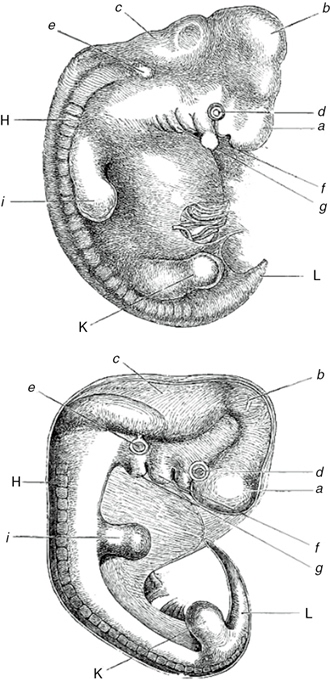
Embryonic Development.—Man is developed from an ovule, about the 125th of an inch in diameter, which differs in no respect from the ovules of other animals. The embryo itself at a very early period can hardly be distinguished from that of other members of the vertebrate kingdom. At this period the arteries run in arch-like branches, as if to carry the blood to branchiæ which are not present in the higher vertebrata, though the slits on the sides of the neck still remain (f, g, fig. 1), marking their former position. At a somewhat later period, when the extremities are developed, “the feet of lizards and mammals,” as the illustrious Von Baer remarks, “the wings and feet of birds, no less than the hands and feet of man, all arise from the same fundamental form.” It is, says Prof. Huxley, “quite in the later stages of development that the young human being presents marked differences from the young ape, while the latter departs as much from the dog in its developments, as the man does. Startling as this last assertion may appear to be, it is demonstrably true.”
As some of my readers may never have seen a drawing of an embryo, I have given one of man and another of a dog, at about the same early stage of development, carefully copied from two works of undoubted accuracy.2
Fig. 1.Upper figure human embryo, from Ecker. Lower figure that of a dog, from Bischoff.
|
a. Fore-brain, cerebral hemispheres, &c. |
g. Second visceral arch. |
|
|
b. Mid-brain, corpora quadrigemina. |
H. Vertebral columns and muscles in process of development. |
|
|
c. Hind-brain, cerebellum, medulla oblongata. |
i. Anterior |
┐ │ extremities ┘ |
|
d. Eye. |
K. Posterior |
|
|
e. Ear. |
L. Tail or os coccyx. |
|
|
f. First visceral arch. |
||
After the foregoing statements made by such high authorities, it would be superfluous on my part to give a number of borrowed details, shewing that the embryo of man closely resembles that of other mammals ... . I will conclude with a quotation from Huxley, who after asking, does man originate in a different way from a dog, bird, frog or fish? says, “the reply is not doubtful for a moment; without question, the mode of origin and the early stages of the development of man are identical with those of the animals immediately below him in the scale: without a doubt in these respects, he is far nearer to apes, than the apes are to the dog.”
Rudiments.—This subject, though not intrinsically more important than the two last, will for several reasons be here treated with more fullness. Not one of the higher animals can be named which does not bear some part in a rudimentary condition; and man forms no exception to the rule. Rudimentary organs must be distinguished from those that are nascent; though in some cases the distinction is not easy. The former are either absolutely useless, such as the mammæ of male quadrupeds, or the incisor teeth of ruminants which never cut through the gums; or they are of such slight service to their present possessors, that we cannot suppose that they were developed under the conditions which now exist. Organs in this latter state are not strictly rudimentary, but they are tending in this direction. Nascent organs, on the other hand, though not fully developed, are of high service to their possessors, and are capable of further development. Rudimentary organs are eminently variable; and this is partly intelligible, as they are useless or nearly useless, and consequently are no longer subjected to natural selection. They often become wholly suppressed. When this occurs, they are nevertheless liable to occasional reappearance through reversion; and this is a circumstance well worthy of attention.
...
Some few persons have the power of contracting the superficial muscles on their scalps; and these muscles are in a variable and partially rudimentary condition. M. A. de Candolle has communicated to me a curious instance of the long-continued persistence or inheritance of this power, as well as of its unusual development. He knows a family, in which one member, the present head of a family, could, when a youth, pitch several heavy books from his head by the movement of the scalp alone; and he won wagers by performing this feat. His father, uncle, grandfather, and all his three children possess the same power to the same unusual degree. This family became divided eight generations ago into two branches; so that the head of the above-mentioned branch is cousin in the seventh degree to the head of the other branch. This distant cousin resides in another part of France, and on being asked whether he possessed the same faculty, immediately exhibited his power. This case offers a good illustration how persistently an absolutely useless faculty may be transmitted.
The extrinsic muscles which serve to move the whole external ear, and the intrinsic muscles which move the different parts, all of which belong to the system of the panniculus, are in a rudimentary condition in man; they are also variable in development, or at least in function. I have seen one man who could draw his ears forwards, and another who could draw them backwards; and from what one of these persons told me, it is probable that most of us by often touching our ears and thus directing our attention towards them, could by repeated trials recover some power of movement. The faculty of erecting the ears and of directing them to different points of the compass, is no doubt of the highest service to many animals, as they thus perceive the point of danger; but I have never heard of a man who possessed the least power of erecting his ears,—the one movement which might be of use to him. The whole external shell of the ear may be considered a rudiment, together with the various folds and prominences (helix and anti-helix, tragus and anti-tragus, &c.) which in the lower animals strengthen and support the ear when erect, without adding much to its weight. Some authors, however, suppose that the cartilage of the shell serves to transmit vibrations to the acoustic nerve; but Mr. Toynbee, after collecting all the known evidence on this head, concludes that the external shell is of no distinct use. The ears of the chimpanzee and orang are curiously like those of man, and I am assured by the keepers in the Zoological Gardens that these animals never move or erect them; so that they are in an equally rudimentary condition, as far as function is concerned, as in man. Why these animals, as well as the progenitors of man, should have lost the power of erecting their ears we cannot say. It may be, though I am not quite satisfied with this view, that owing to their arboreal habits and great strength they were but little exposed to danger, and so during a lengthened period moved their ears but little, and thus gradually lost the power of moving them. This would be a parallel case with that of those large and heavy birds, which from inhabiting oceanic islands have not been exposed to the attacks of beasts of prey, and have consequently lost the power of using their wings for flight.
Fig. 2.Human Ear, modelled and drawn by Mr. Woolner.
a. The projecting point.
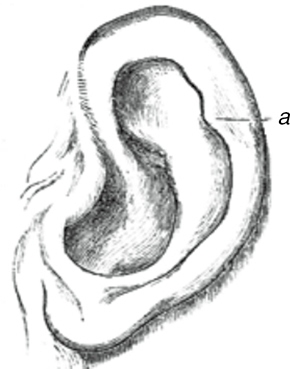
The celebrated sculptor, Mr. Woolner, informs me of one little peculiarity in the external ear, which he has often observed both in men and women, and of which he perceived the full signification. His attention was first called to the subject whilst at work on his figure of Puck, to which he had given pointed ears. He was thus led to examine the ears of various monkeys, and subsequently more carefully those of man. The peculiarity consists in a little blunt point, projecting from the inwardly folded margin, or helix. Mr. Woolner made an exact model of one such case, and has sent me the accompanying drawing (Fig. 2). These points not only project inwards, but often a little outwards, so that they are visible when the head is viewed from directly in front or behind. They are variable in size and somewhat in position, standing either a little higher or lower; and they sometimes occur on one ear and not on the other. Now the meaning of these projections is not, I think, doubtful; but it may be thought that they offer too trifling a character to be worth notice. This thought, however, is as false as it is natural. Every character, however slight, must be the result of some definite cause; and if it occurs in many individuals deserves consideration. The helix obviously consists of the extreme margin of the ear folded inwards; and this folding appears to be in some manner connected with the whole external ear being permanently pressed backwards. In many monkeys, which do not stand high in the order, as baboons and some species of macacus, the upper portion of the ear is slightly pointed, and the margin is not at all folded inwards; but if the margin were to be thus folded, a slight point would necessarily project inwards and probably a little outwards. This could actually be observed in a specimen of the Ateles beelzebuth in the Zoological Gardens; and we may safely conclude that it is a similar structure—a vestige of formerly pointed ears—which occasionally reappears in man ... .
Man differs conspicuously from all the other Primates in being almost naked. But a few short straggling hairs are found over the greater part of the body in the male sex, and fine down on that of the female sex. In individuals belonging to the same race these hairs are highly variable, not only in abundance, but likewise in position: thus the shoulders in some Europeans are quite naked, whilst in others they bear thick tufts of hair. There can be little doubt that the hairs thus scattered over the body are the rudiments of the uniform hairy coat of the lower animals. This view is rendered all the more probable, as it is known that fine, short, and pale-coloured hairs on the limbs and other parts of the body occasionally become developed into “thickset, long, and rather coarse dark hairs,” when abnormally nourished near old-standing inflamed surfaces.
...
It appears as if the posterior molar or wisdom-teeth were tending to become rudimentary in the more civilised races of man. These teeth are rather smaller than the other molars, as is likewise the case with the corresponding teeth in the chimpanzee and orang; and they have only two separate fangs. They do not cut through the gums till about the seventeenth year, and I am assured by dentists that they are much more liable to decay, and are earlier lost, than the other teeth. It is also remarkable that they are much more liable to vary both in structure and in the period of their development than the other teeth. In the Melanian races, on the other hand, the wisdom-teeth are usually furnished with three separate fangs, and are generally sound: they also differ from the other molars in size less than in the Caucasian races. Prof. Schaaffhausen accounts for this difference between the races by “the posterior dental portion of the jaw being always shortened” in those that are civilised, and this shortening may, I presume, be safely attributed to civilised men habitually feeding on soft, cooked food, and thus using their jaws less. I am informed by Mr. Brace that it is becoming quite a common practice in the United States to remove some of the molar teeth of children, as the jaw does not grow large enough for the perfect development of the normal number.
...
The bearing of the three great classes of facts now given is unmistakeable. But it would be superfluous here fully to recapitulate the line of argument given in detail in my ‘Origin of Species.’ The homological construction of the whole frame in the members of the same class is intelligible, if we admit their descent from a common progenitor, together with their subsequent adaptation to diversified conditions. On any other view the similarity of pattern between the hand of a man or monkey, the foot of a horse, the flipper of a seal, the wing of a bat, &c., is utterly inexplicable. It is no scientific explanation to assert that they have all been formed on the same ideal plan. With respect to development, we can clearly understand, on the principle of variations supervening at a rather late embryonic period, and being inherited at a corresponding period, how it is that the embryos of wonderfully different forms should still retain, more or less perfectly, the structure of their common progenitor. No other explanation has ever been given of the marvellous fact that the embryo of a man, dog, seal, bat, reptile, &c., can at first hardly be distinguished from each other. In order to understand the existence of rudimentary organs, we have only to suppose that a former progenitor possessed the parts in question in a perfect state, and that under changed habits of life they became greatly reduced, either from simple disuse, or through the natural selection of those individuals which were least encumbered with a superfluous part, aided by the other means previously indicated.
Thus we can understand how it has come to pass that man and all other vertebrate animals have been constructed on the same general model, why they pass through the same early stages of development, and why they retain certain rudiments in common. Consequently we ought frankly to admit their community of descent: to take any other view, is to admit that our own structure and that of all the animals around us, is a mere snare laid to entrap our judgment. This conclusion is greatly strengthened, if we look to the members of the whole animal series, and consider the evidence derived from their affinities or classification, their geographical distribution and geological succession. It is only our natural prejudice, and that arrogance which made our forefathers declare that they were descended from demi-gods, which leads us to demur to this conclusion. But the time will before long come when it will be thought wonderful, that naturalists, who were well acquainted with the comparative structure and development of man and other mammals, should have believed that each was the work of a separate act of creation.
Chapter II. Comparison of the Mental Powers of Man and the Lower Animals
The difference in mental power between the highest ape and the lowest savage, immense—Certain instincts in common—The emotions—Curiosity—Imitation—Attention—Memory—Imagination—Reason—Progressive improvement—Tools and weapons used by animals—Language—Self-consciousness—Sense of beauty—Belief in God, spiritual agencies, superstitions.
We have seen in the last chapter that man bears in his bodily structure clear traces of his descent from some lower form; but it may be urged that, as man differs so greatly in his mental power from all other animals, there must be some error in this conclusion. No doubt the difference in this respect is enormous, even if we compare the mind of one of the lowest savages, who has no words to express any number higher than four, and who uses no abstract terms for the commonest objects or affections, with that of the most highly organised ape. The difference would, no doubt, still remain immense, even if one of the higher apes had been improved or civilised as much as a dog has been in comparison with its parent-form, the wolf or jackal. The Fuegians rank amongst the lowest barbarians; but I was continually struck with surprise how closely the three natives on board H.M.S. “Beagle,” who had lived some years in England and could talk a little English, resembled us in disposition and in most of our mental faculties. If no organic being excepting man had possessed any mental power, or if his powers had been of a wholly different nature from those of the lower animals, then we should never have been able to convince ourselves that our high faculties had been gradually developed. But it can be clearly shewn that there is no fundamental difference of this kind. We must also admit that there is a much wider interval in mental power between one of the lowest fishes, as a lamprey or lancelet, and one of the higher apes, than between an ape and man; yet this immense interval is filled up by numberless gradations.
Nor is the difference slight in moral disposition between a barbarian, such as the man described by the old navigator Byron, who dashed his child on the rocks for dropping a basket of sea-urchins, and a Howard or Clarkson; and in intellect, between a savage who does not use any abstract terms, and a Newton or Shakespeare. Differences of this kind between the highest men of the highest races and the lowest savages, are connected by the finest gradations. Therefore it is possible that they might pass and be developed into each other.
My object in this chapter is solely to shew that there is no fundamental difference between man and the higher mammals in their mental faculties. Each division of the subject might have been extended into a separate essay, but must here be treated briefly. As no classification of the mental powers has been universally accepted, I shall arrange my remarks in the order most convenient for my purpose; and will select those facts which have most struck me, with the hope that they may produce some effect on the reader.
...
To return to our immediate subject: the lower animals, like man, manifestly feel pleasure and pain, happiness and misery. Happiness is never better exhibited than by young animals, such as puppies, kittens, lambs, &c., when playing together, like our own children. Even insects play together, as has been described by that excellent observer, P. Huber, who saw ants chasing and pretending to bite each other, like so many puppies.
The fact that the lower animals are excited by the same emotions as ourselves is so well established, that it will not be necessary to weary the reader by many details. Terror acts in the same manner on them as on us, causing the muscles to tremble, the heart to palpitate, the sphincters to be relaxed, and the hair to stand on end. Suspicion, the offspring of fear, is eminently characteristic of most wild animals. Courage and timidity are extremely variable qualities in the individuals of the same species, as is plainly seen in our dogs. Some dogs and horses are ill-tempered and easily turn sulky; others are good-tempered; and these qualities are certainly inherited. Everyone knows how liable animals are to furious rage, and how plainly they show it. Many anecdotes, probably true, have been published on the long-delayed and artful revenge of various animals. The accurate Rengger and Brehm state that the American and African monkeys which they kept tame, certainly revenged themselves. The love of a dog for his master is notorious; in the agony of death he has been known to caress his master, and everyone has heard of the dog suffering under vivisection, who licked the hand of the operator; this man, unless he had a heart of stone, must have felt remorse to the last hour of his life. As Whewell has remarked, “who that reads the touching instances of maternal affection, related so often of the women of all nations, and of the females of all animals, can doubt that the principle of action is the same in the two cases?”
...
Most of the more complex emotions are common to the higher animals and ourselves. Everyone has seen how jealous a dog is of his master’s affection, if lavished on any other creature; and I have observed the same fact with monkeys. This shews that animals not only love, but have the desire to be loved. Animals manifestly feel emulation. They love approbation or praise; and a dog carrying a basket for his master exhibits in a high degree self-complacency or pride. There can, I think, be no doubt that a dog feels shame, as distinct from fear, and something very like modesty when begging too often for food. A great dog scorns the snarling of a little dog, and this may be called magnanimity. Several observers have stated that monkeys certainly dislike being laughed at; and they sometimes invent imaginary offences. In the Zoological Gardens I saw a baboon who always got into a furious rage when his keeper took out a letter or book and read it aloud to him; and his rage was so violent that, as I witnessed on one occasion, he bit his own leg till the blood flowed.
We will now turn to the more intellectual emotions and faculties, which are very important, as forming the basis for the development of the higher mental powers. Animals manifestly enjoy excitement and suffer from ennui, as may be seen with dogs, and, according to Rengger, with monkeys. All animals feel Wonder, and many exhibit Curiosity. They sometimes suffer from this latter quality, as when the hunter plays antics and thus attracts them; I have witnessed this with deer, and so it is with the wary chamois, and with some kinds of wild-ducks. Brehm gives a curious account of the instinctive dread which his monkeys exhibited towards snakes; but their curiosity was so great that they could not desist from occasionally satiating their horror in a most human fashion, by lifting up the lid of the box in which the snakes were kept. I was so much surprised at his account, that I took a stuffed and coiled-up snake into the monkey-house at the Zoological Gardens, and the excitement thus caused was one of the most curious spectacles which I ever beheld. Three species of Cercopithecus were the most alarmed; they dashed about their cages and uttered sharp signal-cries of danger, which were understood by the other monkeys. A few young monkeys and one old Anubis baboon alone took no notice of the snake. I then placed the stuffed specimen on the ground in one of the larger compartments. After a time all the monkeys collected round it in a large circle, and staring intently, presented a most ludicrous appearance. They became extremely nervous; so that when a wooden ball, with which they were familiar as a plaything, was accidently moved in the straw, under which it was partly hidden, they all instantly started away. These monkeys behaved very differently when a dead fish, a mouse, and some other new objects were placed in their cages; for though at first frightened, they soon approached, handled and examined them. I then placed a live snake in a paper bag, with the mouth loosely closed, in one of the larger compartments. One of the monkeys immediately approached, cautiously opened the bag a little, peeped in, and instantly dashed away. Then I witnessed what Brehm has described, for monkey after monkey, with head raised high and turned on one side, could not resist taking momentary peeps into the upright bag, at the dreadful object lying quiet at the bottom. It would almost appear as if monkeys had some notion of zoological affinities, for those kept by Brehm exhibited a strange, though mistaken, instinctive dread of innocent lizards and frogs. An orang, also, has been known to be much alarmed at the first sight of a turtle.
The principle of Imitation is strong in man, and especially in man in a barbarous state. Desor has remarked that no animal voluntarily imitates an action performed by man, until in the ascending scale we come to monkeys, which are well-known to be ridiculous mockers. Animals, however, sometimes imitate each others’ actions: thus two species of wolves, which had been reared by dogs, learned to bark, as does sometimes the jackal, but whether this can be called voluntary imitation is another question. From one account which I have read, there is reason to believe that puppies nursed by cats sometimes learn to lick their feet and thus to clean their faces: it is at least certain, as I hear from a perfectly trustworthy friend, that some dogs behave in this manner. Birds imitate the songs of their parents, and sometimes those of other birds; and parrots are notorious imitators of any sound which they often hear.
Hardly any faculty is more important for the intellectual progress of man than the power of Attention. Animals clearly manifest this power, as when a cat watches by a hole and prepares to spring on its prey. Wild animals sometimes become so absorbed when thus engaged, that they may be easily approached. Mr. Bartlett has given me a curious proof how variable this faculty is in monkeys. A man who trains monkeys to act used to purchase common kinds from the Zoological Society at the price of five pounds for each; but he offered to give double the price, if he might keep three or four of them for a few days, in order to select one. When asked how he could possibly so soon learn whether a particular monkey would turn out a good actor, he answered that it all depended on their power of attention. If when he was talking and explaining anything to a monkey, itsattention was easily distracted, as by a fly on the wall or other trifling object, the case was hopeless. If he tried by punishment to make an inattentive monkey act, it turned sulky. On the other hand, a monkey which carefully attended to him could always be trained.
It is almost superfluous to state that animals have excellent Memories for persons and places. A baboon at the Cape of Good Hope, as I have been informed by Sir Andrew Smith, recognised him with joy after an absence of nine months. I had a dog who was savage and averse to all strangers, and I purposely tried his memory after an absence of five years and two days. I went near the stable where he lived, and shouted to him in my old manner; he showed no joy, but instantly followed me out walking and obeyed me, exactly as if I had parted with him only half-an-hour before. A train of old associations, dormant during five years, had thus been instantaneously awakened in his mind. Even ants, as P. Huber has clearly shewn, recognised their fellow-ants belonging to the same community after a separation of four months. Animals can certainly by some means judge of the intervals of time between recurrent events.
The Imagination is one of the highest prerogatives of man. By this faculty he unites, independently of the will, former images and ideas, and thus creates brilliant and novel results. A poet, as Jean Paul Richter remarks,3 “who must reflect whether he shall make a character say yes or no—to the devil with him; he is only a stupid corpse.” Dreaming gives us the best notion of this power; as Jean Paul again says, “The dream is an involuntary art of poetry.” The value of the products of our imagination depends of course on the number, accuracy, and clearness of our impressions; on our judgment and taste in selecting or rejecting the involuntary combinations, and to a certain extent on our power of voluntarily combining them. As dogs, cats, horses, and probably all the higher animals, even birds, as is stated on good authority,4 have vivid dreams, and this is shewn by their movements and voice, we must admit that they possess some power of imagination.
Of all the faculties of the human mind, it will, I presume, be admitted that Reason stands at the summit. Few persons any longer dispute that animals possess some power of reasoning. Animals may constantly be seen to pause, deliberate, and resolve. It is a significant fact, that the more the habits of any particular animal are studied by a naturalist, the more he attributes to reason and the less to unlearnt instincts.5 In future chapters we shall see that some animals extremely low in the scale apparently display a certain amount of reason. No doubt it is often difficult to distinguish between the power of reason and that of instinct. Thus Dr. Hayes, in his work on ‘The Open Polar Sea,’ repeatedly remarks that his dogs, instead of continuing to draw the sledges in a compact body, diverged and separated when they came to thin ice, so that their weight might be more evenly distributed. This was often the first warning and notice which the travellers received that the ice was becoming thin and dangerous. Now, did the dogs act thus from the experience of each individual, or from the example of the older and wiser dogs, or from an inherited habit, that is from an instinct? This instinct might possibly have arisen since the time, long ago, when dogs were first employed by the natives in drawing their sledges; or the Arctic wolves, the parent-stock of the Esquimaux dog, may have acquired this instinct, impelling them not to attack their prey in a close pack when on thin ice. Questions of this kind are most difficult to answer.
So many facts have been recorded in various works shewing that animals possess some degree of reason, that I will here give only two or three instances, authenticated by Rengger, and relating to American monkeys, which stand low in their order. He states that when he first gave eggs to his monkeys, they smashed them and thus lost much of their contents; afterwards they gently hit one end against some hard body, and picked off the bits of shell with their fingers. After cutting themselves only once with any sharp tool, they would not touch it again, or would handle it with the greatest care. Lumps of sugar were often given them wrapped up in paper; and Rengger sometimes put a live wasp in the paper, so that in hastily unfolding it they got stung; after this had once happened, they always first held the packet to their ears to detect any movement within. Any one who is not convinced by such facts as these, and by what he may observe with his own dogs, that animals can reason, would not be convinced by anything that I could add. Nevertheless I will give one case with respect to dogs, as it rests on two distinct observers, and can hardly depend on the modification of any instinct.
Mr. Colquhoun6 winged two wild-ducks, which fell on the opposite side of a stream; his retriever tried to bring over both at once, but could not succeed; she then, though never before known to ruffle a feather, deliberately killed one, brought over the other, and returned for the dead bird.Col. Hutchinson relates that two partridges were shot at once, one being killed, the other wounded; the latter ran away, and was caught by the retriever, who on her return came across the dead bird; “she stopped, evidently greatly puzzled, and after one or two trials, finding she could not take it up without permitting the escape of the winged bird, she considered a moment, then deliberately murdered it by giving it a severe crunch, and afterwards brought away both together. This was the only known instance of her ever having wilfully injured any game.” Here we have reason, though not quite perfect, for the retriever might have brought the wounded bird first and then returned for the dead one, as in the case of the two wild-ducks.
The muleteers in S. America say, “I will not give you the mule whose step is easiest, but la mas rational,—the one that reasons best;” and Humboldt7 adds, “this popular expression, dictated by long experience, combats the system of animated machines, better perhaps than all the arguments of speculative philosophy.”
...
Chapter III. Comparison of the Mental Powers of Man and the Lower Animals —Continued
The moral sense—Fundamental proposition—The qualities of social animals—Origin of sociability—Struggle between opposed instincts—Man a social animal—The more enduring social instincts conquer other less persistent instincts—The social virtues alone regarded by savages—The self-regarding virtues acquired at a later stage of development—The importance of the judgment of the members of the same community on conduct—Transmission of moral tendencies—Summary.
...
Concluding Remarks.—Philosophers of the derivative8 school of morals formerly assumed that the foundation of morality lay in a form of Selfishness; but more recently in the “Greatest Happiness principle.” According to the view given above, the moral sense is fundamentally identical with the social instincts; and in the case of the lower animals it would be absurd to speak of these instincts as having been developed from selfishness, or for the happiness of the community. They have, however, certainly been developed for the general good of the community. The term, general good, may be defined as the means by which the greatest possible number of individuals can be reared in full vigour and health, with all their faculties perfect, under the conditions to which they are exposed. As the social instincts both of man and the lower animals have no doubt been developed by the same steps, it would be advisable, if found practicable, to use the same definition in both cases, and to take as the test of morality, the general good or welfare of the community, rather than the general happiness; but this definition would perhaps require some limitation on account of political ethics.
When a man risks his life to save that of a fellow-creature, it seems more appropriate to say that he acts for the general good or welfare, rather than for the general happiness of mankind. No doubt the welfare and the happiness of the individual usually coincide; and a contented, happy tribe will flourish better than one that is discontented and unhappy. We have seen that at an early period in the history of man, the expressed wishes of the community will have naturally influenced to a large extent the conduct of each member; and as all wish for happiness, the “greatest happiness principle” will have become a most important secondary guide and object; the social instincts, including sympathy, always serving as the primary impulse and guide. Thus the reproach of laying the foundation of the most noble part of our nature in the base principle of selfishness is removed; unless indeed the satisfaction which every animal feels when it follows its proper instincts, and the dissatisfaction felt when prevented, be called selfish.
The expression of the wishes and judgment of the members of the same community, at first by oral and afterwards by written language, serves, as just remarked, as a most important secondary guide of conduct, in aid of the social instincts, but sometimes in opposition to them. This latter fact is well exemplified by the Law of Honour, that is the law of the opinion of our equals, and not of all our countrymen. The breach of this law, even when the breach is known to be strictly accordant with true morality, has caused many a man more agony than a real crime. We recognise the same influence in the burning sense of shame which most of us have felt even after the interval of years, when calling to mind some accidental breach of a trifling though fixed rule of etiquette. The judgment of the community will generally be guided by some rude experience of what is best in the long run for all the members; but this judgment will not rarely err from ignorance and from weak powers of reasoning. Hence the strangest customs and superstitions, in complete opposition to the true welfare and happiness of mankind, have become all-powerful throughout the world. We see this in the horror felt by a Hindoo who breaks his caste, in the shame of a Mahometan woman who exposes her face, and in innumerable other instances. It would be difficult to distinguish between the remorse felt by a Hindoo who has eaten unclean food, from that felt after committing a theft; but the former would probably be the more severe.
How so many absurd rules of conduct, as well as so many absurd religious beliefs, have originated we do not know; nor how it is that they have become, in all quarters of the world, so deeply impressed on the mind of men; but it is worthy of remark that a belief constantly inculcated during the early years of life, whilst the brain is impressible, appears to acquire almost the nature of an instinct; and the very essence of an instinct is that it is followed independently of reason. Neither can we say why certain admirable virtues, such as the love of truth, are much more highly appreciated by some savage tribes than by others9; nor, again, why similar differences prevail even amongst civilised nations. Knowing how firmly fixed many strange customs and superstitions have become, we need feel no surprise that the self-regarding virtues should now appear to us so natural, supported as they are by reason, as to be thought innate, although they were not valued by man in his early condition.
Notwithstanding many sources of doubt, man can generally and readily distinguish between the higher and lower moral rules. The higher are founded on the social instincts, and relate to the welfare of others. They are supported by the approbation of our fellow-men and by reason. The lower rules, though some of them when implying self-sacrifice hardly deserve to be called lower, relate chiefly to self, and owe their origin to public opinion, when matured by experience and cultivated; for they are not practised by rude tribes.
As man advances in civilisation, and small tribes are united into larger communities, the simplest reason would tell each individual that he ought to extend his social instincts and sympathies to all the members of the same nation, though personally unknown to him. This point being once reached, there is only an artificial barrier to prevent his sympathies extending to the men of all nations and races. If, indeed, such men are separated from him by great differences in appearance or habits, experience unfortunately shews us how long it is before we look at them as our fellow-creatures. Sympathy beyond the confines of man, that is humanity to the lower animals, seems to be one of the latest moral acquisitions. It is apparently unfelt by savages, except towards their pets. How little the old Romans knew of it is shewn by their abhorrent gladiatorial exhibitions. The very idea of humanity, as far as I could observe, was new to most of the Gauchos of the Pampas. This virtue, one of the noblest with which man is endowed, seems to arise incidentally from our sympathies becoming more tender and more widely diffused, until they are extended to all sentient beings. As soon as this virtue is honoured and practised by some few men, it spreads through instruction and example to the young, and eventually through public opinion.
The highest stage in moral culture at which we can arrive, is when we recognise that we ought to control our thoughts, and “not even in inmost thought to think again the sins that made the past so pleasant to us.”10 Whatever makes any bad action familiar to the mind, renders its performance by so much the easier. As Marcus Aurelius long ago said, “Such as are thy habitual thoughts, such also will be the character of thy mind; for the soul is dyed by the thoughts.”11
Our great philosopher, Herbert Spencer, has recently explained his views on the moral sense. He says,12 “I believe that the experiences of utility organised and consolidated through all past generations of the human race, have been producing corresponding modifications, which, by continued transmission and accumulation, have become in us certain faculties of moral intuition—certain emotions responding to right and wrong conduct, which have no apparent basis in the individual experiences of utility.” There is not the least inherent improbability, as it seems to me, in virtuous tendencies being more or less strongly inherited; for, not to mention the various dispositions and habits transmitted by many of our domestic animals, I have heard of cases in which a desire to steal and a tendency to lie appeared to run in families of the upper ranks; and as stealing is so rare a crime in the wealthy classes, we can hardly account by accidental coincidence for the tendency occurring in two or three members of the same family. If bad tendencies are transmitted, it is probable that good ones are likewise transmitted. Excepting through the principle of the transmission of moral tendencies, we cannot understand the differences believed to exist in this respect between the various races of mankind. We have, however, as yet, hardly sufficient evidence on this head.
Even the partial transmission of virtuous tendencies would be an immense assistance to the primary impulse derived directly from the social instincts, and indirectly from the approbation of our fellow-men. Admitting for the moment that virtuous tendencies are inherited, it appears probable, at least in such cases as chastity, temperance, humanity to animals, &c., that they become first impressed on the mental organisation through habit, instruction, and example, continued during several generations in the same family, and in a quite subordinate degree, or not at all, by the individuals possessing such virtues, having succeeded best in the struggle for life. My chief source of doubt with respect to any such inheritance, is that senseless customs, superstitions, and tastes, such as the horror of a Hindoo for unclean food, ought on the same principle to be transmitted. Although this in itself is perhaps not less probable than that animals should acquire inherited tastes for certain kinds of food or fear of certain foes, I have not met with any evidence in support of the transmission of superstitious customs or senseless habits.
Finally, the social instincts which no doubt were acquired by man, as by the lower animals, for the good of the community, will from the first have given to him some wish to aid his fellows, and some feeling of sympathy. Such impulses will have served him at a very early period as a rude rule of right and wrong. But as man gradually advanced in intellectual power and was enabled to trace the more remote consequences of his actions; as he acquired sufficient knowledge to reject baneful customs and superstitions; as he regarded more and more not only the welfare but the happiness of his fellow-men; as from habit, following on beneficial experience, instruction, and example, his sympathies became more tender and widely diffused, so as to extend to the men of all races, to the imbecile, the maimed, and other useless members of society, and finally to the lower animals,—so would the standard of his morality rise higher and higher. And it is admitted by moralists of the derivative school and by some intuitionists, that the standard of morality has risen since an early period in the history of man.13
As a struggle may sometimes be seen going on between the various instincts of the lower animals, it is not surprising that there should be a struggle in man between his social instincts, with their derived virtues, and his lower, though at the moment, stronger impulses or desires. This, as Mr. Galton14 has remarked, is all the less surprising, as man has emerged from a state of barbarism within a comparatively recent period. After having yielded to some temptation we feel a sense of dissatisfaction, analogous to that felt from other unsatisfied instincts, called in this case conscience; for we cannot prevent past images and impressions continually passing through our minds, and these in their weakened state we compare with the ever-present social instincts, or with habits gained in early youth and strengthened during our whole lives, perhaps inherited, so that they are at last rendered almost as strong as instincts. Looking to future generations, there is no cause to fear that the social instincts will grow weaker, and we may expect that virtuous habits will grow stronger, becoming perhaps fixed by inheritance. In this case the struggle between our higher and lower impulses will be less severe, and virtue will be triumphant.
Summary of the two last Chapters.—There can be no doubt that the difference between the mind of the lowest man and that of the highest animal is immense. An anthropomorphous ape, if he could take a dispassionate view of his own case, would admit that though he could form an artful plan to plunder a garden—though he could use stones for fighting or for breaking open nuts, yet that the thought of fashioning a stone into a tool was quite beyond his scope. Still less, as he would admit, could he follow out a train of metaphysical reasoning, or solve a mathematical problem, or reflect on God, or admire a grand natural scene. Some apes, however, would probably declare that they could and did admire the beauty of the coloured skin and fur of their partners in marriage. They would admit, that though they could make other apes understand by cries some of their perceptions and simpler wants, the notion of expressing definite ideas by definite sounds had never crossed their minds. They might insist that they were ready to aid their fellow-apes of the same troop in many ways, to risk their lives for them, and to take charge of their orphans; but they would be forced to acknowledge that disinterested love for all living creatures, the most noble attribute of man, was quite beyond their comprehension.
Nevertheless the difference in mind between man and the higher animals, great as it is, is certainly one of degree and not of kind. We have seen that the senses and intuitions, the various emotions and faculties, such as love, memory, attention, curiosity, imitation, reason, &c., of which man boasts, may be found in an incipient, or even sometimes in a well-developed condition, in the lower animals. They are also capable of some inherited improvement, as we see in the domestic dog compared with the wolf or jackal. If it be maintained that certain powers, such as self-consciousness, abstraction, &c., are peculiar to man, it may well be that these are the incidental results of other highly-advanced intellectual faculties; and these again are mainly the result of the continued use of a highly developed language. At what age does the new-born infant possess the power of abstraction, or become selfconscious and reflect on its own existence? We cannot answer; nor can we answer in regard to the ascending organic scale. The half-art and half-instinct of language still bears the stamp of its gradual evolution. The ennobling belief in God is not universal with man; and the belief in active spiritual agencies naturally follows from his other mental powers. The moral sense perhaps affords the best and highest distinction between man and the lower animals; but I need not say anything on this head, as I have so lately endeavoured to shew that the social instincts,—the prime principle of man’s moral constitution15—with the aid of active intellectual powers and the effects of habit, naturally lead to the golden rule, “As ye would that men should do to you, do ye to them likewise;” and this lies at the foundation of morality.
In a future chapter I shall make some few remarks on the probable steps and means by which the several mental and moral faculties of man have been gradually evolved. That this at least is possible ought not to be denied, when we daily see their development in every infant; and when we may trace a perfect gradation from the mind of an utter idiot, lower than that of the lowest animal, to the mind of a Newton.
Chapter IV. On the Manner of Development of Man from Some Lower Form
Variability of body and mind in man—Inheritance—Causes of variability—Laws of variation the same in man as in the lower animals—Direct action of the conditions of life—Effects of the increased use and disuse of parts—Arrested development—Reversion—Correlated variation—Rate of increase—Checks to increase—Natural selection—Man the most dominant animal in the world—Importance of his corporeal structure—The causes which have led to his becoming erect—Consequent changes of structure—Decrease in size of the canine teeth—Increased size and altered shape of the skull—Nakedness—Absence of a tail—Defenceless condition of man.
We have seen in the first chapter that the homological structure of man, his embryological development and the rudiments which he still retains, all declare in the plainest manner that he is descended from some lower form. The possession of exalted mental powers is no insuperable objection to this conclusion. In order that an ape-like creature should have been transformed into man, it is necessary that this early form, as well as many successive links, should all have varied in mind and body. It is impossible to obtain direct evidence on this head; but if it can be shewn that man now varies—that his variations are induced by the same general causes, and obey the same general laws, as in the case of the lower animals—there can be little doubt that the preceding intermediate links varied in a like manner. The variations at each successive stage of descent must, also, have been in some manner accumulated and fixed.
The facts and conclusions to be given in this chapter relate almost exclusively to the probable means by which the transformation of man has been effected, as far as his bodily structure is concerned. The following chapter will be devoted to the development of his intellectual and moral faculties. But the present discussion likewise bears on the origin of the different races or species of mankind, whichever term may be preferred.
It is manifest that man is now subject to much variability. No two individuals of the same race are quite alike. We may compare millions of faces, and each will be distinct. There is an equally great amount of diversity in the proportions and dimensions of the various parts of the body; the length of the legs being one of the most variable points. Although in some quarters of the world an elongated skull, and in other quarters a short skull prevails, yet there is great diversity of shape even within the limits of the same race, as with the aborigines of America and South Australia,—the latter a race “probably as pure and homogeneous in blood, customs, and language as any in existence”—and even with the inhabitants of so confined an area as the Sandwich Islands.
...
If we consider all the races of man, as forming a single species, his range is enormous; but some separate races, as the Americans and Polynesians, have very wide ranges. It is a well-known law that widely-ranging species are much more variable than species with restricted ranges; and the variability of man may with more truth be compared with that of widely-ranging species, than with that of domesticated animals.
...
Natural Selection.—We have now seen that man is variable in body and mind; and that the variations are induced, either directly or indirectly, by the same general causes, and obey the same general laws, as with the lower animals ... . I cannot, therefore, understand how it is that Mr. Wallace maintains, that “natural selection could only have endowed the savage with a brain a little superior to that of an ape.”
...
As the various mental faculties were gradually developed, the brain would almost certainly have become larger. No one, I presume, doubts that the large size of the brain in man, relatively to his body, in comparison with that of the gorilla or orang, is closely connected with his higher mental powers. We meet with closely analogous facts with insects, in which the cerebral ganglia are of extraordinary dimensions in ants; these ganglia in all the Hymenoptera being many times larger than in the less intelligent orders, such as beetles. On the other hand, no one supposes that the intellect of any two animals or of any two men can be accurately gauged by the cubic contents of their skulls. It is certain that there may be extraordinary mental activity with an extremely small absolute mass of nervous matter: thus the wonderfully diversified instincts, mental powers, and affections of ants are generally known, yet their cerebral ganglia are not so large as the quarter of a small pin’s head. Under this latter point of view, the brain of an ant is one of the most marvellous atoms of matter in the world, perhaps more marvellous than the brain of man.
The belief that there exists in man some close relation between the size of the brain and the development of the intellectual faculties is supported by the comparison of the skulls of savage and civilised races, of ancient and modern people, and by the analogy of the whole vertebrate series. Dr. J. Barnard Davis has proved by many careful measurements, that the mean internal capacity of the skull in Europeans is 92·3 cubic inches; in Americans 87·5; in Asiatics 87·1; and in Australians only 81·9 inches. Professor Broca found that skulls from graves in Paris of the nineteenth century, were larger than those from vaults of the twelfth century, in the proportion of 1484 to 1426; and Prichard is persuaded that the present inhabitants of Britain have “much more capacious brain-cases” than the ancient inhabitants. Nevertheless it must be admitted that some skulls of very high antiquity, such as the famous one of Neanderthal, are well developed and capacious. With respect to the lower animals, M. E. Lartet, by comparing the crania of tertiary and recent mammals, belonging to the same groups, has come to the remarkable conclusion that the brain is generally larger and the convolutions more complex in the more recent form. On the other hand I have shewn that the brains of domestic rabbits are considerably reduced in bulk, in comparison with those of the wild rabbit or hare; and this may be attributed to their having been closely confined during many generations, so that they have exerted but little their intellect, instincts, senses, and voluntary movements.
...
Conclusion.—In this chapter we have seen that as man at the present day is liable, like every other animal, to multiform individual differences or slight variations, so no doubt were the early progenitors of man; the variations being then as now induced by the same general causes, and governed by the same general and complex laws. As all animals tend to multiply beyond their means of subsistence, so it must have been with the progenitors of man; and this will inevitably have led to a struggle for existence and to natural selection. This latter process will have been greatly aided by the inherited effects of the increased use of parts; these two processes incessantly reacting on each other. It appears, also, as we shall hereafter see, that various unimportant characters have been acquired by man through sexual selection. An unexplained residuum of change, perhaps a large one, must be left to the assumed uniform action of those unknown agencies, which occasionally induce strongly-marked and abrupt deviations of structure in our domestic productions.
Judging from the habits of savages and of the greater number of the Quadrumana, primeval men, and even the ape-like progenitors of man, probably lived in society. With strictly social animals, natural selection sometimes acts indirectly on the individual, through the preservation of variations which are beneficial only to the community. A community including a large number of well-endowed individuals increases in number and is victorious over other and less well-endowed communities; although each separate member may gain no advantage over the other members of the same community. With associated insects many remarkable structures, which are of little or no service to the individual or its own offspring, such as the pollen-collecting apparatus, or the sting of the worker-bee, or the great jaws of soldier-ants, have been thus acquired. With the higher social animals, I am not aware that any structure has been modified solely for the good of the community, though some are of secondary service to it. For instance, the horns of ruminants and the great canine teeth of baboons appear to have been acquired by the males as weapons for sexual strife, but they are used in defence of the herd or troop. In regard to certain mental faculties the case, as we shall see in the following chapter, is wholly different; for these faculties have been chiefly, or even exclusively, gained for the benefit of the community; the individuals composing the community being at the same time indirectly benefited.
It has often been objected to such views as the foregoing, that man is one of the most helpless and defenceless creatures in the world; and that during his early and less well-developed condition he would have been still more helpless. The Duke of Argyll, for instance, insists that “the human frame has diverged from the structure of brutes, in the direction of greater physical helplessness and weakness. That is to say, it is a divergence which of all others it is most impossible to ascribe to mere natural selection.” He adduces the naked and unprotected state of the body, the absence of great teeth or claws for defence, the little strength of man, his small speed in running, and his slight power of smell, by which to discover food or to avoid danger. To these deficiencies there might have been added the still more serious loss of the power of quickly climbing trees, so as to escape from enemies. Seeing that the unclothed Fuegians can exist under their wretched climate, the loss of hair would not have been a great injury to primeval man, if he inhabited a warm country. When we compare defenceless man with the apes, many of which are provided with formidable canine teeth, we must remember that these in their fully-developed condition are possessed by the males alone, being chiefly used by them for fighting with their rivals; yet the females which are not thus provided, are able to survive.
In regard to bodily size or strength, we do not know whether man is descended from some comparatively small species, like the chimpanzee, or from one as powerful as the gorilla; and, therefore, we cannot say whether man has become larger and stronger, or smaller and weaker, in comparison with his progenitors. We should, however, bear in mind that an animal possessing great size, strength, and ferocity, and which, like the gorilla, could defend itself from all enemies, would probably, though not necessarily, have failed to become social; and this would most effectually have checked the acquirement by man of his higher mental qualities, such as sympathy and the love of his fellow-creatures. Hence it might have been an immense advantage to man to have sprung from some comparatively weak creature.
The slight corporeal strength of man, his little speed, his want of natural weapons, &c., are more than counterbalanced, firstly by his intellectual powers, through which he has, whilst still remaining in a barbarous state, formed for himself weapons, tools, &c., and secondly by his social qualities which lead him to give aid to his fellow-men and to receive it in return. No country in the world abounds in a greater degree with dangerous beasts than Southern Africa; no country presents more fearful physical hardships than the Arctic regions; yet one of the puniest races, namely, the Bushmen, maintain themselves in Southern Africa, as do the dwarfed Esquimaux in the Arctic regions. The early progenitors of man were, no doubt, inferior in intellect, and probably in social disposition, to the lowest existing savages; but it is quite conceivable that they might have existed, or even flourished, if, whilst they gradually lost their brute-like powers, such as climbing trees, &c., they at the same time advanced in intellect. But granting that the progenitors of man were far more helpless and defenceless than any existing savages, if they had inhabited some warm continent or large island, such as Australia or New Guinea, or Borneo (the latter island being now tenanted by the orang), they would not have been exposed to any special danger. In an area as large as one of these islands, the competition between tribe and tribe would have been sufficient, under favourable conditions, to have raised man, through the survival of the fittest, combined with the inherited effects of habit, to his present high position in the organic scale.
Chapter VI. On the Affinities and Genealogy of Man
Position of man in the animal series—The natural system genealogical—Adaptive characters of slight value—Various small points of resemblance between man and the Quadrumana—Rank of man in the natural system—Birthplace and antiquity of man—Absence of fossil connecting-links—Lower stages in the genealogy of man, as inferred, firstly from his affinities and secondly from his structure—Early androgynous condition of the Vertebrata—Conclusion.
Even if it be granted that the difference between man and his nearest allies is as great in corporeal structure as some naturalists maintain, and although we must grant that the difference between them is immense in mental power, yet the facts given in the previous chapters declare, as it appears to me, in the plainest manner, that man is descended from some lower form, notwithstanding that connecting-links have not hitherto been discovered.
Man is liable to numerous, slight, and diversified variations, which are induced by the same general causes, are governed and transmitted in accordance with the same general laws, as in the lower animals. Man tends to multiply at so rapid a rate that his offspring are necessarily exposed to a struggle for existence, and consequently to natural selection. He has given rise to many races, some of which are so different that they have often been ranked by naturalists as distinct species. His body is constructed on the same homological plan as that of other mammals, independently of the uses to which the several parts may be put. He passes through the same phases of embryological development. He retains many rudimentary and useless structures, which no doubt were once serviceable. Characters occasionally make their reappearance in him, which we have every reason to believe were possessed by his early progenitors. If the origin of man had been wholly different from that of all other animals, these various appearances would be mere empty deceptions; but such an admission is incredible. These appearances, on the other hand, are intelligible, at least to a large extent, if man is the co-descendant with other mammals of some unknown and lower form.
Some naturalists, from being deeply impressed with the mental and spiritual powers of man, have divided the whole organic world into three kingdoms, the Human, the Animal, and the Vegetable, thus giving to man a separate kingdom. Spiritual powers cannot be compared or classed by the naturalist; but he may endeavour to shew, as I have done, that the mental faculties of man and the lower animals do not differ in kind, although immensely in degree. A difference in degree, however great, does not justify us in placing man in a distinct kingdom, as will perhaps be best illustrated by comparing the mental powers of two insects, namely, a coccus or scale-insect and an ant, which undoubtedly belong to the same class. The difference is here greater, though of a somewhat different kind, than that between man and the highest mammal. The female coccus, whilst young, attaches itself by its proboscis to a plant; sucks the sap but never moves again; is fertilised and lays eggs; and this is its whole history. On the other hand, to describe the habits and mental powers of a female ant, would require, as Pierre Huber has shewn, a large volume; I may, however, briefly specify a few points. Ants communicate information to each other, and several unite for the same work, or games of play. They recognise their fellow-ants after months of absence. They build great edifices, keep them clean, close the doors in the evening, and post sentries. They make roads, and even tunnels under rivers. They collect food for the community, and when an object, too large for entrance, is brought to the nest, they enlarge the door, and afterwards build it up again. They go out to battle in regular bands, and freely sacrifice their lives for the common weal. They emigrate in accordance with a preconcerted plan. They capture slaves. They keep Aphides as milch-cows. They move the eggs of their aphides, as well as their own eggs and cocoons, into warm parts of the nest, in order that they may be quickly hatched; and endless similar facts could be given. On the whole, the difference in mental power between an ant and a coccus is immense; yet no one has ever dreamed of placing them in distinct classes, much less in distinct kingdoms. No doubt this interval is bridged over by the intermediate mental powers of many other insects; and this is not the case with man and the higher apes. But we have every reason to believe that breaks in the series are simply the result of many forms having become extinct.
Professor Owen, relying chiefly on the structure of the brain, has divided the mammalian series into four sub-classes. One of these he devotes to man; in another he places both the marsupials and the monotremata; so that he makes man as distinct from all other mammals as are these two latter groups conjoined. This view has not been accepted, as far as I am aware, by any naturalist capable of forming an independent judgment, and therefore need not here be further considered.
We can understand why a classification founded on any single character or organ—even an organ so wonderfully complex and important as the brain—or on the high development of the mental faculties, is almost sure to prove unsatisfactory. This principle has indeed been tried with hymenopterous insects; but when thus classed by their habits or instincts, the arrangement proved thoroughly artificial. (3. Westwood, ‘Modern Classification of Insects,’ vol. ii. 1840, p. 87.) Classifications may, of course, be based on any character whatever, as on size, colour, or the element inhabited; but naturalists have long felt a profound conviction that there is a natural system. This system, it is now generally admitted, must be, as far as possible, genealogical in arrangement,—that is, the co-descendants of the same form must be kept together in one group, apart from the co-descendants of any other form; but if the parent-forms are related, so will be their descendants, and the two groups together will form a larger group. The amount of difference between the several groups—that is the amount of modification which each has undergone—is expressed by such terms as genera, families, orders, and classes. As we have no record of the lines of descent, the pedigree can be discovered only by observing the degrees of resemblance between the beings which are to be classed. For this object numerous points of resemblance are of much more importance than the amount of similarity or dissimilarity in a few points. If two languages were found to resemble each other in a multitude of words and points of construction, they would be universally recognised as having sprung from a common source, notwithstanding that they differed greatly in some few words or points of construction. But with organic beings the points of resemblance must not consist of adaptations to similar habits of life: two animals may, for instance, have had their whole frames modified for living in the water, and yet they will not be brought any nearer to each other in the natural system. Hence we can see how it is that resemblances in several unimportant structures, in useless and rudimentary organs, or not now functionally active, or in an embryological condition, are by far the most serviceable for classification; for they can hardly be due to adaptations within a late period; and thus they reveal the old lines of descent or of true affinity.
We can further see why a great amount of modification in some one character ought not to lead us to separate widely any two organisms. A part which already differs much from the same part in other allied forms has already, according to the theory of evolution, varied much; consequently it would (as long as the organism remained exposed to the same exciting conditions) be liable to further variations of the same kind; and these, if beneficial, would be preserved, and thus be continually augmented. In many cases the continued development of a part, for instance, of the beak of a bird, or of the teeth of a mammal, would not aid the species in gaining its food, or for any other object; but with man we can see no definite limit to the continued development of the brain and mental faculties, as far as advantage is concerned. Therefore in determining the position of man in the natural or genealogical system, the extreme development of his brain ought not to outweigh a multitude of resemblances in other less important or quite unimportant points.
The greater number of naturalists who have taken into consideration the whole structure of man, including his mental faculties, have followed Blumenbach and Cuvier, and have placed man in a separate Order, under the title of the Bimana, and therefore on an equality with the orders of the Quadrumana, Carnivora, etc. Recently many of our best naturalists have recurred to the view first propounded by Linnaeus, so remarkable for his sagacity, and have placed man in the same Order with the Quadrumana, under the title of the Primates. The justice of this conclusion will be admitted: for in the first place, we must bear in mind the comparative insignificance for classification of the great development of the brain in man, and that the strongly-marked differences between the skulls of man and the Quadrumana (lately insisted upon by Bischoff, Aeby, and others) apparently follow from their differently developed brains. In the second place, we must remember that nearly all the other and more important differences between man and the Quadrumana are manifestly adaptive in their nature, and relate chiefly to the erect position of man; such as the structure of his hand, foot, and pelvis, the curvature of his spine, and the position of his head. The family of Seals offers a good illustration of the small importance of adaptive characters for classification. These animals differ from all other Carnivora in the form of their bodies and in the structure of their limbs, far more than does man from the higher apes; yet in most systems, from that of Cuvier to the most recent one by Mr. Flower (4. ‘Proceedings Zoological Society,’ 1863, p. 4.), seals are ranked as a mere family in the Order of the Carnivora. If man had not been his own classifier, he would never have thought of founding a separate order for his own reception ... .
Chapter VII. On the Races of Man
The nature and value of specific characters—Application to the races of man—Arguments in favour of, and opposed to, ranking the so-called races of man as distinct species—Sub-species—Monogenists and polygenists—Convergence of character—Numerous points of resemblance in body and mind between the most distinct races of man—The state of man when he first spread over the earth—Each race not descended from a single pair—The extinction of races—The formation of races—The effects of crossing—Slight influence of the direct action of the conditions of life—Slight or no influence of natural selection—Sexual selection.
...
The question whether mankind consists of one or several species has of late years been much agitated by anthropologists, who are divided into two schools of monogenists and polygenists. Those who do not admit the principle of evolution, must look at species either as separate creations or as in some manner distinct entities; and they must decide what forms to rank as species by the analogy of other organic beings which are commonly thus received. But it is a hopeless endeavour to decide this point on sound grounds, until some definition of the term “species” is generally accepted; and the definition must not include an element which cannot possibly be ascertained, such as an act of creation. We might as well attempt without any definition to decide whether a certain number of houses should be called a village, or town, or city. We have a practical illustration of the difficulty in the never-ending doubts whether many closely-allied mammals, birds, insects, and plants, which represent each other in North America and Europe, should be ranked species or geographical races; and so it is with the productions of many islands situated at some little distance from the nearest continent.
Those naturalists, on the other hand, who admit the principle of evolution, and this is now admitted by the greater number of rising men, will feel no doubt that all the races of man are descended from a single primitive stock; whether or not they think fit to designate them as distinct species, for the sake of expressing their amount of difference. With our domestic animals the question whether the various races have arisen from one or more species is different. Although all such races, as well as all the natural species within the same genus, have undoubtedly sprung from the same primitive stock, yet it is a fit subject for discussion, whether, for instance, all the domestic races of the dog have acquired their present differences since some one species was first domesticated and bred by man; or whether they owe some of their characters to inheritance from distinct species, which had already been modified in a state of nature. With mankind no such question can arise, for he cannot be said to have been domesticated at any particular period.
When the races of man diverged at an extremely remote epoch from their common progenitor, they will have differed but little from each other, and been few in number; consequently they will then, as far as their distinguishing characters are concerned, have had less claim to rank as distinct species, than the existing so-called races. Nevertheless such early races would perhaps have been ranked by some naturalists as distinct species, so arbitrary is the term, if their differences, although extremely slight, had been more constant than at present, and had not graduated into each other.
It is, however, possible, though far from probable, that the early progenitors of man might at first have diverged much in character, until they became more unlike each other than are any existing races; but that subsequently, as suggested by Vogt, they converged in character. When man selects for the same object the offspring of two distinct species, he sometimes induces, as far as general appearance is concerned, a considerable amount of convergence. This is the case, as shewn by Von Nathusius, with the improved breeds of pigs, which are descended from two distinct species; and in a less well-marked manner with the improved breeds of cattle. A great anatomist, Gratiolet, maintains that the anthropomorphous apes do not form a natural sub-group; but that the orang is a highly developed gibbon or semnopithecus; the chimpanzee a highly developed macacus; and the gorilla a highly developed mandrill. If this conclusion, which rests almost exclusively on brain-characters, be admitted, we should have a case of convergence at least in external characters, for the anthropomorphous apes are certainly more like each other in many points than they are to other apes. All analogical resemblances, as of a whale to a fish, may indeed be said to be cases of convergence; but this term has never been applied to superficial and adaptive resemblances. It would be extremely rash in most cases to attribute to convergence close similarity in many points of structure in beings which had once been widely different. The form of a crystal is determined solely by the molecular forces, and it is not surprising that dissimilar substances should sometimes assume the same form; but with organic beings we should bear in mind that the form of each depends on an infinitude of complex relations, namely on the variations which have arisen, these being due to causes far too intricate to be followed out,—on the nature of the variations which have been preserved, and this depends on the surrounding physical conditions, and in a still higher degree on the surrounding organisms with which each has come into competition,—and lastly, on inheritance (in itself a fluctuating element) from innumerable progenitors, all of which have had their forms determined through equally complex relations.
It appears utterly incredible that two organisms, if differing in a marked manner, should ever afterwards converge so closely as to lead to a near approach to identity throughout their whole organisation. In the case of the convergent pigs above referred to, evidence of their descent from two primitive stocks is still plainly retained, according to Von Nathusius, in certain bones of their skulls. If the races of man were descended, as supposed by some naturalists, from two or more distinct species, which had differed as much, or nearly as much, from each other, as the orang differs from the gorilla, it can hardly be doubted that marked differences in the structure of certain bones would still have been discoverable in man as he now exists.
Although the existing races of man differ in many respects, as in colour, hair, shape of skull, proportions of the body, &c., yet if their whole organisation be taken into consideration they are found to resemble each other closely in a multitude of points. Many of these points are of so unimportant or of so singular a nature, that it is extremely improbable that they should have been independently acquired by aboriginally distinct species or races. The same remark holds good with equal or greater force with respect to the numerous points of mental similarity between the most distinct races of man. The American aborigines, Negroes and Europeans differ as much from each other in mind as any three races that can be named; yet I was incessantly struck, whilst living with the Fuegians on board the “Beagle,” with the many little traits of character, shewing how similar their minds were to ours; and so it was with a full-blooded negro with whom I happened once to be intimate.
He who will carefully read Mr. Tylor’s and Sir J. Lubbock’s interesting works can hardly fail to be deeply impressed with the close similarity between the men of all races in tastes, dispositions and habits. This is shewn by the pleasure which they all take in dancing, rude music, acting, painting, tattooing, and otherwise decorating themselves,—in their mutual comprehension of gesture-language—and, as I shall be able to shew in a future essay, by the same expression in their features, and by the same inarticulate cries, when they are excited by various emotions. This similarity, or rather identity, is striking, when contrasted with the different expressions which may be observed in distinct species of monkeys. There is good evidence that the art of shooting with bows and arrows has not been handed down from any common progenitor of mankind, yet the stone arrow-heads, brought from the most distant parts of the world and manufactured at the most remote periods, are, as Nilsson has shewn, almost identical; and this fact can only be accounted for by the various races having similar inventive or mental powers. The same observation has been made by archæologists with respect to certain widely-prevalent ornaments, such as zigzags, &c.; and with respect to various simple beliefs and customs, such as the burying of the dead under megalithic structures. I remember observing in South America, that there, as in so many other parts of the world, man has generally chosen the summits of lofty hills, on which to throw up piles of stones, either for the sake of recording some remarkable event, or for burying his dead.
Now when naturalists observe a close agreement in numerous small details of habits, tastes and dispositions between two or more domestic races, or between nearly-allied natural forms, they use this fact as an argument that all are descended from a common progenitor who was thus endowed; and consequently that all should be classed under the same species. The same argument may be applied with much force to the races of man.
As it is improbable that the numerous and unimportant points of resemblance between the several races of man in bodily structure and mental faculties (I do not here refer to similar customs) should all have been independently acquired, they must have been inherited from progenitors who were thus characterised. We thus gain some insight into the early state of man, before he had spread step by step over the face of the earth. The spreading of man to regions widely separated by the sea, no doubt, preceded any considerable amount of divergence of character in the several races; for otherwise we should sometimes meet with the same race in distinct continents; and this is never the case. Sir J. Lubbock, after comparing the arts now practised by savages in all parts of the world, specifies those which man could not have known, when he first wandered from his original birthplace; for if once learnt they would never have been forgotten. He thus shews that “the spear, which is but a development of the knife-point, and the club, which is but a long hammer, are the only things left.” He admits, however, that the art of making fire probably had already been discovered, for it is common to all the races now existing, and was known to the ancient cave-inhabitants of Europe. Perhaps the art of making rude canoes or rafts was likewise known; but as man existed at a remote epoch, when the land in many places stood at a very different level, he would have been able, without the aid of canoes, to have spread widely. Sir J. Lubbock further remarks how improbable it is that our earliest ancestors could have “counted as high as ten, considering that so many races now in existence cannot get beyond four.” Nevertheless, at this early period, the intellectual and social faculties of man could hardly have been inferior in any extreme degree to those now possessed by the lowest savages; otherwise primeval man could not have been so eminently successful in the struggle for life, as proved by his early and wide diffusion.
From the fundamental differences between certain languages, some philologists have inferred that when man first became widely diffused he was not a speaking animal; but it may be suspected that languages, far less perfect than any now spoken, aided by gestures, might have been used, and yet have left no traces on subsequent and more highly-developed tongues. Without the use of some language, however imperfect, it appears doubtful whether man’s intellect could have risen to the standard implied by his dominant position at an early period.
Whether primeval man, when he possessed very few arts of the rudest kind, and when his power of language was extremely imperfect, would have deserved to be called man, must depend on the definition which we employ. In a series of forms graduating insensibly from some ape-likecreature to man as he now exists, it would be impossible to fix on any definite point when the term “man” ought to be used. But this is a matter of very little importance. So again it is almost a matter of indifference whether the so-called races of man are thus designated, or are ranked as species or sub-species; but the latter term appears the most appropriate. Finally, we may conclude that when the principles of evolution are generally accepted, as they surely will be before long, the dispute between the monogenists and the polygenists will die a silent and unobserved death.
One other question ought not to be passed over without notice, namely, whether, as is sometimes assumed, each sub-species or race of man has sprung from a single pair of progenitors. With our domestic animals a new race can readily be formed from a single pair possessing some new character, or even from a single individual thus characterised, by carefully matching the varying offspring; but most of our races have been formed, not intentionally from a selected pair, but unconsciously by the preservation of many individuals which have varied, however slightly, in some useful or desired manner. If in one country stronger and heavier horses, and in another country lighter and fleeter horses, were habitually preferred, we may feel sure that two distinct sub-breeds would, in the course of time, be produced, without any particular pairs or individuals having been separated and bred from in either country. Many races have been thus formed, and their manner of formation is closely analogous with that of natural species. We know, also, that the horses which have been brought to the Falkland Islands have become, during successive generations, smaller and weaker, whilst those which have run wild on the Pampas have acquired larger and coarser heads; and such changes are manifestly due, not to any one pair, but to all the individuals having been subjected to the same conditions, aided, perhaps, by the principle of reversion. The new sub-breeds in none of these cases are descended from any single pair, but from many individuals which have varied in different degrees, but in the same general manner; and we may conclude that the races of man have been similarly produced, the modifications being either the direct result of exposure to different conditions, or the indirect result of some form of selection. But to this latter subject we shall presently return.
On the Extinction of the Races of Man.—The partial and complete extinction of many races and sub-races of man are historically known events. Humboldt saw in South America a parrot which was the sole living creature that could speak the language of a lost tribe. Ancient monuments and stone implements found in all parts of the world, of which no tradition is preserved by the present inhabitants, indicate much extinction. Some small and broken tribes, remnants of former races, still survive in isolated and generally mountainous districts. In Europe the ancient races were all, according to Schaaffhausen, “lower in the scale than the rudest living savages;” they must therefore have differed, to a certain extent, from any existing race ... .
On the Formation of the Races of Man.—It may be premised that when we find the same race, though broken up into distinct tribes, ranging over a great area, as over America, we may attribute their general resemblance to descent from a common stock. In some cases the crossing of races already, distinct has led to the formation of new races. The singular fact that Europeans and Hindoos, who belong to the same Aryan stock and speak a language fundamentally the same, differ widely in appearance, whilst Europeans differ but little from Jews, who belong to the Semitic stock and speak quite another language, has been accounted for by Broca through the Aryan branches having been largely crossed during their wide diffusion by various indigenous tribes. When two races in close contact cross, the first result is a heterogeneous mixture: thus Mr. Hunter, in describing the Santali or hill-tribes of India, says that hundreds of imperceptible gradations may be traced “from the black, squat tribes of the mountains to the tall olive-coloured Brahman, with his intellectual brow, calm eyes, and high but narrow head;” so that it is necessary in courts of justice to ask the witnesses whether they are Santalis or Hindoos. Whether a heterogeneous people, such as the inhabitants of some of the Polynesian islands, formed by the crossing of two distinct races, with few or no pure members left, would ever become homogeneous, is not known from direct evidence. But as with our domesticated animals, a crossed breed can certainly, in the course of a few generations, be fixed and made uniform by careful selection, we may infer that the free and prolonged intercrossing during many generations of a heterogeneous mixture would supply the place of selection, and overcome any tendency to reversion, so that a crossed race would ultimately become homogeneous, though it might not partake in an equal degree of the characters of the two parent-races.
Of all the differences between the races of man, the colour of the skin is the most conspicuous and one of the best marked. Differences of this kind, it was formerly thought, could be accounted for by long exposure under different climates; but Pallas first shewed that this view is not tenable, and he has been followed by almost all anthropologists. The view has been rejected chiefly because the distribution of the variously coloured races, most of whom must have long inhabited their present homes, does not coincide with corresponding differences of climate. Weight must also be given to such cases as that of the Dutch families, who, as we hear on excellent authority, have not undergone the least change of colour, after residing for three centuries in South Africa. The uniform appearance in various parts of the world of gypsies and Jews, though the uniformity of the latter has been somewhat exaggerated, is likewise an argument on the same side. A very damp or a very dry atmosphere has been supposed to be more influential in modifying the colour of the skin than mere heat; but as D’Orbigny in South America, and Livingstone in Africa, arrived at diametrically opposite conclusions with respect to dampness and dryness, any conclusion on this head must be considered as very doubtful.
Various facts, which I have elsewhere given, prove that the colour of the skin and hair is sometimes correlated in a surprising manner with a complete immunity from the action of certain vegetable poisons and from the attacks of certain parasites. Hence it occurred to me, that negroes and other dark races might have acquired their dark tints by the darker individuals escaping during a long series of generations from the deadly influence of the miasmas of their native countries.
I afterwards found that the same idea had long ago occurred to Dr. Wells. That negroes, and even mulattoes, are almost completely exempt from the yellow-fever, which is so destructive in tropical America, has long been known. They likewise escape to a large extent the fatal intermittent fevers that prevail along, at least, 2600 miles of the shores of Africa, and which annually cause one-fifth of the white settlers to die, and another fifth to return home invalided ... .
That the immunity of the negro is in any degree correlated with the colour of his skin is a mere conjecture: it may be correlated with some difference in his blood, nervous system, or other tissues ... .
Although with our present knowledge we cannot account for the strongly-marked differences in colour between the races of man, either through correlation with constitutional peculiarities, or through the direct action of climate; yet we must not quite ignore the latter agency, for there is good reason to believe that some inherited effect is thus produced.
...
If, however, we look to the races of man, as distributed over the world, we must infer that their characteristic differences cannot be accounted for by the direct action of different conditions of life, even after exposure to them for an enormous period of time. The Esquimaux live exclusively on animal food; they are clothed in thick fur, and are exposed to intense cold and to prolonged darkness; yet they do not differ in any extreme degree from the inhabitants of Southern China, who live entirely on vegetable food and are exposed almost naked to a hot, glaring climate. The unclothed Fuegians live on the marine productions of their inhospitable shores; the Botocudos of Brazil wander about the hot forests of the interior and live chiefly on vegetable productions; yet these tribes resemble each other so closely that the Fuegians on board the “Beagle” were mistaken by some Brazilians for Botocudos. The Botocudos again, as well as the other inhabitants of tropical America, are wholly different from the Negroes who inhabit the opposite shores of the Atlantic, are exposed to a nearly similar climate, and follow nearly the same habits of life.
Nor can the differences between the races of man be accounted for, except to a quite insignificant degree, by the inherited effects of the increased or decreased use of parts. Men who habitually live in canoes, may have their legs somewhat stunted; those who inhabit lofty regions have their chests enlarged; and those who constantly use certain sense-organs have the cavities in which they are lodged somewhat increased in size, and their features consequently a little modified. With civilised nations, the reduced size of the jaws from lessened use, the habitual play of different muscles serving to express different emotions, and the increased size of the brain from greater intellectual activity, have together produced a considerable effect on their general appearance in comparison with savages. It is also possible that increased bodily stature, with no corresponding increase in the size of the brain, may have given to some races (judging from the previously adduced cases of the rabbits) an elongated skull of the dolichocephalic type.
...
We have now seen that the characteristic differences between the races of man cannot be accounted for in a satisfactory manner by the direct action of the conditions of life, nor by the effects of the continued use of parts, nor through the principle of correlation. We are therefore led to inquire whether slight individual differences, to which man is eminently liable, may not have been preserved and augmented during a long series of generations through natural selection. But here we are at once met by the objection that beneficial variations alone can be thus preserved; and as far as we are enabled to judge (although always liable to error on this head) not one of the external differences between the races of man are of any direct or special service to him. The intellectual and moral or social faculties must of course be excepted from this remark; but differences in these faculties can have had little or no influence on external characters. The variability of all the characteristic differences between the races, before referred to, likewise indicates that these differences cannot be of much importance; for, had they been important, they would long ago have been either fixed and preserved, or eliminated. In this respect man resembles those forms, called by naturalists protean or polymorphic, which have remained extremely variable, owing, as it seems, to their variations being of an indifferent nature, and consequently to their having escaped the action of natural selection.
We have thus far been baffled in all our attempts to account for the differences between the races of man; but there remains one important agency, namely Sexual Selection, which appears to have acted as powerfully on man, as on many other animals. I do not intend to assert that sexual selection will account for all the differences between the races. An unexplained residuum is left, about which we can in our ignorance only say, that as individuals are continually born with, for instance, heads a little rounder or narrower, and with noses a little longer or shorter, such slight differences might become fixed and uniform, if the unknown agencies which induced them were to act in a more constant manner, aided by long-continued intercrossing. Such modifications come under the provisional class, alluded to in our fourth chapter, which for the want of a better term have been called spontaneous variations. Nor do I pretend that the effects of sexual selection can be indicated with scientific precision; but it can be shewn that it would be an inexplicable fact if man had not been modified by this agency, which has acted so powerfully on innumerable animals, both high and low in the scale. It can further be shewn that the differences between the races of man, as in colour, hairyness, form of features, &c., are of the nature which it might have been expected would have been acted on by sexual selection. But in order to treat this subject in a fitting manner, I have found it necessary to pass the whole animal kingdom in review; I have therefore devoted to it the Second Part of this work. At the close I shall return to man, and, after attempting to shew how far he has been modified through sexual selection, will give a brief summary of the chapters in this First Part.
Part II.—Sexual Selection
Chapter XIX. Secondary Sexual Characters of Man
Differences between man and woman—Causes of such differences and of certain characters common to both sexes—Law of battle—Differences in mental powers—and voice—On the influence of beauty in determining the marriages of mankind—Attention paid by savages to ornaments—Their ideas of beauty in woman—The tendency to exaggerate each natural peculiarity.
With mankind the differences between the sexes are greater than in most species of Quadrumana, but not so great as in some, for instance, the mandrill. Man on an average is considerably taller, heavier, and stronger than woman, with squarer shoulders and more plainly-pronounced muscles. Owing to the relation which exists between muscular development and the projection of the brows, the superciliary ridge is generally more strongly marked in man than in woman. His body, and especially his face, is more hairy, and his voice has a different and more powerful tone. In certain tribes the women are said, whether truly I know not, to differ slightly in tint from the men; and with Europeans, the women are perhaps the more brightly coloured of the two, as may be seen when both sexes have been equally exposed to the weather.
Man is more courageous, pugnacious, and energetic than woman, and has a more inventive genius. His brain is absolutely larger, but whether relatively to the larger size of his body, in comparison with that of woman, has not, I believe been fully ascertained. In woman the face is rounder; the jaws and the base of the skull smaller; the outlines of her body rounder, in parts more prominent; and her pelvis is broader than in man; but this latter character may perhaps be considered rather as a primary than a secondary sexual character. She comes to maturity at an earlier age than man.
As with animals of all classes, so with man, the distinctive characters of the male sex are not fully developed until he is nearly mature; and if emasculated they never appear. The beard, for instance, is a secondary sexual character, and male children are beardless, though at an early age they have abundant hair on their heads. It is probably due to the rather late appearance in life of the successive variations, by which man acquired his masculine characters, that they are transmitted to the male sex alone. Male and female children resemble each other closely, like the young of so many other animals in which the adult sexes differ; they likewise resemble the mature female much more closely, than the mature male. The female, however, ultimately assumes certain distinctive characters, and in the formation of her skull, is said to be intermediate between the child and the man. Again, as the young of closely allied though distinct species do not differ nearly so much from each other as do the adults, so it is with the children of the different races of man. Some have even maintained that race-differences cannot be detected in the infantile skull. In regard to colour, the newborn negro child is reddish nut-brown, which soon becomes slaty-grey; the black colour being fully developed within a year in the Sudan, but not until three years in Egypt. The eyes of the negro are at first blue, and the hair chestnut-brown rather than black, being curled only at the ends. The children of the Australians immediately after birth are yellowish-brown, and become dark at a later age. Those of the Guaranys of Paraguay are whitish-yellow, but they acquire in the course of a few weeks the yellowish-brown tint of their parents. Similar observations have been made in other parts of America.
...
There can be little doubt that the greater size and strength of man, in comparison with woman, together with his broader shoulders, more developed muscles, rugged outline of body, his greater courage and pugnacity, are all due in chief part to inheritance from some early male progenitor, who, like the existing anthropoid apes, was thus characterised. These characters will, however, have been preserved or even augmented during the long ages whilst man was still in a barbarous condition, by the strongest and boldest men having succeeded best in the general struggle for life, as well as in securing wives, and thus having left a large number of offspring. It is not probable that the greater strength of man was primarily acquired through the inherited effects of his having worked harder than woman for his own subsistence and that of his family; for the women in all barbarous nations are compelled to work at least as hard as the men. With civilised people the arbitrament of battle for the possession of the women has long ceased; on the other hand, the men, as a general rule, have to work harder than the women for their mutual subsistence; and thus their greater strength will have been kept up.
Difference in the Mental Powers of the two Sexes.—With respect to differences of this nature between man and woman, it is probable that sexual selection has played a very important part. I am aware that some writers doubt whether there is any inherent difference; but this is at least probable from the analogy of the lower animals which present other secondary sexual characters. No one will dispute that the bull differs in disposition from the cow, the wild-boar from the sow, the stallion from the mare, and, as is well known to the keepers of menageries, the males of the larger apes from the females. Woman seems to differ from man in mental disposition, chiefly in her greater tenderness and less selfishness; and this holds good even with savages, as shewn by a well-known passage in Mungo Park’s Travels, and by statements made by many other travellers. Woman, owing to her maternal instincts, displays these qualities towards her infants in an eminent degree; therefore it is likely that she should often extend them towards her fellow-creatures. Man is the rival of other men; he delights in competition, and this leads to ambition which passes too easily into selfishness. These latter qualities seem to be his natural and unfortunate birthright. It is generally admitted that with woman the powers of intuition, of rapid perception, and perhaps of imitation, are more strongly marked than in man; but some, at least, of these faculties are characteristic of the lower races, and therefore of a past and lower state of civilisation.
The chief distinction in the intellectual powers of the two sexes is shewn by man attaining to a higher eminence, in whatever he takes up, than woman can attain—whether requiring deep thought, reason, or imagination, or merely the use of the senses and hands. If two lists were made of the most eminent men and women in poetry, painting, sculpture, music,—comprising composition and performance, history, science, and philosophy, with half-a-dozen names under each subject, the two lists would not bear comparison. We may also infer, from the law of the deviation of averages, so well illustrated by Mr. Galton, in his work on ‘Hereditary Genius,’ that if men are capable of decided eminence over women in many subjects, the average standard of mental power in man must be above that of woman.
The half-human male progenitors of man, and men in a savage state, have struggled together during many generations for the possession of the females. But mere bodily strength and size would do little for victory, unless associated with courage, perseverance, and determined energy. With social animals, the young males have to pass through many a contest before they win a female, and the older males have to retain their females by renewed battles. They have, also, in the case of man, to defend their females, as well as their young, from enemies of all kinds, and to hunt for their joint subsistence. But to avoid enemies, or to attack them with success, to capture wild animals, and to invent and fashion weapons, requires the aid of the higher mental faculties, namely, observation, reason, invention, or imagination. These various faculties will thus have been continually put to the test, and selected during manhood; they will, moreover, have been strengthened by use during this same period of life. Consequently, in accordance with the principle often alluded to, we might expect that they would at least tend to be transmitted chiefly to the male offspring at the corresponding period of manhood.
Now, when two men are put into competition, or a man with a woman, who possess every mental quality in the same perfection, with the exception that the one has higher energy, perseverance, and courage, this one will generally become more eminent, whatever the object may be, and will gain the victory. He may be said to possess genius—for genius has been declared by a great authority to be patience; and patience, in this sense, means unflinching, undaunted perseverance. But this view of genius is perhaps deficient; for without the higher powers of the imagination and reason, no eminent success in many subjects can be gained. But these latter as well as the former faculties will have been developed in man, partly through sexual selection,—that is, through the contest of rival males, and partly through natural selection,—that is, from success in the general struggle for life; and as in both cases the struggle will have been during maturity, the characters thus gained will have been transmitted more fully to the male than to the female offspring. Thus man has ultimately become superior to woman. It is, indeed, fortunate that the law of the equal transmission of characters to both sexes has commonly prevailed throughout the whole class of mammals; otherwise it is probable that man would have become as superior in mental endowment to woman, as the peacock is in ornamental plumage to the peahen.
...
Chapter XXI. General Summary and Conclusion
Main conclusion that man is descended from some lower form—Manner of development—Genealogy of man—Intellectual and moral faculties—Sexual selection—Concluding remarks.
A brief summary will here be sufficient to recall to the reader’s mind the more salient points in this work. Many of the views which have been advanced are highly speculative, and some no doubt will prove erroneous; but I have in every case given the reasons which have led me to one view rather than to another. It seemed worthwhile to try how far the principle of evolution would throw light on some of the more complex problems in the natural history of man. False facts are highly injurious to the progress of science, for they often long endure; but false views, if supported by some evidence, do little harm, as everyone takes a salutary pleasure in proving their falseness; and when this is done, one path towards error is closed and the road to truth is often at the same time opened.
The main conclusion arrived at in this work, and now held by many naturalists who are well competent to form a sound judgment, is that man is descended from some less highly organised form. The grounds upon which this conclusion rests will never be shaken, for the close similarity between man and the lower animals in embryonic development, as well as in innumerable points of structure and constitution, both of high and of the most trifling importance,—the rudiments which he retains, and the abnormal reversions to which he is occasionally liable,—are facts which cannot be disputed. They have long been known, but until recently they told us nothing with respect to the origin of man. Now when viewed by the light of our knowledge of the whole organic world, their meaning is unmistakeable. The great principle of evolution stands up clear and firm, when these groups of facts are considered in connection with others, such as the mutual affinities of the members of the same group, their geographical distribution in past and present times, and their geological succession. It is incredible that all these facts should speak falsely. He who is not content to look, like a savage, at the phenomena of nature as disconnected, cannot any longer believe that man is the work of a separate act of creation. He will be forced to admit that the close resemblance of the embryo of man to that, for instance, of a dog—the construction of his skull, limbs, and whole frame, independently of the uses to which the parts may be put, on the same plan with that of other mammals—the occasional reappearance of various structures, for instance of several distinct muscles, which man does not normally possess, but which are common to the Quadrumana—and a crowd of analogous facts—all point in the plainest manner to the conclusion that man is the co-descendant with other mammals of a common progenitor.
We have seen that man incessantly presents individual differences in all parts of his body and in his mental faculties. These differences or variations seem to be induced by the same general causes, and to obey the same laws as with the lower animals. In both cases similar laws of inheritance prevail. Man tends to increase at a greater rate than his means of subsistence; consequently he is occasionally subjected to a severe struggle for existence, and natural selection will have effected whatever lies within its scope. A succession of strongly-marked variations of a similar nature are by no means requisite; slight fluctuating differences in the individual suffice for the work of natural selection. We may feel assured that the inherited effects of the long-continued use or disuse of parts will have done much in the same direction with natural selection. Modifications formerly of importance, though no longer of any special use, will be long inherited. When one part is modified, other parts will change through the principle of correlation, of which we have instances in many curious cases of correlated monstrosities. Something may be attributed to the direct and definite action of the surrounding conditions of life, such as abundant food, heat, or moisture; and lastly, many characters of slight physiological importance, some indeed of considerable importance, have been gained through sexual selection.
No doubt man, as well as every other animal, presents structures, which as far as we can judge with our little knowledge, are not now of any service to him, nor have been so during any former period of his existence, either in relation to his general conditions of life, or of one sex to the other. Such structures cannot be accounted for by any form of selection, or by the inherited effects of the use and disuse of parts. We know, however, that many strange and strongly-marked peculiarities of structure occasionally appear in our domesticated productions, and if the unknown causes which produce them were to act more uniformly, they would probably become common to all the individuals of the species. We may hope hereafter to understand something about the causes of such occasional modifications, especially through the study of monstrosities: hence the labours of experimentalists, such as those of M. Camille Dareste, are full of promise for the future. In the greater number of cases we can only say that the cause of each slight variation and of each monstrosity lies much more in the nature or constitution of the organism, than in the nature of the surrounding conditions; though new and changed conditions certainly play an important part in exciting organic changes of all kinds.
Through the means just specified, aided perhaps by others as yet undiscovered, man has been raised to his present state. But since he attained to the rank of manhood, he has diverged into distinct races, or as they may be more appropriately called sub-species. Some of these, for instance the Negro and European, are so distinct that, if specimens had been brought to a naturalist without any further information, they would undoubtedly have been considered by him as good and true species. Nevertheless all the races agree in so many unimportant details of structure and in so many mental peculiarities, that these can be accounted for only through inheritance from a common progenitor; and a progenitor thus characterised would probably have deserved to rank as man.
It must not be supposed that the divergence of each race from the other races, and of all the races from a common stock, can be traced back to any one pair of progenitors. On the contrary, at every stage in the process of modification, all the individuals which were in any way best fitted for their conditions of life, though in different degrees, would have survived in greater numbers than the less well fitted. The process would have been like that followed by man, when he does not intentionally select particular individuals, but breeds from all the superior and neglects all the inferior individuals. He thus slowly but surely modifies his stock, and unconsciously forms a new strain. So with respect to modifications, acquired independently of selection, and due to variations arising from the nature of the organism and the action of the surrounding conditions, or from changed habits of life, no single pair will have been modified in a much greater degree than the other pairs which inhabit the same country, for all will have been continually blended through free intercrossing.
By considering the embryological structure of man,—the homologies which he presents with the lower animals,—the rudiments which he retains,—and the reversions to which he is liable, we can partly recall in imagination the former condition of our early progenitors; and can approximately place them in their proper position in the zoological series. We thus learn that man is descended from a hairy quadruped, furnished with a tail and pointed ears, probably arboreal in its habits, and an inhabitant of the Old World. This creature, if its whole structure had been examined by a naturalist, would have been classed amongst the Quadrumana, as surely as would the common and still more ancient progenitor of the Old and New World monkeys. The Quadrumana and all the higher mammals are probably derived from an ancient marsupial animal, and this through a long line of diversified forms, either from some reptile-like or some amphibian-like creature, and this again from some fish-like animal. In the dim obscurity of the past we can see that the early progenitor of all the Vertebrata must have been an aquatic animal, provided with branchiæ, with the two sexes united in the same individual, and with the most important organs of the body (such as the brain and heart) imperfectly developed. This animal seems to have been more like the larvæ of our existing marine Ascidians than any other known form.
The greatest difficulty which presents itself, when we are driven to the above conclusion on the origin of man, is the high standard of intellectual power and of moral disposition which he has attained. But everyone who admits the general principle of evolution, must see that the mental powers of the higher animals, which are the same in kind with those of mankind, though so different in degree, are capable of advancement. Thus the interval between the mental powers of one of the higher apes and of a fish, or between those of an ant and scale-insect, is immense. The development of these powers in animals does not offer any special difficulty; for with our domesticated animals, the mental faculties are certainly variable, and the variations are inherited. No one doubts that these faculties are of the utmost importance to animals in a state of nature. Therefore the conditions are favourable for their development through natural selection. The same conclusion may be extended to man; the intellect must have been all-important to him, even at a very remote period, enabling him to use language, to invent and make weapons, tools, traps, &c.; by which means, in combination with his social habits, he long ago became the most dominant of all living creatures.
A great stride in the development of the intellect will have followed, as soon as, through a previous considerable advance, the half-art and half-instinct of language came into use; for the continued use of language will have reacted on the brain, and produced an inherited effect; and this again will have reacted on the improvement of language. The large size of the brain in man, in comparison with that of the lower animals, relatively to the size of their bodies, may be attributed in chief part, as Mr. Chauncey Wright has well remarked, to the early use of some simple form of language,—that wonderful engine which affixes signs to all sorts of objects and qualities, and excites trains of thought which would never arise from the mere impression of the senses, and if they did arise could not be followed out. The higher intellectual powers of man, such as those of ratiocination, abstraction, self-consciousness, &c., will have followed from the continued improvement of other mental faculties; but without considerable culture of the mind, both in the race and in the individual, it is doubtful whether these high powers would be exercised, and thus fully attained.
The development of the moral qualities is a more interesting and difficult problem. Their foundation lies in the social instincts, including in this term the family ties. These instincts are of a highly complex nature, and in the case of the lower animals give special tendencies towards certain definite actions; but the more important elements for us are love, and the distinct emotion of sympathy. Animals endowed with the social instincts take pleasure in each other’s company, warn each other of danger, defend and aid each other in many ways. These instincts are not extended to all the individuals of the species, but only to those of the same community. As they are highly beneficial to the species, they have in all probability been acquired through natural selection.
A moral being is one who is capable of comparing his past and future actions and motives,—of approving of some and disapproving of others; and the fact that man is the one being who with certainty can be thus designated makes the greatest of all distinctions between him and the lower animals. But in our third chapter I have endeavoured to shew that the moral sense follows, firstly, from the enduring and always present nature of the social instincts, in which respect man agrees with the lower animals; and secondly, from his mental faculties being highly active and his impressions of past events extremely vivid, in which respects he differs from the lower animals. Owing to this condition of mind, man cannot avoid looking backwards and comparing the impressions of past events and actions. He also continually looks forward. Hence after some temporary desire or passion has mastered his social instincts, he will reflect and compare the now weakened impression of such past impulses, with the ever present social instinct; and he will then feel that sense of dissatisfaction which all unsatisfied instincts leave behind them. Consequently he resolves to act differently for the future—and this is conscience. Any instinct which is permanently stronger or more enduring than another, gives rise to a feeling which we express by saying that it ought to be obeyed. A pointer dog, if able to reflect on his past conduct, would say to himself, I ought (as indeed we say of him) to have pointed at that hare and not have yielded to the passing temptation of hunting it.
Social animals are partly impelled by a wish to aid the members of the same community in a general manner, but more commonly to perform certain definite actions. Man is impelled by the same general wish to aid his fellows, but has few or no special instincts. He differs also from the lower animals in being able to express his desires by words, which thus become the guide to the aid required and bestowed. The motive to give aid is likewise somewhat modified in man: it no longer consists solely of a blind instinctive impulse, but is largely influenced by the praise or blame of his fellow men. Both the appreciation and the bestowal of praise and blame rest on sympathy; and this emotion, as we have seen, is one of the most important elements of the social instincts. Sympathy, though gained as an instinct, is also much strengthened by exercise or habit. As all men desire their own happiness, praise or blame is bestowed on actions and motives, according as they lead to this end; and as happiness is an essential part of the general good, the greatest-happiness principle indirectly serves as a nearly safe standard of right and wrong. As the reasoning powers advance and experience is gained, the more remote effects of certain lines of conduct on the character of the individual, and on the general good, are perceived; and then the self-regarding virtues, from coming within the scope of public opinion, receive praise, and their opposites receive blame. But with the less civilised nations reason often errs, and many bad customs and base superstitions come within the same scope, and consequently are esteemed as high virtues, and their breach as heavy crimes.
The moral faculties are generally esteemed, and with justice, as of higher value than the intellectual powers. But we should always bear in mind that the activity of the mind in vividly recalling past impressions is one of the fundamental though secondary bases of conscience. This fact affords the strongest argument for educating and stimulating in all possible ways the intellectual faculties of every human being. No doubt a man with a torpid mind, if his social affections and sympathies are well developed, will be led to good actions, and may have a fairly sensitive conscience. But whatever renders the imagination of men more vivid and strengthens the habit of recalling and comparing past impressions, will make the conscience more sensitive, and may even compensate to a certain extent for weak social affections and sympathies.
The moral nature of man has reached the highest standard as yet attained, partly through the advancement of the reasoning powers and consequently of a just public opinion, but especially through the sympathies being rendered more tender and widely diffused through the effects of habit, example, instruction, and reflection. It is not improbable that virtuous tendencies may through long practice be inherited. With the more civilised races, the conviction of the existence of an all-seeing Deity has had a potent influence on the advancement of morality. Ultimately man no longer accepts the praise or blame of his fellows as his chief guide, though few escape this influence, but his habitual convictions controlled by reason afford him the safest rule. His conscience then becomes his supreme judge and monitor. Nevertheless the first foundation or origin of the moral sense lies in the social instincts, including sympathy; and these instincts no doubt were primarily gained, as in the case of the lower animals, through natural selection.
The belief in God has often been advanced as not only the greatest, but the most complete of all the distinctions between man and the lower animals. It is however impossible, as we have seen, to maintain that this belief is innate or instinctive in man. On the other hand a belief in all-pervading spiritual agencies seems to be universal; and apparently follows from a considerable advance in the reasoning powers of man, and from a still greater advance in his faculties of imagination, curiosity and wonder. I am aware that the assumed instinctive belief in God has been used by many persons as an argument for His existence. But this is a rash argument, as we should thus be compelled to believe in the existence of many cruel and malignant spirits, possessing only a little more power than man; for the belief in them is far more general than of a beneficent Deity. The idea of a universal and beneficent Creator of the universe does not seem to arise in the mind of man, until he has been elevated by long-continued culture.
He who believes in the advancement of man from some lowly-organised form, will naturally ask how does this bear on the belief in the immortality of the soul. The barbarous races of man, as Sir J. Lubbock has shewn, possess no clear belief of this kind; but arguments derived from the primeval beliefs of savages are, as we have just seen, of little or no avail. Few persons feel any anxiety from the impossibility of determining at what precise period in the development of the individual, from the first trace of the minute germinal vesicle to the child either before or after birth, man becomes an immortal being; and there is no greater cause for anxiety because the period in the gradually ascending organic scale cannot possibly be determined.
I am aware that the conclusions arrived at in this work will be denounced by some as highly irreligious; but he who thus denounces them is bound to shew why it is more irreligious to explain the origin of man as a distinct species by descent from some lower form, through the laws of variation and natural selection, than to explain the birth of the individual through the laws of ordinary reproduction. The birth both of the species and of the individual are equally parts of that grand sequence of events, which our minds refuse to accept as the result of blind chance. The understanding revolts at such a conclusion, whether or not we are able to believe that every slight variation of structure,—the union of each pair in marriage,—the dissemination of each seed,—and other such events, have all been ordained for some special purpose.
Sexual selection has been treated at great length in these volumes; for, as I have attempted to shew, it has played an important part in the history of the organic world. As summaries have been given to each chapter, it would be superfluous here to add a detailed summary. I am aware that much remains doubtful, but I have endeavoured to give a fair view of the whole case. In the lower divisions of the animal kingdom, sexual selection seems to have done nothing: such animals are often affixed for life to the same spot, or have the two sexes combined in the same individual, or what is still more important, their perceptive and intellectual faculties are not sufficiently advanced to allow of the feelings of love and jealousy, or of the exertion of choice. When, however, we come to the Arthropoda and Vertebrata, even to the lowest classes in these two great Sub-Kingdoms, sexual selection has effected much; and it deserves notice that we here find the intellectual faculties developed, but in two very distinct lines, to the highest standard, namely in the Hymenoptera (ants, bees, &c.) amongst the Arthropoda, and in the Mammalia, including man, amongst the Vertebrata.
In the most distinct classes of the animal kingdom, with mammals, birds, reptiles, fishes, insects, and even crustaceans, the differences between the sexes follow almost exactly the same rules. The males are almost always the wooers; and they alone are armed with special weapons for fighting with their rivals. They are generally stronger and larger than the females, and are endowed with the requisite qualities of courage and pugnacity. They are provided, either exclusively or in a much higher degree than the females, with organs for producing vocal or instrumental music, and with odoriferous glands. They are ornamented with infinitely diversified appendages, and with the most brilliant or conspicuous colours, often arranged in elegant patterns, whilst the females are left unadorned. When the sexes differ in more important structures, it is the male which is provided with special sense-organs for discovering the female, with locomotive organs for reaching her, and often with prehensile organs for holding her. These various structures for securing or charming the female are often developed in the male during only part of the year, namely the breeding season. They have in many cases been transferred in a greater or less degree to the females; and in the latter case they appear in her as mere rudiments. They are lost by the males after emasculation. Generally they are not developed in the male during early youth, but appear a short time before the age for reproduction. Hence in most cases the young of both sexes resemble each other; and the female resembles her young offspring throughout life. In almost every great class a few anomalous cases occur in which there has been an almost complete transposition of the characters proper to the two sexes; the females assuming characters which properly belong to the males. This surprising uniformity in the laws regulating the differences between the sexes in so many and such widely separated classes, is intelligible if we admit the action throughout all the higher divisions of the animal kingdom of one common cause, namely sexual selection.
Sexual selection depends on the success of certain individuals over others of the same sex in relation to the propagation of the species; whilst natural selection depends on the success of both sexes, at all ages, in relation to the general conditions of life. The sexual struggle is of two kinds; in the one it is between the individuals of the same sex, generally the male sex, in order to drive away or kill their rivals, the females remaining passive; whilst in the other, the struggle is likewise between the individuals of the same sex, in order to excite or charm those of the opposite sex, generally the females, which no longer remain passive, but select the more agreeable partners. This latter kind of selection is closely analogous to that which man unintentionally, yet effectually, brings to bear on his domesticated productions, when he continues for a long time choosing the most pleasing or useful individuals, without any wish to modify the breed.
The laws of inheritance determine whether characters gained through sexual selection by either sex shall be transmitted to the same sex, or to both sexes; as well as the age at which they shall be developed. It appears that variations which arise late in life are commonly transmitted to one and the same sex.
Variability is the necessary basis for the action of selection, and is wholly independent of it. It follows from this, that variations of the same general nature have often been taken advantage of and accumulated through sexual selection in relation to the propagation of the species, and through natural selection in relation to the general purposes of life. Hence secondary sexual characters, when equally transmitted to both sexes can be distinguished from ordinary specific characters only by the light of analogy. The modifications acquired through sexual selection are often so strongly pronounced that the two sexes have frequently been ranked as distinct species, or even as distinct genera. Such strongly-marked differences must be in some manner highly important; and we know that they have been acquired in some instances at the cost not only of inconvenience, but of exposure to actual danger.
The belief in the power of sexual selection rests chiefly on the following considerations. The characters which we have the best reason for supposing to have been thus acquired are confined to one sex; and this alone renders it probable that they are in some way connected with the act of reproduction. These characters in innumerable instances are fully developed only at maturity; and often during only a part of the year, which is always the breeding-season. The males (passing over a few exceptional cases) are the most active in courtship; they are the best armed, and are rendered the most attractive in various ways. It is to be especially observed that the males display their attractions with elaborate care in the presence of the females; and that they rarely or never display them excepting during the season of love. It is incredible that all this display should be purposeless. Lastly we have distinct evidence with some quadrupeds and birds that the individuals of the one sex are capable of feeling a strong antipathy or preference for certain individuals of the opposite sex.
Bearing these facts in mind, and not forgetting the marked results of man’s unconscious selection, it seems to me almost certain that if the individuals of one sex were during a long series of generations to prefer pairing with certain individuals of the other sex, characterised in some peculiar manner, the offspring would slowly but surely become modified in this same manner. I have not attempted to conceal that, excepting when the males are more numerous than the females, or when polygamy prevails, it is doubtful how the more attractive males succeed in leaving a larger number of offspring to inherit their superiority in ornaments or other charms than the less attractive males; but I have shewn that this would probably follow from the females,—especially the more vigorous females which would be the first to breed, preferring not only the more attractive but at the same time the more vigorous and victorious males.
Although we have some positive evidence that birds appreciate bright and beautiful objects, as with the Bower-birds of Australia, and although they certainly appreciate the power of song, yet I fully admit that it is an astonishing fact that the females of many birds and some mammals should be endowed with sufficient taste for what has apparently been effected through sexual selection; and this is even more astonishing in the case of reptiles, fish, and insects. But we really know very little about the minds of the lower animals. It cannot be supposed that male Birds of Paradise or Peacocks, for instance, should take so much pains in erecting, spreading, and vibrating their beautiful plumes before the females for no purpose. We should remember the fact given on excellent authority in a former chapter, namely that several peahens, when debarred from an admired male, remained widows during a whole season rather than pair with another bird.
...
Everyone who admits the principle of evolution, and yet feels great difficulty in admitting that female mammals, birds, reptiles, and fish, could have acquired the high standard of taste which is implied by the beauty of the males, and which generally coincides with our own standard, should reflect that in each member of the vertebrate series the nerve-cells of the brain are the direct offshoots of those possessed by the common progenitor of the whole group. It thus becomes intelligible that the brain and mental faculties should be capable under similar conditions of nearly the same course of development, and consequently of performing nearly the same functions.
The reader who has taken the trouble to go through the several chapters devoted to sexual selection, will be able to judge how far the conclusions at which I have arrived are supported by sufficient evidence. If he accepts these conclusions, he may, I think, safely extend them to mankind; but it would be superfluous here to repeat what I have so lately said on the manner in which sexual selection has apparently acted on both the male and female side, causing the two sexes of man to differ in body and mind, and the several races to differ from each other in various characters, as well as from their ancient and lowly-organised progenitors.
He who admits the principle of sexual selection will be led to the remarkable conclusion that the cerebral system not only regulates most of the existing functions of the body, but has indirectly influenced the progressive development of various bodily structures and of certain mental qualities. Courage, pugnacity, perseverance, strength and size of body, weapons of all kinds, musical organs, both vocal and instrumental, bright colours, stripes and marks, and ornamental appendages, have all been indirectly gained by the one sex or the other, through the influence of love and jealousy, through the appreciation of the beautiful in sound, colour or form, and through the exertion of a choice; and these powers of the mind manifestly depend on the development of the cerebral system.
Man scans with scrupulous care the character and pedigree of his horses, cattle, and dogs before he matches them; but when he comes to his own marriage he rarely, or never, takes any such care. He is impelled by nearly the same motives as are the lower animals when left to their own free choice, though he is in so far superior to them that he highly values mental charms and virtues. On the other hand he is strongly attracted by mere wealth or rank. Yet he might by selection do something not only for the bodily constitution and frame of his offspring, but for their intellectual and moral qualities. Both sexes ought to refrain from marriage if in any marked degree inferior in body or mind; but such hopes are Utopian and will never be even partially realised until the laws of inheritance are thoroughly known. All do good service who aid towards this end. When the principles of breeding and of inheritance are better understood, we shall not hear ignorant members of our legislature rejecting with scorn a plan for ascertaining by an easy method whether or not consanguineous marriages are injurious to man.
The advancement of the welfare of mankind is a most intricate problem: all ought to refrain from marriage who cannot avoid abject poverty for their children; for poverty is not only a great evil, but tends to its own increase by leading to recklessness in marriage. On the other hand, as Mr. Galton has remarked, if the prudent avoid marriage, whilst the reckless marry, the inferior members will tend to supplant the better members of society. Man, like every other animal, has no doubt advanced to his present high condition through a struggle for existence consequent on his rapid multiplication; and if he is to advance still higher he must remain subject to a severe struggle. Otherwise he would soon sink into indolence, and the more highly-gifted men would not be more successful in the battle of life than the less gifted. Hence our natural rate of increase, though leading to many and obvious evils, must not be greatly diminished by any means. There should be open competition for all men; and the most able should not be prevented by laws or customs from succeeding best and rearing the largest number of offspring. Important as the struggle for existence has been and even still is, yet as far as the highest part of man’s nature is concerned there are other agencies more important. For the moral qualities are advanced, either directly or indirectly, much more through the effects of habit, the reasoning powers, instruction, religion, &c., than through natural selection; though to this latter agency the social instincts, which afforded the basis for the development of the moral sense, may be safely attributed.
The main conclusion arrived at in this work, namely that man is descended from some lowly-organised form, will, I regret to think, be highly distasteful to many persons. But there can hardly be a doubt that we are descended from barbarians. The astonishment which I felt on first seeing a party of Fuegians on a wild and broken shore will never be forgotten by me, for the reflection at once rushed into my mind—such were our ancestors. These men were absolutely naked and bedaubed with paint, their long hair was tangled, their mouths frothed with excitement, and their expression was wild, startled, and distrustful. They possessed hardly any arts, and like wild animals lived on what they could catch; they had no government, and were merciless to everyone not of their own small tribe. He who has seen a savage in his native land will not feel much shame, if forced to acknowledge that the blood of some more humble creature flows in his veins. For my own part I would as soon be descended from that heroic little monkey, who braved his dreaded enemy in order to save the life of his keeper; or from that old baboon, who, descending from the mountains, carried away in triumph his young comrade from a crowd of astonished dogs—as from a savage who delights to torture his enemies, offers up bloody sacrifices, practises infanticide without remorse, treats his wives like slaves, knows no decency, and is haunted by the grossest superstitions.
Man may be excused for feeling some pride at having risen, though not through his own exertions, to the very summit of the organic scale; and the fact of his having thus risen, instead of having been aboriginally placed there, may give him hopes for a still higher destiny in the distant future. But we are not here concerned with hopes or fears, only with the truth as far as our reason allows us to discover it. I have given the evidence to the best of my ability; and we must acknowledge, as it seems to me, that man with all his noble qualities, with sympathy which feels for the most debased, with benevolence which extends not only to other men but to the humblest living creature, with his god-like intellect which has penetrated into the movements and constitution of the solar system—with all these exalted powers—Man still bears in his bodily frame the indelible stamp of his lowly origin.
Reading and Discussion Questions
1.Why do you think that Darwin includes the bit about monkeys getting drunk and smoking tobacco? Is this just a humorous anecdote or is there a deeper point here?
2.While Darwin avoided the question of human origins in the Origin, in the Descent it is clear that he intends to fully integrate human beings into his evolutionary perspective. How, if at all, might this issue change how people think about our places in nature or bear on issues of race, gender, religion, and morality?
3.How would you characterize Darwin’s attitudes toward issues of race and gender, as expressed in this selection? To what extent would you say that his views on these topics are grounded in biology and to what extent are they simply reflective of his cultural context—Victorian era values characteristic of the time and place in which he lived? On the topics of both race and of gender, what is Darwin suggesting, what differences is he trying to explain, what evidence does he provide, and what role might social values be playing in the discussion?
1Huxley, ‘Man’s Place in Nature,’ 1863, p. 34.
2The human embryo (upper fig.) is from Ecker, ‘Icones Phys.,’ 1851–1859, tab. xxx. fig. 2. This embryo was ten lines in length, so that the drawing is much magnified. The embryo of the dog is from Bischoff, ‘Entwicklungsgeschichte des Hunde-Eies,’ 1845, tab. xi. fig. 42 B. This drawing is five times magnified, the embryo being 25 days old. The internal viscera have been omitted, and the uterine appendages in both drawings removed. I was directed to these figures by Prof. Huxley, from whose work, ‘Man’s Place in Nature.’ the idea of giving them was taken.
3Quoted in Dr. Maudsley’s ‘Physiology and Pathology of Mind,’ 1868, pp. 19, 220.
4Dr. Jerdon, ‘Birds of India,’ vol. i. 1862, p. xxi.
5Mr. L. H. Morgan’s work on ‘The American Beaver,’ 1868, offers a good illustration of this remark. I cannot, however, avoid thinking that he goes too far in underrating the power of Instinct.
6‘The Moor and the Loch,’ p. 45. Col. Hutchinson on ‘Dog Breaking,’ 1850, p. 46.
7‘Personal Narrative,’ Eng. translat., vol. iii. p. 106.
8This term is used in an able article in the ‘Westminster Review,’ Oct. 1869, p. 498. For the Greatest Happiness principle, see J. S. Mill, ‘Utilitarianism,’ p. 17.
9Good instances are given by Mr. Wallace in ‘Scientific Opinion,’ Sept. 15, 1869; and more fully in his ‘Contributions to the Theory of Natural Selection,’ 1870, p. 353.
10Tennyson, ‘Idylls of the King,’ p. 244.
11‘The Thoughts of the Emperor M. Aurelius Antoninus,’ Eng. translat., 2nd edit., 1869, p. 112. Marcus Aurelius was born A.D. 121.
12Letter to Mr. Mill in Bain’s ‘Mental and Moral Science,’ 1868, p. 722.
13A writer in the ‘North British Review’ (July, 1869, p. 531), well capable of forming a sound judgment, expresses himself strongly to this effect. Mr. Lecky (‘Hist. of Morals,’ vol. i. p. 143) seems to a certain extent to coincide.
14See his remarkable work on ‘Hereditary Genius,’ 1869, p. 349. The Duke of Argyll (‘Primeval Man,’ 1869, p. 188) has some good remarks on the contest in man’s nature between right and wrong.
15‘The Thoughts of Marcus Aurelius,’ &c., p. 139.