
· · · DISTRICT OF COLUMBIA, MARYLAND, VIRGINIA · · ·
Benjamin Banneker, the sooty astronomer … is to be associated with our Genevese money-changer [Swiss-born Treasury Secretary Albert Gallatin] for the purpose of “correcting” some part of this foreigner’s “procedure.” … The African scholar, if he could correct nothing else, might very easily correct Mr. Gallatin’s English; nay, if Banneker had just arrived from the Gold Coast or the kingdom of Whidau, he would be superior to our imported financier.
—THE PORT-FOLIO, AUGUST 22, 1801
The largest historic site in Washington, DC, seen by more people (albeit unaware) than any other, commemorates the eighteenth-century work of a free African American named Benjamin Banneker. The site is the city’s northern and southeastern boundary line, separating the District of Columbia from Maryland, which was surveyed by Banneker and Andrew Ellicott. Signs at the site, however, currently say only “Welcome to Washington—Cell Phones Illegal While Driving,” without explaining how, in 1791, an African American got hired for such a prestigious assignment.
Banneker was not only a surveyor, which entailed a mastery of mathematics and astronomy. He was also a clockmaker, the author of the most widely published almanac of his day, and even a bit of a poet.1 Mostly, however, he was a tobacco farmer. For the first sixty years of his life, he cultivated his crop in a sparsely populated area west of Baltimore, located between what later became Catonsville and Ellicott City.
Banneker was thirty-one years old when the Ellicott family arrived in the area and met the African American on the adjacent farm. Twelve-year-old George Ellicott was fascinated by the functioning clock Banneker had carved out of wood, based on his observations of a pocket watch. Banneker was likewise fascinated by young Ellicott’s newly learned mathematical insights, and delighted in the books the boy began to lend him. The Ellicotts had moved to Maryland from Pennsylvania, where they were part of a highly respected Quaker family, among whose members were a clockmaker, several surveyors, and an author of an almanac. Given the family’s influence, perhaps it is not surprising that Banneker too became a surveyor and the author of an almanac.
Since slavery was integral to Maryland’s economy, how did Banneker come to be a free man and the owner of a farm? His father, Robert, had been a slave until offered his freedom as an incentive for hard work. He toiled with a vigor that remained even after his liberation and marriage to Mary Bannka. Robert took his wife’s last name because her father, too, had been a slave, whose African name was Bannka. When Bannka had been brought to America, he was purchased by Molly Walsh, who turned out to know a thing or two about involuntary servitude. Molly had been convicted of stealing milk when she was a teenager in England and sentenced to seven years as an indentured servant in the colonies. After serving her period of bondage in Maryland, she farmed a small plot of wilderness land that she was able to rent. In time Molly earned enough to purchase two slaves. She did not, however, impose English names on them, and after two or three years she granted both their freedom. Then she married Bannka.2
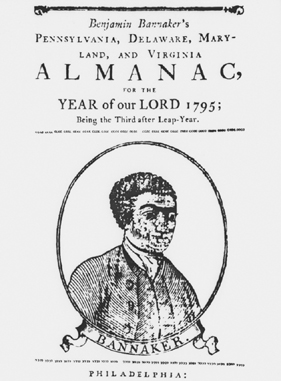
Benjamin Banneker (1731-1806) (photo credit 11.1)
After Molly and Bannka’s daughter married Robert, the young couple took on the farm work, while Molly took on the task of educating her grandson, Benjamin, and his younger sisters. For a brief period, Benjamin attended a nearby Quaker school (the Quakers being not only abolitionists but continually in the forefront of equal rights). As with most rural children in that era, Benjamin stopped attending school once he was old enough to assist his parents on the farm. In time Robert and Mary purchased additional acreage, the records reflecting their name often being listed as Banneker. As his parents aged and his sisters married, Benjamin took over the farm.
Despite his relationship with his Quaker neighbors, Banneker’s journal reveals that he was as vulnerable as other African Americans at that time and for centuries to come. On December 18, 1790, he recorded, “XXXXXX informed me that XXXXXX stole my horse and great coat, and that the said XXXXXX intended to murder me when opportunity presented and further gave me caution to let no person in my house after dark.”3 If Banneker had been white, he could have taken this information to the sheriff. Rather than report it, he later carefully crossed out all the names in this entry, fearing what might happen should his journal fall into the wrong hands.
Still, in other segments of society, being black could be an asset, albeit sometimes as an oddity. Though no publisher accepted Banneker’s first almanac in 1791, some considered it at length, thinking there might be interest in mathematical calculations performed by an African American. Through George Ellicott, now thirty-eight years old, Banneker’s unpublished almanac came to the attention of the Pennsylvania Society for Promoting the Abolition of Slavery, one of whose members was George’s cousin, the prominent surveyor Andrew Ellicott.
Banneker commenced preparing an almanac for the following year. Andrew Ellicott, meanwhile, started work on his recently received commission to survey the boundary of the newly created District of Columbia. To assist him in this task, he offered a position to his fellow surveyor and cousin, George. George, however, was unable to accept the offer and suggested Benjamin Banneker.
Politics in the eighteenth century being no different than politics now, Andrew Ellicott aimed to protect his posterior before making such a righteous choice. He sought the approval of President Washington’s secretary of state, Thomas Jefferson—a shrewd move, since Jefferson’s views on race were conflicted but his political ambitions were not. Jefferson approved the choice.
The wisdom of Ellicott’s marshaling support soon became evident. During the course of the project, Ellicott lodged at various inns; Banneker slept at the base camp, since few if any local inns would provide accommodations to African Americans. Even in camp, Banneker ate his meals separately from the other members of the engineering corps. Without Jefferson’s approval, Banneker’s very presence on the project may well have been rejected.
Ellicott himself, however, regarded Banneker as a colleague. He placed him in charge of the astronomical instruments and asked him to perform the mathematical calculations. Ellicott supervised the field measurements. The city whose boundaries they were to locate was a square with ten-mile sides, occupying land on both sides of the Potomac River and encompassing the ports of Georgetown on the north bank and Alexandria on the south bank. Today, that part of the original city south of the Potomac is no longer part of Washington, DC, having been returned to Virginia in 1846. (See “Robert M. T. Hunter” in this book.)
Banneker’s work on the survey made him an instant celebrity, since his achievement was of value to people in influential positions. First and foremost were the abolitionists, whose arguments against slavery were greatly strengthened by examples of the intellectual equality of African Americans. Even while the survey was under way, a meeting of the Maryland chapter of the Society for Promoting the Abolition of Slavery heard a report regarding “an almanac for the year 1792, the astronomical calculations thereof performed by Benjamin Banneker, a black man, a descendant of African parents. The calculations appear to be attested by a number of respectable characters as very accurate.”4 With the publicity generated by the society, printers were now more confident that an almanac created by an African American would sell well. They were wrong; it sold very well.
Banneker, his golden opportunity at hand, then did an extraordinary thing. He sent a copy of his almanac to Thomas Jefferson, but his cover letter said not a single word about his almanac. It spoke instead about slavery. After noting how, under the rule of the king, Americans had experienced a kind of enslavement, Banneker went on to say:
Your abhorrence thereof was so excited that you publicly held forth this true and invaluable doctrine, which is worthy to be recorded and remembered in all succeeding ages, “We hold these truths to be self-evident, that all men are created equal; that they are endowed by their Creator with certain unalienable rights, and that among these are, life, liberty, and the pursuit of happiness.” … But, Sir, how pitiable is it to reflect, that although you were so fully convinced of the benevolence of the Father of Mankind, and of His equal and impartial distribution of these rights and privileges, which He hath conferred upon them, that you should at the same time counteract His mercies, in detaining by fraud and violence so numerous a part of my brethren.5
The fact that Banneker wrote to Jefferson suggests that he was as keen an observer of politics as he was of planets and stars. Having witnessed Andrew Ellicott seeking Jefferson’s support for his appointment, Banneker knew that the present political constellation made Jefferson an ideal ally. Less than two weeks later, Banneker received the following letter:
Sir,
I thank you sincerely for your letter of the 19th instant and for the almanac it contained. Nobody wishes more than I do to see such proofs as you exhibit, that nature has given to our black brethren, talents equal to those of the other colors of men, and that the appearance of a want of them is owing merely to the degraded condition of their existence, both in Africa & America. I can add with truth, that nobody wishes more ardently to see a good system commenced for raising the condition both of their body & mind to what it ought to be, as fast as the imbecility of their present existence, and other circumstances which cannot be neglected, will admit. I have taken the liberty of sending your almanac to Monsieur de Condorcet, Secretary of the Academy of Sciences at Paris, and member of the Philanthropic society, because I considered it as a document to which your whole color had a right for their justification against the doubts which have been entertained of them. I am with great esteem, Sir
Your most obed’t humble serv’t.,
Thomas Jefferson6
Banneker and the abolitionist societies recognized the immense value of Jefferson’s letter—as no doubt Jefferson did in writing it. The two letters immediately appeared in pamphlets and newspapers throughout the country. The publicity led to Banneker’s 1793 almanac outselling all its competitors, and the 1794 edition outselling that of 1793.
But fame did not eliminate the racial abuses that Banneker faced. Too old to continue working his land, he rented it out to small farmers in the area. Often they refused to pay the rent and on occasion threatened him over the matter. He noted that on August 27, 1797, “Standing by my door, I heard the discharge of a gun, and in 4 or 5 seconds of time after the discharge, the small shot came rattling about me, one or two of which struck the house, which plainly demonstrates that the velocity of sound as much greater than that of a cannon-bullet.”7 Possibly the incident was an accident, not an act of intimidation. That the entry is ambiguous may itself be a clue to the experience of being black at that time and place. Does Banneker’s observation about the velocity of sound reflect his fascination with science even when his life was in danger? Or does it reflect how, for the sake of safety, he disguised his recording of a racist event in scientific garb?
Likewise, what others wrote about Banneker reveals how one’s true feelings about race could be just as difficult to know then as they often are today. The same year that the bullet was fired into Banneker’s home, The Time Piece & Literary Companionpublished a satiric article, purporting to be the last will and testament of one Peter Porcupine. It included the curious-to-decipher bequest, “Should the said Thomas Jefferson survive Banneker, the almanac maker, I request he will get the brains of the said philomath carefully dissected, to satisfy the world in what respects they differ from a white man.”
Benjamin Banneker could not satisfy the world. But he could cope with it. And prevail.