
· · · LOUISIANA, MISSISSIPPI · · ·
The outrages of the Kempers a few years ago are not yet forgotten. That family has on the recent occasion displayed its accustomed contempt for the laws of society, and was very active in … erecting Florida into a government independent alike of Spain and the United States.
—PHILADELPHIA WEEKLY AURORA, MARCH 3, 1811
Why is the Museum of the Republic of West Florida located two states away in Louisiana? The answer has a lot to do with Reuben Kemper, an American immigrant to Spain’s province of West Florida.
After the Revolution, what had been a trickle of Americans migrating to West Florida turned into a flood. Reuben, Nathan, and Samuel Kemper moved there from Virginia around 1800. Like many Americans, they were attracted by the fact that Spain made it easier for the average person to acquire land than did the United States. In the United States, to obtain title to land one had to have the money to purchase it. In Spanish West Florida, one could apply for title to land, and ultimately obtain that title, simply by living on the land and cultivating it—and by professing loyalty to Spain.1 The policy aimed to discourage absentee land speculators and reward individual productivity. To the extent that it was enforced, Spain’s policy resulted in an industrious—and loyal—population.
The Kempers, however, were not happy campers. In 1804 the Natchez Herald reported that Reuben and his brothers,
with a party of about 30 men, with colors flying and horns sounding, marched from the neighborhood of the line of demarcation between this territory [Mississippi] and West Florida … against the fort of Baton Rouge.… They arrived on the following morning about daylight near the fort. The Spanish commandant … had posted a piquet of 18 or 20 men, who hailed the party as they approached. They immediately answered by a volley from their rifles, which dispersed the Spaniards, two of whom were observed to fall.
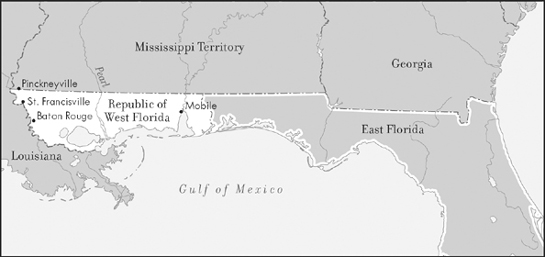
Spanish Florida, 1783-1810
The newspaper account reported that the Kemper party then returned to its headquarters at St. Francisville, without explanation of why they retreated. Instead, the account quoted, in its entirety, a broadside that the Kempers had posted at points along the way.
The posting spoke of “the despotism under which we have long groaned,” and their resolve “to throw off the galling yoke of tyranny, and become free men, by declaring ourselves a free and independent people.” The message closely resembled the Declaration of Independence, though at no point did it say they sought to join the United States. Nevertheless, their declaration raised Spanish eyebrows. Earlier that year, President Thomas Jefferson had signed the Mobile Act, stating that the 1803 Louisiana Purchase included West Florida. But Jefferson also stated that, because of the ambiguity of the document defining the Louisiana Purchase, along with the ambiguity of land transfers between Spain and France, he would not assert American claims militarily.
Although Kemper and his brothers were not in cahoots with the U.S. government, weren’t they freedom fighters nevertheless? Probably not, despite their rousing posters. One month after their attack at Baton Rouge, New York’s Republican Watch Towerrevealed that “Mr. [Reuben] Kemper, the leader of the association, was for some time in the service of Mr. Smith, of Tennessee, to whom he became indebted to a considerable amount. Being prosecuted, he fled to Florida, where, at the head of thirty men, he raised the standard of revolt.”
The details were actually somewhat different. Mr. Smith was John Smith, a resident of Ohio—in fact, a U.S. senator from Ohio. He owned land in West Florida, which he paid the Kemper brothers to manage. Smith’s absentee ownership was in violation of Spanish policy, but Spanish policy was laxly enforced (especially for a U.S. senator).2 The debt mentioned in the news account resulted from Smith’s providing the Kempers with dry goods that they were to sell to local residents. When the business failed, Reuben Kemper was deeply in debt to Smith, but he did not flee to West Florida, since that is where he lived and where the litigation took place. The judgment in favor of Smith resulted in efforts by West Florida authorities to evict the Kempers from Smith’s land. These efforts became increasingly violent confrontations that, not unlike a barroom brawl, began to involve additional people.
Spain’s governor of West Florida viewed the Kempers as ne’er-do-wells who attracted bandits and a few otherwise innocent bystanders. He thus sought to isolate them from their followers by pardoning all those who had been arrested during the eviction confrontations, with the exception of the Kempers. The policy succeeded, as evidenced by the fact that the Kempers’ response—the 1804 attack on Baton Rouge—attracted only some thirty men.
What, meanwhile, did the U.S. government think, since it claimed this region? William Claiborne, governor of the neighboring Louisiana Territory, reported to Secretary of State James Madison that the Kemper incident was “nothing more than a riot, in which a few uninformed, ignorant men had taken part.”3 Madison, in turn, repudiated the Kempers’ actions and vowed to arrest them if they entered American territory.
But what the federal government actually thought turned out to be less clear. When the Kemper brothers, seeking to evade capture by the West Florida militia (composed primarily of American immigrants), fled into American territory, they were not arrested as promised. So Spain arrested them. But to do so, the West Florida militia had to step over the line into Pinckneyville, Mississippi. Because they had crossed the boundary, the United States justified its forces’ freeing the Kempers as they were being transported down the Mississippi River to Baton Rouge.
For the next six years, the brothers tended to their own affairs. When Reuben surfaced again in December 1810, the situation had clearly changed. Baltimore’s Federal Republican reported:
Col. [Reuben] Kemper, in service of the [Republic of West Florida] convention, was on the Alabama River with 340 men, where he will probably remain until he receives a reinforcement.… We learn from St. Francisville that the Legislature assembled there last week under the new constitution … that in consequence of dispatches from Col. Kemper, a detachment of 1500 men (with a suitable train of artillery) under the command of Col. Kirkland, marched from St. Francisville for Pensacola.
How had Reuben Kemper gone from being a debtor corralling a gang of bandits to a leadership position in a rebellion against Spain? Two underlying elements contributed to his success: deteriorating relations with Spain and political uncertainty in the United States. One deteriorating relationship involved the United States’ need for unrestricted access to the sea via the Gulf of Mexico. After the Louisiana Purchase, Spain and the United States quarreled over the tariffs charged to American vessels at Baton Rouge and at Mobile (the mouth of the Alabama and Tombigbee Rivers). These tensions heightened three years after the Kemper incident, when President Jefferson signed the 1807 Embargo Act, prohibiting trade between the United States and any other nation. This extraordinary ban resulted from frustration with France and England’s refusal to recognize American neutrality. Both nations, then at war, had repeatedly seized U.S. ships engaged in trade with their respective enemy. The act, which sought to curtail all trade until the war ended, aimed to hasten that end by withholding American supplies. To prevent smuggling, the Embargo Act also called for a blockade of Spain’s West Florida ports. Spain was not pleased.
Spain had other problems that also contributed to the change in West Florida. Its Latin American colonies, following in the footsteps of the United States, had begun to seek independence, most notably under the leadership of Simón Bolívar. With its position in the world so uncertain, Spain closed immigration from the United States to West Florida. Even American relatives of West Florida citizens were prohibited from entering the province. The immigration restrictions created widespread animosity among the citizens of West Florida toward the nation to which they had previously been loyal.
Uncertainty on the American side also contributed to Reuben Kemper’s reversal of fortune. This uncertainty emanated from a man whose involvement with West Florida is all but forgotten, but whose duel that killed Alexander Hamilton is not: Aaron Burr.
Burr, who had been vice president during Jefferson’s first administration, never stood trial for the duel, but his reputation was in tatters. He subsequently traveled a great deal, often in Louisiana, in Mexico (where he had leased 40,000 acres that were being cultivated by armed “farmers”), and in West Florida. Burr’s travels raised American suspicions, particularly in light of meetings he had held with the U.S. military commander in Louisiana, James Wilkinson. Though a highly talented general in the Revolution, Wilkinson later negotiated with Spain as a private citizen, seeking privileged navigation for Kentucky along the Mississippi River. Many in the Jefferson administration now wondered whether, in the event of war with Spain, the two men were conspiring to coordinate Wilkinson’s forces and Burr’s “farmers” to separate the Louisiana Purchase, Burr’s Mexican lands, and all or some of West Florida into their own country. Wilkinson ultimately revealed this plot, though questions regarding his credibility only added to American uncertainty.
People don’t like uncertainty, and many cope with it by finding a way to fill in the blanks. Reuben Kemper, who was also entangled in the alleged Burr conspiracy, was able to rehabilitate his reputation by providing the public with a way to fill in the blanks. The opportunity to do so presented itself, ironically, following his arrest by the federal government, which was reported nationwide. In January 1811 North Carolina’s The Star, reprinting a story from the Rhode Island Republican, reported:
Since the [Republic of West Florida] Conventional Party have declared themselves free and independent of Old Spain … a number of the inhabitants of this part of the [Mississippi] Territory wishing well to the cause have taken an active part in the business and about a fortnight since several men, to the number of sixty-five, went below the line of demarcation.… All who have returned above the line have had writs served upon them for the purpose of a prosecution, on account of having engaged in an expedition not authorized by the government of the United States—among whom are Col. Kennedy and Col. Kemper.
Because Kemper had lain low for six years, his dubious past escaped the notice of most newspapers. But his arrest risked revealing his days at the head of what the U.S. government had declared to be a gang. Shrewdly, he seized this moment to publish his own account in newspapers throughout the country. He related how he had been contacted by a man named Lewis Kerr, who knew of his past attack at Baton Rouge and invited him to an important meeting, at which he would have to take an oath of secrecy: “Before taking this oath, I told Mr. Kerr that was there anything in opposition to the government of the United States, that it must not be made known to me on any terms whatever! He assured me there was not.” Kemper then employed some classic name-dropping, citing Kerr’s assurance that the secret project “was set on foot by men higher in office than any others in the United States—I believe meaning the president.” Kemper’s article related that the venture being planned—technically not by the United States—was to take possession of West Florida. He was asked how many men he could raise and allowed as he could “fill the place.”
The crux of Kemper’s article followed this account of his recruitment. It sought to separate his participation from Aaron Burr’s alleged conspiracy to create a new country:
I asked him if he had ever learned or could conjecture what Mr. Burr’s plans were, in coming to this country the year before.… His route was a strange one. Mr. Morgan said so it was, but he knew nothing of Mr. Burr’s plans; that he was not in the habit of telling him, but said there was a man in this place some time prior to this had told him that he expected Burr was on some revolutionary plan or other toward Mexico.… I observed that, in my opinion, Burr was an intriguing character, who would stop at nothing in his situation. Mr. Morgan said very true, he was all that, but he was a man of too much sense for that.
Kemper concluded by relating an extraordinary effort he undertook to eliminate any uncertainty about the military action in which he was becoming involved:
I at length determined in going to see Mr. Jefferson, and in June I left the Mississippi Territory for Washington city. On my route, I had planned a thousand ways of introducing the inquiry, knowing the unfavorable impression that had been made on the mind of the president through my particular “friends,” Mr. Claiborne, Governor of Louisiana, Mr. John Smith, Senator from the State of Ohio, and some others.
But the climax of the article—Kemper’s meeting with President Jefferson—engaged in the very thing the article hoped to eliminate: uncertainty. “I rather bungled the business,” Kemper wrote, “obtained no information, and I suppose gave but little. The president thought he had received a novel visit, and I thought he treated his guest in a novel manner.” Meaning what? Who knows. What we do know is how Kemper rehabilitated his reputation by skillfully exploiting uncertainty.
Uncertainty continued to accompany the Kempers as they passed into history. The 1874 American Cyclopaedia described Reuben Kemper as one of the “leaders in the movement to rid West Florida of its Spanish rule.” Extolling Kemper, it says, “The Spanish authorities caused the Kempers to be kidnapped, but they were rescued.… After these occurrences, Reuben Kemper devoted himself to the task of driving the Spaniards from the American continent.” Other histories have viewed Kemper more along the lines of William Horace Brown, who in 1906 described him as “a man whose lawlessness has found respectable apologists—who has even been lauded, like many others of his brutal breed, as a gallant knight of the frontier.”
As for the portion of Spanish West Florida that was “liberated” in September 1810, it constituted itself as an independent republic. But before the year was out, the United States dissolved the Republic of West Florida, taking possession of the western half of the region and annexing it to Louisiana. This action created the segment of southern Louisiana east of the Mississippi River.