
· · · WASHINGTON, IDAHO, MONTANA · · ·
On the nomination of Mr. Polk we hardly know what to say. A more ridiculous, contemptible and forlorn candidate was never put forth by any party.… Mr. Polk is sort of a fourth or rather fortieth-rate lawyer and small politician in Tennessee.
—NEW YORK HERALD, MAY 31, 1844
What, if anything, is generally remembered about President James K. Polk is that his campaign slogan was “Fifty-Four Forty or Fight!” In fact, it wasn’t. The issue (involving present-day Oregon, Washington, and British Columbia) was central to his campaign, but there is no evidence that the slogan existed at that time.1
During Polk’s presidency, the American map changed dramatically, its boundary expanding to include Texas, the Oregon Territory, and everything in between, from the Rockies to the Pacific. Many factors contributed to the change, but a key element was that, at critical moments, Polk was a prodigious political poker player.
To follow how Polk’s moves resulted in these gains, we need to know who else was at the table, since each player’s strategy affected the others. Following his election in 1844, Polk found himself in a high-stakes game already in progress that included Mexico, Britain, and, reflecting public opinion, Congress. He also found himself having been dealt cards that were not particularly good.
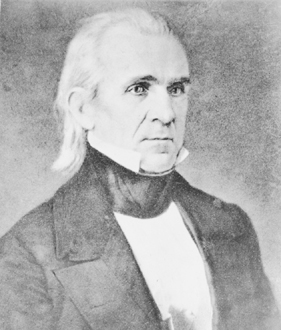
James K. Polk (1795-1849) (photo credit 23.1)
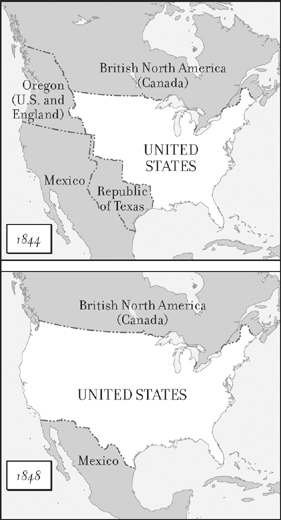
United States when Polk entered office and when he left
In the case of Mexico, Polk began with a crisis over Texas. Texas had battled itself free from Mexico in 1836, though Mexico had not recognized its independence and therefore never agreed to particular borders. Texas claimed that its border with Mexico was the Rio Grande. But its southern border as a Mexican province had been farther north, at the Nueces River. Four days before Polk’s inauguration, President John Tyler signed a congressional resolution admitting Texas to the Union, “subject to the adjustment by this government of all questions of boundary that may arise with other governments.” Mexico, whose objections went considerably beyond “questions of boundary,” recalled its ambassador during the first week of Polk’s presidency, thus upping the ante on the prospect of war.
War with Mexico was not militarily intimidating, particularly since Mexico was in the midst of one of its many revolutions. War with Britain was another matter. And that possibility was another of the cards Polk had been dealt.
Until the presidential campaign that resulted in Polk’s election, the United States and Britain had agreed to disagree about a boundary dividing the Oregon Country, a region far more vast than the present-day state of Oregon. Under an extension of a ten-year joint occupancy agreement included in the 1818 Anglo-American Convention negotiated by Richard Rush, Britain and United States shared the area bounded on the south by the 42nd parallel (below which, at that time, was Mexico), on the east by the crest of the Rocky Mountains, and on the north at 54°40’ (the border with Russian Alaska that Britain negotiated in 1825). By the 1840s, the region’s population had grown to the point that the United States and Britain picked up where they had left off in seeking to determine a boundary. The Tyler administration proposed an extension of the 49th parallel—the line already in place from Minnesota to the Rockies. But the British sought a boundary farther south at the Columbia River.
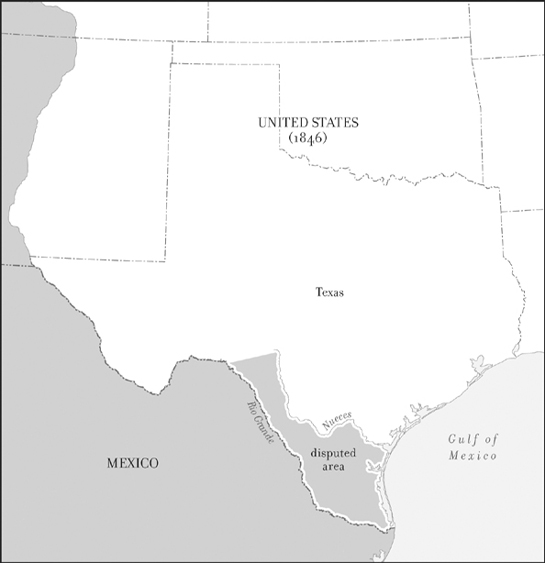
Texas: disputed border
Negotiations crept along cordially enough until the Democratic Party seized upon the issue as a possible means of defeating its formidable opponent in the upcoming election, Henry Clay. Clay’s reputation was that of a creative compromiser, an invaluable skill in a nation fundamentally divided over the issue of slavery. The Democrats sought to outfox Clay by including in the party’s platform a totally uncompromising position regarding Oregon. “Resolved, that our title to the whole of the Territory of Oregon is clear and unquestionable,” it asserted, “that no portion of the same ought to be ceded to England or any other power.”
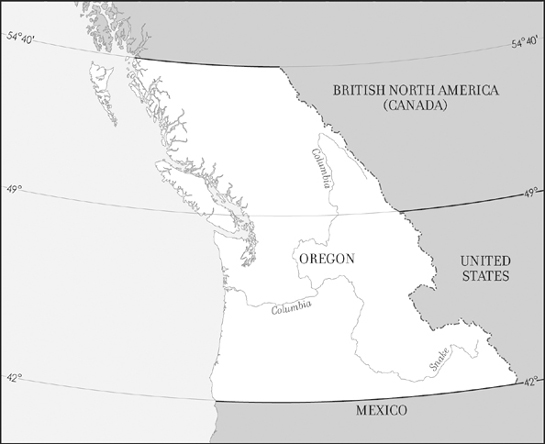
British-American Oregon
For this ploy to be effective, the public had to believe that the entire region was vital to the United States. Consequently, the Democrats beat this drum loudly. Much of the public responded to their alarm. To them, the Democrats had a clear vision regarding Oregon; Henry Clay’s nuanced views were more ponderous. The Democrats won the White House.
But not the Democrat anyone expected. Seven candidates had vied for the party’s nomination on the first ballot. Polk was not among them. Successive balloting failed to give any candidate a majority; none, however, would release his support to any opponent. Ultimately they chose to nominate someone who was no one’s opponent (or hero), and who would publicly promise not to seek reelection if, by some fluke, he won. That candidate was former congressman and former Tennessee governor (twice defeated for reelection) James K. Polk. The fluke was the effectiveness of the Oregon issue.
Polk, for his part, had participated in the ploy and did believe expansion to the Pacific was vital to the nation’s future. The ports provided by the Columbia River and, farther north, Puget Sound, would provide the nation with its only access to the Pacific Ocean (since California was still part of Mexico).
Polk thus took his seat at the table with Mexico threatening to go to war over Texas, and with an American public having provided him the seat through its support for his party’s campaign to acquire the entire region of Oregon, which could mean war with Britain. In addition, he knew that the other players viewed him as a lightweight. The first thing Polk had to do, therefore, was change the way he was perceived. He needed to create the impression that he was somehow in possession of much stronger cards, or that he was wildly unpredictable. Either would do, since either would cause his opponents to take a step back. Polk made that first move in his inaugural address:
The Republic of Texas has made known her desire to come into our Union.… I regard the question of annexation as belonging exclusively to the United States and Texas.… Foreign nations have no right to interfere.… Nor will it become in a less degree my duty to assert and maintain by all constitutional means the right of the United States to that portion of our territory which lies beyond the Rocky Mountains. Our title to the country of the Oregon is “clear and unquestionable.”
That got Britain’s attention, clearly fitting the category of wild and unpredictable. The Liverpool Mercury reported in April 1845:
The Earl of Clarendon drew the attention of their Lordships to the inaugural address of the President of the United States respecting Texas and the Oregon territory, the language of which he described as characterized by a studied neglect of that courtesy and deference which governments were wont to observe when treating upon international affairs, and as leading to the inference that … the only basis of negotiation was unconditional surrender by England of all that was claimed by America.
In achieving his initial objective with Britain, Polk limited his next move in terms of public opinion in the United States. “There has been an important debate in the British Parliament on the Oregon, disclosing the view of England on that subject,” the New York Herald observed in April 1845. “We may now expect a serious difficulty between England and America. We do not see what is to prevent it. America has assumed her position, and England has now taken hers. Neither, therefore, can recede an inch.”
Britain indeed did not recede but rather, turning to Mexico, raised the stakes by urging Mexico to go to war with the United States over Texas. “There are many considerations that militate in favour of the Mexicans,” the London Times editorialized that same week. “Can anything exceed the dissatisfaction of the states of New England, or New York, or of Ohio, at having to meet the calls of war … for the encouragement of slavery?… The military establishment of the United States is very well adapted to … repel a foreign enemy.… But offensive and defensive war are two different things.”
Mexico saw Britain’s move and, three weeks later, added its chips. On May 7, 1845, its congress passed a resolution. “The unjust usurpation of which [the United States] sought to make Mexico the victim, makes it her duty to take up arms in her defense,” it asserted, upping the ante by concluding, “The Mexican nation calls upon her sons to defend their national independence, threatened by the usurpation of the territory of Texas.”2
It was Polk’s turn again. What he needed now was room to maneuver, knowing he could not simultaneously take on two wars. In July he had Secretary of State James Buchanan make Britain an offer that gave him room to maneuver with U.S. public opinion, and time to do so by making it an offer Britain had to refuse. Polk achieved both with deceptive simplicity. He abandoned his campaign pledge (and inaugural address demand) that the United States was entitled to all of Oregon and returned to the previous administration’s bid for a boundary that continued along the 49th parallel from the Rockies to the Pacific. Americans who preferred compromise to war were startled and impressed; Polk’s militant supporters were startled and upset. Unnoticed by both groups was the absence, in Polk’s proposal, of any mention of British access to the Columbia River. But the British noticed. The Columbia was a major artery of Britain’s fur trade, conducted under the auspices of the Hudson’s Bay Company. In addition, a line from the Rockies to the Pacific would divide Vancouver Island and its prized ports in the strait separating it from the mainland. Britain rejected Polk’s proposal.
In the United States, Britain was now viewed as intractable. What wasn’t viewed was the purpose of Polk’s move—to make Americans view themselves as tractable. Polk had acquired the card he needed.
Later in the same month of July 1845, with Britain now pausing to reassess the U.S. president, Polk raised the stakes on Mexico. He ordered troops to cross the Nueces River, with those orders explicitly stating for the first time that the United States considered the Rio Grande to be the border between Texas and Mexico.
Britain, after considerable thought, opted to match this move. “In a short time,” the London Times reported in November, “Admiral Seymour will be upon or near the coast of Oregon with one ship of 80, one of 50, one of 18, and one of 16 guns.”
Within weeks Polk hedged his bet, sending Congressman John Slidell to Mexico with an offer to purchase Texas for as much as $40 million.3 By hedging on Mexico, Polk caused Britain to ponder him yet again. Did war over Oregon amount to bluffing or not?
To make certain the British kept wondering, Polk used his December 2, 1845, State of the Union message (which he would later make further use of domestically) to ensure the uncertainty of his intentions. In speaking of Oregon, he repeatedly invoked the spirit of compromise while simultaneously raising the specter of war:
In consideration that propositions of compromise had been thrice made by two preceding Administrations … and that the pending negotiation had been commenced on the basis of compromise, I deemed it to be my duty not to abruptly break it off.… A proposition was accordingly made which was rejected by the British.… All attempts at compromise having failed, it becomes the duty of Congress to consider what measures it may be proper to adopt … for the maintenance of our just title to that territory.
Over in Britain, one thing was certain. It too had a militant faction that equated compromise with surrender. This faction was spearheaded by Lord Palmerston, a former foreign minister whose party no longer led Parliament. Prime Minister Robert Peel, like Polk, needed room to maneuver. In a parliamentary maneuver, Peel called Palmerston’s bluff and won. Polk, in response to Peel’s having marginalized Palmerston’s opposition, sent word in January 1846 that if the British wished to make a counterproposal to his offer of the 49th parallel, he would send it to the Senate to hear its advice.
Meaning what? Britain, again having to contemplate this perplexing president, did nothing. One month later, Polk turned up the heat: the treaty of joint occupancy could be terminated twelve months after either nation served notice, and he urged Congress to serve notice.
The British Parliament was not the only legislature trying to figure out Polk. So was the U.S. Senate. If the clock ran out, what did the president plan to do? During a two-day period, Polk noted in his diary:
[March 4, 1846] Senator Hanegan of Indiana called.… He spoke of Mr. Haywood’s speech in the Senate that day, in which he had undertaken to expound my views on the Oregon question, and seemed, without asking the direct question, to desire to know whether he was authorized to do so. I told him no one spoke ex cathedra for me, that my views were given in the annual message of the 2nd of December.… On going into my office I found Mr. Yulee & Mr. Lewis there and, as I anticipated, they had called to see me on the subject of Oregon. Unlike Mr. Hanegan, they expressed themselves to be greatly delighted at Mr. Haywood’s speech in the Senate.… I repeated … that my views were contained in my message of the 2nd of December.
[March 5, 1846] Senator Cass called this evening.… I told him my opinions on the Oregon question were contained in my annual message.
Louisiana Senator Alexander Barrow was among those who expressed befuddlement. To his fellow senators he declared:
We have before us a most extraordinary and, I must say, humiliating public spectacle.… We sit here as part of that great National Council which, along with the Executive, directs the affairs of this people.… Amongst us [the president] has a decided party majority, anxious to afford him support in all his measures. And yet … his real purposes in the momentous questions before us … are an enigma to his very adherents here, who cannot, for their lives, settle between them his true meaning and intention!
Like Prime Minister Peel, Polk had to outfox the leadership of his nation’s militant faction. But for Polk that faction was in his own political party. Hence this move of asking Congress to start the clock ticking, while keeping them guessing his intentions if time ran out. As his White House encounters revealed, both sides assumed his ambiguity meant he was leaning toward them. On April 23 the Senate joined the House in voting to end the joint occupancy agreement.
It was not a moment too soon. Two days later, sixteen American soldiers were killed in a skirmish with Mexican troops. In early May Polk sent Congress a declaration of war.
The next move was Britain’s. Which way would it go? The answer arrived on June 3. Britain would agree to the 49th parallel, but only from the Rockies to the main channel of the Juan de Fuca Strait, and only if the Hudson’s Bay Company retained navigational rights to the Columbia River until the expiration of its charter in 1859.
Polk, as he’d promised, sent the proposal to the Senate but yet again flummoxed them by saying he planned to reject the proposal unless two-thirds of the Senate voted in its favor.4 Polk then said nothing more on the subject, leaving the Senate to guess what that meant.
Militants in the Senate continued to oppose the proposed compromise, and those who had been opposed to war supported it. The critical votes would be from those less committed. Some, because of Polk’s having just entered into a war with Mexico, voted for compromise, not wanting to fight two wars at once. Others opted for compromise, anticipating that Polk’s silence and two-thirds request would tilt the field. The proposal thereby ended up being passed 37 to 12. Within weeks it became a treaty, which the Senate ratified 41 to 14.
Polk had not acquired all the Oregon territory his party had advocated in its campaign platform. But he had acquired all the territory that the previous president, also from his party, had unsuccessfully sought.
The Mexican War was brought to conclusion when the Treaty of Guadalupe Hidalgo brought what would become California, Nevada, Utah, and parts of what would become Wyoming, Colorado, New Mexico, and Arizona into the borders of the United States. The treaty was ratified on March 10, 1848, in the midst of the next presidential campaign.
James K. Polk, as promised, was not a candidate.