
· · · VIRGINIA, DISTRICT OF COLUMBIA · · ·
Virginia is ready to receive these people back into her bosom, and they are ready and anxious to return. They desire to enjoy the rights of men, the privileges of free men. Can the American Congress fail to respect such a feeling?
—CONGRESSMAN ROBERT M. T. HUNTER1
In 1791 Andrew Ellicott and Benjamin Banneker marked off the boundaries of the District of Columbia: a square with ten-mile sides, straddling the Potomac River. It encompassed two municipalities (Georgetown and Alexandria), a federal enclave (Washington), and rural areas on either side of the Potomac (Alexandria County and Washington County).
Fifty-five years later, President James K. Polk signed away the entire section of the nation’s capital on the Potomac’s southern side, returning it to Virginia. In reaction, one newspaper in the North wrote:
The Senate has passed, by a majority of more than two to one, the bill which passed the House the 8th of May, retroceding the city and county of Alexandria, D.C. to Virginia.
The Democrats of Maine have nominated John W. Dana, of Fryeburg, as their candidate for governor.2
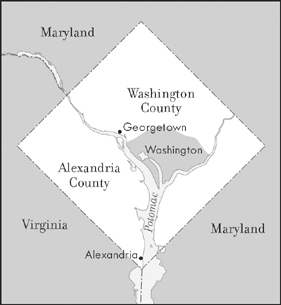
District of Columbia, 1790-1846
In the South, by comparison, a Mississippi paper wrote:
In the Senate, on the 2nd inst., the bill taking the city of Alexandria from the District of Columbia and giving it to the State of Virginia passed.
In the House, on the 3rd, McKay’s tariff bill passed.3
Hello? Was anyone paying attention?
This 1846 legislation was initiated by Virginia Congressman Robert M. T. Hunter. His success, however, culminated efforts that had begun more than forty years earlier. The seeming indifference of the press is misleading. It had been covering these efforts for decades. As early as 1803, Washington, DC’s National Intelligencer reported on the problem of the federal government running the District of Columbia.4 That year and the next, Congress vigorously debated the return of areas ceded to the federal government for the creation of a nation’s capital. The Annals of Congress record that Virginia Congressman John Randolph “believed the interests of the several parts of the [District of Columbia] were as hostile as any in the Union, as it was manifest there was an Alexandria, a Georgetown, and a city interest.… He therefore thought it expedient to retrocede all the territory, excepting the City of Washington.”
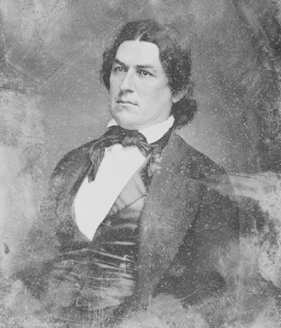
Robert M. T. Hunter (1809-1887) (photo credit 24.1)
While the preponderance of the speakers debated whether or not “retrocession” was constitutional, all agreed with Massachusetts Congressman John Bacon that “the exercise of exclusive legislation [for running the District of Columbia] would take up a great deal of time, and produce a great expense to the nation.… It was likely that as much time would be spent in legislating for this District as for the whole United States.”
Years later, Hunter repeated Randolph’s and Bacon’s concerns, amplified now since they had become established facts:
We have three cities in this District, each aspiring to be great, and all desiring to open up communications to the sources of their trade.… They have shared unequally in the appropriations.… Go look at [Alexandria’s] declining commerce, her deserted buildings, and her almost forsaken harbor. Look to the waste of natural advantages and opportunities in that town, suffering not from the blight of God, but the neglect of man.… We have not done all that might have been done for those who depend upon us for the necessary care which this government alone can bestow.
Because Congress indeed had its hands full running the country, it had given scant and uneven attention to the District of Columbia. This, in turn, intensified the rivalry among the District’s municipalities for congressional attention—particularly regarding commercial needs such as canals and bridges. “One of the early acts of this government … was to throw a mole [dam] across from Mason’s island to the south bank of the Potomac, and thus cut off the channel for boat communication between Alexandria and the water of the upper Potomac,” Hunter cited as an example to his colleagues. “From the time this was done up to the completion of the canal, scarcely a boat was ever seen in Alexandria from the upper Potomac.”5
Indeed, that earlier debate regarding a dam between Mason’s Island (present-day Theodore Roosevelt Island) and the Potomac’s south bank also reflected the rivalry of the municipalities, the inequities of congressional actions, and the resentment in Congress at having to devote time to the municipalities. In that 1804 debate, Virginia Congressman Randolph had declared:
[A] prompt rejection of the bill would serve as a general notice to the inhabitants of the District to desist from their daily and frivolous applications to Congress, to the great obstruction of the public business.
Andrew Gregg of Pennsylvania, however, pointed out that under the Constitution:
The House [was] bound to legislate for these people until it relinquished the claim to the jurisdiction either by authorizing them to legislate for themselves or retroceding them to the states to which they originally belonged.
Regarding the rivalry and inequitable treatment, North Carolina Congressman Nathaniel Macon argued:
The gentlemen in favor of this dam or causeway say it will do no harm.… On the other side, serious apprehensions are entertained of its injurious effects upon … the Eastern Branch [the present-day Anacostia River] and its causing obstructions in the harbor of Alexandria.
In the years leading up to Hunter’s 1846 effort, petitions seeking to detach the Virginia portion of the District of Columbia were repeatedly presented to Congress, resulting in bills that failed to pass in 1824 and 1840. Residents of Georgetown also periodically sought to have their area of the District returned to Maryland, most notably in an 1838 petition presented to Congress and in a bill that failed in 1856.
How, then, did Hunter succeed? Two overarching concerns account for Hunter’s success—and also account for the continued failure of such efforts by District residents on the Maryland side. Over the years, one of those overarching issues diminished, while the other enlarged.
The issue that diminished regarded the location of the nation’s capital itself. Differing visions among the Founding Fathers led to disputes as to whether the capital should be in Philadelphia or New York or a central location or in the South. Only after protracted negotiations between Thomas Jefferson and Alexander Hamilton was the Potomac River location accepted.6 When Congress first debated retrocession in 1803, Delaware Congressman James A. Bayard voiced this ongoing concern. Should the land be returned to Virginia and Maryland, he worried, “What obligation is there in Congress to remain here? … Unfix the Capitol and recede the District and believe me, Congress will soon take wings and fly to some other place.” But compared to when the Founders had debated the capital’s location, the issue now had an added dimension. President Jefferson was just then concluding the Louisiana Purchase, by which the United States suddenly became twice as large as it had been. If the legislative bolts locating the nation’s capital were loosened, where might the expanded nation want its center of power?
As the Louisiana Purchase evolved, the development of railroads so greatly reduced the burdens of travel that the concerns of the new states and territories did not include relocating the nation’s capital. The primary concern that emerged turned out to be the second overarching issue that contributed to Hunter’s success: slavery.
It was during this era of national expansion that Robert Mercer Taliaferro Hunter grew up. The son of a prosperous landowner in Essex County, Virginia, 100 miles south of the District, Hunter attended the University of Virginia, became an attorney, and in 1834 was elected to the Virginia House of Delegates. Three years later he was elected to the U.S. House of Representatives.
Hunter’s personality was ideally suited for the period in which he served in the House. “Mr. Hunter is a conservative Democrat, a calm, quiet, undemonstrative, practical politician,” the New York Herald wrote. “[He] speaks little and writes less.… Although strongly Southern in his sentiments … he draws a glowing picture of the future of the republic.”
Calm and undemonstrative he was, but not unfeeling nor without a sense of humor. He displayed both attributes as a college student in a letter to his widowed sister: “You seemed to be terribly in the dumps when you wrote. Are you still troubled with those thick-coming fancies, which are worse than real evils?… Have all the family feuds been appeased, so that you can no longer find amusement or occupation for your energies?… [If so] you may suppose me your opponent.”
Shortly before Hunter went to college, an upheaval resulting from the Louisiana Purchase had threatened to undo the nation. At issue was whether or not slavery would be permitted in the states being created from its land. Though the dispute was resolved by the Missouri Compromise, no one in Congress wanted to endure such rancor again. Unfortunately, the nation did endure it again, and again. The next major upheaval involved the same question as applied to the land acquired in the Mexican War.
That war began within a week of Hunter’s 1846 proposal for retrocession. Everyone in Congress knew that the United States would win the war and likely acquire vast territory.7 And everyone in Congress knew that such a victory would raise the old question of whether slavery would be permitted in the newly acquired lands. Thus, when Hunter presented his resolution, it was during the calm before the storm. Members of Congress were inclined to do anything that could be done to mitigate the expected storm.
One thing Congress could do was to appease Virginia by giving back the land it had ceded to create the District of Columbia. Such an action, at that point in time, would help Virginia in two significant ways.
The first benefit would be Virginia’s acquisition of additional proslavery voters electing representatives to its legislature. These votes were needed to counter those of the increasing population in Virginia’s mountainous western region (present-day West Virginia), an area not suitable for the large plantations needed to support slave labor. When Hunter presented his proposal, Virginia’s staunchly proslavery Democrats had recently lost their majority in the state’s House of Delegates.
The second significant benefit had to do with the slave trade. As Hunter stated in Congress, Alexandria was suffering economically, in part because no federal facilities had been built on the Virginia side of the Potomac. To make matters worse, Congress had begun to contemplate a prohibition of the slave trade in the District of Columbia. Were that to happen, it would be yet another blow to Alexandria’s economy.
Alexandria had been home to the nation’s largest slave-trading firm, Franklin & Armfield. Though the company had dissolved by the time Hunter proposed retrocession, its partners had sold their interests to a number of local slave traders. The size of the market served even by these smaller Alexandria companies, and by other slave dealers in the District of Columbia, was evidenced on a daily basis in the local papers:
CASH FOR NEGROES—I will give the highest cash price for likely NEGROES from 10 to 25 years of age. Myself or my agent can at all times be found at the establishment formerly owned by Armfield, Franklin & Co. at the west end of Duke Street, Alexandria.—GEORGE KEPHART
NEGROES WANTED—The subscriber wishes to purchase any number of Negroes for the New Orleans market, and will give at all times the highest market price in cash in likely young Negroes. Those wishing to sell will find it in their interest to call at my establishment, corner of 7th Street and Maryland Avenue, where myself or agent can be seen at any time.—THOS. WILLIAMS8
While outlawing the slave trade would be an economic blow to Alexandria, if Congress returned Alexandria to Virginia and then outlawed the slave trade in the District, the prohibition would be a boon to Alexandria, since it would eliminate the competition. To achieve this boon required some delicacy. Hunter, with his calm, dispassionate manner, a Southerner who spoke glowingly of the future of the Union, was just the man for the job. The bill passed the House 96 to 65 (and the Senate 32 to 14).
The legislation stipulated that a referendum be held on the southern side of the Potomac to determine whether a majority of that area’s voters (white males) wished to become Virginians. One group of Alexandrians particularly concerned about the vote’s outcome were its African Americans, since Virginia law prohibited teaching African Americans to read and write and required African American religious activities to be monitored by whites. Describing the day of the referendum, one free African American businessman in Alexandria wrote, “Whilst the citizens of this city and county were voting … humble poor were standing in rows on either side of the court house and, as the votes were announced every quarter of an hour, the suppressed wailings and lamentations of the people of color were constantly ascending to God for help and succor.”9
Today ghosts of the original District of Columbia remain on the map in the borders of present-day Arlington County, Virginia, and along the post—Revolutionary War segment of King Street in Alexandria.
As for Hunter, he was elected to the Senate later that year. While there, the anticipated storm erupted over slavery in the region acquired in the Mexican War. It blew away the Missouri Compromise. In its place, Congress cobbled together the Compromise of 1850 and then, four years later, took cover under the Kansas-Nebraska Act, which left the question of slavery to the states and territories (see “Stephen A. Douglas” in this book). Amid the bitter debates over the Kansas-Nebraska Act, Senator Hunter’s calm demeanor and practical arguments provided influential support for the bill—so much so that, the following year, the Cleveland Herald noted, “Clubs are forming in [New York] for the support of Robert M. T. Hunter, at present U.S. Senator from Virginia, for President of the U.S.”
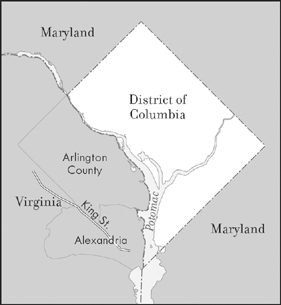
Ghosts of old D.C. border
Though Hunter’s presidential bid failed even to get his name on the ballot at the 1856 Democratic National Convention, it succeeded in calling attention to him as a candidate for the future. Indeed, four years later, a correspondent for the Daily South Carolinian reported:
I would respectfully suggest that a union of the Southern delegates might be effected upon the Honorable Robert M. T. Hunter of Virginia.… Mr. Hunter is peculiarly fitted for the Presidency.… He is a man of superior natural abilities and thorough cultivation … profoundly versed in the history of the rise and fall of empires.… However he is free from even the slightest tinge of pedantry and sentimentality. He is a plain, practical business man.
But the times no longer called for plain, practical men. The Compromise of 1850 and the Kansas-Nebraska Act had failed to mitigate the political storm over slavery. Inadvertently, they fed its escalation to hurricane force. In choosing a presidential candidate at the 1860 Democratic National Convention, the delegates were unable to coalesce after fifty-seven ballots. In each of those votes, Hunter placed a distant third among nine nominees. Ultimately the party shattered. Its splintered constituencies enabled the election of a visionary, Abraham Lincoln.
After Virginia’s secession, Robert M. T. Hunter was elected to the Confederate Congress—but not for long. In July 1861, three months into the Civil War, Hunter became the Confederacy’s secretary of state—also not for long. Individuals and factions were jockeying for power in the newly forming government, as San Francisco’s Evening Bulletin observed in February 1862:
[Robert Toombs] was made Secretary of State for the Confederacy … but resigned late in July, professedly that he might take the field [of battle].… Soon he was sent back to the rebel Senate, probably expecting to be chosen its presiding officer. But R. M. T. Hunter was too smart for him. That Virginian, rich in initials, was made Secretary of State after Toombs … [then] resigned, was sent to the new rebel Senate, and has been elected its president pro tem.
Hunter served in the Confederate Senate for the duration of the war, but the center of action was on the battlefield. Near the war’s conclusion, Hunter was one of three delegates selected to meet with President Lincoln at a peace conference held behind Union lines in Hampton Roads, Virginia.
The war left Hunter economically debilitated. In time, a government tidbit was thrown his way via an appointment as collector of the port of Tappahannock, Virginia. By then, Robert M. T. Hunter had become much like that section of the District he had restored to Virginia—a part of the government but hardly a participant, taking whatever opportunity came his way. Under the circumstances, however, there was no place to which he could retrocede himself.