
· · · WEST VIRGINIA, VIRGINIA · · ·
The consent of the legislature of Virginia is constitutionally necessary to a bill for the admission of West Virginia becoming a law. A body claiming to be such legislature has given its consent. We cannot well deny that it is such, unless … [it] was chosen at elections in which a majority of the … voters of Virginia did not participate. But it is a universal practice … to give no legal consideration whatever to those who do not choose to vote.
—ABRAHAM LINCOLN1
In the U.S. Capitol’s Statuary Hall, Francis H. Pierpont stands commemorated in marble as “the Father of West Virginia.” Yet, technically, he never lived in West Virginia until five years after it became a state. “Technically,” however, is no small matter in this instance. It is what gave birth to West Virginia: a technicality discovered, and put to use, by Francis Pierpont.
West Virginia became a state in the midst of the Civil War. Previously, it had been part of Virginia, which encompassed the Tidewater region (its flat coastal lands), the Piedmont (its rolling hills leading west to the Blue Ridge mountains), the Shenandoah Valley (between the Blue Ridge and the Alleghenies), and western Virginia (the Alleghenies and the land beyond to the Ohio River).
One could say that after Virginia seceded from the Union, western Virginia seceded from Virginia. Legally, that was precisely what it did not do. Since the federal government considered it illegal to secede from the Union, it would have also considered it illegal for western Virginia to secede from Virginia. Thus, for western Virginia to secede from Virginia, it had to devise an approach rooted in the illegality of secession.
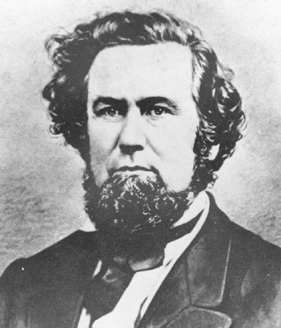
Francis H. Pierpont (1814-1899) (photo credit 34.1)
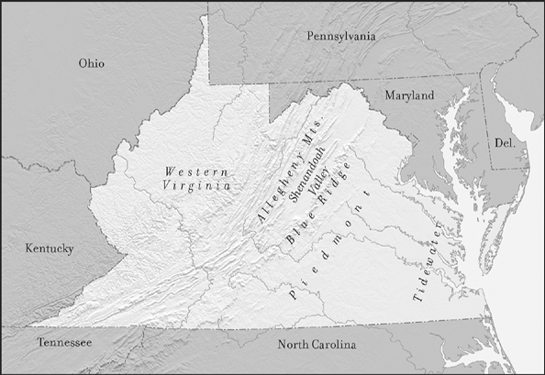
Virginia at the onset of the Civil War
But why would western Virginia have wanted to secede from the revered and influential Old Dominion? The short answer is that the region opposed slavery, but there was more to it than that. Most of its residents did oppose slavery, though their righteousness was likely buttressed by the fact that most could not afford them. The region’s mountainous topography was poorly suited to agriculture. Its mountains, moreover, were ideally suited for escape.
But western Virginia’s wish to secede resulted more directly from an issue at one remove from the slavery conflict. Slaves in Virginia were counted as three-fifths of a person for purposes of apportioning representation in the state legislature (though, of course, slaves could not vote). This formula reflected that which had been used in the U.S. Constitution, and it resulted in slave regions having greater representation than nonslave regions. Western Virginians repeatedly sought to abolish the use of that formula in the Virginia state constitution.
Disproportionate representation was made even more disproportionate by the fact that the authors of Virginia’s constitution (among them, Thomas Jefferson, James Madison, and George Mason) had embedded a property-value requirement for voting in the document. Because many western Virginians barely eked out a livelihood in their hardscrabble terrain, this requirement created a further disparity in representation.
The anger of western Virginians would have been among Francis Pierpont’s earliest memories. As far back as 1817, when he was a three-year-old on the family farm and tannery, the region’s discontent was surfacing in newspapers. Washington, DC’s National Advocate quoted one of the region’s residents: “Western Virginia is ruled with a rod of iron; and unless … we can obtain a change in some manner, our castigation will be so severe that we shall not be able to bear it. We are treated … as a deserted step-child, instead of the legitimate offspring of Virginia.”
Virginians who supported the property requirement for voting feared that giving voting representation to those without a certain level of wealth would “transfer power into entirely new hands,” resulting in “many evils and inflict crying injustice.”2 In 1830, however, the mounting discontent in western Virginia over the issue of representation caused the state to hold a new constitutional convention. Ironically, the property requirement for voting resulted in western Virginians being as underrepresented at the convention as they had been in the legislature. As a result, only marginal changes were made in the 1830 constitution, and they backfired. As the National Journal commented, “That section of the state will never be satisfied to remain a portion of the Old Dominion unless there shall be a still further extension of the right of suffrage.”
Ten years later, the 1840 census introduced a new element into the equation—one that riveted the attention of the nation’s antislavery movement. The Liberator reported in March 1842:
The recent census develops the fact that a majority of the white population [of Virginia] lies west of the Blue Ridge, in the free labor part of the State. Yet the eastern counties have nearly three-fourths of the political power by the amended constitution.… The subject is now before the legislature, and the [antislavery] Richmond Whig advises the Western Virginians to demand either concession to their demands or the formation of a new State, bounded east by the Blue Ridge.
Though the abolitionist press focused exclusively on the slavery aspect of the dispute, underrepresentation continued to spark complaints among western Virginians regarding inequitable schools, roads, and railroads.3
Pierpont was, by this time, a successful attorney in western Virginia. With only intermittent months of education available at a local one-room school, his parents had encouraged him to read what books they had and to seek a college education. But no college existed in western Virginia until after Pierpont had entered Allegheny College in northwestern Pennsylvania. After graduating with honors, he became a schoolteacher near his home in Fairmont. Many Americans were migrating westward at the time, and Pierpont too chose to relocate. He, however, went south, becoming a teacher in Pontotoc, Mississippi, for reasons no longer known. Whatever the reasons, the choice displayed a recurring pattern in Pierpont’s life: his willingness to embark with others on a major move, yet moving in his own direction.
During his years as a teacher, Pierpont was also learning law. After returning home in 1841, he became a licensed attorney. His keen legal mind won him the Baltimore and Ohio (B&O) Railroad as a client, representing its interests in nearby counties. After the Virginia legislature yielded in granting the B&O permission to lay track in western Virginia, the railroad’s main line ended up passing through Fairmont, near to which he opened a coal mine. By the early 1850s he was a wealthy and prominent man, married to a well-bred, abolitionist wife from the North.
Also by the early 1850s, the next census had shown that over 10,000 more whites now lived in western Virginia than in the rest of the state. At the same time, the conflict between western Virginia and the rest of the state regarding slavery had also grown by leaps and bounds (as it did nationwide following the tumultuous Compromise of 1850). In 1851 presidential aspirant Daniel Webster cast his strongly pro-Union gaze on western Virginia, in a speech closely followed nationwide. “Ye men of Western Virginia … what course do you propose to yourselves by disunion? If you secede, what do you secede from, and what do you secede to?” Webster asked, imploring the people of the region to consider that their economy was more connected to the nation’s hinterland than to the rest of Virginia. “Do you look for the current of the Ohio to change, and bring you and your commerce to the tide-waters of eastern rivers? What man in his senses can suppose that you will remain part and parcel of Virginia a month after Virginia should have ceased to be part and parcel of the United States?”4
Four months later, Virginia sought to consolidate the loyalty of its western residents by ratifying yet another constitution, this one extending voting rights to all white male residents over twenty-one, regardless of whether or not they owned any property. But it was too late. Though it resolved the conflict over representation, the conflict over slavery now dominated the political landscape, and the new constitution did not move that mountain.
The equation changed yet again on November 6, 1860, the day Lincoln was elected president. One month after his inauguration, Virginia voted to secede. Pierpont, a delegate to that April 1861 convention on secession, hurried home with the news. His longtime friend Alston G. Dayton later recalled:
The people stood and listened dumbfounded.… They gathered in knots on the streets and corners in the towns and villages, at the country stores and crossroads, and with bated breaths whispered to each other, “What does it mean?” … [But then] they began to ask … why should they be menaced, devastated, destroyed, because the seashore planters will it so? … Their anger rose to fever heat.… They would protest. They would have another convention.… They would secede from the seceding Virginia.5
Within a month, western Virginians did indeed convene in Wheeling to decide upon a course of action. Leading the effort to secede from Virginia was John S. Carlisle. Pierpont opposed Carlisle’s proposal. He pointed out that, because the federal government maintained that states could not secede from the Union, it could not then recognize a state that had seceded from its parent state. Moreover, he cited the clause in the U.S. Constitution that declares, “no new States shall be formed or erected within the jurisdiction of any other State; nor any State be formed by the junction of two or more States, or parts of States, without the consent of the legislatures of the States concerned as well as of the Congress.” Since Carlisle’s proposal would erect a new state within the jurisdiction of Virginia, Virginia would have to consent, and that was not going to happen.
Pierpont’s insights shattered the unity at the Wheeling convention. Anger and recriminations replaced determination during subsequent sessions, until Pierpont himself discovered a way to thread a legal needle that would repair the damage and create the state. His scheme was later recounted by Dayton:
Virginia was still in the Union; only her officers had abandoned their trust.… Virginia was entitled to her representatives in Congress, to elect her legislative agents.… If a legislature thus elected under the law saw fit to grant permission to the counties west of the Alleghenies to form a new State, then the requirement of the federal Constitution would be fully and legally met. If the counties east of the Alleghenies did not want this permission given, let them … elect their accredited membership to the legislature and vote the proposition down.… It was plain sailing after Pierpont had found the way.
Whether the delegates to the convention reacted with stunned silence or with chortles is not recorded. Pierpont was proposing a four-step legal maneuver. Step one entailed declaring that, since Virginia’s elected officials had (from the federal government’s perspective) abandoned their offices, a new election would be held in Virginia to replace them. Voters throughout the state could, as in any election, choose to vote or not. Unspoken, but obvious to all, was that those voters who supported secession would not invalidate their claim by voting in an election for a Virginia that claimed to be part of the United States. In addition, the Confederate army, present throughout nearly all of the slave-holding regions of Virginia, would never permit such an election. In effect, only western Virginia (where the Union army had already established itself) would vote. Step two would be to get the U.S. Congress to recognize and seat those elected as the duly authorized replacement representatives of Virginia. Once thus recognized, step three consisted of creating the new state by complying with the U.S. Constitution. To do so, the replacement legislature of “Virginia” would pass a resolution calling for a statewide referendum on whether or not to allow western Virginia to form itself into a separate state. As with the election of replacement officials, the referendum would be, theoretically, statewide—though here too it was obvious that only voters in western Virginia would participate. Once statehood was approved by those who voted, step four consisted of completing the constitutional requirement by formally seeking acceptance of the new state from the U.S. Congress.6
It was fiendish, it was brilliant, and it worked. In May 1861 Pierpont was elected governor of what was called “the replacement government of Virginia,” and in June Congress officially seated its representatives to the House and Senate. In August the new “Virginia” legislature passed a resolution enabling the state to hold a referendum on whether or not to allow a new state to be created from Virginia’s western region. The referendum took place in October. As before, voting took place only in western Virginia. Since Virginia’s constitution required voting to be done by voice, not by secret ballot, the referendum was overwhelmingly approved. Consequently, another convention was held, this one to write a constitution for the new state. That constitution was then sent to Congress for final approval.
Here, however, the plan began to unravel. While Congress had played along with the charade of seating representatives from “Virginia,” recognizing “Virginia’s” approval of West Virginia’s creation was another question. Kentucky Senator Lazarus W. Powell put the cards on the table:
I do not believe it was ever contemplated by the Constitution of the country, that less than one-fourth of the people constituting a State should, in revolutionary times like these, form themselves into a legislature and give their consent to themselves to form a new State within the limits of one of the States of this Union. It is inaugurating a principle that, in my judgment, is dangerous.
Ohio Senator Benjamin Wade was unimpressed. In his view, because the South had abandoned the Union, Congress was not playing with a full deck:
If all was calm, if all was peace, if all was just as it should be, then to tear old Virginia asunder might cause a commotion that would induce men to hesitate.… Now is the time for great events, when you can see that a commotion in the land has brought it within the compass of your power to do a great and mighty good, to perform it. To treat the fact of that commotion as a reason why you should not do it is the narrowest statesmanship in the world.
The times were such that paradoxes—and brute force—ruled. The Senate ultimately passed an amended statehood bill by a vote of twenty-three to seventeen; the House passed it ninety-six to fifty-five. The amendment stipulated that the West Virginia Constitutional Convention insert language into the document explicitly ending slavery.
The reason such language was not already in the proposed constitution was that two of the counties that had voted in favor of creating West Virginia were at the northern end of the fertile and slave-holding Shenandoah Valley, where the presence of Union troops had enabled a vote to be taken. Some in Congress questioned the logic of including these counties, separated by mountains from the rest of western Virginia. But it wasn’t just those two Shenandoah Valley counties western Virginians dreamed of possessing. “Virginia” Senator John Carlisle maintained that all the land west of the Blue Ridge mountains should compose the new state.
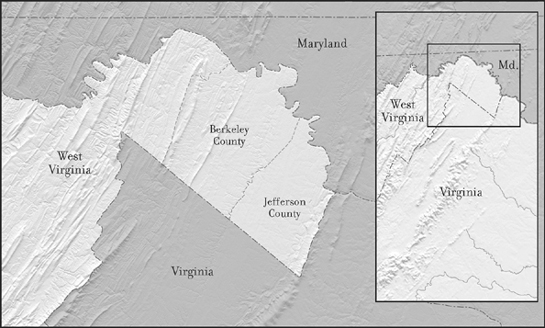
Top of the Shenandoah Valley
Western Virginians were not alone in urging Congress to include the Shenandoah Valley in the new state’s boundary. The B&O Railroad, another powerful interest (closely connected to Pierpont) urged it as well. The North’s southernmost railroad was a Confederate target no matter what, boundaries being meaningless in wartime. But the B&O, looking ahead to the postwar period, knew that it would be better off having none of its track under Virginia’s jurisdiction.7 Senator Carlisle spoke for both parties when he beseeched the Senate to locate West Virginia’s eastern boundary farther east, “including the counties in the valley, which properly belong, in a commercial aspect, to the same trading community that we do. But we can at least do this: we can secure the counties through which the Baltimore and Ohio Railroad passes.” West Virginia, as it turned out, did not get everything it wanted, but the B&O did.
West Virginia’s statehood convention modified its proposed constitution as directed by Congress, and President Lincoln signed the legislation. Come June 20, 1863, West Virginia would officially become a state. Meanwhile, the Confederate army was approaching in full force. General Robert E. Lee and all of his corps—the commands of Generals James Longstreet, Richard Ewell, A. P. Hill, and J. E. B. Stuart—were moving up through much of what was scheduled to become West Virginia. “We direct particular attention to the following dispatch from Governor Pierpont of Virginia.… The rebels are advancing in force, and are only about nineteen miles distant from this city [Wheeling],” a Pennsylvania newspaper reported one day before the state’s official creation. “If ever there was a time for the citizens of western Pennsylvania to awaken in earnest, before the horrors and civil war are actually thrust upon their homes and firesides, now is the time.”8
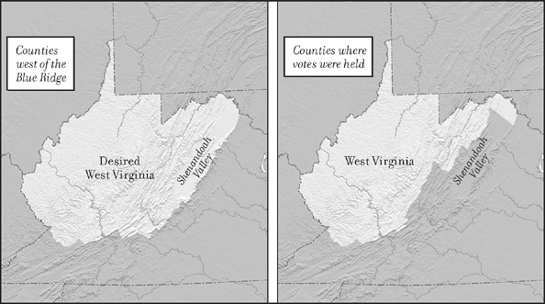
West Virginia: idealism versus realism
As it happened, the storm clouds did not burst until two weeks after West Virginia’s birth. When they did, it was indeed in Pennsylvania, at the previously sleepy town of Gettysburg. During that military hurricane, Francis Pierpont was unpacking documents in Alexandria, Virginia. The father of West Virginia was still the governor of “Virginia.” He opted to remain in that post, in the hope that he could better serve the Union in that capacity.9 At the moment, however, there was only one place in what now remained of Virginia where he could safely locate his “government.” The town of Alexandria, just across the Potomac River from Washington, DC, though Confederate in sympathies, was heavily occupied by Union troops protecting the nation’s capital.
With the end of the Civil War, Pierpont’s hopes of serving the Union by remaining in office were given the boot. Authority now resided with General John M. Schofield, who oversaw Virginia during Reconstruction. In effect, Pierpont went from being the governor of “Virginia” to being the “governor” of Virginia. But the lawyer in him continued to act on behalf of those he represented. He sought to have voting rights restored to Virginians who had served in the Confederate army, while at the same time he advocated the creation of schools for newly freed slaves. His commitment to equal justice eventually angered enough people—from ex-Confederates to progressives—that he was removed from office by General Schofield in 1868.
Returning to his hometown, Pierpont lived for the first time in the new state he had done so much to create. Virginia, meanwhile, had commenced a constitutional challenge by suing West Virginia over its possession of Berkeley and Jefferson Counties. In 1871 the Supreme Court rejected Virginia’s challenge. As significant as the decision itself was the extent to which it was covered in the press, which was precious little. Americans now had, and for many decades would continue to have, little interest in revisiting the issues of the Civil War—be it the constitutionality of West Virginia or the constitutionality of racial segregation.
Francis Pierpont lived out the rest of his life quietly. He passed away in 1899 at the age of eighty-five and was buried alongside family members in his hometown of Fairmont, now in West Virginia. Though West Virginians too did not wish to revisit the past, they did wish to revisit Francis Pierpont. An obituary in Utah’s Salt Lake Tribune noted that his “remains lay in state in the [family’s] church, and were viewed by thousands of people. The casket was almost buried in flowers.”