
· · · NEW MEXICO, ARIZONA · · ·
Mr. Perea of New Mexico Territory: I ask the unanimous consent of the Convention to allow the delegates from New Mexico to record their votes for President and Vice-President of the United States.
Chairman: The motion is not in order.
Mr. Watts of New Mexico Territory: Mr. Chairman, we are ready to pour out our life-blood in carrying your glorious heaven-born banner wherever the honor of our country requires it to be carried. We feel as patriotic and as much disposed to sustain it as any other portion of the country, and I hope that we shall not be denied the privileges which have been granted to other sister Territories upon this floor. I want an opportunity to record our votes for Abraham Lincoln and Andrew Johnson.
—REPUBLICAN PRESIDENTIAL CONVENTION, 1864
Francisco Perea and John S. Watts, sixteen years apart in age, had only recently gotten to know one another when they jointly sought to have the Republican Party include New Mexico’s vote. Yet prior to their relationship, both played key roles in defusing an explosive situation that followed the United States’ 1848 acquisition of New Mexico (and a great deal more) in the Mexican War. The danger was that, in acquiring the land, the United States had also acquired people who spoke another language and had not sought to become Americans.
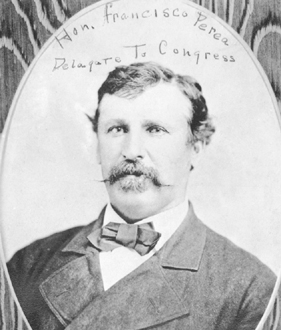
Francisco Perea (1830-1913) (photo credit 35.1)
Watts and Perea’s leadership had little to do with the fact that one was Anglo and the other Hispanic. Neither group was of one mind regarding New Mexico’s future. Their leadership resulted from the fact that both men comprehended those complexities. Their success as leaders can be seen today in the seemingly simple straight line dividing New Mexico and Arizona.
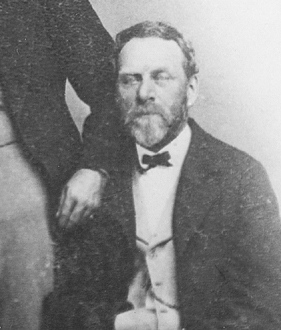
John S. Watts (1816-1876) (photo credit 35.2)
New Mexico’s complexities were embedded in the orders General Stephen Kearny received after capturing Santa Fe in the opening year of the Mexican War. “In your whole conduct you will act in such a manner as best to conciliate the inhabitants,” the secretary of war had instructed, “and render them friendly to the United States.” Hardly complex orders in theory, but in practice they entailed considerable complexity. The first complication surfaced when the general issued a set of laws to govern New Mexico. Collectively known as the Kearny Code, they adhered to the secretary of war’s orders by leaving in place the region’s Mexican laws and guaranteeing freedom of religion, freedom of speech, the right to assemble—indeed, everything in the Bill of Rights with one exception: the right to bear arms.
The part of the Kearny Code that proved to be dicey—and that later affected Perea, Watts, and the Arizona boundary they sought—was its opening statement. “The country heretofore known as New Mexico,” it benignly began, “shall be known hereafter and designated as the territory of New Mexico, in the United States of America.” Sounds simple enough … unless one should ask (and many did): what was “the country heretofore known as New Mexico”?
To New Mexicans, the answer was clear and important. Nuevo Méjico had been a province in Mexico that extended north along the Rio Grande valley from what is now the Mexican border. But after Tejas won its independence from Mexico in 1836, becoming the Republic of Texas, it claimed the Rio Grande valley on the Texas side of the river. Mexico never accepted this claim. When Texas later joined the United States, Congress stipulated the Rio Grande as its western border, and the Mexican War began.
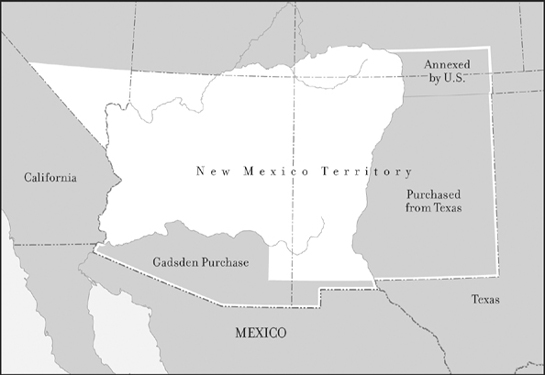
New Mexico Territory, 1848-50
While the implication in General Kearny’s statement might go unnoticed today, Congress and President James K. Polk spotted it at once and rejected it, since it was unconstitutional to create a new jurisdiction that altered an existing state line without the consent of that state. Nevertheless, four years later Congress found a way to grant New Mexico’s wish via the nation’s enduring curse: slavery.
The Compromise of 1850 was delicately held together in part by adding an additional issue to the deal: the Texas-New Mexico border. Texas had acquired enormous debt during its days as a republic. Under the compromise, Congress enabled Texas to pay off its debt by purchasing a large block of its western region, which it then gave to the New Mexico Territory. For some reason, New Mexico’s new boundary, the 103rd meridian (later found to have been inaccurately surveyed), was considerably farther east than the Rio Grande Valley. Though unstated, the reason was not lost on a newly appointed territorial judge being sent to New Mexico, John S. Watts.
Watts had recently arrived from Indiana, where he had spent his youth, become a lawyer, and served for a term in the state legislature. He got along well with the New Mexicans and did well for himself, too. After a few years as a judge, he resigned to go into private practice, specializing in Hispanic land claims. His clients were not the campesinos scratching out a meager living on parched parcels; they were the grandees, the wealthiest families with Spanish land grants that encompassed thousands of acres. In some instances, Watts did work for no money, accepting land instead. He soon became both wealthy and well connected with the region’s leading families.
When Watts had first headed to Santa Fe, young Francisco Perea, who came from a prominent Nuevo Mexicano family, was heading to St. Louis. He had just finished college in Manhattan at the Bank Street Academy. During the years that Perea was away, a new fuse was lit in New Mexican politics. In 1853 James Gadsden purchased a region of Mexico on behalf on the United States. The region, which was added to the New Mexico Territory, was needed to build a second transcontinental railroad through the South. Northern states believed such a railroad would provide new economic opportunities in the South and help wean it away from slavery. Southern states believed such a railroad was vital for slavery to survive. They saw it as linking the slave state of Texas to the slavery-still-possible state of California. The only territory in between was New Mexico.
Slavery had been abolished in Mexico in 1820, and Mexican law had been preserved in New Mexico. This was the new fuse that Congress lit when it officially created the Territory of New Mexico as an adjunct to the Compromise of 1850. In return for granting New Mexico’s dream of regaining its former land, it loosened the bolts on its inherited law by saying this particular territory could decide for itself whether or not to permit slavery.
Few if any Hispanics aspired to become slave owners. But all remembered that their nemesis, Texas, had begun organizing its War of Independence when Mexico had banned slavery. The same thing was now happening again. “A large number of delegates from different parts of the Gadsden Purchase assembled at Tucson for the purpose of taking into consideration the measures necessary for the organization of a Territorial government,” the New York Herald reported in November 1856. “Many emigrants from Texas this year have stopped in the Purchase, and doubtless if the new territorial government were formed it would soon fill up with a hardy, industrious American population.” The boundaries the Anglos in the Gadsden Purchase had in mind for “Arizona,” as they called it, encompassed the southern half of the New Mexico Territory—thereby bordering both Texas and California.
Hispanics in New Mexico liked the idea of creating a separate territory composed primarily of the Texas transplants. But dividing the territory horizontally would put the planned transcontinental railroad in Arizona. In seeking a vertical division, many New Mexicans thought it wise to espouse nonconfrontational views on slavery so as to minimize Southern support for the “Arizonans.”
Though Watts was an Anglo, his career was based in the Hispanic community. And though he hailed from Indiana, where slavery had never been permitted, he too adopted less-than-abolitionist views regarding slavery—though he joined the new Republican Party, which came into existence primarily for the purpose of opposing slavery.
All these elements accelerated with the candidacy of Abraham Lincoln in 1860. Perea was in San Francisco the night Lincoln was elected. He later recalled, “The occasion was celebrated by immense processions of men and boys marching through the principal streets to the music of many brass bands, the firing of cannon, and the discharge of anvils. It is needless to say all of us New Mexicans heartily joined in to swell the throng.”1
Perea now returned to New Mexico just as Watts was leaving it. Watts was headed to Washington, having been elected the territory’s delegate to Congress. In letters to President Lincoln, he urged him to choose New Mexicans for the territory’s appointed positions, despite the fact that New Mexico’s leading citizens were ambivalent about slavery. He warned that appointing outsiders would offend New Mexicans, pointing out that slavery was not their foremost concern (Texas was). By choosing New Mexicans, the president would win their hearts and, should war erupt, their loyalty.2 Lincoln heeded this advice, though he took a lot of heat for it. Watts’s insights proved to be right. The man who proved it was Francisco Perea.
Perea had returned to discover that his birthplace was in crisis. As Southern states began seceding from the Union, Anglos in the Gadsden Purchase began seeking the establishment of a Confederate Territory of Arizona. Traveling throughout the Rio Grande valley, Perea visited the leading Hispanic families and urged them to commit their loyalty to the United States. His efforts succeeded. Hispanic New Mexico produced a greater percentage of volunteers for the Union army than any other state or territory.3
Perea’s success validated not only Watts’s advice regarding appointments but also Watts’s insight regarding New Mexico’s fear of Texans. Perea’s most effective argument for loyalty to the Union was that if the Confederacy accepted Arizona as a territory, it would send Texan troops to defend it.
And indeed they did. In July 1861 the Second Regiment of Texas Mounted Rifles entered the Gadsden Purchase. Perea had enlisted in the Union army, where he commanded one of the brigades assigned to oust the Texas troops. Over the course of several battles, Union forces finally prevailed.
Watts, meanwhile, was fighting the battle of the boundary. He introduced a bill in Congress for the creation of an Arizona Territory that would be divided by a vertical line along the 109th meridian. New York Congressman William A. Wheeler argued that dividing the territory was unnecessary, noting that the only logic for the location of the proposed Arizona-New Mexico border was that it continued the line dividing Utah and Colorado. When Watts responded with the reason for its location, he also shed light on why the Texas-New Mexico line had been located so far east of the Rio Grande valley. Because of the location of that Texas-New Mexico line, Watts pointed out that his proposed Arizona-New Mexico line “divides the Territory of New Mexico into two equal parts.”
The boundary battle, however, was about more than geographic equality. It was also about ethnic equality. Watts knew that this moment, on the floor of the House of Representatives, was the time and place to attack this head on:
There may be a well-grounded dispute in the minds of some people as to who are white and who are black. [Laughter] There are many men in the Territory of New Mexico who, by living constantly in the open air and exposed to the rays of a burning sun, have become bronzed in complexion.… Whatever may be their color, the treaty stipulations between the United States and the republic of Mexico have invested them with all the privileges and immunities of American citizens.… [T]he first duty which the government owes to its people is to give both military and civil protection. In this case, the government is under a double obligation.… [Mexico was] compelled to relinquish her right to a portion of her territory and her right to protect a portion of her people, endeared to her by ten thousand pleasant memories and hopes, and doubly endeared by ten thousand painful forebodings for the future.
Watts linked this understanding of the Hispanic population’s experience with the issue of boundaries:
I know how the people of New Mexico felt—I know how I felt—when a preceding Congress, merely for the purpose of beautifying the lines of the new Territory of Colorado, took sixty miles broad and two hundred and fifty miles in length from the Territory of New Mexico. Yes sir, Congress took those people and put them with a people alien in laws, alien in language, alien in association.
On February 24, 1863, Congress created the Territory of Arizona, stipulating the boundaries advocated by Watts on behalf of his Hispanic constituents.
Though Watts remained active in Republican politics, he chose to return to his law practice. Following that year’s November elections, John C. Watts introduced President Lincoln to New Mexico’s newly elected territorial delegate, Francisco Perea.